


European Market Review: December Puts a Bow on Record Year for European Short-Term Rentals
Published: January 25, 2024
Last updated: October 11, 2024

Scott Sage
2023 for Europe ended on a high note. After a momentous fall season where demand and available listings reached all-time highs, December ended the year with more record-breaking performance. European short-term rentals (STRs) saw 26.7 million nights stayed in December, the highest in a month of December on record, exceeding 2022 levels by 14.5% and 2019 levels by 17.5%. Available listings, which had seen tremendous year-over-year (YOY) growth in the fall, grew 17.3% YOY in December, the second-highest YOY growth in available listings seen in 2023. Despite strong YOY growth in available listings, there was less growth in available listing nights than demand nights last month, and occupancy growth was 0.5% YOY.
At a Glance: December STR Performance in Europe
- Available listings were up 17.3% YOY and up 12% from 2019
- Demand was up 14.5% YOY, 17.5% vs. 2019
- Average daily rates (ADRs) were up 11.6% YOY and 46.8% vs. 2019
- Revenue was up 27.8% YOY and 72.4% from 2019
- Occupancy was up 0.5% YOY and up 6.1% vs. 2019
- Revenue per available rental (RevPAR) grew 12.1% YOY and was up 55.8% from 2019
A Bumper Year for European Short-Term Rentals: 2023 in Review
2023 was the best year on record for European STRs. Demand reached new heights, and enduring occupancy strength fueled revenue growth and STR investment. Here’s a recap of the year’s stats:
Supply: Last year, an unfavorable lending environment in Europe failed to deter STR investors who were drawn into the market by the strength of monthly STR revenue growth. After recovering to pre-pandemic levels at the beginning of 2023, monthly supply maintained a double-digit YOY growth rate for the greater part of the year. Listing growth was particularly strong in Q4 (+18% YOY), and 2023 ended with available listings exceeding 2022 by 12.4% YOY.
Demand: 385 million nights were stayed in 2023, a record high. The full return of international travelers, along with a robust job economy, strong wage growth, and declining inflation in Europe, enabled a 10.5% YOY growth rate for demand. The growing popularity of off-season travel in the post-pandemic era was reflected in spring and fall demand growth, with both "shoulder seasons" exceeding 2019 levels of demand by more than 15%.
Occupancy: Despite record demand, accelerating listing growth last year put a damper on occupancy. Average occupancy across Europe was 55.4% in 2023, declining 1.9% YOY. While dipping from last year, 2023 occupancy still exceeded 2019 levels by 0.6%.
ADR: Vigorous demand growth coupled with enduring occupancy gave hosts significant pricing power this past year. Nightly rates across Europe averaged 164 € in 2023, an 11.9% YOY increase.
RevPAR: Greater pricing power led to growing revenues for STR hosts. Revenue per available rental night (RevPAR) averaged 90 € in 2023, an increase of 9.8% YOY and an incredible 36.8% increase from 2019.

2023: The Year of the Europe Trip for Americans
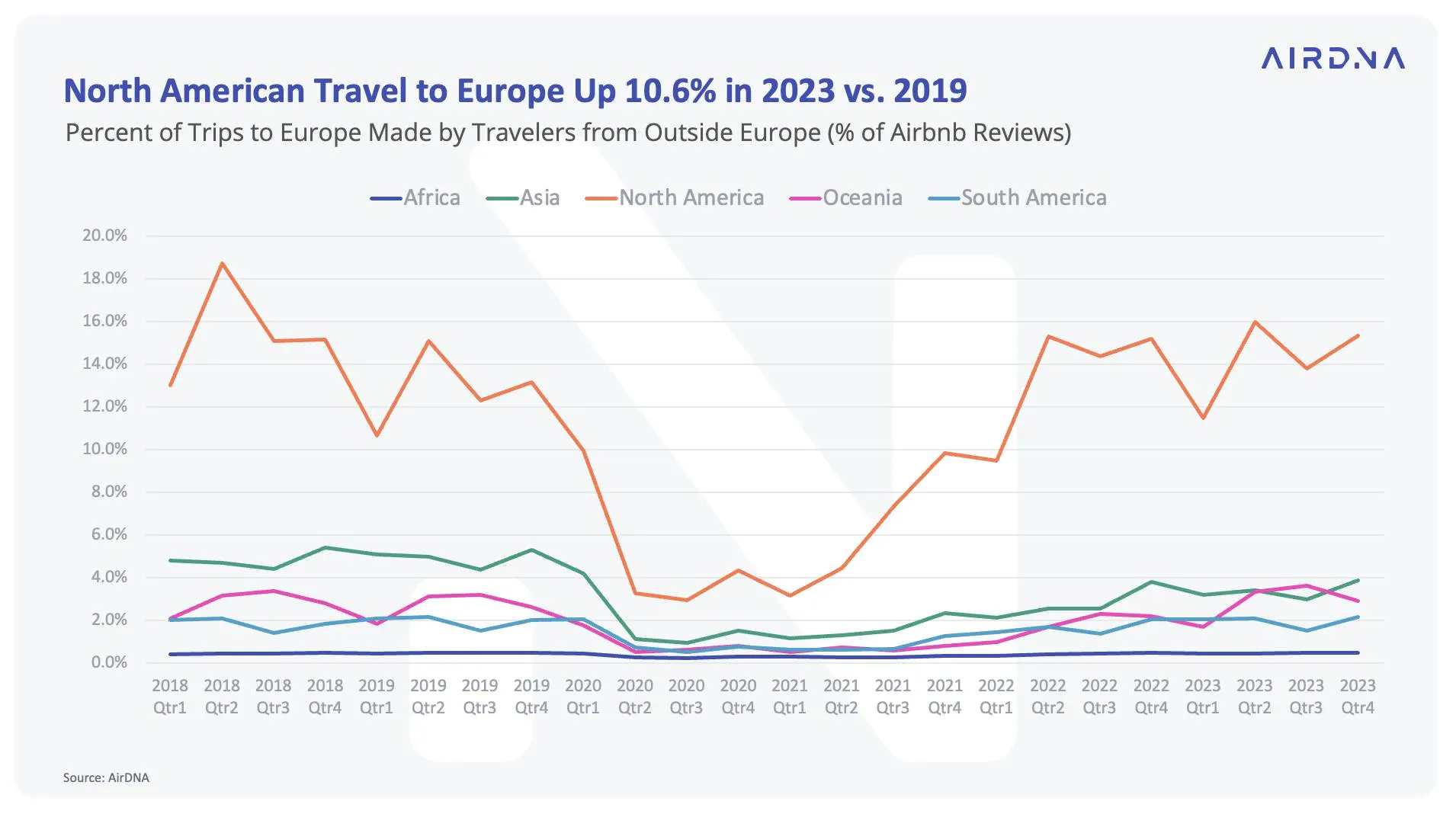
2023 was the year of the “Europe Trip” for many American travelers. The first full year without any COVID travel restrictions in Europe was met with great enthusiasm, particularly from Americans who were eager to travel abroad after three years of COVID lockdowns and restrictions. Last year, U.S. travelers made up 11% of Airbnb stays in Europe, up 12% from 2019, when they made up 9.8% of Airbnb stays in Europe. Overall, North American travelers made up 14.3% of Airbnb stays in Europe last year, a 10.6% increase from 2019, when North American travelers made up about 13% of stays.
North American travelers may have fully returned to Europe, but many countries have yet to make their comeback. Asian travelers have historically made up the second-largest percentage of travelers to Europe. Last year, just 3.3% of Airbnb stays in Europe were by travelers from Asia, a significant dip from 2019 when Asian travelers made up 4.8% of stays.
Demand Boomed in the Top 20 European Countries
For all but one of the top 20 European countries, 2023 was a year of significant demand growth. Five of the top 20 countries saw YOY demand growth exceeding 20%: Norway (+34.2% YOY), Poland (+24.6% YOY), Czech Republic (+23.6%), Hungary (+23.3%), and Sweden (+21.2%). International travelers played a large part in bolstering travel demand, making up more than 75% of Airbnb stays in each of these five countries.
Another nine countries saw YOY demand growth ranging from 10-20%, and five countries saw more modest single-digit growth. YOY growth rates had been stronger in 2021-2022 for some of these countries when domestic travel within Europe resumed, while international travel is not able to push higher growth. For example, in both France and the United Kingdom, domestic travelers make up 65% of stays. YOY demand growth in France and the United Kingdom was 34% and 31%, respectively, in 2022, compared to 11.1% and 17.5% this past year.
While it was a strong year for demand growth, notably six of the top 20 European countries continue to see demand lag behind pre-pandemic levels in 2019: Czech Republic (-26.6%), Croatia (-26.5%), Ireland (-20.7%), the Netherlands (-19.0%), Denmark (-16.2%), and Hungary (-15.1%).

Listing Growth Dampened Occupancy and RevPAR in Top 20 Countries
It was a tremendous year for demand growth in Europe but an even bigger year for supply growth. YOY growth in available listing nights exceeded YOY growth in demand nights in 16 of the top 20 European countries.
As available listings increase within a market, occupancy rates often decrease. More available listings means guests have more options to choose from, and each host on average receives fewer bookings, even if total demand has increased. Looking at the relationship between listing growth and occupancy performance among our top 20 European countries, we can see that countries that experienced the most listing growth last year also saw some of the greatest YOY occupancy declines. Norway (+47.4% YOY), Sweden (+36.9% YOY), and Finland (+27.7% YOY) led available listing growth last year, and occupancy fell more than 5% YOY in all three countries. On the other hand, countries such as Greece and the Netherlands saw much more modest listing growth, resulting in small occupancy dips of less than 1% last year. In cases when there is significant listing growth but enough demand growth to offset listing growth, occupancy rates can increase, which was the case in Austria, Belgium, and the Czech Republic last year.
The relationship between available listings and occupancy is negative, but the relationship between occupancy and RevPAR is positive. As occupancy rates increase in a market, hosts are able to charge more per night and make more revenue per available night. Hosts in countries that saw occupancy growth last year held onto pricing power and saw the greatest YOY RevPAR increases: Czech Republic (+16.6%), Austria (+14.3%), and Belgium (+11.2%). Hosts in countries that saw modest occupancy dips were also able to increase nightly rates, causing RevPARs in countries such as Germany and the United Kingdom to still increase more than 10%. Last year, the countries that experienced steep occupancy declines were the bottom RevPAR performers. RevPARs declined 2.6% in Poland, 1.5% in Norway, and only slightly increased in Finland (+0.2%).
Listing and Demand Growth Accelerated in European Cities in 2023
With the return of international travel to cities this year, YOY growth in supply and demand was greater within the top 50 European cities than outside those cities. Demand and available listings grew 23% YOY in the top 50 cities. In smaller cities, towns, and rural areas outside of the top 50 cities, demand grew 8% YOY, while available listings grew 11%.
Despite rapid growth in 2023, supply and demand within the top 50 cities failed to return to pre-pandemic levels. Total demand in 2023 remained 14.1% below 2019 levels, and total available listings remained 17.3% below 2019 levels. Meanwhile, outside of the top 50 cities where demand surged during the pandemic, demand last year was up 18.3% compared to 2019, and available listings were up 11.4%.
Among the top 50 European cities, only 13 saw YOY occupancy growth. For some of the 13 cities, STR regulations limiting the numbers, areas, and numbers of nights that short-term rentals can operate played a large role in artificially driving occupancy growth. For example, in Barcelona, where YOY occupancy growth was 3%, licenses for short-term rentals have been under a moratorium for years, and room rentals are not permitted. In Amsterdam, Netherlands, where YOY occupancy growth was 1%, regulations limit the number of nights hosts can rent out their homes to 30 nights per year.
Cities that experienced the greatest occupancy dips last year were Warsaw (-14% YOY), Dublin (-11% YOY), Belgrade (-10% YOY), Turin (-9% YOY), and London (-8% YOY). All five cities saw more than 25% YOY listing growth that significantly exceeded demand growth. With falling occupancy, RevPARs suffered. Turin (-6% YOY), Warsaw (-6% YOY), and London (-3% YOY) experienced YOY RevPAR dips, while Belgrade (+6% YOY) and Dublin (+0.3% YOY) saw slight RevPAR growth.
Booking Trends Point to Continued STR Growth in 2024
Short-term rental demand for Europe is off to a roaring start for 2024. Current demand on the books for the next six months is pacing 19.3% above last year. With Easter landing in March instead of April this year, demand pacing for March is currently up 35% YOY while demand for April is down 3% YOY. May through July are showing great promise, with demand pacing up 29% for May and up 22.4% and 20.8% for June and July, respectively.

A look at booking activity in the United Kingdom around Sunshine Saturday also offers some optimism that another strong travel year is ahead. Sunshine Saturday is the first Saturday of the new year and is famous in the United Kingdom for being the most popular day to book a holiday, as the winter blues set in.
While booking activity usually extends through the end of the month, a peek at booking activity for the first two weeks of January reveals demand is already on a trajectory of growth in the UK. Short term rental booking activity for the first two weeks of January is up 1.3% from 2023. With the UK being one of the earliest countries in Europe to start booking holidays in the new year, their strong booking activity is a good indicator of STR demand growth that is to come in 2024.


ARTICLE SUMMARY
Short-term rentals in Europe had a strong 2023, with cities in particular getting a boost from travelers from North America returning in full force.
Scott Sage
Senior Vice President, Marketing & Customer Experience
Scott is an Airbnb Superhost and industry pro, having founded Home Base BnBs—a short term rental management company that scaled to 200+ units. Scott combines his experience and passion for hosting to empower AirDNA customers' success. When he's not thinking about STRs, he is hiking, playing basketball, or playing pickleball.


