

 Calculate Revenue
 Research Markets
 Find For Sale Properties
 Compare My Listing
 STR Revenue Calculator
 Custom Comp Sets
 Submarket Insights
 Custom Search Filters
 Rate Recommendations
 Performance Benchmarking
 Competitor Comparison
 Owner Contact Details
 Property-level performance data
 Tourism Insights
 Real Estate Investment Analytics
 About Us
 Sales
Sales Support
 Press
PressHow to Choose the Right Vrbo Cancellation Policy
Published: July 9, 2024
Last updated: September 25, 2026

Bram Gallagher
Key Takeaways
- Vrbo provides diverse cancellation policies from strict to flexible, helping hosts balance financial security and guest appeal.
- Choosing and managing the right cancellation policy is key to minimizing revenue loss and maintaining occupancy.
- Implementing clear communication, accurate listings, and adaptable policies can reduce cancellations and improve guest satisfaction.
Cancellations are the wild cards in the deck of short-term vacation rental hosting. Unexpected changes to guest plans can throw your plans—and your profits—into disarray.
Cancellation policies allow you to set the rules of the game and control unpredictable cancellations so that you can keep your schedule and your short-term rental (STR) income on track. In this ultimate guide for STR hosts, we’ll explore Vrbo cancellation policy options, how to fine-tune these policies, and tips for handling guest cancellations like a pro. Ready to turn those wild cards into winning hands? Let’s dive in.
Try Our Vacation Rental Pricing Tool
Use Smart Rates™ to optimize your pricing strategy.
Vrbo Cancellation Policy Options
Hosts on Vrbo can choose between several cancellation policies to best suit their needs and preferences. These options range from strict no-refund policies to more flexible custom policies.
Let's explore each cancellation policy option in more detail:
No Refund Policy
This is the strictest policy Vrbo offers. Under this policy, guests receive no refund regardless of when they cancel.
The no-refund policy provides maximum financial security for hosts and can be particularly beneficial during peak travel seasons or high-demand periods. It also minimizes the potential for last-minute cancellations that leave the property vacant.
However, the rigid terms of this cancellation policy may deter some potential guests, especially those booking far in advance.
Strict Policy
The Strict cancellation policy offers a full refund to guests who cancel at least 60 days before the check-in date. If the cancellation occurs within 60 days of check-in, the guest won’t receive a refund.
For guests who book far in advance, this policy provides a generous window for them to receive a refund while also giving hosts ample time to rebook the property.
Firm Policy
This tiered policy offers guests a full refund if they cancel at least 60 days before check-in, and a 50% refund if they cancel between 30 and 60 days before check-in. Cancellations made less than 30 days before check-in do not qualify for a refund.

Moderate Policy
Under the Moderate policy, guests receive a full refund if they cancel at least 30 days before check-in, and a 50% refund if they cancel between 14 and 30 days before check-in. There are no refunds for cancellations made within 14 days of check-in.
This policy offers a middle-ground approach that balances flexibility and security. It’s well-suited for properties in markets with shorter booking lead times, that is, in markets where guests tend to book close to the check-in date.
Relaxed Policy
The Relaxed cancellation policy provides a full refund for cancellations made at least 14 days before check-in. Guests who cancel between 13 and 7 days before check-in receive a 50% refund, with no refund for cancellations within 7 days of check-in.
The 14/7 day cancellation policy is the most flexible standard policy that Vrbo offers. Hosts who choose a relaxed policy can access a guest demographic that prioritizes flexibility and may not otherwise book. The additional reservations you receive from guests who consider cancellation policies in their booking decision process may outweigh the risk of surprise vacancies.
Custom cancellation policies
Hosts can also create custom cancellation policies tailored to their specific requirements. These policies can combine elements from the predefined options or introduce new terms, such as partial refunds for custom amounts at different intervals. Custom policies allow hosts to set cancellation terms that align closely with their booking and occupancy strategies.
Most Popular Cancellation Policies on Vrbo
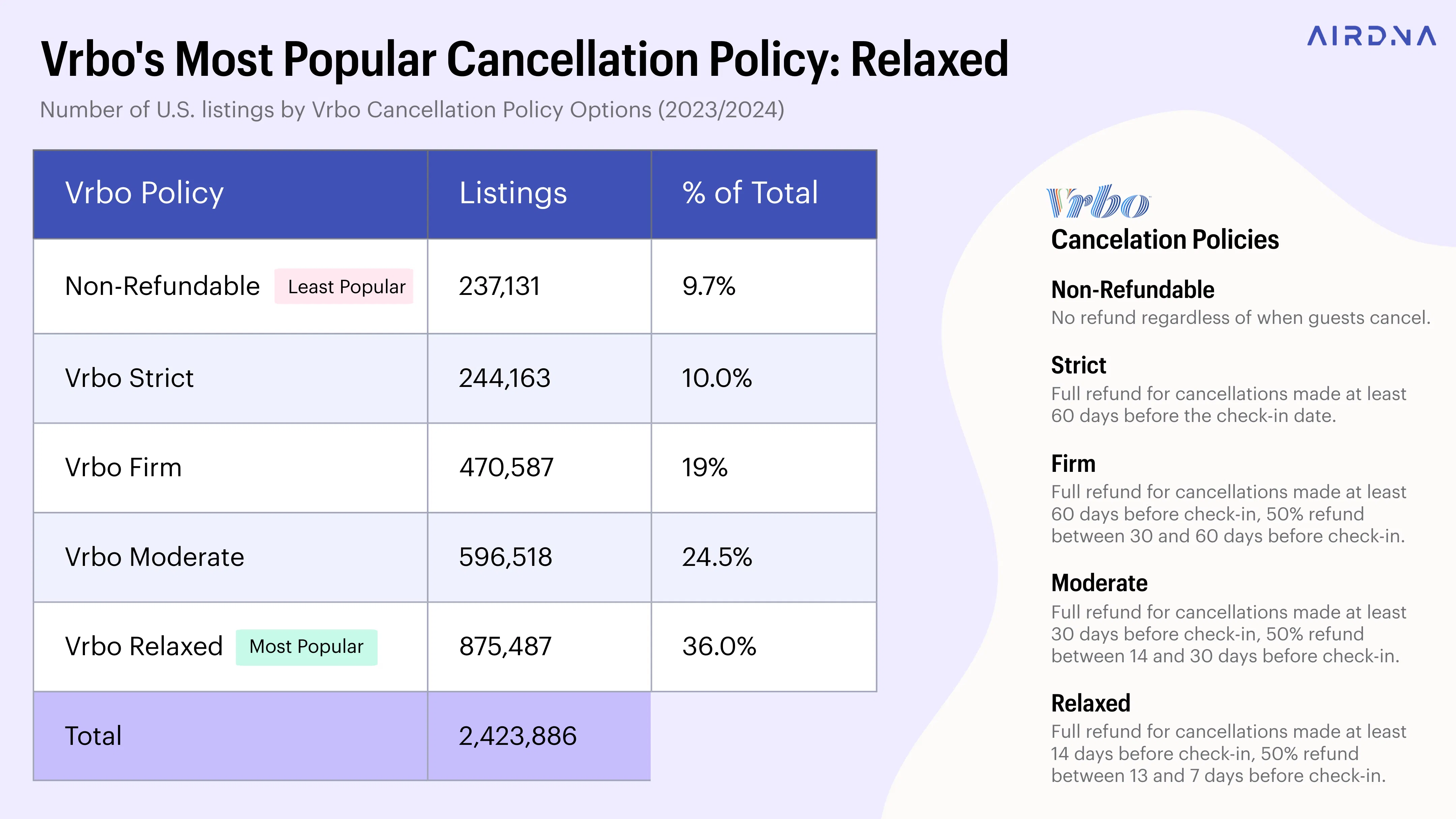
Broadly speaking, the more strict the cancellation policy, the more commonly it’s used by Vrbo hosts. The most common Vrbo cancellation policy among property managers is the Relaxed policy, which accounts for 36% of Vrbo listings. About 10% use Non-Refundable and Strict cancellation policies respectively.
How is your STR performing?
Your vacation rental may be amazing, but is it better than your competition? Connect your Airbnb listing to AirDNA to see its Booking Performance Score.
How to Edit Your Vrbo Cancellation Policy
Editing your property’s cancellation policy is straightforward. Here’s how:
- Log in to your Vrbo account and navigate to your property dashboard.
- Select "Policies" from the menu.
- Choose "Cancellation policy" and select your preferred option from the dropdown menu.
- If creating a custom policy, carefully detail the terms and conditions.
- Save your changes.
Remember, any changes to your cancellation policy will only apply to new bookings. Existing reservations will retain the policy in place at the time of booking.
How to Cancel a Guest Reservation
As a host, you may sometimes need to cancel a reservation. Here's how to do it:
- Go to your Vrbo dashboard and find the booking you need to cancel.
- Click on "Cancel reservation" and follow the prompts.
- Choose a reason for the cancellation from the provided options.
- Review the cancellation details, including any applicable penalties.
- Confirm the cancellation.

Vrbo Host-Initiated Cancellations
You’re probably already familiar with Vrbo host fees, which includes a booking fee (either a flat annual rate or a pay-per-booking rate) and a payment processing service fee. As of October 2023, Vrbo hosts in the U.S. will also be charged a $50 fee if they initiate a cancellation.
The cancelation fee can increase depending on the value of the booking and the timing of the cancellation:
- Within 48 hours of check-in or after check-in: 50% of the reservation amount for the nights not stayed.
- More than 48 hours but within 30 days of check-in: 25% of the reservation amount.
- More than 30 days before check-in: 10% of the reservation amount.
Keep in mind that these fees apply if you outright cancel the reservation, double book your property and need to cancel one reservation, or mislead a guest by substituting one property for another. You can also be charged if you circumvent Vrbo’s host cancellation policies by asking a guest to initiate the cancellation instead.
If a cancellation isn’t within your control, you could be eligible for a cancellation waiver.
Situations considered out of your control include:
- Natural disasters
- Government-imposed travel restrictions.
- You guest breaks house rules (or intends to)
- Maintenance emergencies
- Situations that threaten a guest’s safety
- The guest fails to pay
- Suspected fraud
Vrbo’s Bad Weather Cancellation Policy
Vrbo has a specific policy for cancellations due to severe weather or natural disasters. If a mandatory evacuation is ordered for your area, or if it's impossible for guests to reach your property due to weather conditions, Vrbo may refund the guest even if it falls outside your standard policy.
This policy applies in situations involving:
- Earthquakes
- Tsunamis
- Volcanic eruptions
- Landslides
- Essential utility outages
- Tornados
- Cyclones
- Flooding
- Wildfires
- Historically severe weather events
Stay informed about local weather conditions and communicate proactively with guests if you expect severe weather.

How to Approve a Guest’s Cancellation Request
When a guest requests a cancellation:
- You'll receive a notification in your Vrbo inbox.
- Review the request and the applicable refund based on your policy.
- Respond within 24 hours to avoid automatic approval.
- If you approve, the refund will be processed according to your policy.
Customize Your Experience
Your pricing strategy should be as unique as your rental property.
10 Tips for Preventing Cancellations
While some cancellations are inevitable, you can take steps to minimize them:
1. Clear Communication: Use clear and prompt communication with your guests. Answer inquiries as soon as possible and provide detailed, helpful information about your property. Remember: something that might seem obvious to you won’t be obvious to a guest who has never visited your property.
2. Accurate Listings: Include up-to-date photos and honest descriptions. Misleading information can lead to disappointment and cancellations, which can negatively affect your hosting and/or property reputation
3. Flexible Policies: Consider offering flexible cancellation policies. This can make your property more appealing and reduce the risk of cancellations.
4. Detailed House Rules: Set clear house rules. Outline expectations for check-in times, noise levels, and other important details. Detailing rules up front can help weed out customers who are looking for certain allowances before they book. You can prevent cancellations that may arise because the guest discovers that your property isn’t the right fit after they’ve already secured a reservation.
5. Encourage Reviews: Positive reviews build trust, so encourage past guests to leave reviews. Prospective guests will feel more confident about choosing your property if there is a track record of guest satisfaction.
6. Confirm Reservations: Confirm reservations and send reminders. This keeps your property fresh in the guest’s mind and reduces the chances of last-minute cancellations.
7. Clear Terms: Make sure your cancellation terms are easy to understand. Clear cancellation policies help manage guest expectations and reduce misunderstandings.
8. Flexibility in Dates: Offer date flexibility when possible. This can be a helpful option if guests need to change their plans.
9. Highlight Amenities: Emphasize unique amenities and conveniences. Whether it's proximity to attractions or luxury features, highlighting these can make your property stand out.
10. Quick Response to Issues: Address any issues quickly. If a problem arises, resolve it promptly to keep guests happy and reduce cancellation risk.
Leverage Cancellation Data for Business Insights
Understanding cancellation patterns can provide valuable insights for your short-term rental business.
Pay attention to who cancels and when. Scope out the cancellation policies of competitor vacation rental properties in your area. Cancellation data can help you:
- Identify seasonal trends in cancellations and adjust your policies accordingly.
- Determine if certain types of guests are more likely to cancel and tailor your marketing strategy accordingly.
- Assess whether your cancellation policy is competitive in your market.
- Decide whether it’s worth setting different cancellation terms for each listing in your portfolio.
- Calculate the true cost of cancellations to your business and make informed decisions about overbooking strategies.
A note on seasonality: If you have an STR in a coastal or other market with distinct high and low periods, you might consider adopting seasonal cancellation policies. More flexible policies can attract bookings when demand is lower. Offering a relaxed policy during these times can help maintain occupancy rate.
Remember, while a strict cancellation policy may seem attractive, it's essential to balance protection for your business with guest satisfaction. Consider experimenting with different cancellation policies and monitoring your occupancy rates and reviews to find the right balance for your property and market.
Understanding and effectively managing Vrbo's cancellation policies can make a big impact on your bottom line. Take the time to select the right policy for your listings and familiarize yourself with best practices for handling cancellations.
Market-Informed Pricing Decisions
AirDNA’s vacation rental pricing tool uses data-driven recommendations to propose the best daily rates.
ARTICLE SUMMARY
In this guide, we cover Vrbo cancellation policy options––including the most popular choice among hosts—and how to navigate and prevent guest cancellations.
Bram Gallagher
AirDNA Director of Economics and Forecasting
Bram Gallagher is an Economist at AirDNA, specializing in uncovering insights that drive smarter short-term rental decisions. He put his Ph.D. in Economics from the University of Georgia to work researching and forecasting hotel data with CBRE prior to joining AirDNA, as well as teaching economics at a number of universities. In his spare time, Bram enjoys making wooden furniture with hand tools.
