

 Calculate Revenue
 Research Markets
 Find For Sale Properties
 Compare My Listing
 STR Revenue Calculator
 Custom Comp Sets
 Submarket Insights
 Custom Search Filters
 Rate Recommendations
 Performance Benchmarking
 Competitor Comparison
 Owner Contact Details
 Property-level performance data
 Tourism Insights
 Real Estate Investment Analytics
 About Us
 Sales
Sales Support
 Press
PressEuropean Review January 2025: Roaring Start Promises a Strong Rest of Year
Published: February 17, 2025

Linda Rollins
Key Takeaways
- January short-term rental demand surged 16.9% year-over-year (YoY), setting an all-time high for booked nights and driving occupancy growth across Europe.
- Strong snowfall led to a surge in last-minute ski bookings, with some destinations seeing demand increase by nearly 50% YoY.
- Bookings for Easter week are up 77% YoY, with travelers extending their vacations and favoring coastal destinations.
Short-term rental (STR) demand in Europe surged at the start of the new year, with January posting a strong performance.
While January is typically the slowest month for STR demand in Europe, total demand nights reached 23 million—an impressive 16.9% increase year-over-year. Listing growth also remained robust, rising 10.2% YoY to 3.2 million available listings.
With demand outpacing supply, occupancy grew by 3% YoY, while ADR saw a modest 1.5% increase. RevPAR across Europe averaged €60 last month, marking a 4.6% YoY rise.

At a Glance: January 2025 STR Performance in Europe
- Available listings totaled 3.2 million, up 10.2% year-over-year (YOY)
- Demand nights reached 23 million, an increase of 16.9% YOY
- Average daily rates (ADR) averaged €156, up 1.5% YOY
- Average occupancy rate was 38%, up 3% YOY and down 4.1% compared to 2019
- Revenue per Available Rental Night (RevPAR) increased 4.6% YOY to €60
- Booked nights increased 23.3% YOY
The State of the European Economy
After two years of sluggish economic recovery, Europe is poised for a stronger rebound in 2025. According to European Central Bank (ECB) December macroeconomic projections, GDP growth is expected to reach 0.7% in 2024, followed by a more optimistic 1.1% in 2025 and 1.4% in 2026.
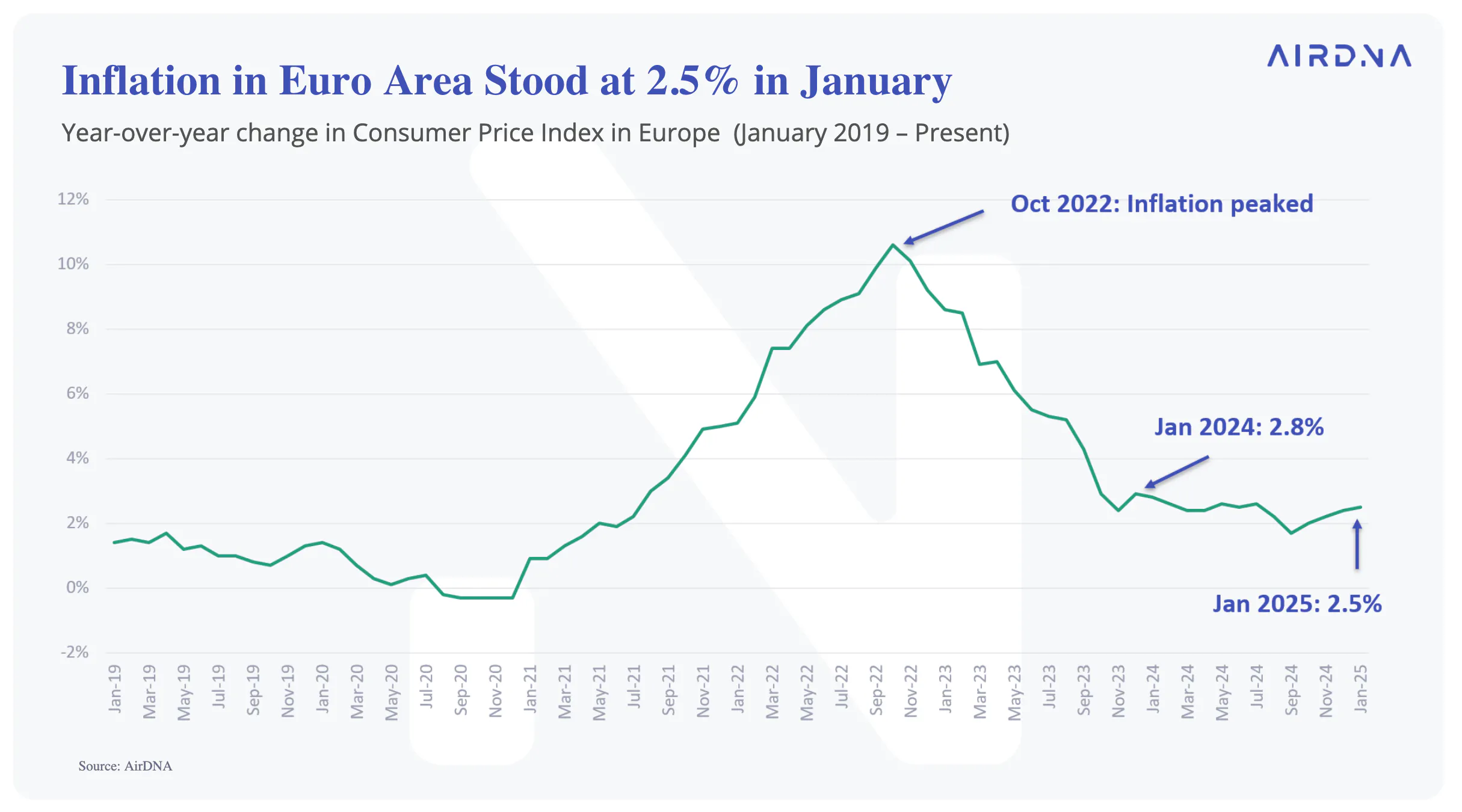
Private consumption is projected to remain the primary driver of economic growth in 2025, with a forecasted 1.3% increase. This growth is supported by easing inflation, a resilient labor market, and rising wages. As of January 2025, euro area inflation stood at 2.5%, slightly above December’s 2.4% but down from 2.8% a year ago. Employment grew by 0.8% in 2024 and is expected to rise another 0.4% in 2025, while wages are on track for a 3.3% increase this year.
The loosening of tight monetary policy is set to play a key role in boosting investment and GDP growth in 2025.
Since June 2024, the ECB has implemented five interest rate cuts, signaling a shift from the tightening cycle of July 2022 to June 2024. With many of the downward effects of past rate hikes already factored in, improving financing conditions are expected to drive a 1.2% increase in investment this year.
January Bookings Reached an All Time High
If January was offering an indication of what’s to come, then there is good reason to have optimism that this year will be an enduring year for consumer spending.
Last month, Europe not only set a record for demand nights stayed in January but also reached an all-time high for booked nights. Booked nights— reservations made during the reporting month for stays in the same month or future months—serve as a key indicator of upcoming short-term rental demand.
In January, future reservations across Europe surged 23.3% year-over-year. Along with March and July, January is one of the most active months for STR bookings, making this strong start a promising signal for continued growth in the months ahead.
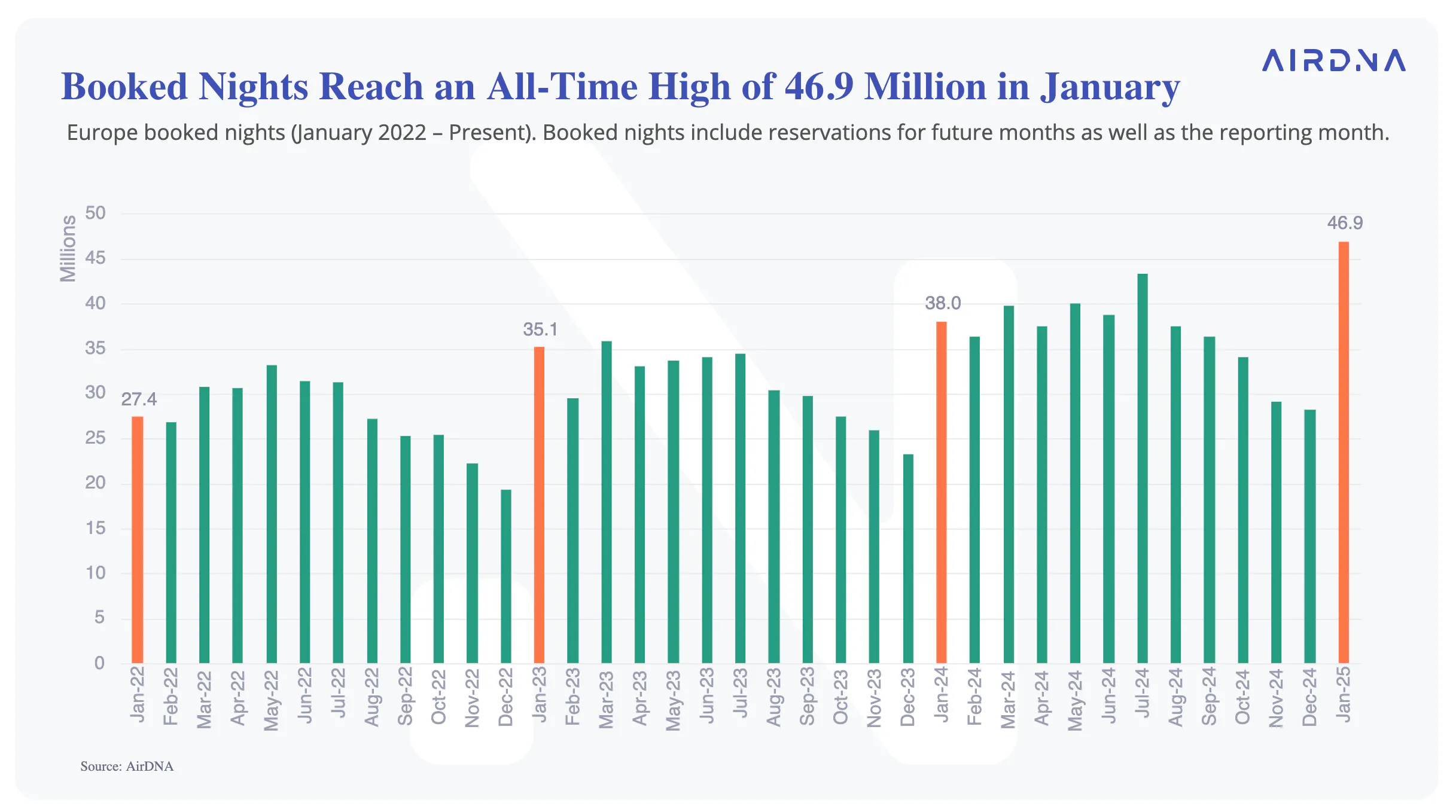
Breaking down booking growth among the largest STR countries in Europe, here are the top five countries that saw the biggest YoY growth in January bookings for future stays. Notably, Poland and Norway led Europe in demand growth in 2024 and are also starting the new year with booking strength.
- Greece (+45% YoY)
- Poland (+36% YoY)
- Norway (+35% YoY)
- Czech Republic (+32% YoY)
- Germany (+30% YoY)
On a similar note, many of the countries that lagged behind in demand growth last year are also seeing the weakest YoY growth in January bookings for future stays:
- Belgium (+18% YoY)
- Portugal (+17% YoY)
- Denmark (+16% YoY)
- Ireland (+15% YoY)
- United Kingdom (+12% YoY)

Robust Demand Fueled Double Digit Growth in Nights Stayed
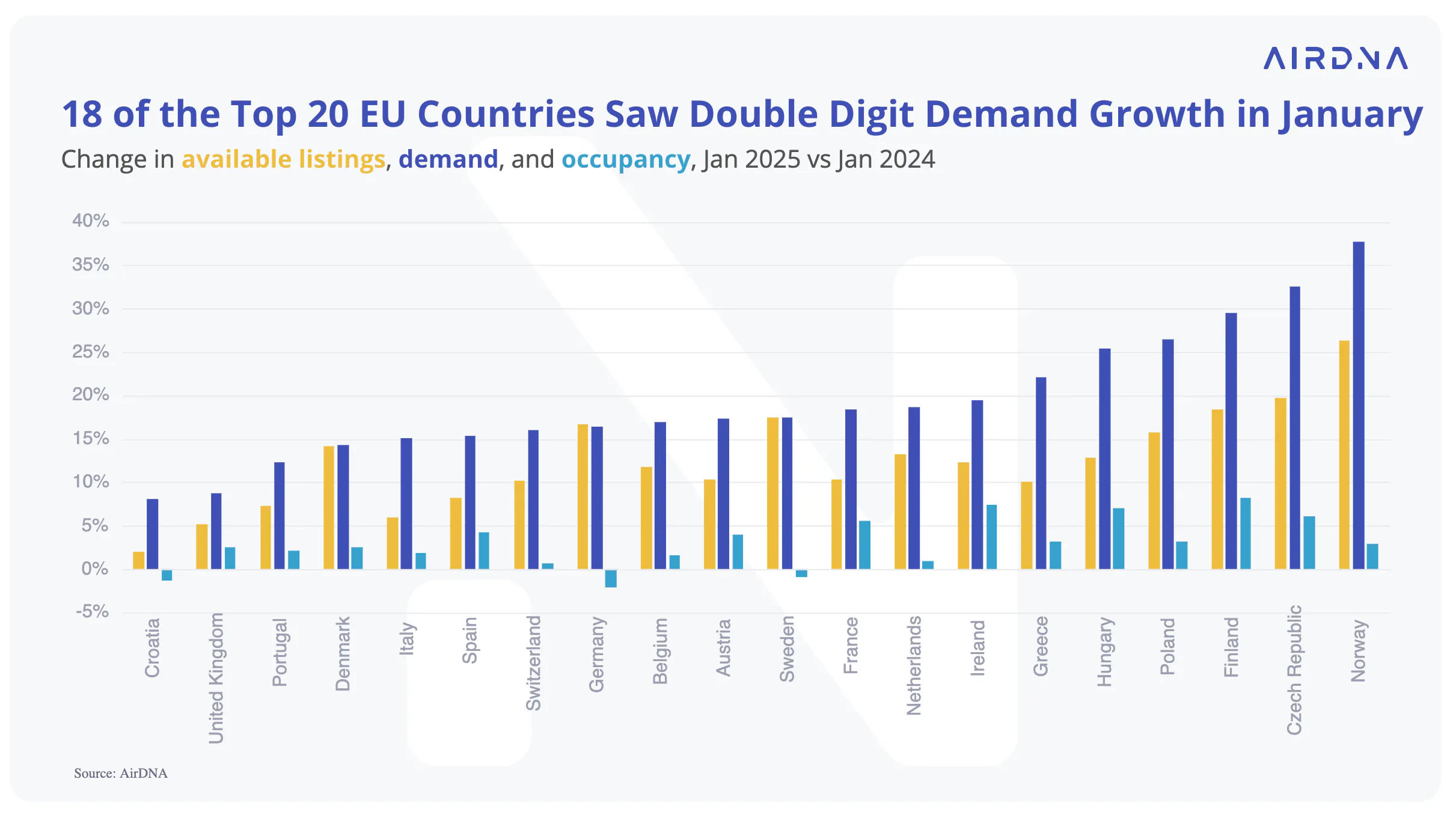
Turning to demand performance among the top 20 largest European countries, 18 of the top 20 countries saw double digit growth in night stayed for January. The leading countries saw more than 25% YoY growth in nights stayed:
- Hungary (+25.5% YoY)
- Poland (+26.4% YoY)
- Finland (+29.6% YoY)
- Czech Republic (+32.5% YoY)
- Norway (+37.7% YoY)
Listing growth did not keep up with vigorous demand and occupancy rates in all five of the top performing countries jumped more than 3% YoY.
The bottom 5 countries that lagged behind for growth in nights stayed were:
- Croatia (+8.1%)
- United Kingdom (+8.7%)
- Portugal (+12.4%)
- Denmark (+14.3%)
- Italy (+15.1%)
Of the bottom 5 countries, only Croatia experienced occupancy decline (-1.3% YoY) in January. The only other two countries that experienced occupancy decline in January were Germany (-2.1%) and Sweden (-1%).
European Ski Season Takes Off
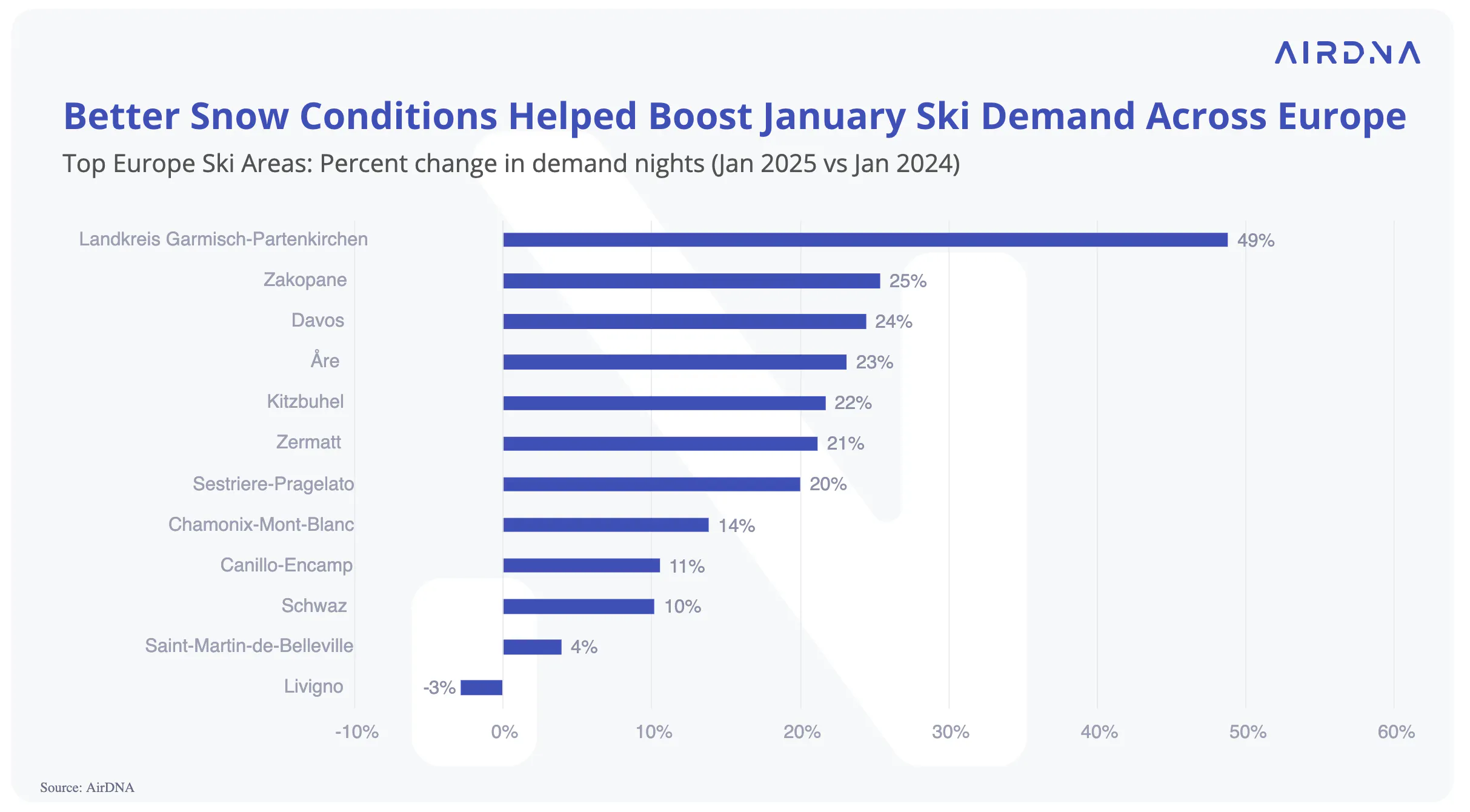
January marks the peak of ski season across Europe, and this year’s conditions are far more favorable than last winter, when mild temperatures driven by El Niño disrupted many ski areas. With better snowfall this season, short-term rental bookings in ski destinations are seeing strong momentum.
Among 12 of Europe’s most popular ski areas, 11 recorded year-over-year growth in January bookings. Leading the surge was Landkreis Garmisch-Partenkirchen, Germany, where a combination of strong listing growth and abundant snowfall drove a 49% YoY increase in demand. Other standout destinations included Zakopane, Poland (+25% YoY) and Davos, Switzerland (+24% YoY), both benefiting from improved conditions and increased traveler interest.
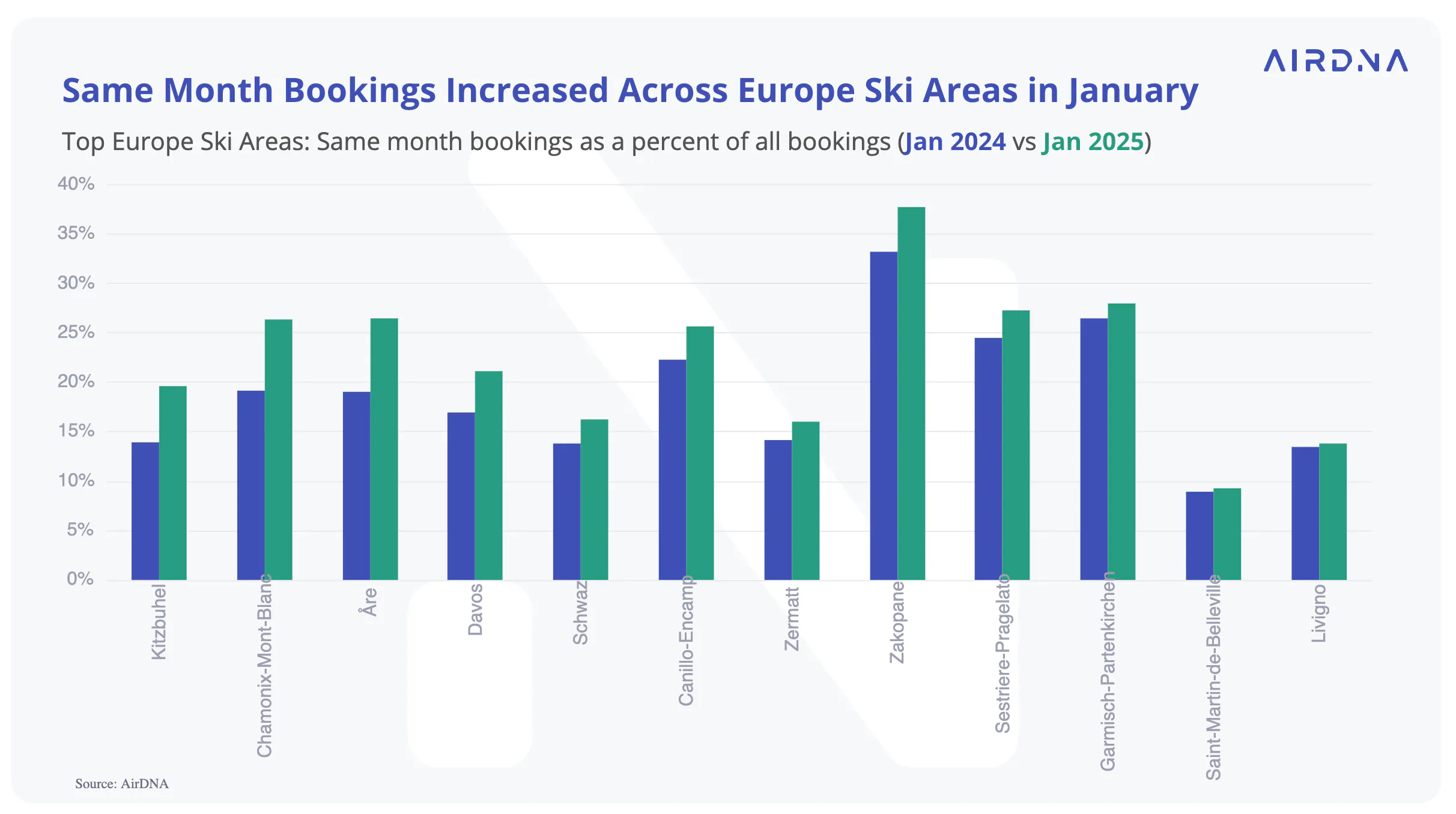
A key driver of January’s demand surge was the rise in same-month bookings. Powder-chasers tend to book their stays based on snow conditions. Plentiful snow last month bode well for last minute bookings across all 12 of Europe’s popular ski areas.
Kitzbühel, Austria saw the most significant shift, with same-month bookings rising from 14% of total January bookings in 2024 to 20% in 2025. Chamonix-Mont-Blanc, France, and Åre, Sweden, also experienced strong growth, with same-month bookings increasing from 19% to 26% year-over-year, highlighting the impact of favorable snow conditions on traveler behavior.
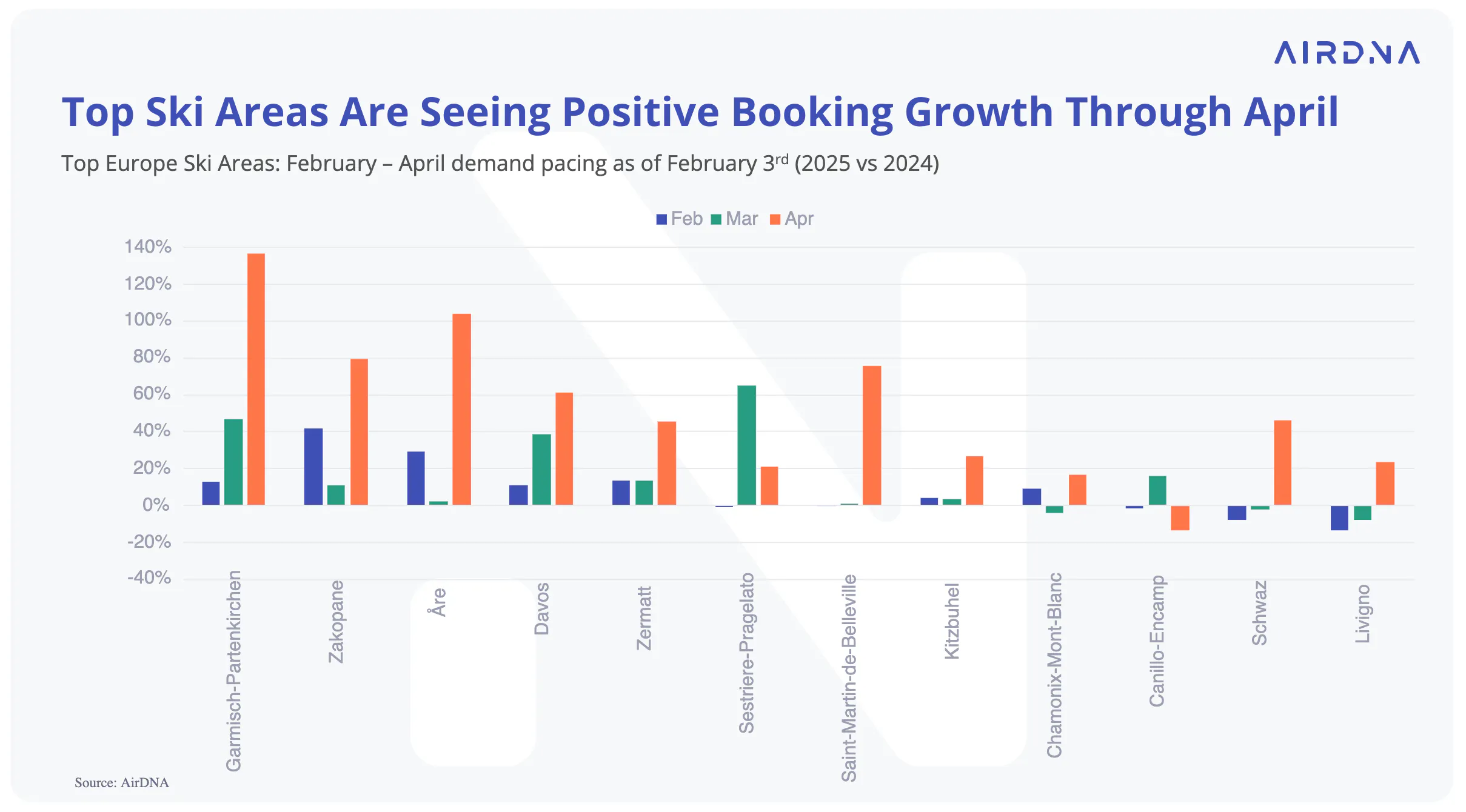
As we look ahead at current demand on the books for February and March, the majority of the popular ski areas are seeing growth in bookings for the next two months.
Landkreis Garmisch-Partenkirchen, Zakopane, and Davos are leading the way in forward bookings, with demand for February and March already more than 20% higher year-over-year. April reservations are also seeing a strong lift across many popular ski areas, signaling guest optimism that favorable snow conditions will extend later into the season.
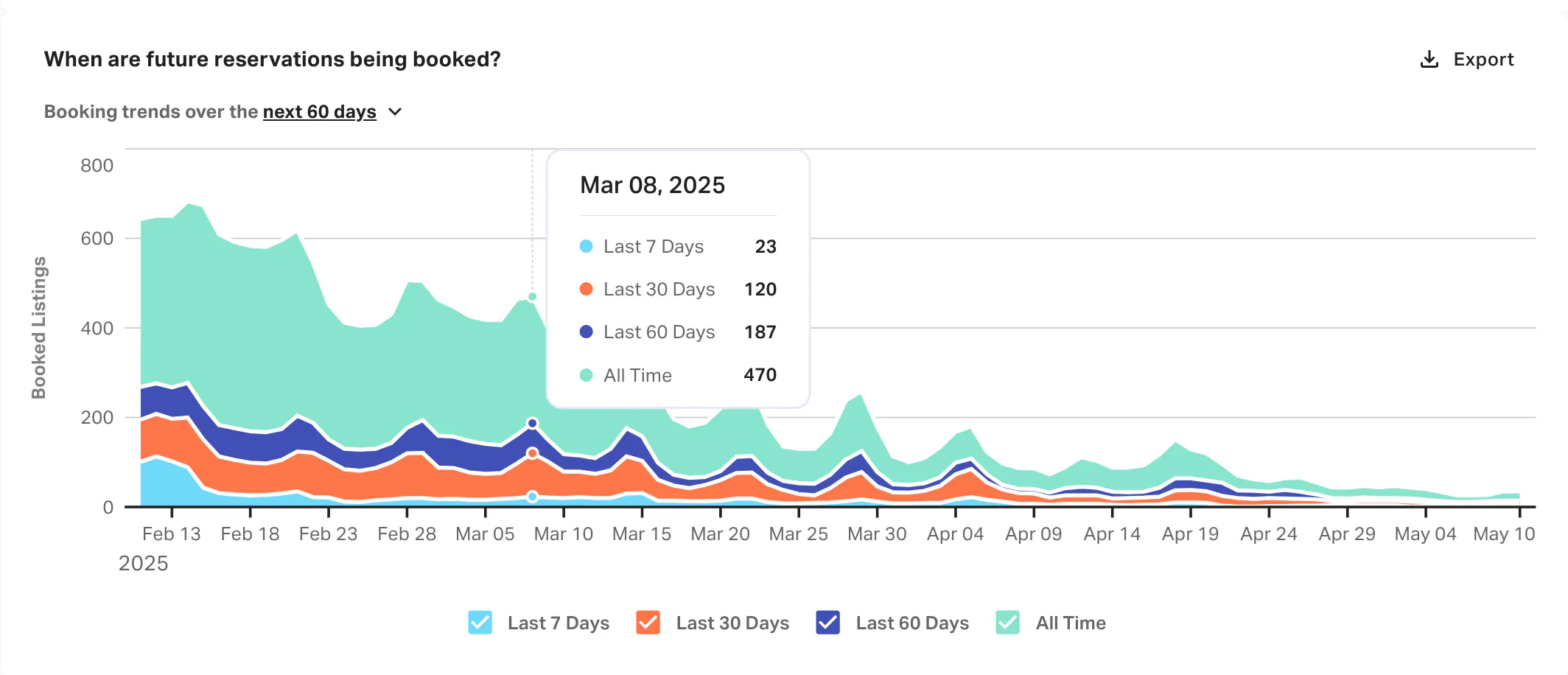
Since ski season bookings are heavily influenced by snow conditions—and a significant share of reservations happen within the same month—hosts in ski markets should closely monitor booking windows to maximize occupancy and revenue. AirDNA provides valuable insights into how far in advance guests are booking, helping hosts fine-tune their pricing strategies and stay competitive throughout the season.
Spring Break Pacing for Europe
Travelers aren’t just booking ski trips—they’re also looking ahead to their spring and Easter holidays.
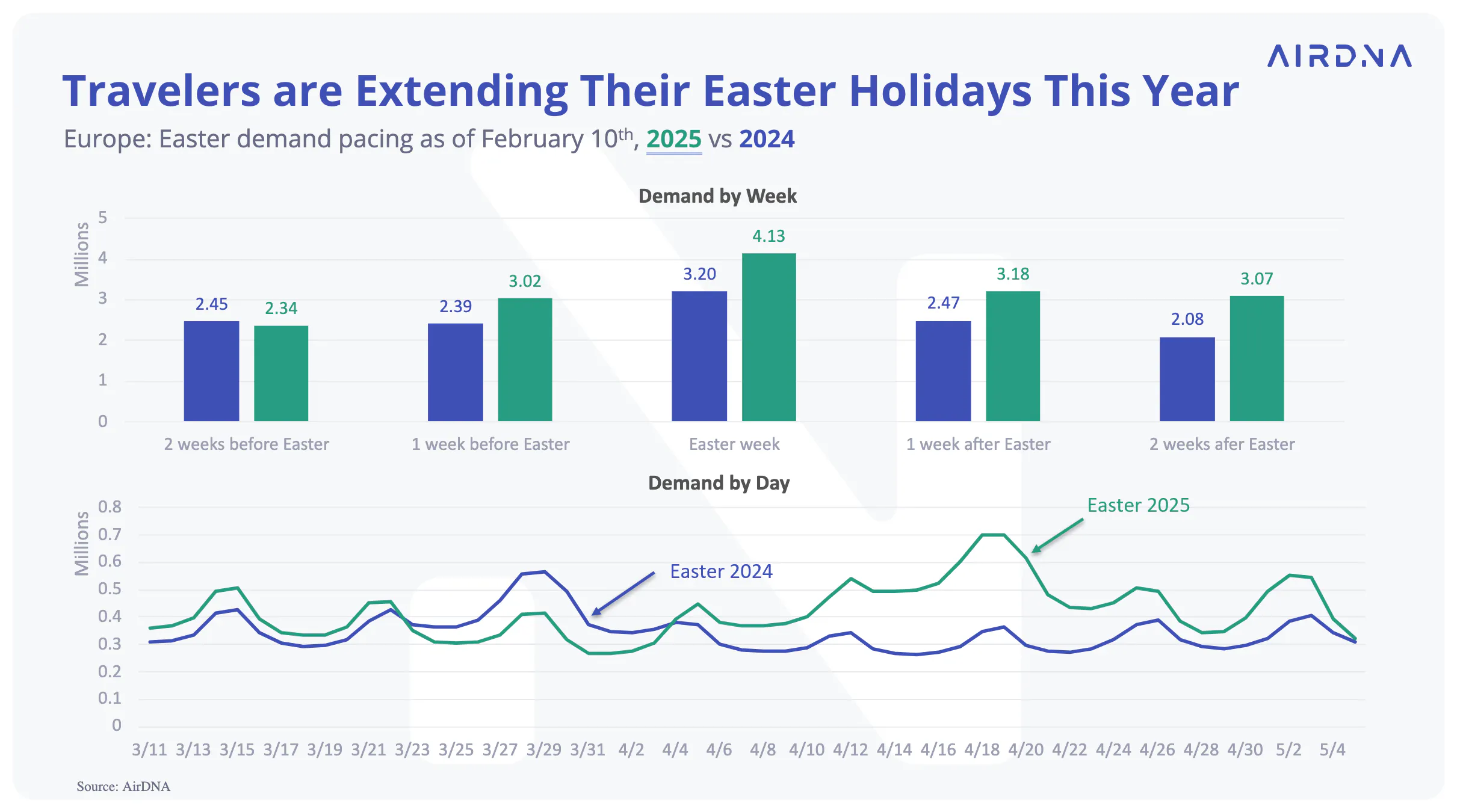
Last year, demand for Easter surged in the final weeks leading up to the holiday, with bookings for Easter week rising 30% compared to two weeks prior. This year, that increase is even more dramatic, with demand for Easter week up 77% over the same period.
Beyond the holiday itself, bookings for both the week before and the week after Easter are seeing significant growth, indicating that more travelers are extending their Easter vacations. This trend may be driven in part by the timing—2025 marks the latest Easter since 2019, bringing warmer weather in late April and added flexibility for those taking advantage of employer-provided holidays.
The shift toward Easter travel also aligns with the broader rise in shoulder season tourism. Businesses like the popular UK vacation rental platform On the Beach have encouraged travelers to consider Easter as a cost-effective alternative to peak summer trips. With growing interest in late spring and early autumn travel, this year’s surge in Easter bookings suggests that more people are adjusting their holiday timing to enjoy milder weather and fewer crowds.
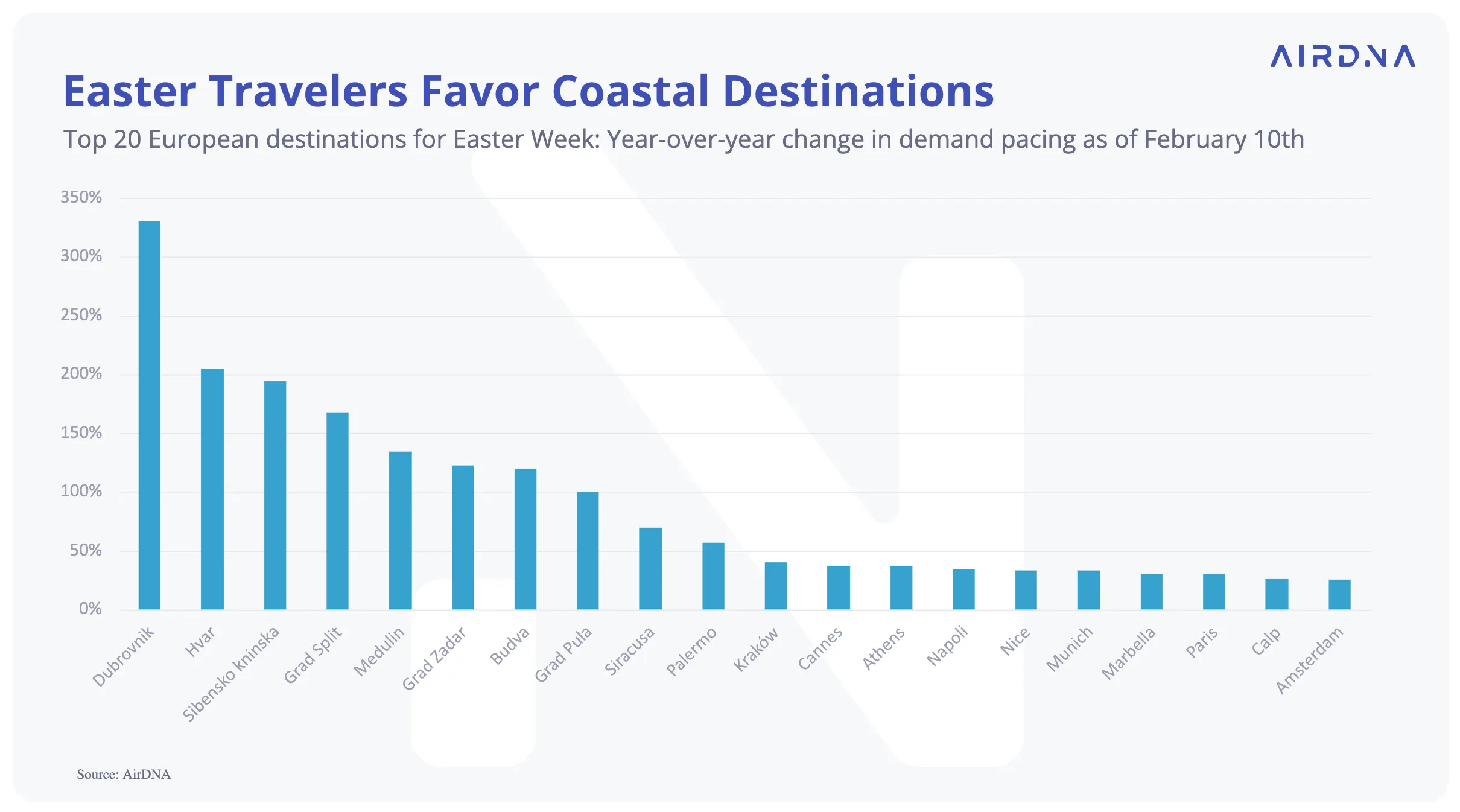
As for where travelers are looking to spend their Easter vacations this year, it appears many are embracing a warmer Easter and have coastal destinations in mind. Among the top 50 European cities, coastal destinations in Croatia, Italy, and France are taking the lead for growth in bookings for the week of Easter.
Croatian coastal destinations are known to be seasonal and typically only start seeing demand pick up in April. Easter landing in March last year did not offer much of a demand boost but this year’s late Easter is creating impressive booking growth. As a result, demand for stays in Dubrovnik, Hvar, Šibensko-kninska županija, Grad Split, Medulin, and Grad Zadar are up more than 100% YoY.
ARTICLE SUMMARY
January 2025 saw record STR demand, strong booking growth, and rising occupancy. Ski destinations thrived with better snow, while bookings for Easter travel surged.
Linda Rollins
Senior Research Analyst
Linda Rollins is a Senior Research Analyst at AirDNA and a self-managing short-term rental host, which means she understands the market as both an analyst and an operator. She writes research and blogs for AirDNA and for Adapt, its revenue management tool, making her work a go-to resource for investors trying to find and size up the right opportunities, and for operators looking to understand changing market dynamics and find concrete ways to improve occupancy, rates, and guest experience. Her data is regularly cited in major news outlets, and she has a knack for bringing both the numbers and the story behind them. In her free time, Linda enjoys spending time with her family, traveling, and looking for good eats.
