Where to List Short-Term Rentals: Airbnb vs. Vrbo vs. Booking.com
Published: September 19, 2025
Last updated: October 30, 2026

Jamie Zhang
Key Takeaways
- Airbnb captures nearly half of global bookings and is strongest for urban rentals, smaller spaces, and younger travelers.
- Vrbo excels with larger homes in vacation destinations, capturing 45% of bookings in coastal markets for properties with 5 or more bedrooms.
- Booking.com holds 40% of global bookings and dominates in Europe, especially for urban rentals and international guests.
You've set up your listing, uploaded great photos, and crafted the perfect description. Then, reality hits: crickets. Or maybe you're getting bookings, but not the kind of guests you expected, or not nearly enough to meet your goals.
Here's the thing: deciding where to list your short-term rental matters more than most hosts realize. The platform you choose doesn't just affect visibility; it shapes who finds your property, what they're willing to pay, and how often your calendar fills up.
We analyzed booking data across the three biggest vacation rental platforms: Airbnb, Vrbo, and Booking.com. Turns out, each one attracts different guests, performs better with certain property types, and dominates in specific markets.
Understanding where your property fits best could be the key to finally hitting your booking goals.
A Side-by-Side Comparison of the Top Short-Term Rental Sites
Choosing where to list short-term rentals is one of the biggest growth levers you have as a host. With more short-term rental platforms out there than ever, it’s not always obvious which one’s the best fit.
That’s why it helps to zoom out before diving in. Below is a side-by-side look at three of the top marketplaces for vacation rentals: Airbnb, Vrbo, and Booking.com. These are some of the best short-term rental sites in terms of reach and recognition, but each one comes with trade-offs.

Of course, a chart can only tell you so much.
Next, we’ll break down each platform in more detail so you can decide where to list your short-term rental and how to make the most of it.
Where to List Your Vacation Rental and Why
Not all platforms perform identically, and what works for one host might fall flat for another. We wanted to break down how Airbnb, Vrbo, and Booking.com actually stack up when it comes to real bookings, not just features or popularity.
To do that, we looked at what platforms completed stays are getting booked on. Since calendar data can be murky (some hosts block time for personal use or other platforms), we used guest reviews as a more reliable signal. A review only shows up after a real guest checks out. That helped us see which types of properties do well on each platform, and where each OTA has the strongest presence. (You can pop down to the end to read more about our methodology.)
The goal? To help you figure out which platform (or combination) gives your place the best shot at being seen and booked.
Airbnb
If the short-term rental world had a front door, it would probably be Airbnb’s. Close to 50% of all short-term rental bookings happen on Airbnb, which means if your property’s not there, you're missing where most guests are already looking.

Airbnb is especially strong in urban markets, where it’s become the go-to for solo travelers, weekend stays, and business trips. Smaller properties such as studios, one-bedrooms, and guest suites tend to perform best, especially when they are well-located in walkable neighborhoods or near local attractions. Airbnb also has a reputation for showcasing design-forward and unique stays, which helps hosts stand out in competitive markets.
Airbnb is where many first-time hosts start, thanks to its intuitive setup and massive guest base. Still, volume alone isn’t the only reason it’s among the best short-term rental sites. It also gives hosts a fair amount of flexibility on policies, pricing, and how you manage your calendar.
Here are a few things to keep in mind about Airbnb:
- Fee structure: Airbnb uses a split-fee model by default, around 3% for hosts, with guests paying a separate service fee. If you're using a channel manager or connected software, expect a switch to a single-service fee structure between 14–16%, paid by hosts.
- Payout timing: Hosts receive payment 24 hours after guest check-in, which can help with cash flow, especially for short bookings.
- Cancellation flexibility: Airbnb lets hosts choose from three cancellation tiers—Flexible, Moderate, or Strict—giving you more control than some other vacation rental websites.
- Guest expectations: Airbnb guests expect seamless communication, self check-in, and polished presentation. Think strong photos, clear house rules, and fast responses.
- Host protections: Every booking includes AirCover for Hosts, with $3 million in damage protection and $1 million in liability coverage at no extra cost.
Bottom line: Airbnb is almost always part of the equation when deciding where to list my vacation rental. However, for certain properties or locations, it might just be the starting point, not the whole strategy.
Booking.com
If your short-term rental is located in Europe or attracts a lot of international guests, Booking.com might deserve your attention. As of July 2025, Booking.com holds around 40% of global bookings, making it the second-largest platform after Airbnb. In Europe, it’s a different story: Booking.com is the clear leader, outpacing Airbnb across the continent and commanding the largest share of guest bookings in that region.
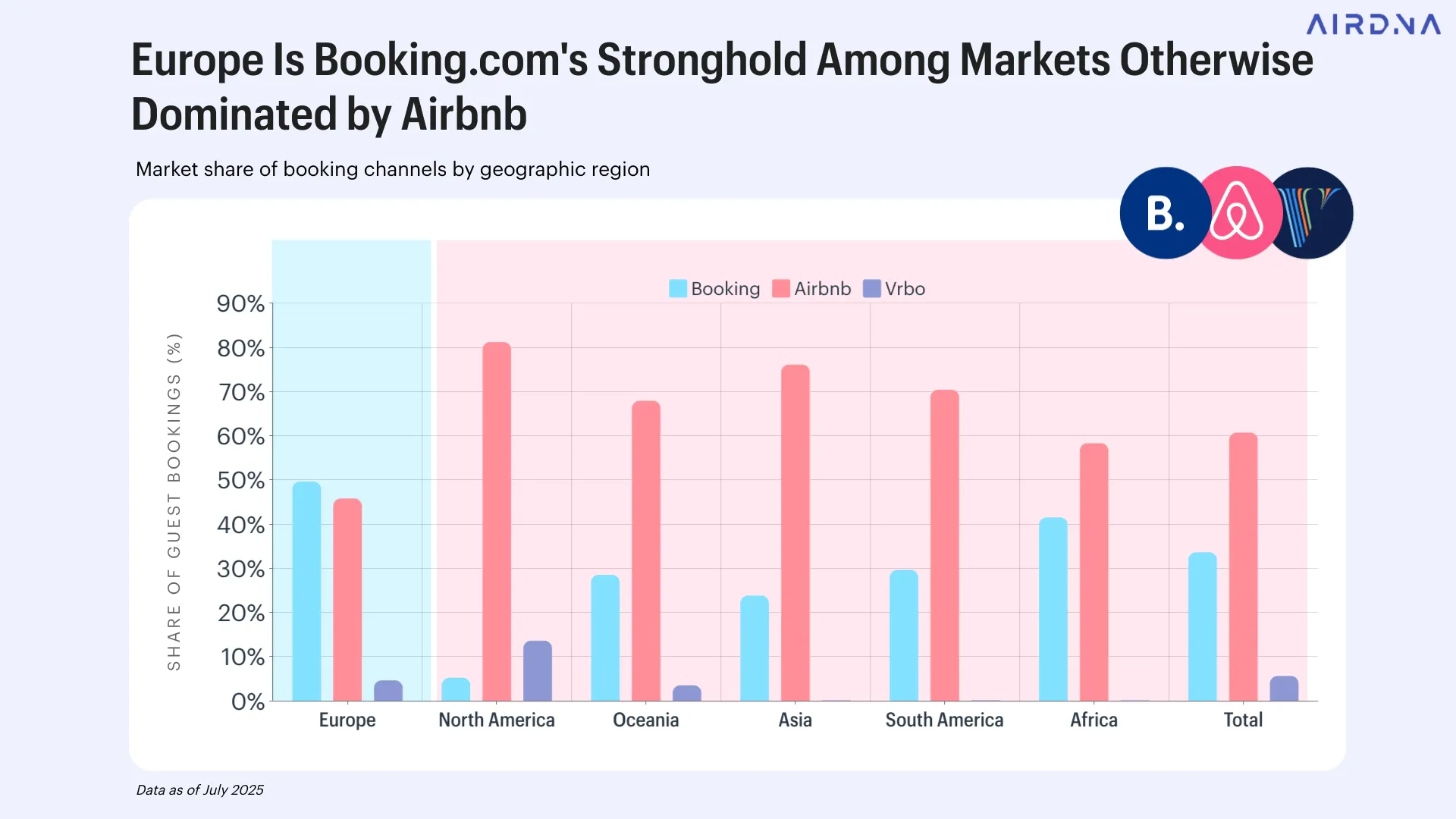
Booking.com also tends to perform well with international travelers, especially those from Europe who are already familiar with the brand through hotel stays. While it's less dominant in North America and resort destinations, its global reach and high search volume make it a valuable secondary or tertiary listing site, especially if you're already on Airbnb.
The platform is particularly strong in urban markets and well-suited for listings that offer instant book, hotel-style amenities, or apartments in major cities. If your property has a seamless check-in process, clear expectations, and is optimized for quick-turn guests, Booking.com’s audience is likely to be a match.
Here are a few other things to keep in mind about Booking.com :
- Fee structure: Booking.com typically charges a 15% commission to hosts, with no added guest fee. The price guests see is the price you set.
- Payout timing: Hosts can choose between weekly or monthly payouts, which may be less immediate than other platforms.
- Cancellation policies: Booking.com defaults to more guest-friendly cancellation terms, and there’s less flexibility for strict host-defined policies.
- Guest type: The platform attracts international travelers, frequent European tourists, and guests booking urban stays or hotel-like properties.
- Host protection: Booking.com offers liability insurance up to $1 million, but damage protection varies. Hosts can require refundable deposits or opt into optional guest-paid damage waivers.
If you're thinking, “Should I list my Airbnb on Booking.com?”, the answer might depend on where you're hosting. For properties in European cities, Africa, or global travel hubs, Booking.com can tap into guest segments Airbnb may not reach and help fill availability gaps across seasons.
Vrbo
Vrbo is all about whole-home stays. It’s designed for families and groups who want space, not just a place to sleep. That’s why it tends to perform well in classic vacation spots where full-home rentals are expected.
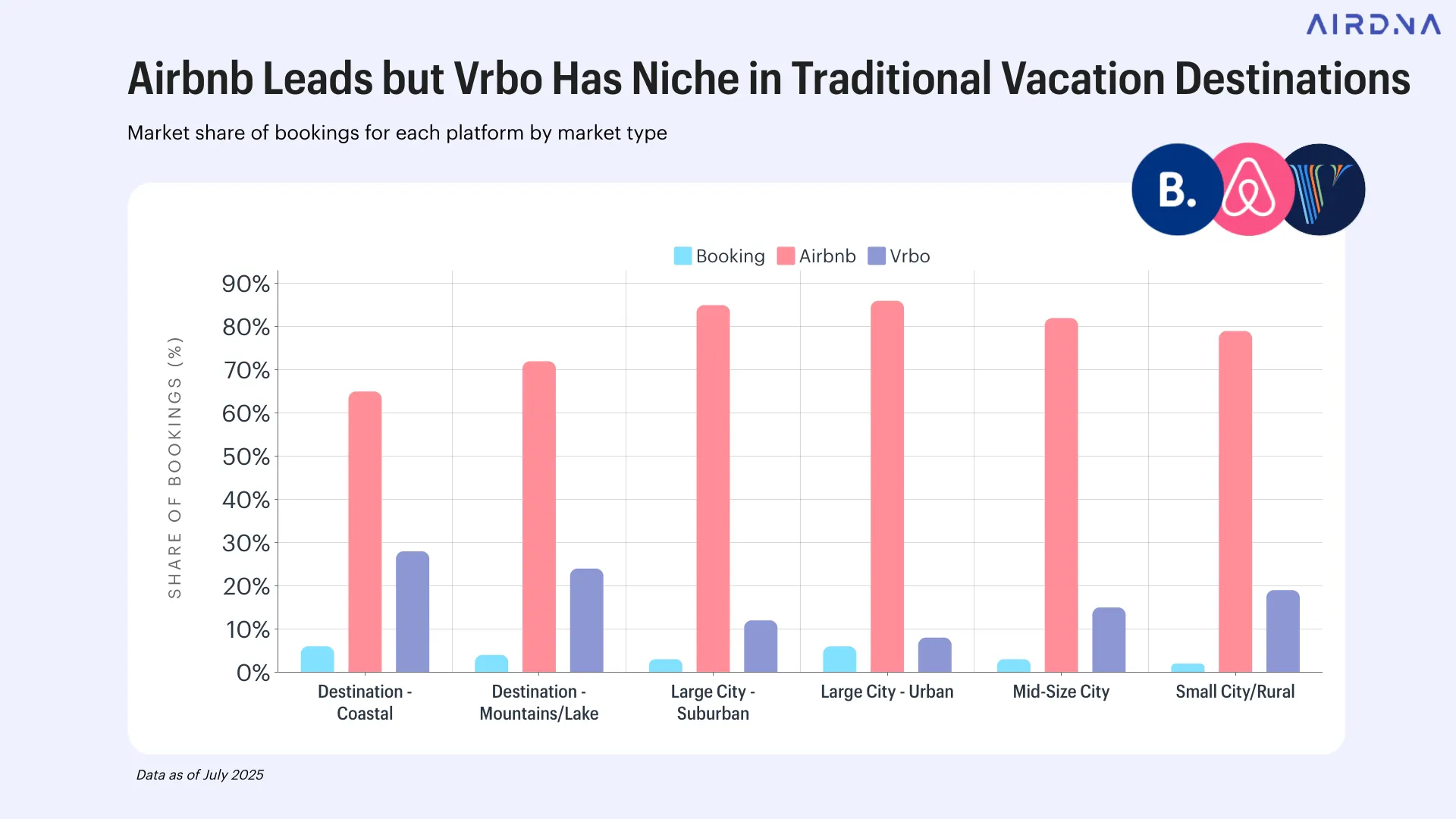
In places like mountain towns, lake destinations, and rural markets, guests are often looking for privacy and room to spread out. Vrbo captures a solid share of bookings in these areas: 30.9% in Mountain/Lake markets, and 33.8% in Small City/Rural areas (if you’re curious how we define these market types, check out our methodology here!)
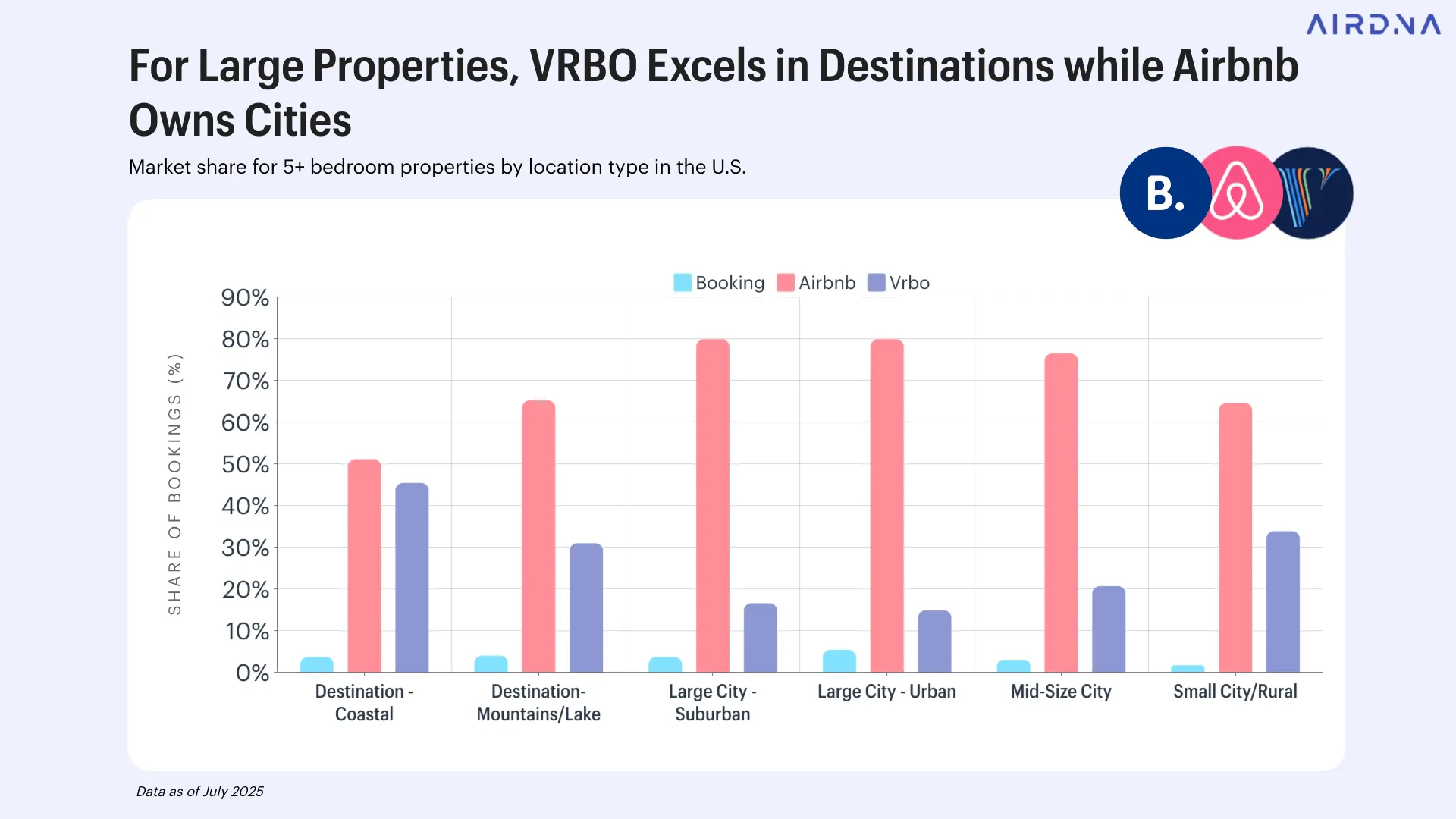
That trend holds when you look at property size, especially in Coastal markets. While Airbnb leads for smaller homes, Vrbo gains ground as listings get larger. For homes with five bedrooms or more in Coastal markets, Vrbo captures 45% of bookings, nearly matching Airbnb. If you’re hosting a bigger property in a destination market, Vrbo is often where families and groups go first, especially when they’re planning longer trips.
Other Vacation Rental Sites Worth Considering
While Airbnb, Vrbo, and Booking.com dominate most conversations, there’s a growing number of niche and regional home-sharing platforms that may be a better fit depending on your listing and goals. These rental sites like Airbnb often serve more specific guest types or booking behaviors and can help you reach travelers you might be missing on the bigger platforms.
- Plum Guide: Focuses on high-end, design-forward homes. Great if your property is professionally styled or in a premium location.
- Whimstay: Specializes in last-minute bookings, offering a way to fill gaps and attract spontaneous travelers.
- Hopper Homes: Mobile-first platform that taps into a younger, app-native audience browsing on the go.
To learn more, check out our article on the Top 5 Airbnb Alternative sites.
Direct booking sites and PMS-integrated options
If you're looking to take more control over your bookings and reduce fees, creating your own direct booking site is worth exploring. Tools like Uplisting let you build your own site, sync calendars, and manage rates, all while avoiding third-party commissions.
AirDNA Adapt pairs perfectly here, helping you set smart pricing based on local demand. You can then apply those Adapt rate recommendations directly through Uplisting or your preferred property management system (PMS), keeping everything connected, data-informed, and fully yours.

How to Choose the Best Short-Term Rental Site for Your Property
There’s no one “best” site to list your short-term rental and that’s actually a good thing. The right platform (or combination of platforms) for your property depends on a few key factors:
- Location: Are you in a walkable city, a resort area, or a rural destination? Platform performance can vary widely by region and market type.
- Property size: Studios and one-bedrooms often do better on Airbnb, while Vrbo shines with larger homes.
- Guest type: Who are you hoping to attract—families, couples, or business travelers?
- Seasonality: Peak vs. off-season demand, and how far in advance potential guests book.
All these are reasons why many hosts don’t stick to just one platform. Cross-listing, listing your rental on multiple sites, is a great way to reach more travelers and fill your calendar faster. It takes a bit more setup, but if managed well, cross-listing can lead to better occupancy and higher revenue.
If you're thinking about going multi-channel, we’ve put together a guide to cross-listing your short-term rental the right way.

Methodology on Booking Share Data
The booking share data in this guide is based on guest review counts, not total nights blocked or booked.
Why? While AirDNA’s database includes a field called demand nights, that number can be misleading. It includes nights blocked for real bookings and nights manually blocked by the host (like syncing calendars or holding time for personal use). Since those two types of blocks look the same in the data, demand nights tend to overstate how many bookings were actually made through a specific platform.
Instead, we used review counts as a more accurate signal. A review only appears after a completed stay on that channel, so it gives us a clearer picture of real bookings. To estimate total reservations, we adjusted for the typical review rate on each platform:
- Airbnb: ~70% of guests leave a review
- Vrbo: ~50%
- Booking.com: ~50%
Using those rates, we estimated total bookings and calculated each platform’s share of reservations in a given market. While it's still an estimate, this method gives a much truer picture of actual booking behavior.
FAQ
Where should I list my short-term rental?
There’s no one-size-fits-all answer. Airbnb is the most common starting point thanks to its global reach and intuitive setup. Depending on your property type and market, however, Vrbo or Booking.com might deliver better results or help fill in calendar gaps. Use data to help guide where you list, and don’t be afraid to test multiple channels.
What is the best vacation rental hosting site?
In terms of booking volume, Airbnb is currently the leader, capturing nearly half of global short-term rental bookings, and over 70% in North America. It also leads in most international markets outside Europe. However, Vrbo and Booking.com remain key players, each with loyal guest bases and strong regional performance.
What platforms are similar to Airbnb?
Several platforms offer a similar experience to Airbnb, but each has its own strengths:
- Vrbo is a close competitor in North America, especially for whole-home rentals and family stays in vacation markets.
- Booking.com draws international travelers and is strong in Europe and urban areas.
- Plum Guide focuses on high-end, curated properties.
- Whimstay targets last-minute bookings.
- Hopper Homes is a mobile-first option geared toward younger travelers.
If you're looking for platforms similar to Airbnb, it’s worth exploring based on your guest type and property features.
Should I list my Airbnb on Booking.com?
If you're in a city or tourist-heavy area with strong international traffic, listing your Airbnb on Booking.com could be worth it. Booking.com performs especially well in Europe and major urban markets, and attracts guests who may not use Airbnb at all. Just keep in mind: Booking.com has a different guest experience (no built-in host messaging, for example) and tends to work best for hosts who offer instant booking and more hotel-style amenities.
Which vacation rental site has the lowest fees?
Fee structures vary. Airbnb typically charges a 3% host fee (or 14–16% if you're using channel management software), while Vrbo offers either a pay-per-booking model (~8%) or a flat annual fee. Booking.com charges a host-only commission of around 15%. If keeping fees low is your priority, Airbnb’s basic model usually offers the lowest cut, but it’s always worth weighing fees against booking volume and guest quality.
Is Vrbo or Airbnb better?
The choice between Airbnb vs. Vrbo shouldn’t be a choice at all. The data says that properties listed on both platforms receive more demand nights and earn more revenue. Airbnb is ideal for urban listings, solo travelers, and hosts just getting started. Vrbo tends to perform better for larger homes, family stays, and vacation destinations like mountain towns or beach communities. Listing on both Airbnb and Vrbo maximizes your visibility. Just make sure you have a reliable way to manage bookings across channels.
ARTICLE SUMMARY
Not all booking sites are created equal. We dug into the data on Airbnb, Vrbo, and Booking.com to reveal how they really perform and how to choose the best short-term rental site for your property.
Jamie Zhang
AirDNA Data Analyst
Jamie Zhang is a Data Analyst at AirDNA, leveraging her background in data science and analytics to uncover key trends in the short-term rental industry. Before joining AirDNA, she worked as a data analyst at Shanghai Disney, where she specialized in revenue forecasting and financial planning . She holds a Master’s degree in International Economics and International Relations from Johns Hopkins. Jamie enjoys cycling to explore different corners of the city.