


Booking.com vs Airbnb for Hosts: Which Is Better?
Published: October 24, 2025
Last updated: May 5, 2026

Jamie Zhang

Key Takeaways
- Airbnb and Booking.com are the two largest global STR platforms, with over 8 million short-term rentals and 8.4 million alternative accommodation listings, respectively.
- Airbnb leads in the Americas, while Booking.com has a stronger foothold in many European markets and larger listings.
- Many hosts are choosing both Booking.com and Airbnb. Over 1.6 million listings are cross-listed globally, showing a growing trend toward multi-platform strategies for greater visibility.
Picking the right platform for your short-term rental isn’t as simple as flipping a coin.
Should you stick with Airbnb? Try Booking.com? List on both? For hosts, especially those just getting started, this decision can feel confusing, overwhelming, and oddly high-stakes.
Plus, it’s not just about picking a platform. It’s about picking the one that fits your guests, your property, and how you want to manage it. Choose wrong, and you could wind up juggling cancellations, fielding mismatched guest expectations, or leaving bookings on the table.
We’ve got your back. We looked at the data to see how Booking.com vs Airbnb actually differ across guest types, property performance, and platform features. Whether you're all-in on Airbnb, Booking.com-curious, or considering a dual-platform strategy, we’ll help you decide what makes the most sense for your short-term rental business.
Booking.com vs Airbnb Overview
While Airbnb often dominates the short-term rental conversation, Booking.com plays a comparable role in the global STR ecosystem but only in certain areas of the world. These platforms cater to different types of travelers, markets, and host strategies, and understanding their reach is the first step in deciding where to list.
Platform size
Booking.com, with its roots in hotel bookings, has grown into a vacation rental powerhouse. Of its 28 million listings in 230 countries and regions, 8.4 million are reported to be alternative accommodations, up 8% year-over-year. According to AirDNA data, 1.6 million of those alternative accommodations are short-term rental listings. We came to that number by scraping property IDs from Booking.com.
Audience
Booking.com attracts a broad range of travelers—including working professionals and last-minute bookers—thanks to its frictionless booking experience and strong global marketing.
Airbnb, by contrast, leans heavily into unique stays, guest-host connection, and experience-driven travel. With over 8 million listings in 220 countries and regions, it remains the most recognized STR platform globally, especially among millennial and Gen Z travelers.

Is Airbnb or Booking.com Better for Hosts?
It’s one of the first questions hosts ask, yet it’s often a misguided one. Airbnb will always be an obvious choice because it captures the majority of short-term rental listings around the world. It has stronger brand recognition, a loyal user base, and a head start in the short-term rental space.
The right question is not “Is Airbnb or Booking.com better?”
Try asking: “Is listing on Booking.com in addition to Airbnb worth it?”
How common it is to cross-list on Booking.com and Airbnb depends entirely on where you’re hosting, what kind of property you have, and who you're trying to attract. From regional dominance to property type trends, here’s what AirDNA data tells us about where each platform shines brightest.
Europe is a key Booking.com market
Airbnb may dominate globally, but Booking.com has a strong foothold in Europe. 14% of European STR listings are exclusively marketed on Booking.com and 23% are cross-listed.
In total, 37% of all European STR listings are on Booking.com in Europe. This is the platform’s strongest regional share by far. In contrast, only 17% of North American listings appear on Booking.com.
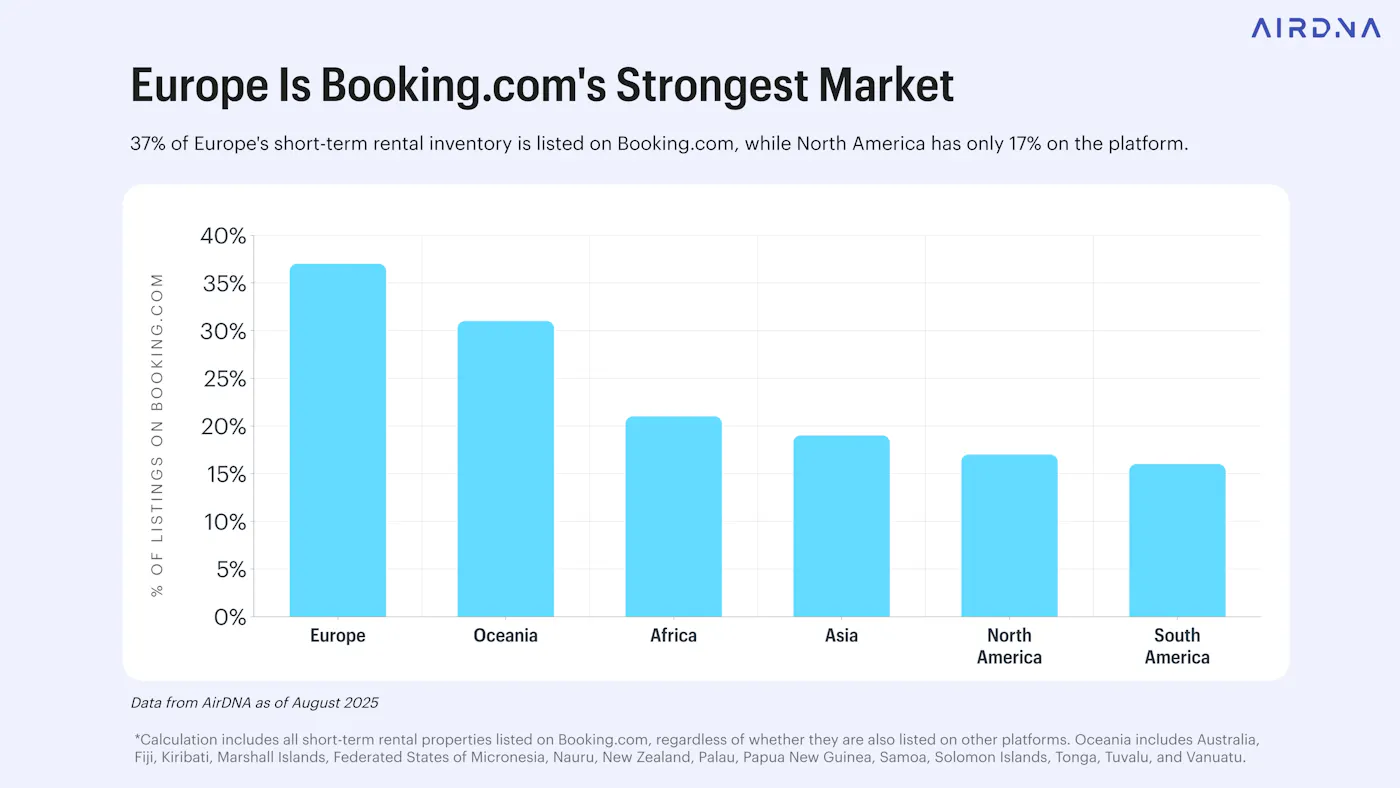
At the country level, the divide gets sharper. In Poland and Germany, Booking.com accounts for half or more of all short-term rental listings when you include both exclusive and cross-listed properties. Spain is close behind, with nearly half the market on the platform.

In France, 70% of listings are Airbnb-only. However, the STR market is so large there that the 29% of vacation rentals that are listed on Booking.com represents 20% of all Booking.com listings in Europe, the Middle East, and Africa combined. This goes to show that even where Airbnb dominates, Booking.com can’t be ignored.
The bottom line? If you're hosting in Europe, you absolutely need to be listed on Booking.com.
More hosts are playing both sides
It’s no longer about choosing between platforms. Many hosts are choosing both.
As of August 2025, 1.6 million listings are cross-listed on Airbnb and Booking.com. These hosts are tapping into each platform’s strengths: Airbnb’s experience-seeking guests and Booking.com’s efficiency-driven travelers. Hosts are no longer relying on just one source of demand.

Cross-listing is especially common in high-demand, mature markets where competition is stiff and occupancy matters. In countries like Spain and Greece, over 30% of listings are on both platforms.
If you’re managing multiple units or operating in a competitive market, you should be cross-listing on Airbnb and Booking.com in order to maximize visibility.
Booking.com takes the lead for larger properties
The performance of Booking.com vs. Airbnb doesn’t just vary by location. It also shifts depending on property size.
Globally, Airbnb’s inventory is dominated by studios and 1-bedrooms: nearly half of all listings fall into that category. Booking.com, by contrast, skews larger, with 2- and 3-bedroom homes making up a greater share of its inventory.
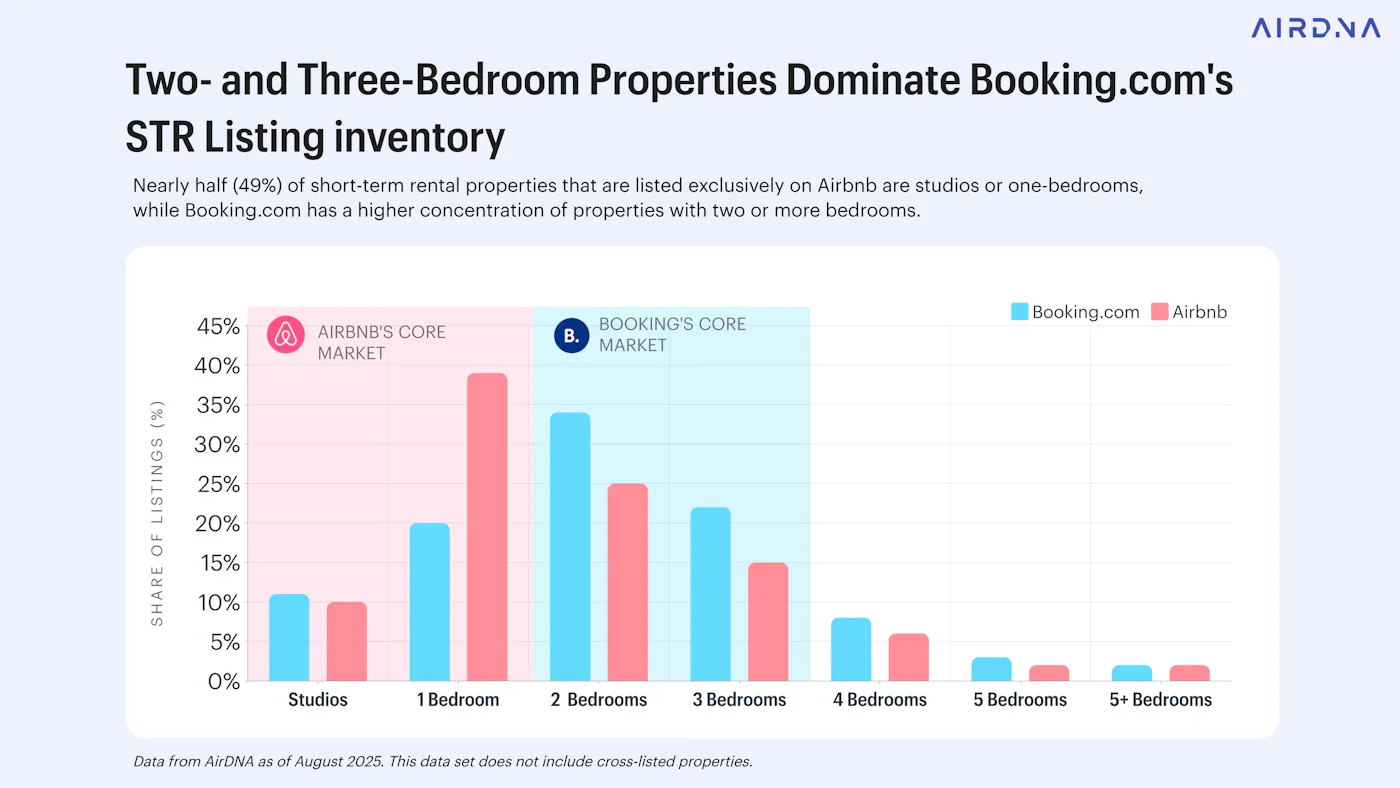
That trend is even more striking in Europe. As of August 2025, more than half of all 3-bedroom STRs in Europe are listed on Booking.com, either exclusively or cross-listed with Airbnb.
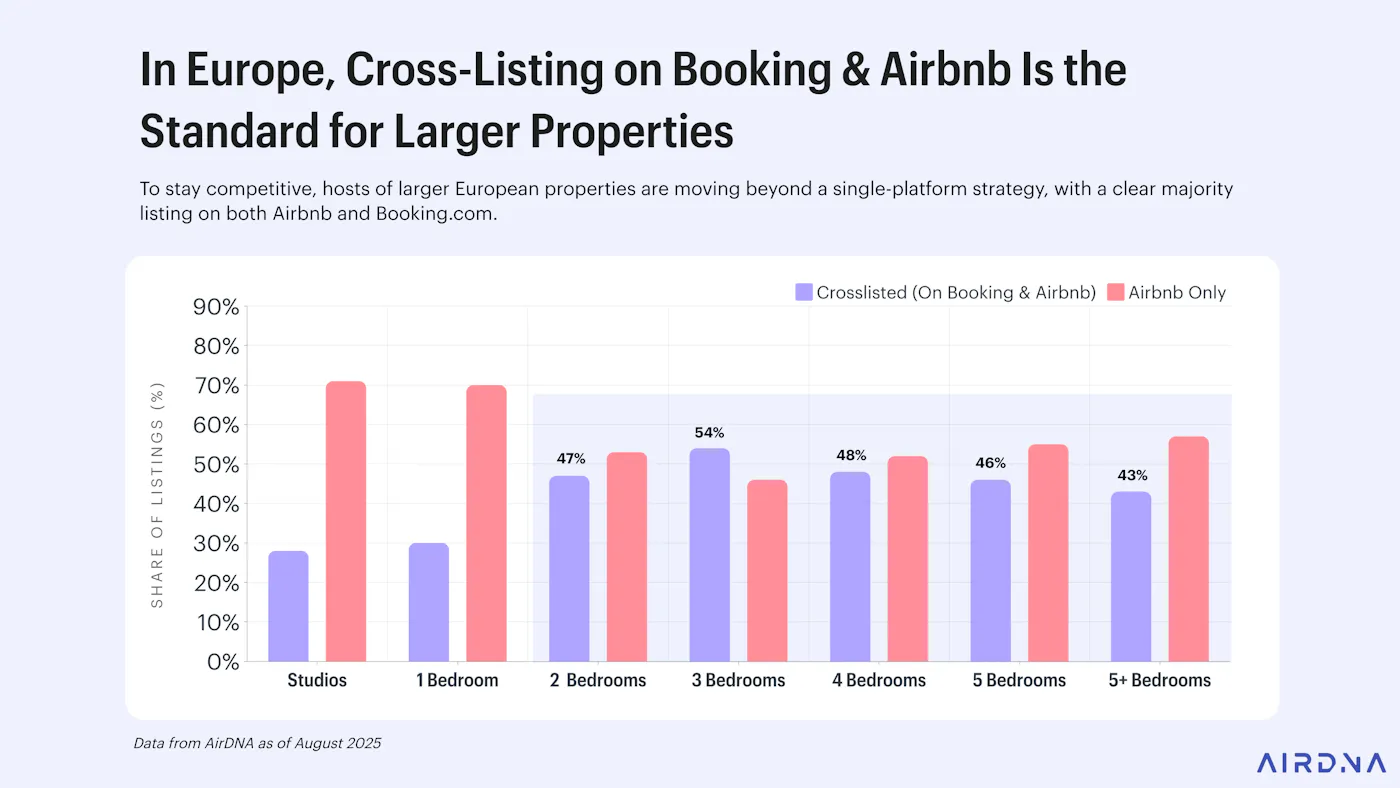
In Spain, where hosting on Booking.com is more common than for Europe as a whole, the share of larger properties on the platform is even larger. 61% of all 3-bedroom properties and 60% of all 4-bedroom properties in Spain are listed on Booking.com. This just goes to show that Booking.com’s prevalence varies not just by continent, but by country and specific market, too.
How this data informs the Booking.com vs Airbnb debate :
- Smaller, experience-rich units thrive on Airbnb.
- Larger homes with multiple bedrooms (especially in Europe) are more likely to be on Booking.com.
- Hosts with 2+ bedroom properties may benefit most from a dual-platform strategy.
In short: bigger homes belong on Booking.com.
Airbnb still comes out on top in the Americas
In North and South America, Airbnb still leads by a wide margin. More than 80% of listings across both regions are exclusive to Airbnb, making it the go-to platform for most hosts (and most guests).
That kind of market share gives Airbnb a stronghold, especially among hosts with smaller properties, leisure travelers, and those offering unique, locally-rooted stays. The platform’s brand recognition and loyal following mean you can do just fine without branching out.
That said, Booking.com still has value, especially in urban markets or for shorter stays where travelers may be booking quickly and looking for something simple. Business travelers and international guests often default to Booking.com, even in Airbnb-heavy regions.
At the end of the day, Airbnb might be all you need in the Americas. Cross-listing could help you stretch your reach, though, especially if your calendar isn’t as full as you’d like.
If you’re only listed on Airbnb and exploring a dual-platform strategy, Vrbo might be the smarter choice than Booking.com in the Americas.
Platform Features of Booking.com vs Airbnb
So far, we’ve looked at where each platform performs best. However, choosing where to list isn’t just about performance metrics. It’s also about what actually works for you as a host.
Do you want more control over who books your place? Prefer faster payouts? Need stronger marketing support? These questions matter just as much as guest volume or brand recognition.
Booking.com vs Airbnb cater to different hosting styles, and their platforms reflect that. Airbnb tends to offer more customization and guest interaction, while Booking.com leans into automation and exposure at scale.
Let’s take a look at how the platforms compare across core features.

User base and website traffic
Airbnb is a pioneer in the vacation rental industry, boasting a strong global presence. The platform’s brand is synonymous with short-term rentals and alternative lodging.
Booking.com, on the other hand, was initially a hotel booking site. It has expanded into vacation rentals by leveraging its existing user base.
Here are some of the key differences:
- Airbnb appeals more to younger travelers and those seeking unique stays. Booking.com appeals to a diverse user base that travels flexibly between hotels and vacation homes.
- Airbnb is pushing its international expansion to diversify its user base, whereas Booking.com has a strong foothold in Europe and is now focusing on growing its U.S. short-term rental market share.
- Airbnb is known for pioneering the vacation rental space, while Booking.com has expanded from its hotel booking roots to include a wide range of accommodations.
Marketing features and booking rates
Property owners who have listed their rentals on both platforms tend to see a higher booking frequency on Booking.com compared to Airbnb. According to Booking.com, over 45% of their new vacation rental listings get booked within the first week post-launch.
This advantage is largely due to Booking.com's sophisticated retargeting and cross-marketing strategies. In this case, retargeting refers to pursuing potential customers who have previously interacted with Booking.com or shown interest in a property by targeting them with advertisements across various digital channels. This aggressive marketing approach often results in more bookings, though potentially with different guest expectations than those from Airbnb.
Airbnb emphasizes customer experience and has built a loyal user base that often chooses Airbnb exclusively for their travel accommodations. This "cult culture" around Airbnb focuses on unique stays and local experiences.
Guest demographics and behaviors
Airbnb guests often skew younger, with a significant portion falling into the millennial and Gen Z demographics. These travelers are typically seeking unique experiences and local interactions rather than standardized accommodations. They also often prefer longer stays, with the average Airbnb booking length exceeding that of Booking.com. Airbnb guests are more likely to book entire homes or apartments and predominantly travel for leisure or remote work opportunities.
Booking.com attracts a more diverse range of guests. While it certainly caters to leisure travelers, it also sees a higher proportion of business travelers compared to Airbnb. Guests on Booking.com are often looking for a wider range of options, from budget accommodations to luxury stays. They're more likely to book shorter stays with less lead time—often just a few days before arrival—and may prioritize conveniences like 24/7 check-in or on-site amenities over unique experiences.
Both platforms receive family travelers and groups, but Airbnb tends to have an edge in this category because it offers more entire-home rentals. Families often prefer the space, privacy, and amenities (like kitchens and multiple bedrooms) that entire-home rentals provide, making Airbnb a popular choice for this demographic.
Property listing process
Listing a property on Airbnb is straightforward and intuitive. The platform guides hosts through the process, from adding property details and photos to setting up pricing and availability. Their user-friendly interface and comprehensive guides make it easy for new hosts to create Airbnb listings.
Listing a property on Booking.com may be even easier than listing on Airbnb. Booking.com allows you to import your review score from other platforms and display it on your property page. You can also import your property details and sync your availability calendar with other platforms. This means that listing on Booking.com is seamless if you already have an Airbnb or Vrbo account.

Guest screening methods
The ability to vet potential guests is a crucial consideration for many hosts. Each platform handles guest vetting slightly differently.
Airbnb provides hosts with more control over guest vetting. The platform has built robust tools that allow hosts to thoroughly screen potential guests before accepting their reservations, helping to ensure property safety and guest compatibility.
Before booking, Airbnb hosts can require guests to:
- Verify their identity by uploading a government ID
- Have positive reviews from other hosts
- Agree to house rules
- Complete a booking questionnaire
- Provide a verified phone number
The Airbnb website also allows hosts to message potential guests before accepting a booking (unless Instant Book is enabled), giving them an opportunity to assess the guest's intentions and suitability.
Booking.com, traditionally more aligned with the hotel booking model, offers less direct interaction between hosts and guests before a booking is confirmed. Hosts can set up their properties to only accept reservations from guests with a verified phone number and/or home address. Outside of that, though, the vetting process is generally more hands-off compared to Airbnb, which may be preferable for hosts seeking a more automated booking process with less pre-booking communication.
Booking.com hosts can read reviews left by prospective guests on other properties to get a sense of their engagement on the platform and their character. Hosts can also set certain restrictions on bookings, such as minimum stay requirements, advance notice periods, and cancellation policies, which can help in indirectly vetting the seriousness and suitability of potential guests.
Both platforms have systems in place to flag potentially problematic guests, but Airbnb hosts can be more actively involved in approving guests.
Guest communication
Most users would agree that in the battle of Booking.com vs Airbnb, Airbnb has a significant advantage in terms of communication and messaging capabilities. This difference can substantially impact the host-guest relationship and overall booking experience.
Airbnb offers a more direct and personal communication channel. Hosts and guests can message each other through Airbnb before, during, and after the stay. The messaging platform enables detailed discussions about check-in procedures, house rules, and local recommendations. It also includes automated quick responses and translation features to bridge language barriers, making it easier to communicate with international guests.
Booking.com, on the other hand, has a more structured communication process. While it does offer a messaging system, the communication is often more limited and formal and primarily covers pre-arrival information, house rules and clarifications.
The platform encourages standardized, efficient exchanges rather than the relationship-building conversations that Airbnb facilitates. However, this more streamlined approach may appeal to hosts who prefer minimal guest interaction.
All that said, both platforms have measures in place to protect users' privacy, like preventing anyone from exchanging personal contact information until after a booking is confirmed.
Commissions and fees
Most Airbnb hosts will pay a 3% commission fee per booking, but could pay up to 15% under the single service fee structure that’s now mandatory for software-connected hosts. This fee structure is an important consideration when comparing Booking.com vs Airbnb for potential revenue impact.
This discrepancy is because Airbnb has two types of fee structures:
- Under the split fee model, hosts pay a fixed 3% commission for each booking. An additional fee of 10-20% is charged to the guest—which could soften your competitive edge.
- The single-service fee model is where the host pays a 14-16% commission and guests are not charged any fees. Airbnb hosts that have a traditional hospitality listing, like a hotel or serviced apartment, are charged host-only fees as are hosts that use a property management software. Keep in mind that the applicable fee model can be dependent on where you’re located, too.
Booking.com doesn't charge guests a separate fee but instead charges hosts a minimum 15% commission on each booking. Hosts can also choose to pay a higher commission percentage (up to 25% in some cases) for better visibility on the platform, which can lead to more bookings. This visibility boost program is called Preferred Partner Program and can significantly impact a property's performance on the site.

It's worth noting that both platforms may have additional fees for specific services or promotions. Hosts should carefully review the fee structures and consider how they impact their overall pricing strategy and bottom line. When comparing Booking.com vs Airbnb, remember that the platform with the lower fee isn't necessarily the better choice if the competitor delivers more bookings or higher-value guests.
Host payouts
Airbnb typically releases payments to hosts about 24 hours after the guest's scheduled check-in time. This relatively quick payout system helps hosts maintain cash flow and is one of the platform's advantages when comparing Booking.com vs Airbnb for hosts focused on regular income.
Hosts can choose from various payout methods, including:
- Direct deposit to a bank account
- PayPal
- Western Union
- Payoneer or bank transfer (in some countries)
In contrast, Booking.com usually processes payments after the guest's stay is complete, which can mean waiting longer to receive your funds. The platform offers several payout options, including bank transfer, PayPal, and virtual credit card. The exact timing of payouts can vary depending on the payment model chosen by the host (prepayment or pay-at-the-property), with prepayment options generally resulting in faster access to funds.
Both platforms allow hosts to track their earnings and upcoming payouts through their respective dashboards.
Pricing strategies and tools
Airbnb allows hosts to set base prices, weekend prices, and special event pricing. Airbnb also provides a Smart Pricing tool that automatically adjusts prices based on demand, seasonality, and other factors. Hosts can set minimum and maximum thresholds for Smart Pricing.
Booking.com also allows for flexible pricing strategies. Similar to Airbnb, hosts can set different rates for weekdays, weekends, and times of year. Booking.com offers a Rate Intelligence tool that provides insights into competitor pricing and market demand, helping hosts optimize their rates.
Both platforms allow hosts to offer discounts for longer stays or last-minute bookings. However, Airbnb tends to offer more granular control over pricing variations.
When it comes to pricing, third-party tools for rate optimization are your best bet. Airbnb and Booking.com balance guest and host priorities, which means their suggested rates may not always align with your earning goals. Pricing-specific software that caters to hosts offers more advanced pricing insights—factoring in demand, seasonality, and local events—to help you set smarter rates across any platform.
Cancellation policies
Airbnb offers a range of standardized cancellation policies—from Flexible to Strict. All standard cancellation policies for stays less than 28 nights have a 24-hour penalty-free cancellation period as long as the reservation is made at least 7 days before check-in. Airbnb hosts can also offer non-refundable discounts to encourage commitment.
Booking.com gives hosts more flexibility to customize cancellation windows, penalties, and prepayment terms. While it has fewer default options, it encourages flexible policies through its Smart Flex program, which uses demand data to offer free cancellation selectively. The platform compensates hosts if a guest cancels and the booking can’t be replaced.
Damage protection
In the area of damage protection, Airbnb edges out Booking.com.
Airbnb offers AirCover for Hosts, which includes up to $3 million in damage protection and liability insurance. This coverage is included for all hosts at no additional cost. Airbnb also allows hosts to charge a security deposit through a property management software (PMS), which can be claimed if damage occurs.
Keep in mind, though, that you’ll have to submit receipts to Airbnb for them to decide whether the damage is claimable. Anecdotally, many hosts find that they aren’t reimbursed for minor claims like stolen goods.
Booking.com offers Partner Liability Insurance covering up to $1 million per booking for property damage or bodily injury. This insurance is automatic and free for all eligible properties listed on the platform.
For added peace of mind, you can require guests to pay a refundable damage deposit upon booking your property. Booking.com will facilitate the damage payment processing for you for claims up to $500, but you’ll have to manage the entire deposit payment process on your own if it exceeds that limit.

Booking request processes
Airbnb's Instant Book feature allows guests to book without host approval, as long as they’re not booking within 2 days of check-in. Hosts can set certain requirements for Instant Book guests, such as positive reviews from other hosts. Airbnb incentivizes hosts to use Instant Book by giving these listings higher visibility in search results.
Booking.com operates primarily on an instant booking model. Most listings on the platform are instantly bookable, aligning with the traditional hotel booking experience that Booking.com users expect. That being said, Booking.com does have a Request to Book feature that prompts guests to send a booking request that hosts can accept or decline within 24 hours. Unlike Airbnb, hosts aren’t able to communicate directly with guests until a booking is confirmed.
Review and rating systems
In the area of reviews, Airbnb has a leg up since it allows hosts to review guests. This helps hosts make more informed decisions about who they allow to stay at their property.
Airbnb has a double-blind review system where both hosts and guests have 14 days to leave a review after check-out. Reviews are only made public once both parties have submitted their reviews or after the 14-day period ends. This system aims to encourage honest feedback from both hosts and guests.
Booking.com's review system is more traditional. Guests can leave reviews after their stay, which are typically published immediately after moderation. Hosts can respond to reviews but cannot leave reviews for guests.
Airbnb is also more granular than Booking.com in its review structure. Guests must provide separate ratings on a scale of 1-5 for each category, including cleanliness, accuracy, communication, location, and value, in addition to an overall rating for their stay.
Booking.com, on the other hand,uses a 1-20 rating scale and guests are only required to provide an overall rating. Guests can choose whether or not they want to rate cleanliness, comfort, value, facilities, location and staff.
Booking.com vs Airbnb: Which Platform Should You Choose?
You’ve seen the differences. Now it’s time to decide what works best for you. If you want a simple, hands-on hosting experience, one platform may be enough. If you're aiming for more reach or higher occupancy, cross-listing is worth the extra effort according to the data. Here’s a quick way to start thinking it through:
- Is your property unique, niche, or designed for local experiences? Airbnb is your best bet.
- Are you hosting in Europe or a major city? Cross-listing on Booking.com will extend your reach.
- Do you prefer to vet guests before accepting a booking? Airbnb offers more control.
- Are your guests mostly business travelers or short-stay bookers? Booking.com may convert better.
- Do you have a larger property (2+ bedrooms), especially in Europe? Don’t overlook Booking.com.
- Do you want a more hands-on, host-to-guest experience? Airbnb is more personalized.
- Do you want minimal guest interaction and more automation? Booking.com is more streamlined.
- Do you rely on faster payouts for cash flow? Airbnb typically pays out sooner.
- Are flexible cancellation options important to you? Booking.com offers more custom policies.
- Do you want to fill your calendar faster, even if it means more platform management? Cross-listing could be worth it.
- Are you only managing one property and prefer simplicity? Airbnb might be all you need.
Strategies for Managing Listings on Multiple Platforms
Listing on both Airbnb and Booking.com can help you reach more guests, but it also means more moving parts. From calendar management to guest messaging, staying organized is key.
If you're just starting out, it's smart to focus on one platform until you’ve got a system in place. Once you're comfortable managing your listing, expanding to a second platform can increase your visibility and booking potential.
Here are a few ways to make cross-listing work smoothly:
- Use a channel manager like Uplisting to sync calendars and avoid double bookings
- Standardize your listing content (titles, descriptions, photos) to save time
- Adjust pricing and policies per platform to reflect guest expectations and fee differences.
- Stay responsive across both platforms, or use automation tools to help manage communication.
- Track where your bookings come from so you can adjust your strategy over time.
The right setup depends on your property, your location, and how much time you’re able to dedicate. For many hosts, managing both platforms is a worthwhile step toward higher occupancy and more consistent income.
FAQs
Is Airbnb or Booking.com better for hosts?
It depends on your market and property type. Globally, 73% of listings are exclusive to Airbnb, while only 10% are Booking.com only. But in Europe, Booking.com has a much stronger presence: 37% of all listings are either exclusive to Booking.com or cross-listed, giving it a sizable share of the market.
If you're hosting in Europe or have a larger property, Booking.com may expand your reach. Airbnb tends to work well for smaller, experience-focused stays, especially in the Americas.
How does Booking.com compare to Airbnb?
Airbnb is built around host-guest interaction and customization: think guest screening, messaging, and curated experiences. Booking.com leans into efficiency and automation. It’s the go-to platform for many business travelers, city breaks, and last-minute bookings.
AirDNA data shows that Booking.com is also especially strong for larger properties: in Europe, over 50% of all 3-bedroom listings are on Booking.com (either exclusively or cross-listed). Meanwhile, nearly half of Airbnb’s global inventory consists of studios and one-bedroom units.
Who is Airbnb’s biggest competitor?
In terms of listings, Booking.com is the clear rival in Europe while Vrbo is the main competitor in the Americas. Booking.com’s presence rivals or surpasses Airbnb in many European markets. In Germany, Spain, and Poland, for example, Booking.com accounts for more than 50% of all short-term rental supply when you include properties listed exclusively on Booking.com as well as cross-listed properties.
ARTICLE SUMMARY
Wondering whether Booking.com vs. Airbnb is the better fit for your short-term rental? This guide breaks down what makes each platform different—and why so many hosts are choosing to list on both.
Jamie Zhang
AirDNA Data Analyst
Jamie Zhang is a Data Analyst at AirDNA, leveraging her background in data science and analytics to uncover key trends in the short-term rental industry. Before joining AirDNA, she worked as a data analyst at Shanghai Disney, where she specialized in revenue forecasting and financial planning . She holds a Master’s degree in International Economics and International Relations from Johns Hopkins. Jamie enjoys cycling to explore different corners of the city.


Get started with AirDNA today.
Powerful, easy-to-use tools that help hosts and investors succeed in the short-term rental market.
Try for free