Milan’s Gold Medal Moment: Olympic Demand Powers STR Growth
Published: February 7, 2026
Last updated: February 9, 2026

Camilo Schmid Rivas
Key Takeaways
- Bookings for February 2026 are already outpacing 2025 by as much as 6,000 reservations, with available listings up 15.9% year-over-year (YoY).
- Luxury short-term rentals are leading the revenue race with a 133% YoY increase in RevPAR during the Olympics.
- Constrained supply in places like Livigno is pushing rates and total revenue even higher in key markets.
As the Winter Olympics kick off in Milan, the short-term rental (STR) market is seeing early signs of a historic performance. With millions of visitors, high-profile venues, and strong international demand, the city and its surrounding regions are experiencing a surge in bookings, prices, and revenue.
In this article, we take a data-driven look at how Olympic energy is transforming Milan’s STR landscape, from neighborhood-level demand to pricing power across Italy’s alpine destinations.
A Historical Look at Milan
The City of Milan has long stood out as one of Italy’s primary economic powerhouses. The Lombardy region, where Milan is located, consistently contributes nearly a quarter of Italy’s GDP. According to Eurostate, its total GDP share was 23% of the nation in 2023.
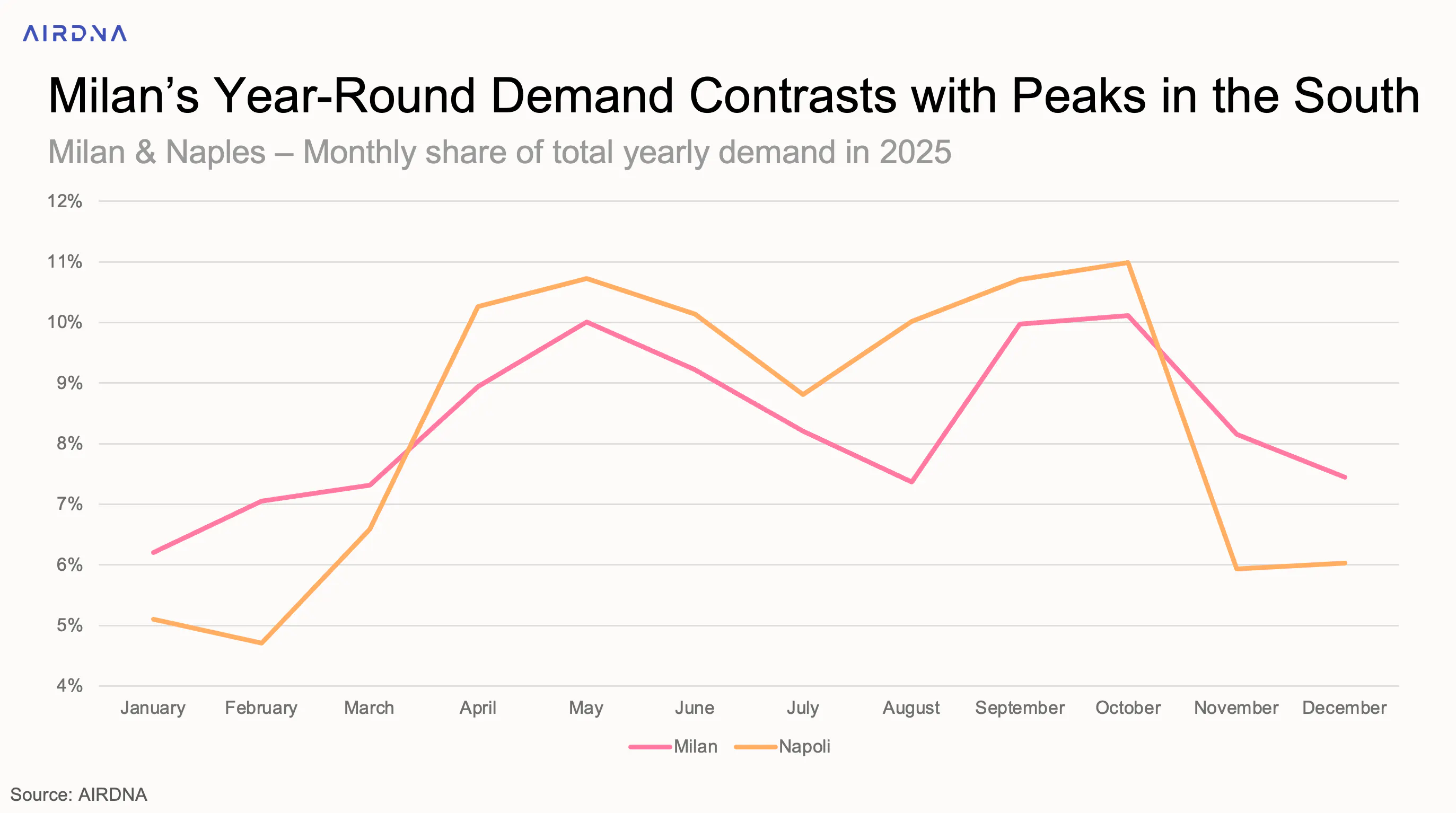
As a key business hub, Milan's short-term rental (STR) market exhibits a relatively flat seasonality. Unlike some other destinations, demand here doesn’t hinge exclusively on summer tourism. The graph below shows the monthly share of total annual demand for Naples and Milan in 2025.
Comparing these locations highlights the difference between a southern seasonal market and a northern, business-oriented market. Naples experiences notable peaks with 70% of its yearly demand concentrated between April and October.
In contrast, Milan shows a more even distribution of demand across the calendar. The city sees mild peaks in May, September, and October, and generally higher demand during the winter months.
In early 2026, Milan steps onto the global stage as a host of the Winter Olympics. It’s an event that brings an entirely new wave of demand, and new opportunities for short-term rental hosts.
Olympic Energy Drives Demand in Milan
With more than 2 million visitors expected, according to the Italian government, the 2026 Winter Olympics will bring a massive influx of travelers to northern Italy. The games will feature over 116 events, 2,800 athletes, and participants from more than 90 National Olympic Committees.
The games are set to attract large crowds across northern Italy, but Milan will be front and center for high-profile competitions like speed skating and ice hockey. As demand builds, local hosts are responding to the opportunity by activating more inventory. AirDNA data already shows a 15.9% year-over-year increase in available listings during the Olympic period.
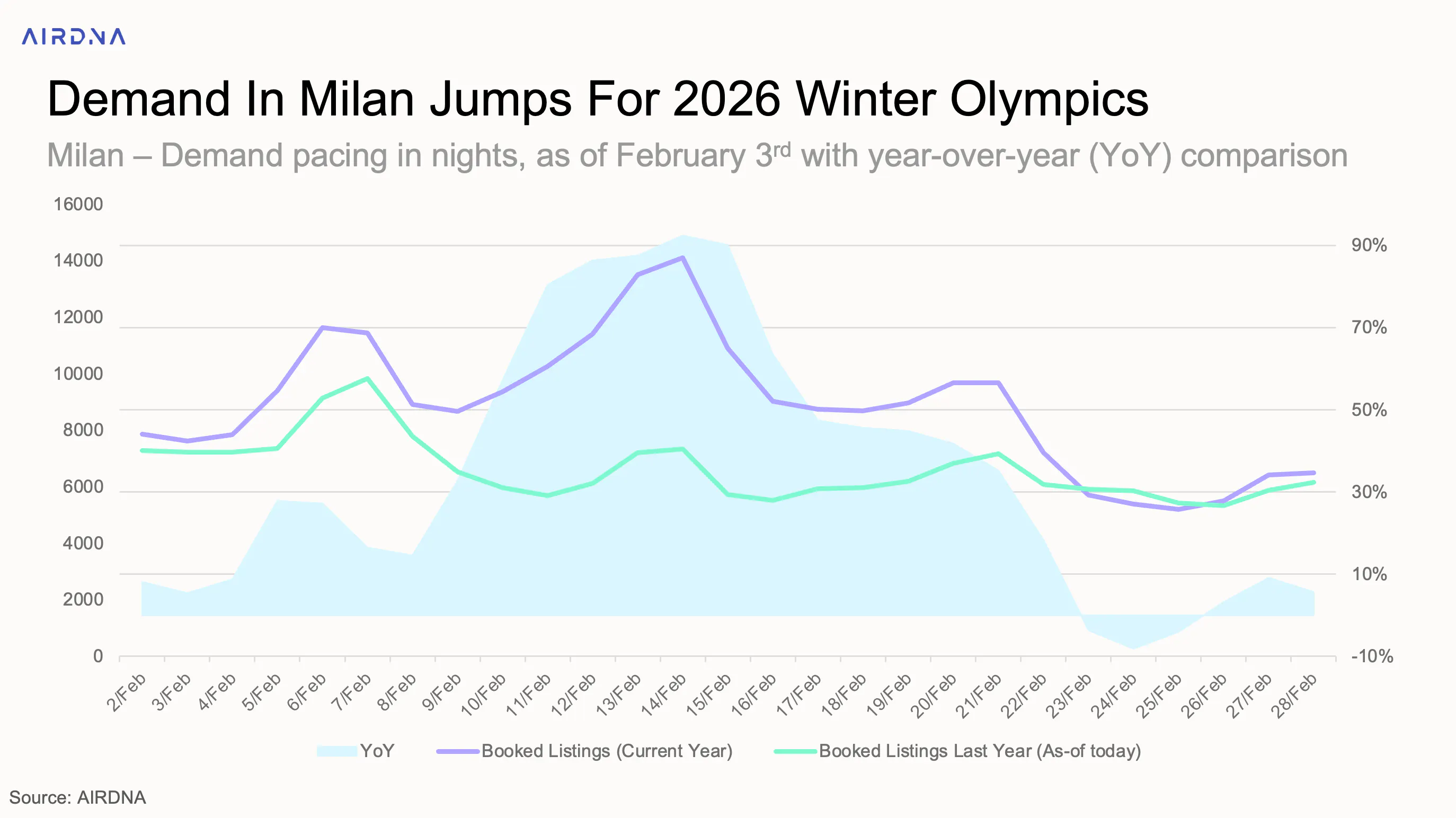
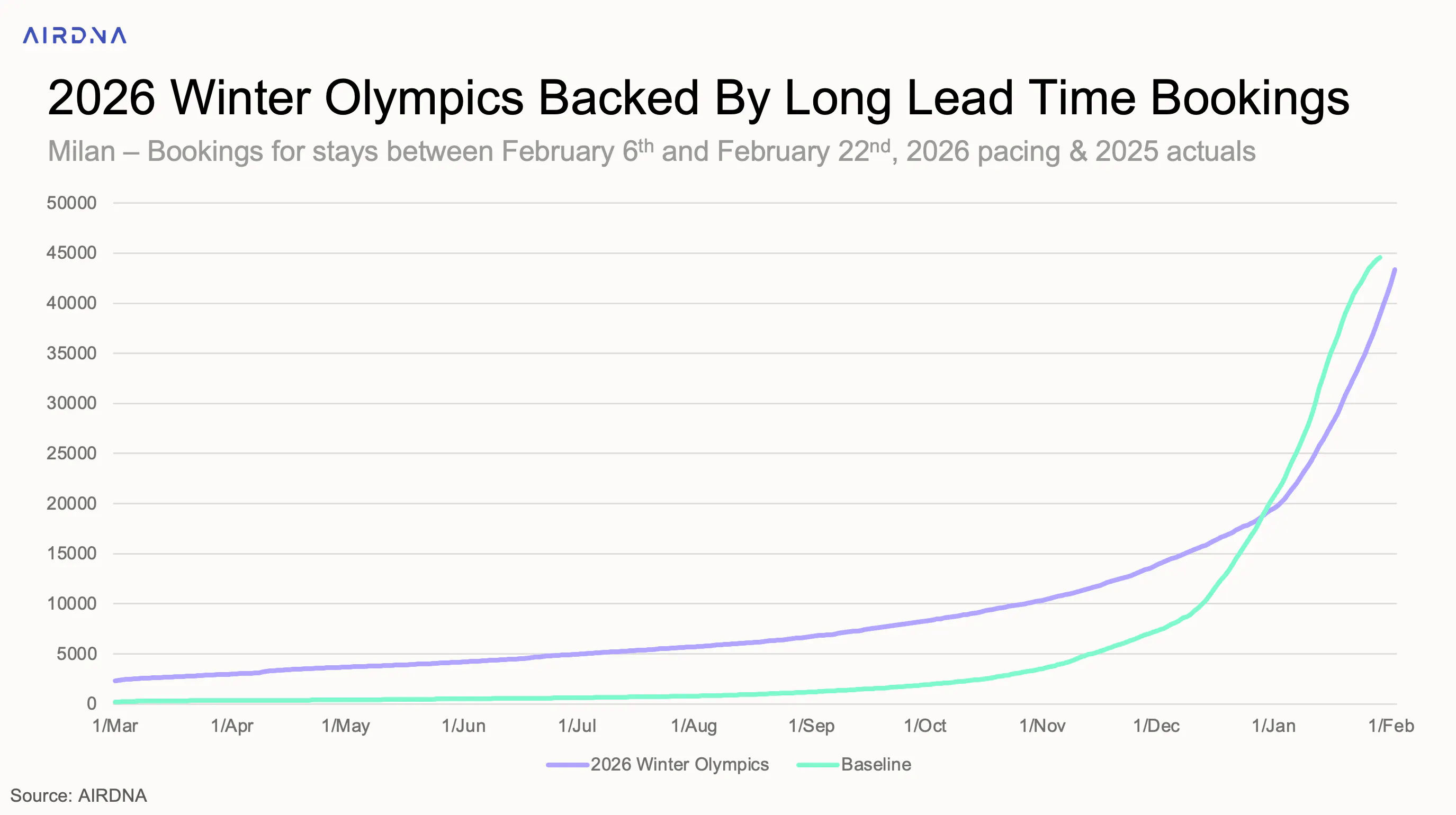
When we observe the booking curve for the Olympic period—February 6 to February 22, 2026—to the same dates in 2025, the difference is already striking. Demand for Olympic stays has been building since early 2025, and it shows: current pacing data reveals 2,000 to 6,000 more reservations on the books than during the same period last year.
While 2026 demand was tracking well ahead for most of the year, the two lines began to converge in January. This isn’t a sign of softening interest, though. It’s likely a reflection of shorter booking windows. Many travelers are still finalizing plans, and a large portion of reservations may come in just before the Games begin. When we look back after the event and compare actual bookings, we expect a gap to reemerge and show that Olympic demand clearly outpaced the 2025 baseline.
Demand pacing varies by neighborhood
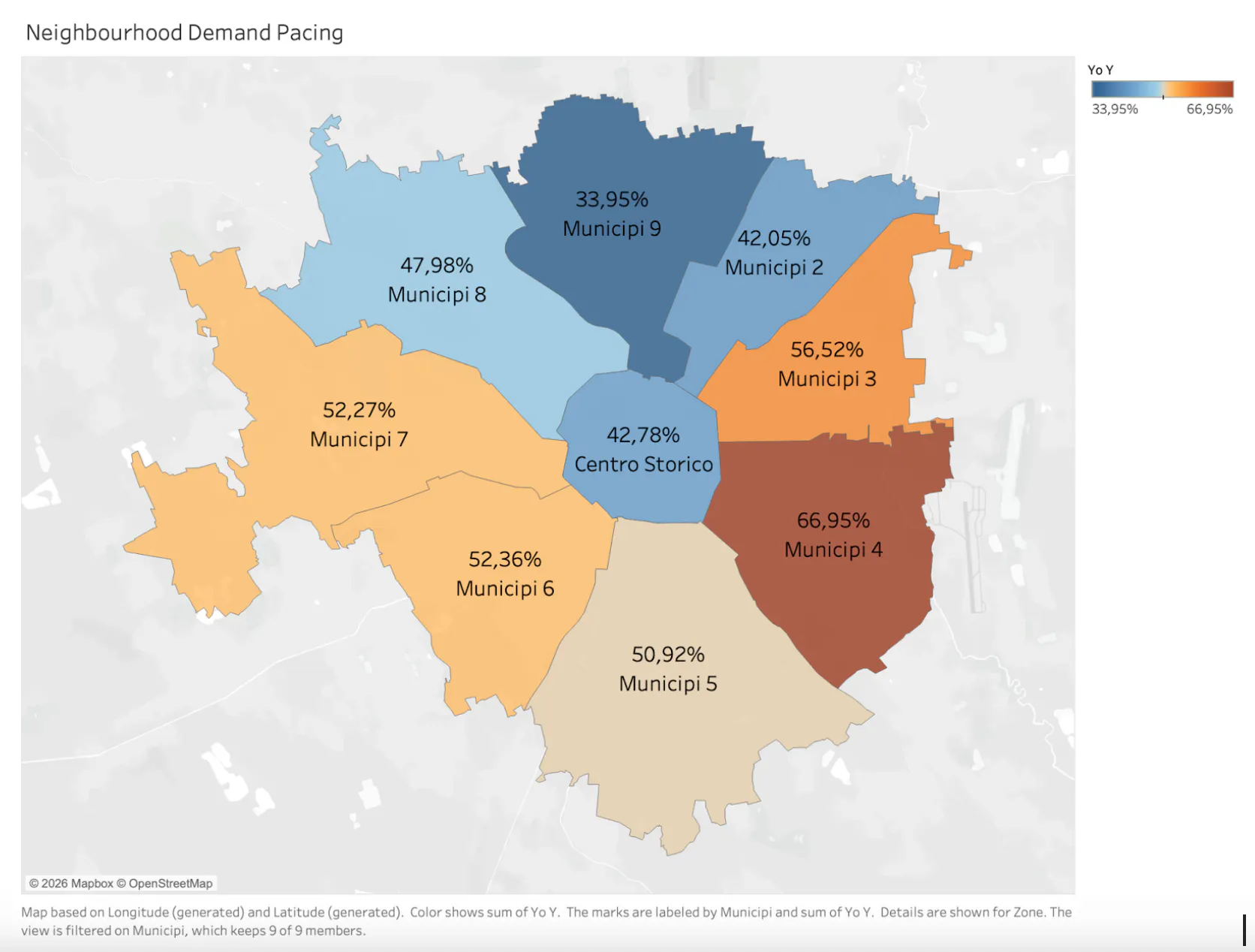
The chart below shows year-over-year demand changes for key municipalities in Milan between February 6 and 22. While every neighborhood is seeing a lift, some are benefiting more than others.
Municipio 4 stands out with a 66.9% increase in demand, thanks to its proximity to the newly built Milano Santa Giulia Ice Hockey Arena—a major venue drawing travelers eager to stay close to the action. This spike in interest is also spilling over into neighboring zones. Municipio 3 and Municipio 6 are close behind, with year-over-year demand growth of 56.5% and 52.4%, respectively.
ADRs Soar Ahead of the Games
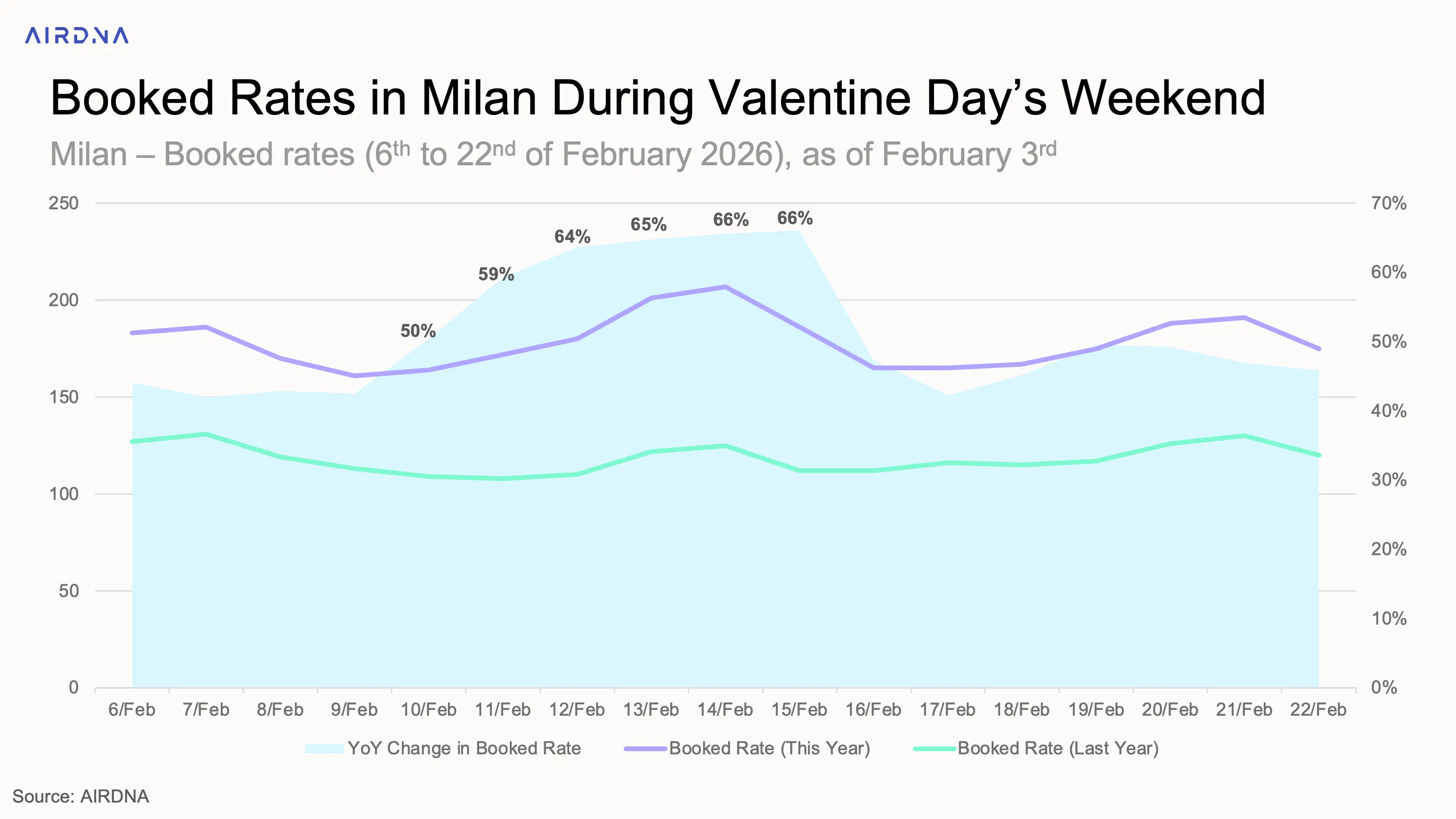
As demand climbs across Milan’s municipalities, we’re seeing an overall rise in booked rates, too. The graph below shows booked rates for 2026 and 2025 during the Winter Olympics period, along with their respective year-over-year (YOY) changes.
On average, booked rates are up 51% year-over-year between February 6 and February 22, with the steepest spike landing around Valentine’s Day week. Between February 13 and 15, ADRs are 65% higher than the same dates in 2025. Event-driven demand combined with the romantic holiday is supercharging pricing power during key travel windows.
Luxury leads in demand pacing by price tier
Fueled by the large influx of international visitors for the 2026 Winter Olympics, Milan's short-term rental market is seeing an extraordinary revenue increase. Although all listings are affected, the premium segment is benefiting the most.
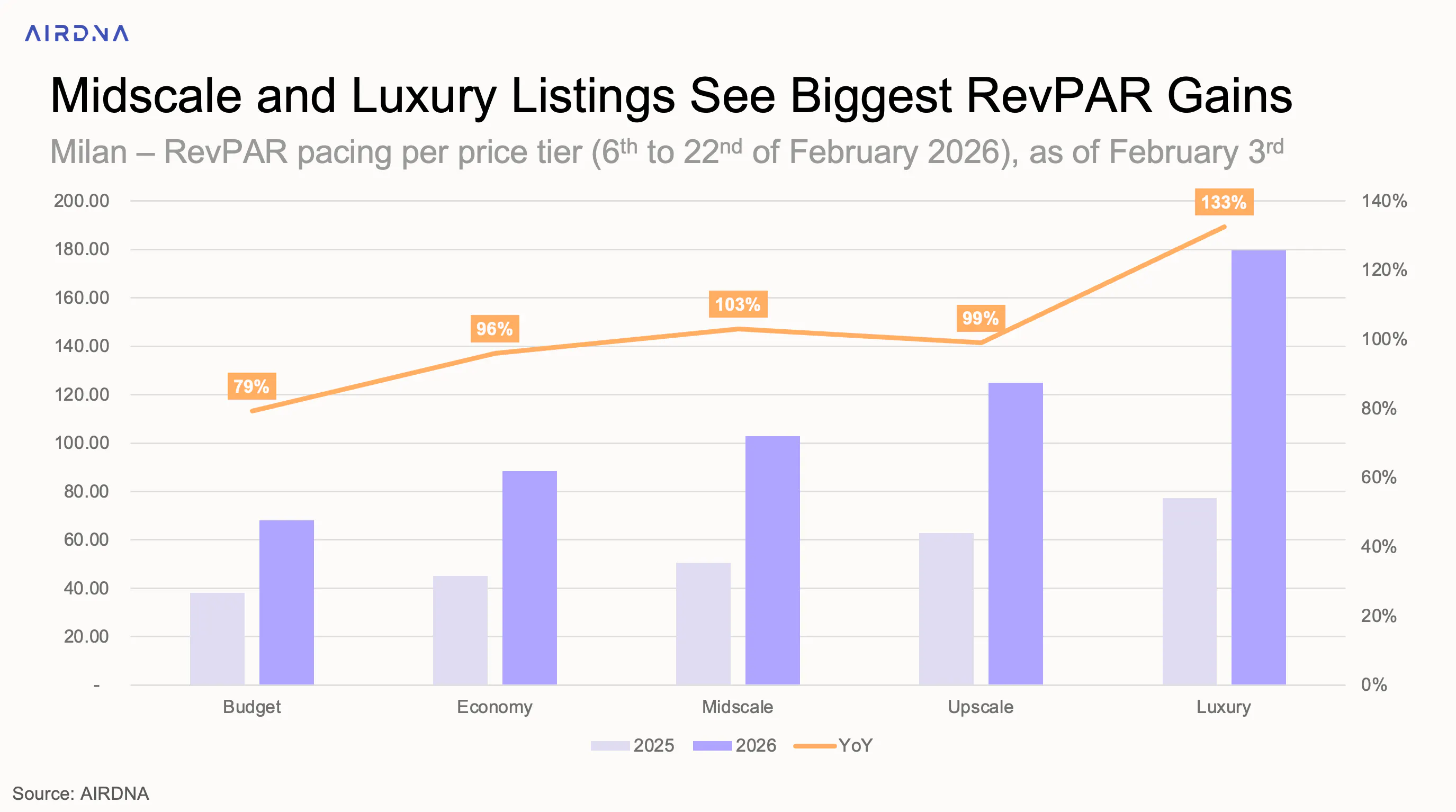
The graph below shows year-over-year RevPAR growth by price tier during the Olympic period (February 6–22). RevPAR, short for Revenue per Available Rental, is a key profitability metric that blends both occupancy and nightly rates to show how much income a listing generates on average each night.
Luxury listings are setting the pace with a 133% increase in RevPAR, far outpacing the 79% rise in the Budget tier. This split mirrors a broader trend seen across Europe: high-end properties continue to outperform. Despite global economic and political uncertainty, travelers seeking elevated experiences are still willing to spend and hosts in the premium tier are reaping the rewards.
Olympic Momentum Spreads Beyond Milan
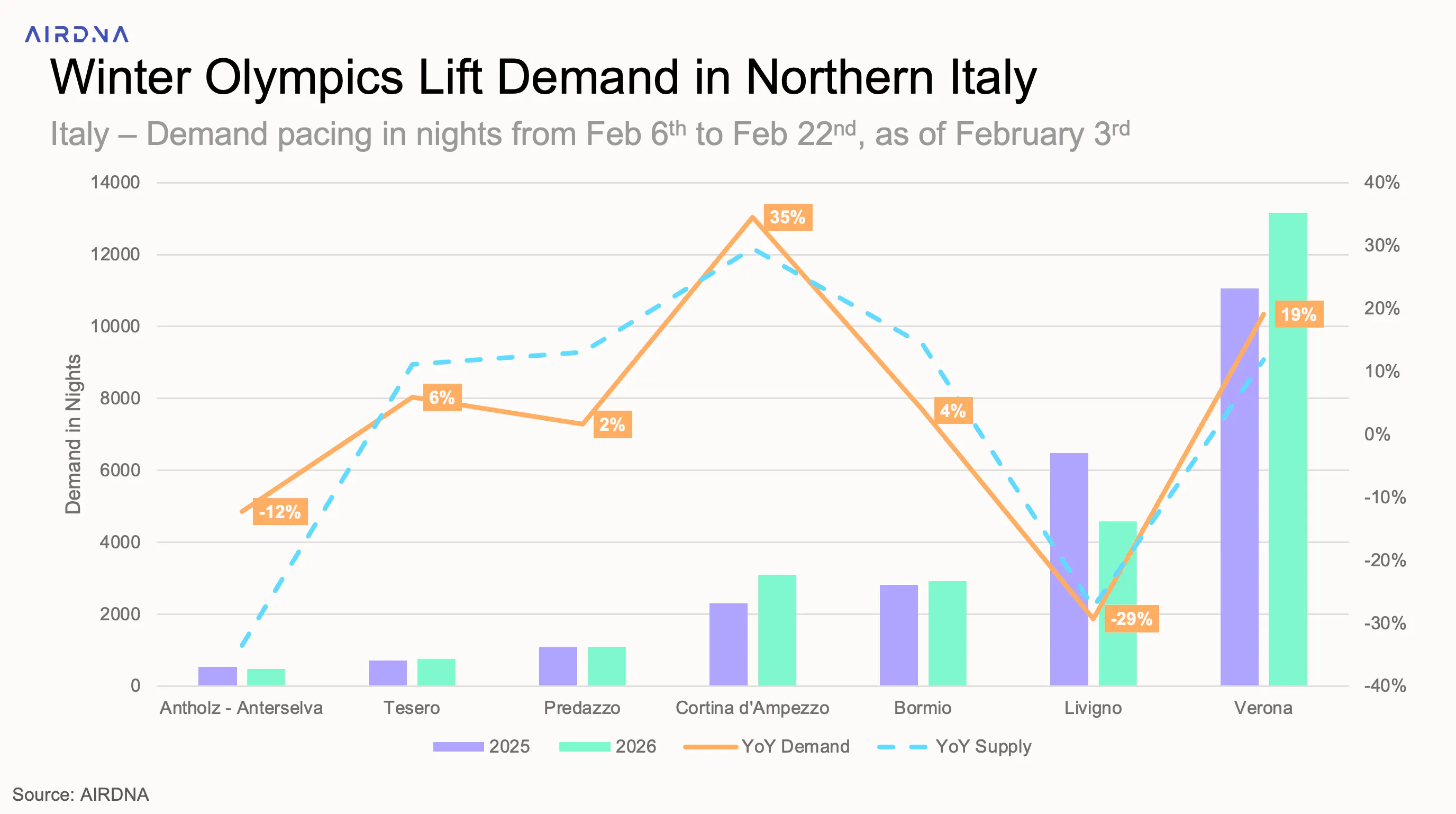
The impact of the 2026 Winter Olympics isn't limited to Milan. Demand is rippling across northern Italy, especially into host cities and alpine destinations with strong ties to Olympic events. Notable demand increases are apparent in Verona (+19%) and Cortina (+35%) ahead of the 2026 Winter Games.
Where supply is down, revenue is up
Most alpine destinations experience moderate gains as bookings for early February increase, but Livigno stands out with a 29% year-over-year decrease in booked nights. The drop reflects a 27% reduction in available listings, largely due to regulatory changes like new registration rules and increased taxes affecting hosts across Italy.
Still, the hosts who remain are making the most of the moment. Despite fewer listings, total revenue in Livigno is up 44% year-over-year, driven by higher nightly rates and strong occupancy.
A similar pattern is unfolding in Antholz-Anterselva, where a 34% cut in supply has pushed occupancy down to 68%. Even so, occupancy has climbed 32% compared to the same period last year.
Pricing power defines the winners
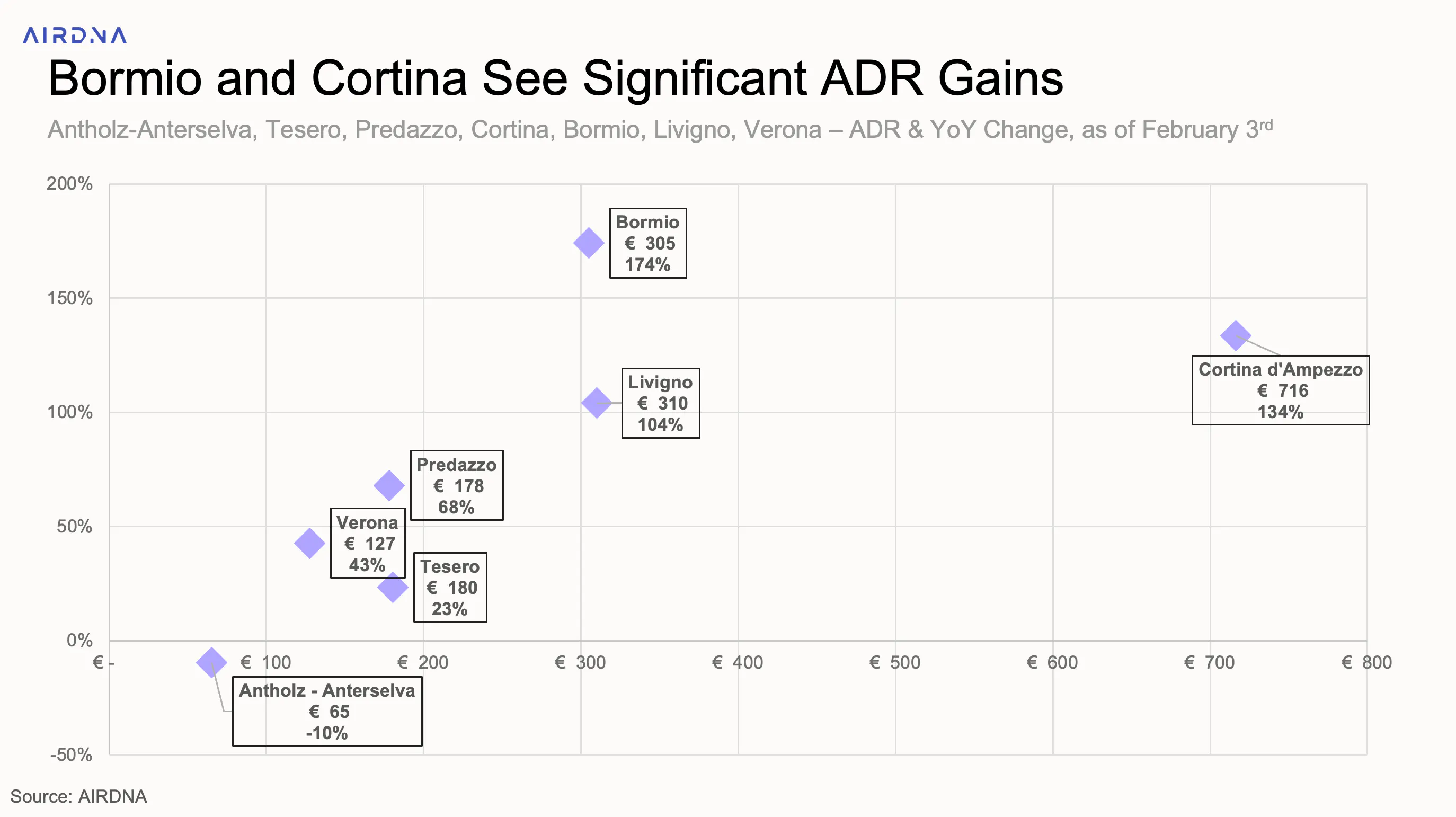
While demand increases are significant, the biggest differentiator among northern Italy markets is pricing. In Cortina and Bormio, ADRs have more than doubled.
In Livigno, where supply contracted in 2026, ADRs have also doubled as guests are forced to vie for limited inventory. In Antholz-Anterselva, on the other hand, nightly rates have declined. There, hosts are likely focusing on occupancy (+32% YoY) as the main driver of RevPAR growth.
Taken together, these trends reflect a broader shift in traveler distribution and host behavior across Italy’s Olympic corridor. Demand is expanding beyond traditional ski hubs toward host and gateway cities linked to the Games.
Momentum Carries into the 2026 Paralympics
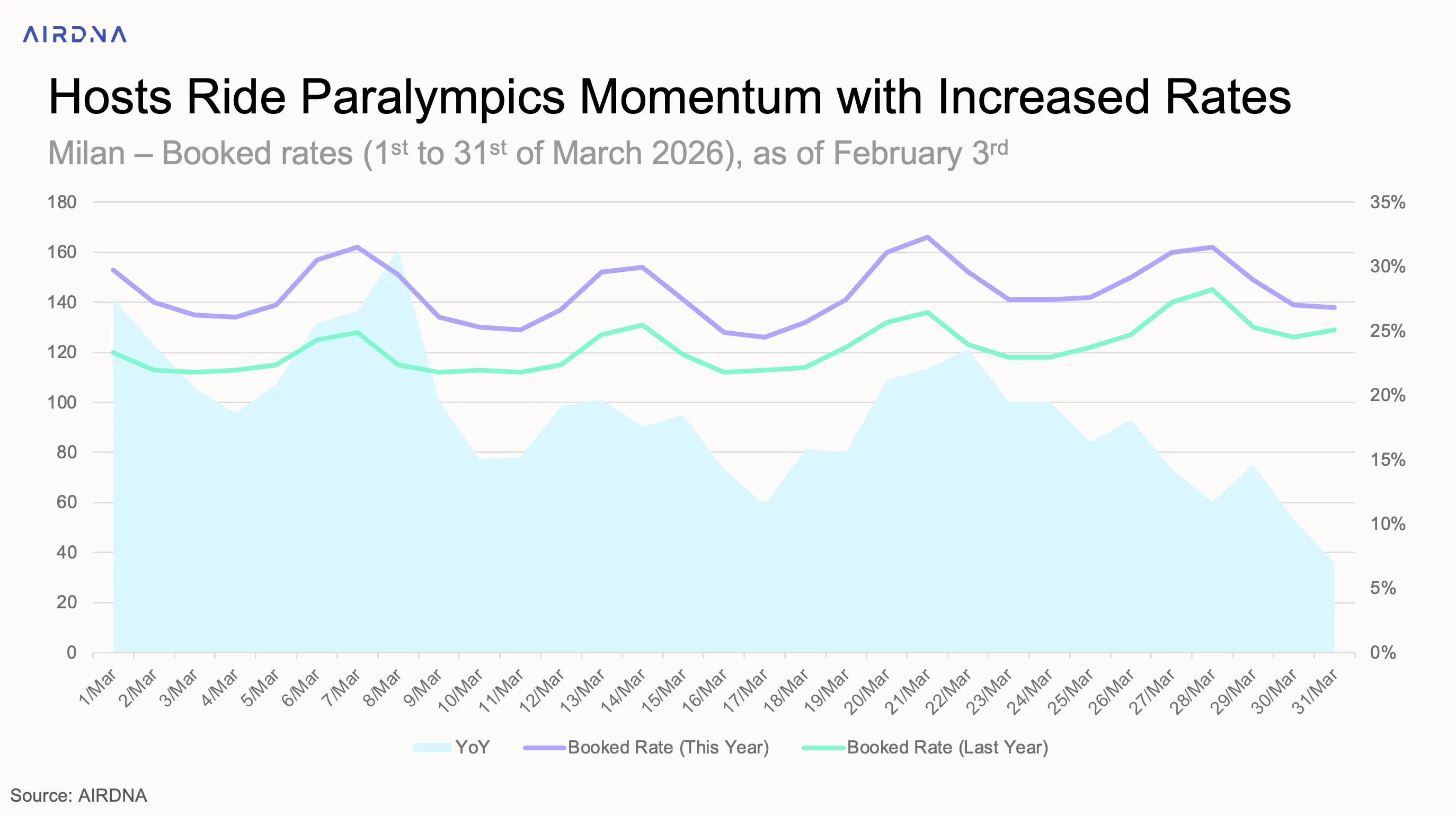
With the Winter Olympics followed closely by the Paralympics from March 6 to March 15, hosts in Milan are riding the momentum. Booked rates for March 2026 are up year-over-year, peaking at the debut of the Paralympics. Between March 5 and 8, booked rates are up an average of 26% year-over-year.
ARTICLE SUMMARY
Milan’s short-term rental market is heating up ahead of the 2026 Winter and the momentum is spreading across northern Italy. This article explores how Olympic-driven demand is impacting bookings, pricing, and revenue across Milan’s neighborhoods and nearby alpine destinations.
Camilo Schmid Rivas
Senior Research Analyst
Camilo Schmid Rivas is a Senior Research Analyst at AirDNA who brings a uniquely well-rounded perspective to short-term rental analytics. With a background that spans investment, real estate, and business analysis—including roles at Stayery and Sollers Consulting—Camilo has worn many analyst hats, each sharpening his ability to turn complex data into clear, actionable insights. A graduate of École hôtelière de Lausanne, he now channels his multidisciplinary expertise into uncovering trends that drive smarter STR decisions. In his free time, he enjoys playing tennis or scuba diving in or around Barcelona.