


Property Managers: 5 Data-Driven Tips on How to Prepare for 2023 | AirDNA
Published: December 2, 2022
Last updated: February 11, 2025

Dillon DuBois
The vacation rental industry has shown incredible resilience over the last few years. In the face of a global pandemic and threatening travel restrictions, short-term rentals (STRs) saw record-breaking demand, peak occupancy, and new supply added en masse.
Now, things are a bit different, though.
In the non-STR world: War, inflation, recession, and rising interest rates are all forcing property managers to reassess their businesses.
And in the STR world: Markets are becoming increasingly competitive, owners face more uncertainty, and what worked before isn’t necessarily working now.
To help you move in the right direction, here are five charts featuring key intel on how to adapt and find success in 2023.
#1: The bigger your portfolio, the harder you need to work for your reviews.
In case you didn’t already know, it’s official: Professional property managers are consistently outperformed by mom-and-pop hosts with just a few listings. The larger the portfolio, the lower the ratings. This chart sums it up.
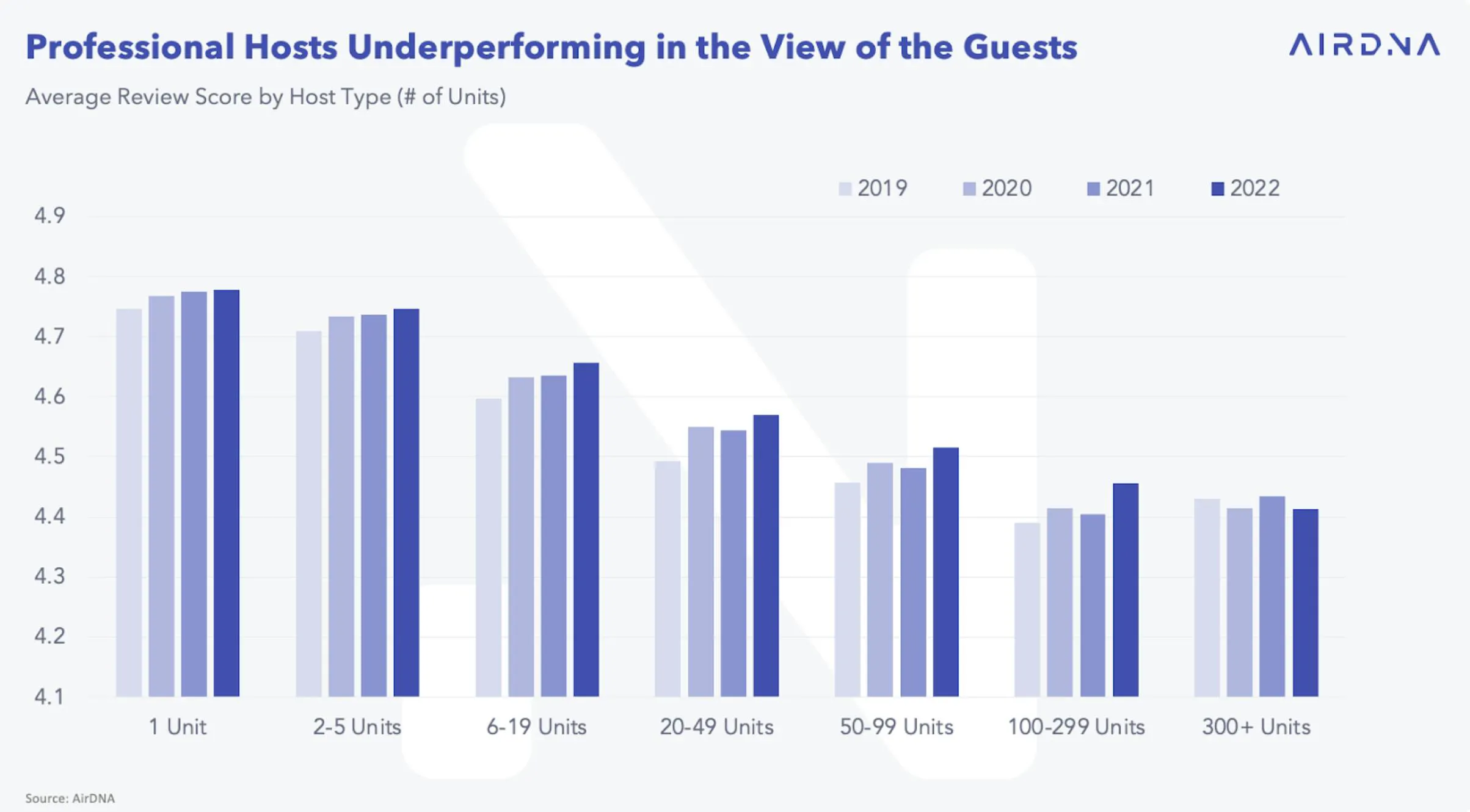
Why? Guests tend to prefer the personalized experience of an individual operator, even though there is no guarantee of quality. By contrast, larger property managers (especially ones operating in multiple cities or countries) are often hyper-optimized and automated which can be disappointing for those who prefer a human touch.
If you're managing more than a handful of properties, it gets worse.
Guests give larger property managers a lower score for “location,” even for properties located in the same location. And even when you correct for location biases, larger managers still underperform when it comes to check-in, cleanliness, communication, and other metrics.
Larger managers are essentially operating with a handicap.
What you can do:
Prioritize communication and accuracy. With all of the technology available to help hosts improve communication, there is absolutely no excuse for professional managers to rank poorly in this area. Aim for not only meeting your guests’ expectations, but exceed them by thinking of unexpected ways to show your guests the full value of your service. In short: Enhancing their experience from before check-in to after they leave.
Action items for communication:
Is your property located 10 minutes walk from the city’s top attraction? Highlight this fact not only in your description but also in your photos and any other communication you have with your guests.
Action items for accuracy:
Are you doing spot-checks of all listings on a regular basis? Are you ensuring that all amenities listed are working & property descriptions are up-to-date?
Just know that you’re always one paper towel roll away from a bad review.
#2: Choose your inventory wisely: Location matters more than ever.
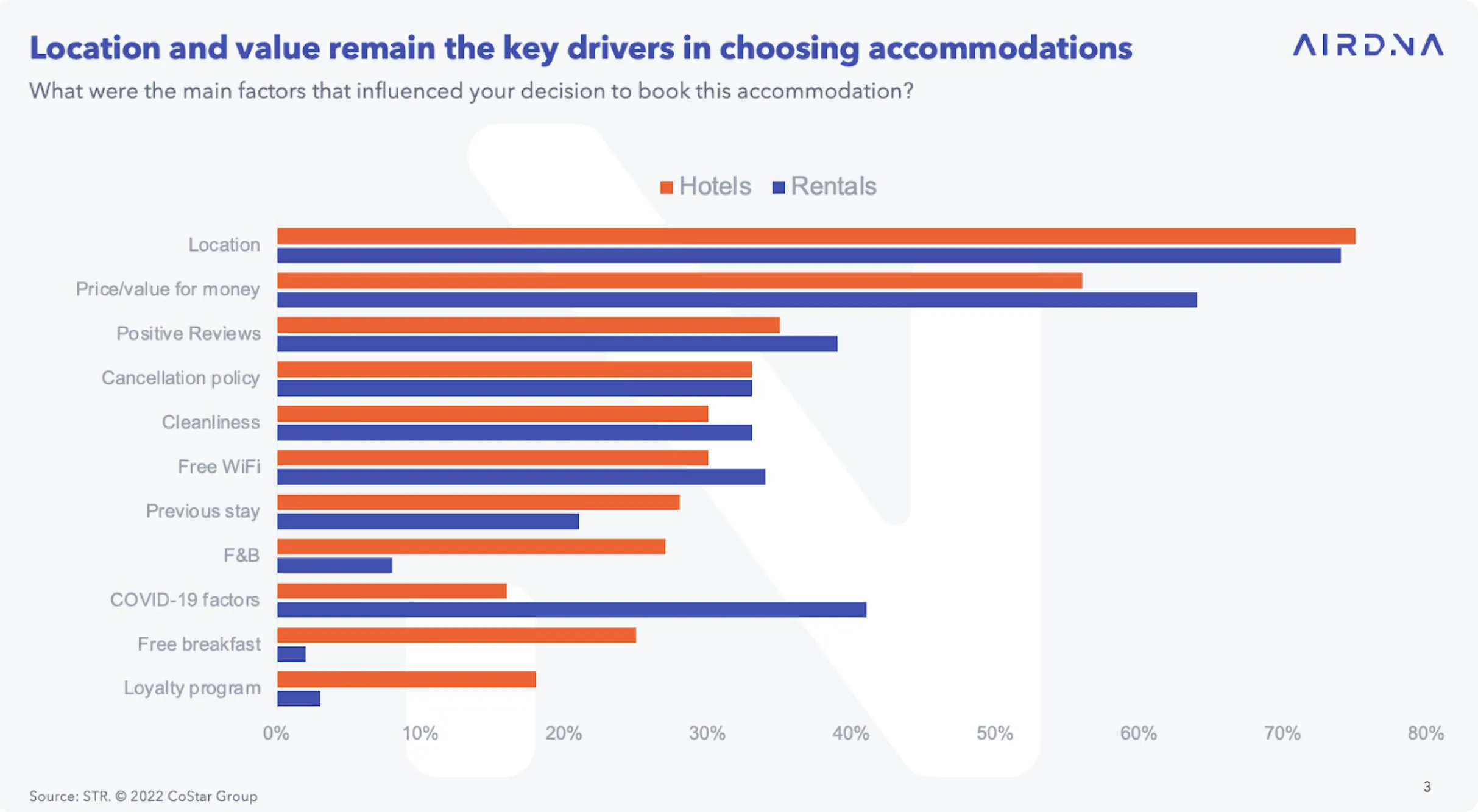
This may seem obvious, but this chart shows just how obvious.
If you’re looking to expand your business, the first factor you should consider is the listing’s location. It’s the number-one determining factor in why travelers select one accommodation over another.
What you can do:
The location standards for your acquisition team have been raised. If your properties are lagging behind, it’s time to take action.
The data on best places for vacation rental management is both widely available and extremely accurate—so there’s no excuse for acquiring listings in suboptimal locations. Growing your business efficiently without data is like trying to read a map without a compass.
We always talk about how data can help you grow, but even more importantly: It helps you avoid growing only in quantity while forgetting quality. Don’t waste your time and effort onboarding properties that will cause you headaches and not generate enough revenue.
#3: Go the extra mile for first-time reviewers without leaving money on the table.
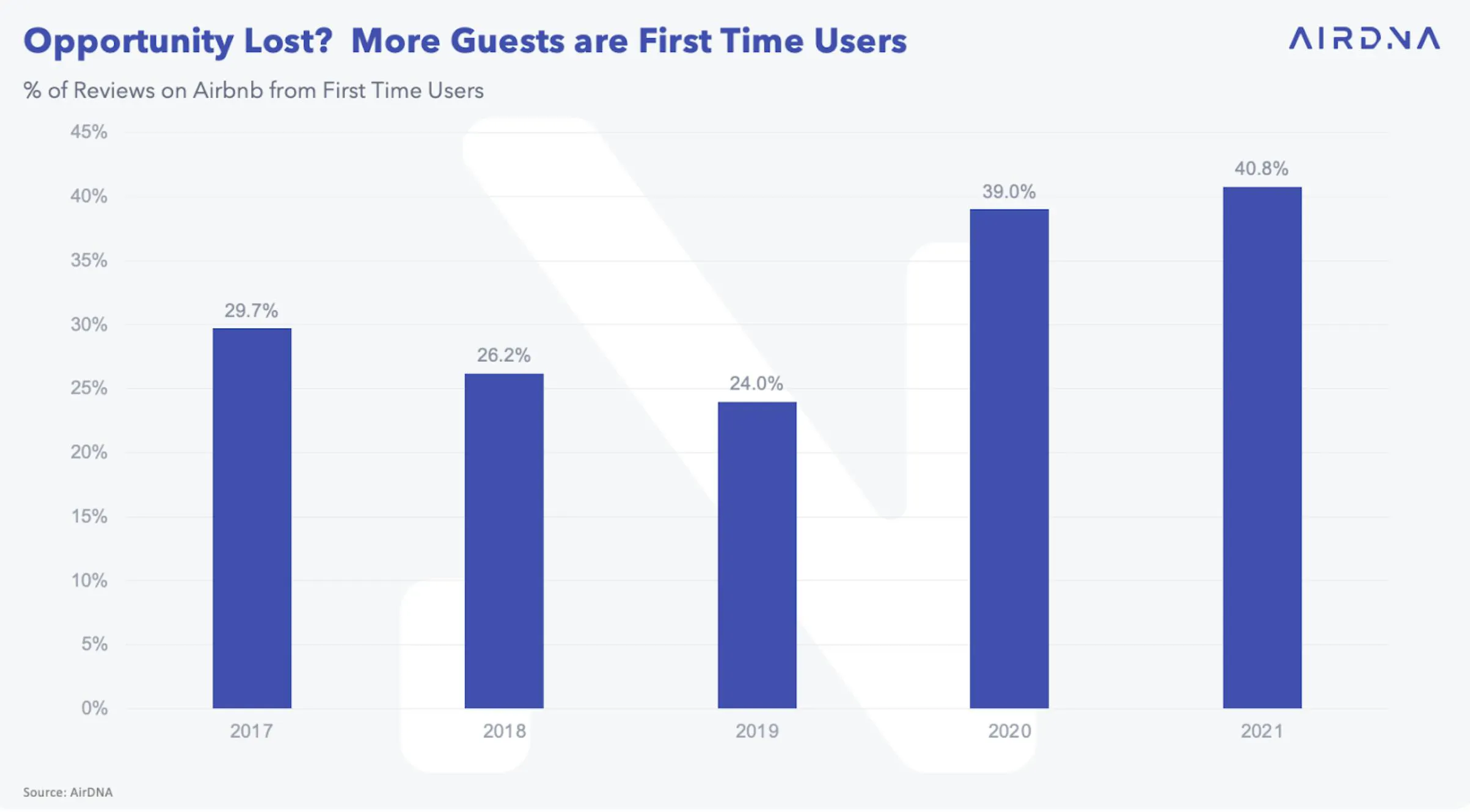
Never stop asking for reviews (particularly from new guests). In 2021, 40.8% of Airbnb reviews were left by first-time users of the platform, up from 24% in 2019. More guests have discovered STRs for the first time thanks to the pandemic-driven search for more space, and new users may have expectations that don’t line up with the service offered. So always be clear from the start about what guests can expect.
Put yourself in your guests' shoes, and think of the small details that make for an exceptional hospitality experience. Is it a chilled bottle of wine and local delicacies ready for their check-in? An insider guide to the best places in the neighborhood? Is the heating switched on using smart appliances so it’s cozy when they arrive?
#4: Don’t overlook your “value” rating.
In November, Airbnb announced its response to community criticism about the way it displays listings’ prices. Travelers now have the option to view properties by the entire cost of the stay (including service and cleaning fees, but excluding taxes), in addition to the traditional view by nightly rate.
While this is certainly more transparent for guests, it may require a pivot for property managers. Airbnb also announced the algorithm will change to prioritize listings that offer better “value” as determined by customer reviews.
What does this mean for your business? Prior to now, if your properties were receiving a perfect 5/5 score for value, it wasn’t necessarily a good thing—it meant guests found your listing to be an extremely good value for money. (Translation: You were underpriced.)
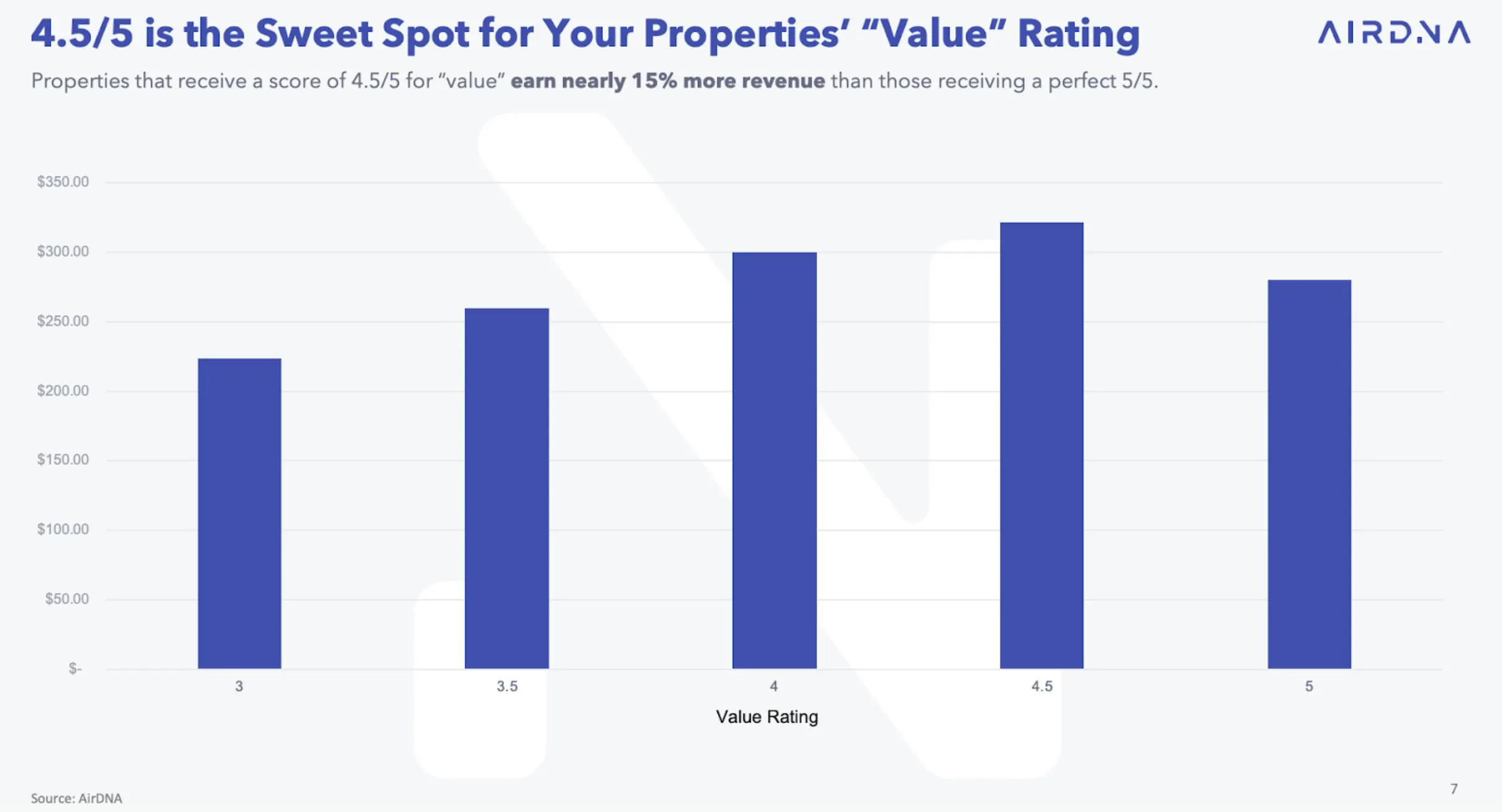
Now, with Airbnb announcing it will boost listings with high-value ratings, it’s worth more consideration.
The main recommendation here is to keep a close eye on how your "value" rating overlays with your other primary metrics. What value rating corresponds with your highest revenue per available room (RevPAR)? What about lowest?
#5: Don’t panic: Understand broad economic cycles.
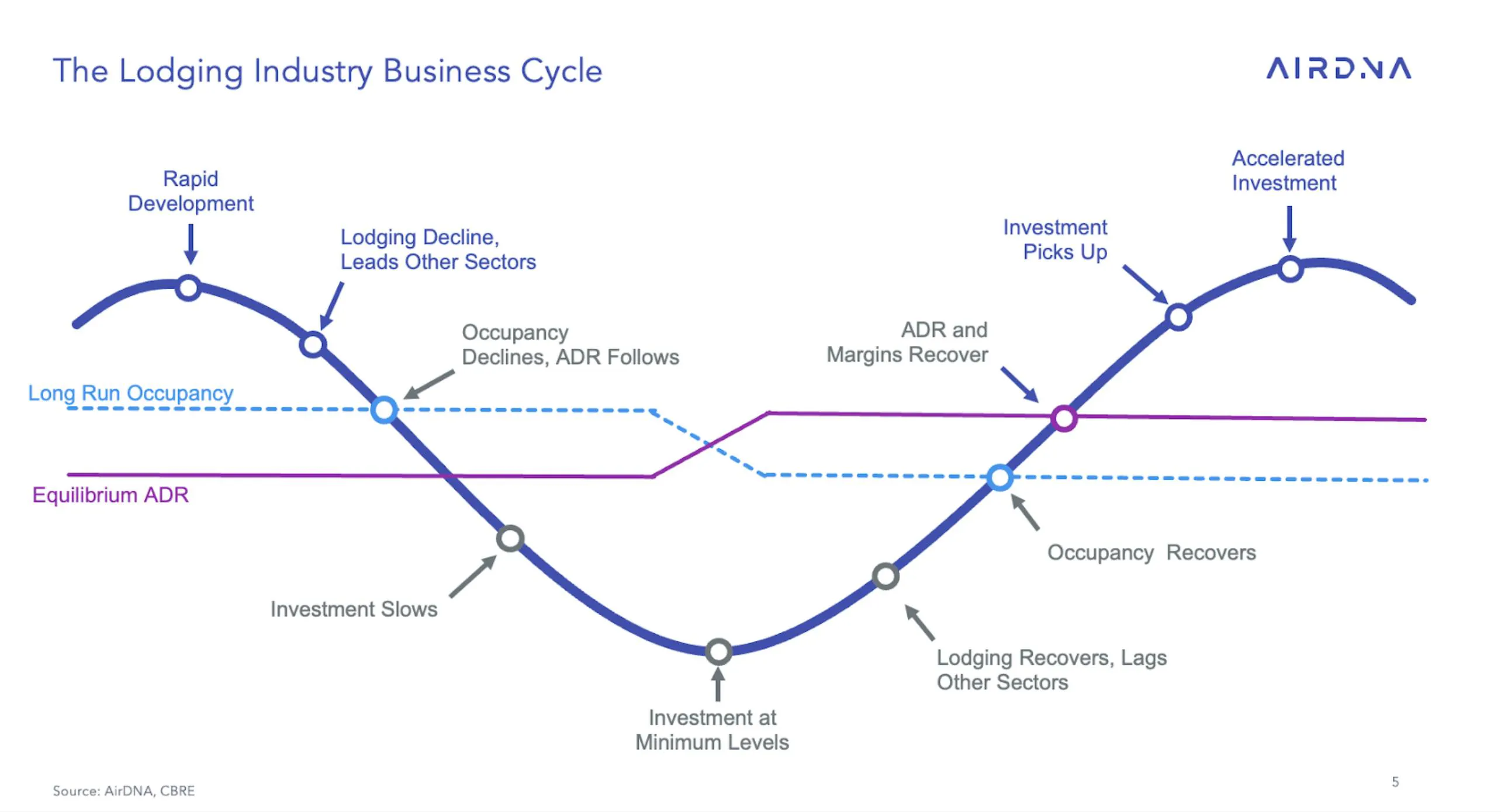
Just as we thought we were out of the woods after the pandemic, the economy decided to take center stage and become the next most significant threat to STRs. Questions like: “Will we enter an economic recession in the next year?” and “How will this affect my bookings?” burn in our minds.
Whether you’re an optimist or a pessimist, there is some good news: The lodging cycle is predictable. Plus, given both industry and macroeconomic performance throughout 2022, we have not (yet) entered a true recession.
So what is the current recession risk? While the United States is at a 50/50 risk of falling into a recession, Europe is nearer to 60% or 70%; all will become clear in the next couple of months after the impact of the European Central Bank interest rate hikes is known. We should watch this closely because, if Europe does enter a recession, this could pull the U.S. down with it.
To keep a cool head, you need to understand the hospitality lodging cycle and where you are in it. This may seem complicated at first, but it’s really quite simple when you break it down.
We were last in the stability phase pre-COVID in 2010. It’s important to remember that lodging lags other economic cycles: When recovery hits, travel is one of the last segments to recover, meaning it’s even easier to predict, as we can follow timelines for other industries to mark the way.
During this phase of recovery, growing occupancy rates will boost average daily rates (ADRs) and profit margins. For all of you pessimists out there, it’s also important to note that once we are at the peak of the growth stage, this doesn’t necessarily mean an immediate decline. In fact, 2015 to early 2020 was all peak. Then, there is usually a trigger of some sort that will announce the lodging decline, and the cycle begins all over again.
Remember that regardless of where you are in the cycle, as long as you know what’s coming, you can prepare yourself and act accordingly.
Ready to take action?
There will always be some external circumstances that are out of your control, like an economic recession, a global pandemic, or a natural disaster. For all the rest, you hold the keys to future-proofing your vacation rental business.
Discover our tools that empower you to use data to eliminate the guesswork, find the best places for growth, establish trust and credibility with your clients, and have more time to focus on quality service for your guests.
ARTICLE SUMMARY
Are you a property manager prepping for 2023? Here are 5 charts with intel on how to adapt and set your business up for success in the new year.
Dillon DuBois
AirDNA Senior Product Manager
Dillon DuBois is a seasoned expert in the short-term rental space, having worn many hats at AirDNA since joining in 2019. From driving B2B marketing initiatives to shaping product strategy, Dillon’s deep understanding of both the company and the industry makes him a key player in delivering innovative solutions. Now a Senior Product Manager, he leverages his experience to bridge the gap between data and user needs. He manages his own short-term rental in Medellín, Colombia, and enjoys all things outdoor adventure, travel, cooking, & surfing.


