Airbnb Revenue Management Secrets: How to Maximize Income in Any Market
Published: January 10, 2025
Last updated: September 25, 2026

Bram Gallagher
Key Takeaways
- Dynamic pricing and revenue tools like AirDNA help hosts stay competitive by adjusting rates based on real-time market conditions.
- Recognizing and managing risk tolerance allows hosts to make confident pricing adjustments.
- Proactive pricing adjustments based on booking windows and demand trends help hosts capture bookings without resorting to last-minute price cuts.
In the competitive short-term rental (STR) market, maximizing revenue is the name of the game for property owners eager to capitalize on their investments.
The secret to effective revenue management goes beyond crunching numbers—it requires using data as a tool to reveal hidden opportunities in every rental. A data-focused approach to Airbnb revenue management empowers property owners to increase their earnings, no matter what the market throws their way.
AirDNA sat down with TechTape founder John An, whose company specializes in Airbnb revenue management and STR optimization, to hear his take on how to harness the power of data to unlock the hidden potential of vacation rentals.

Understanding Revenue Management for Airbnb and Vacation Rentals
Vacation rental revenue management is a bit like cooking—part science, part art. You have to follow the “recipe” of data and market trends, but a lot comes down to knowing when to adjust the ingredients to get the best results. This blend of art and science means getting a feel for what your Airbnb guests are willing to pay at different times and adjusting your prices to match.
Getting started with revenue management for vacation rentals doesn’t mean you need to be a math whiz. Tools like AirDNA help simplify the process by providing valuable insights on occupancy rates, booking windows, and competitor pricing. The key to how to make money from Airbnb is data.
Some of the industry’s most successful hosts—including John An—use short-term rental revenue management platforms to craft data-driven pricing strategies tailored to each market condition.
“Revenue management is implementing a strategy and then consistently shifting and adjusting that strategy based on market conditions and risk comfort,” John says.
Keep in mind that STR revenue management doesn’t have to be a DIY project—there’s always the option of hiring an Airbnb revenue manager.
Key Strategies for Maximizing Airbnb Revenue
Factors that affect STR revenue are in flux all the time. Maximizing revenue therefore requires staying on your toes and being flexible. Key strategies for maximizing Airbnb revenue include balancing ADR and occupancy rates, accounting for risk tolerance, and assessing market conditions.
Let’s dive into each strategy further:
Balance ADR and occupancy rates
Maximizing revenue isn’t about charging the highest nightly rates possible—it’s about understanding the delicate relationship between average daily rate (ADR) and occupancy rates. Think of it as a seesaw: when ADR rises, occupancy often dips, and vice versa. The goal is to find that sweet spot where the two balance out, generating the highest total revenue possible.
For example, pricing too high might result in impressive revenue per night but too many empty nights, leaving revenue on the table. On the flip side, slashing rates might fill your calendar but leave you with less profit overall. The key is to use data and market insights to fine-tune your pricing so that occupancy and ADR complement each other, not compete.
“We have portfolios where we've dropped the ADR by maybe 10, 15%, which sounds like heresy, right?” John says. “But by doing that, we actually increase their occupancy by 30, 40, 50%. And at the end of the day, they're making more revenue with the 10 or 15% reduction in ADR.”
This approach works especially well in competitive markets where securing steady bookings at a slightly lower ADR can prevent last-minute price wars. AirDNA tools can help identify trends in ADR and occupancy for your market, enabling you to make strategic adjustments that optimize both.

Account for risk tolerance
Every property owner has their own level of risk tolerance. That’s why your approach to revenue management won’t look like every other host’s.
Risk tolerance defines whether you’re comfortable pushing rates for higher payouts or prefer the security of steady bookings. Each Airbnb risk management approach has its advantages, but the key is finding your own balance between occupancy and rate flexibility.
With a clear sense of your risk tolerance—and tools like AirDNA to guide rate adjustments—you can set prices that capture maximum value without stretching beyond your limits.
Assess market conditions
Like any industry, the short-term rental market is directly shaped by changes in the broader economy. Inflation, GDP growth, employment rates, and interest fluctuations are just a few macro factors that ripple down to vacation rentals.
John An recommends tuning in when industry experts, like AirDNA’s own Chief Economist Jamie Lane, discuss macroeconomic trends so you can factor those insights into your revenue management strategy.
“For example, if there’s a higher potential for recession, then I take a lower risk profile approach to managing overall portfolios. Or if we're seeing an upturn in the economy, then I can shift that risk,” John explains. “And that really makes a big difference in some of the results we see in the portfolios we manage.”
While individual local conditions are vital to consider, understanding the big-picture economic outlook helps inform a successful high-level strategy. “Market updates really shape how we think of the short-term market as a ‘bear’ or ‘bull’ market,” John says.

The Power of Dynamic Pricing in Airbnb Revenue Management
Airbnb hosts who want to make the most of their rentals can’t overlook dynamic pricing and real-time data analysis. Dynamic pricing is the practice of adjusting rates based on ever-changing factors like demand, seasonality, and local events.
Think of it like airline pricing: tickets fluctuate based on how many seats are left and how close you are to takeoff. With dynamic pricing, Airbnb hosts can adjust rates to attract bookings during slow periods and capitalize on high demand when the timing is right. AirDNA offers rate recommendations for connected Airbnb listings that are based on market data and competitor performance.
Use booking windows to time your pricing adjustments
Using dynamic pricing is an example of staying nimble as an Airbnb host. John frequently reassesses pricing based on occupancy rates and booking windows. A booking window (or lead time) is the number of days between when a guest books a property and when they actually check in. For example, if a guest books today for a stay starting in two weeks, that’s a 14-day booking window.
Why does this matter? The shorter the booking window, the more flexible and responsive you’ll need to be with your pricing to fill last-minute vacancies.
“When a data set says a booking window is, let's say, 10 days, a lot of operators take that as a fact,” John says. “They think ‘My calendar is empty, but it’s okay because the data says my booking window is 10 days.’”
“My perspective,” he continues, “is [that] the booking window continues to collapse because a lot of operators are not adjusting their strategy—they’re waiting, waiting—then everybody dumps their prices.” Properties flood the market with discounted rates at the last minute, leading to price wars and missed revenue. In those cases, it can be wise to drop your prices a few days before the typical booking window begins.
Rather than take things at face value, John makes informed assessments about why data says what it says. This helps him make informed pricing adjustments, anticipate market trends, and adapt pricing ahead of competitors. You’ll be able to capture more bookings by staying proactive instead of reactive—without needing to join the price-cutting scramble.

How to use AirDNA's rate recommendations tool
Effective short-term rental pricing requires reliable data and the right algorithm to translate that data into strategic nightly rates—and that’s where AirDNA revenue management software comes in.
AirDNA’s rate recommendations tool comprehensively analyzes factors like:
- Local market trends
- Property-specific features
- Competitor pricing
- Historical data
- Booking windows
Armed with data from your listing, market, and comp set (more on that below!), our pricing optimization software provides customized daily rate recommendations.
You can fine-tune AirDNA’s recommended rates by selecting a base rate that matches your risk tolerance: conservative, balanced, or aggressive. The base rate you select serves as the backbone of AirDNA’s recommended rate.
Once you’ve reviewed AirDNA’s recommended rates, you can adjust the rate for a specific day or collection of days by an exact dollar amount or a percentage. From there, manually apply those rates to your listing through the Airbnb platform. We recommend users look at and apply rate recommendations on a weekly basis.
The Role of Comp Sets in Maximizing Revenue
A comp set—a group of listings similar to your property that’s used as a benchmark—is another revenue management tool that helps STR managers compare pricing, occupancy rates, and demand patterns. Without one, setting competitive rates becomes much trickier. You’re essentially pricing in the dark, without clear data on what travelers are willing to pay for comparable stays nearby.
Case study: How comp sets helped a luxury Airbnb increase annual revenue
A luxury Airbnb in New Jersey serves as a great example of the importance of comp sets in setting strategic nightly rates—and how AirDNA tools can help you create that comp set, even in unique situations.
In 2021, the owner of a $1-million 12-bedroom mansion in New Jersey generated $185,000 in gross booking revenue by managing revenue independently. When the owner brought John An and TechTape in at the start of 2022 to help maximize revenue, there was an immediate challenge: there were no similar properties in the area to build a comp set.
Since no single property nearby compared to the mansion, John built a “mosaic comp set” by analyzing smaller, high-end homes in the area. Combining data from multiple listings—like 5-, 6-, and 7-bedroom properties—that added up to 11-13 bedrooms allowed him to estimate what travelers might be willing to pay for a larger space.
Creating a custom comp set gave John and his team a baseline to begin optimizing the property’s pricing. Armed with this comp set as well as insights from 2022 and a sharp focus on “what the market will bear and chasing what the market is doing,” John helped the New Jersey mansion reach $345,000 in gross revenue at the end of 2023—marking roughly a 36% increase year-over-year.
Creating custom comp sets with AirDNA
AirDNA automatically creates a comp set for each connected listing of up to 100 similar properties within a 31 mile radius. What if your property is a unicorn—like the 12-bedroom New Jersey mansion—that lacks similar local comps?
An AirDNA advanced tier subscription makes it easy to create a custom comp set, enabling hosts with the most unique property attributes to find comparable properties from different markets.
This tool is useful not only for owners with unique properties, but for those looking for their next investment. Let’s look at an example.
Say you’re looking to buy a coastal property with a hot tub, but don’t have a specific market in mind. You can filter STR listings by market type (Coastal) and amenities (hot tub), then build a custom comp set with the resulting listings of your choice.
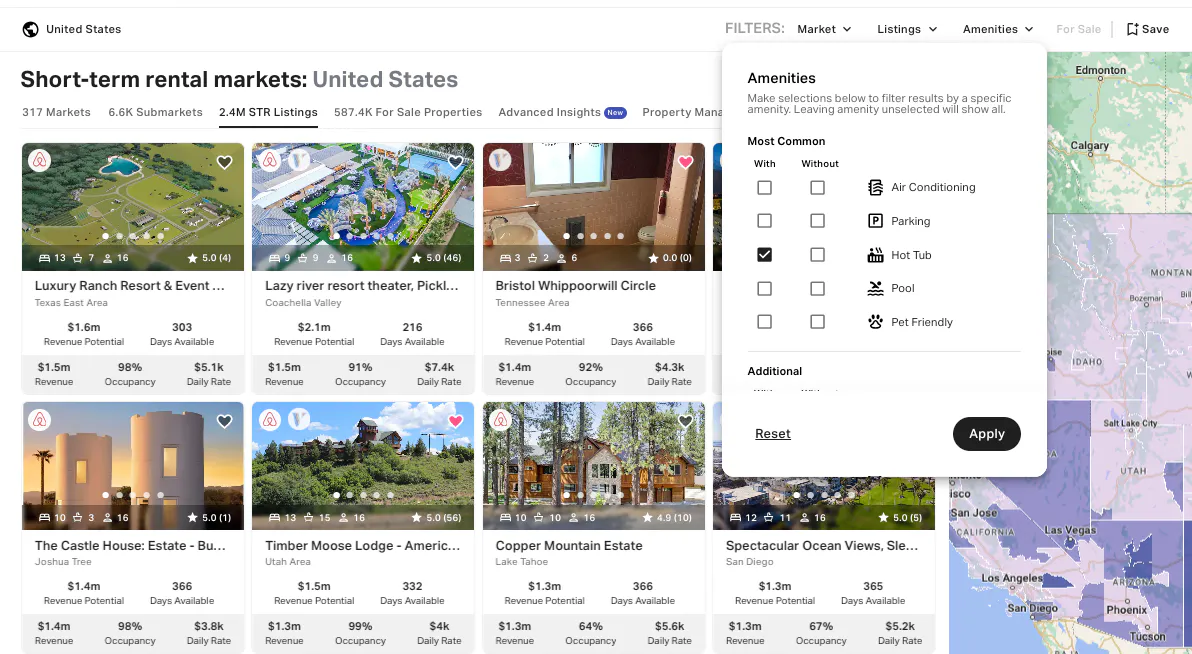
All you have to do is save specific listings to a saved list, or custom comp set, using the heart icon in the upper right-hand corner of each listing. You can add up to 100 active listings to a single saved list.
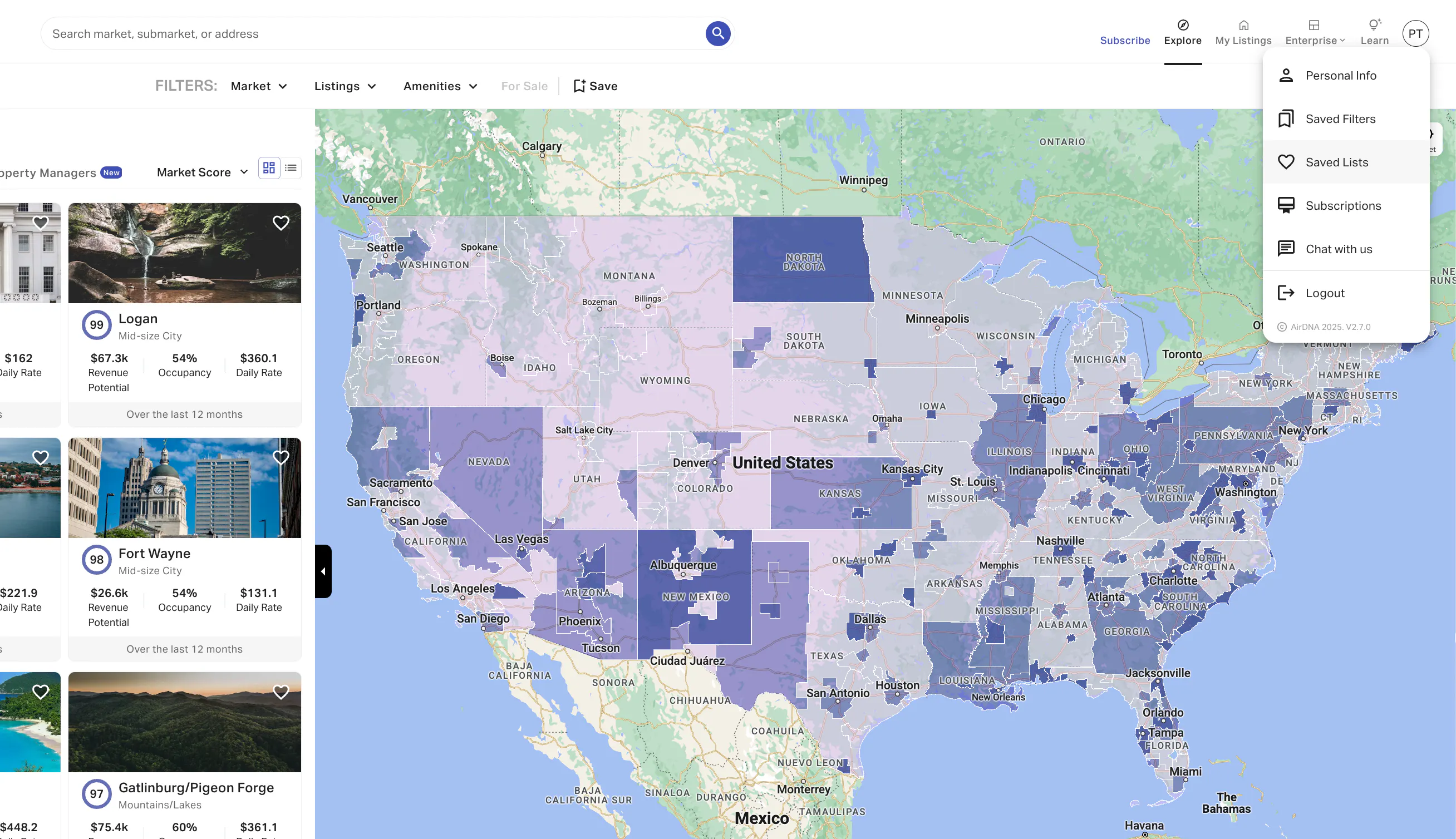
You can find your saved lists in the drop down menu for your account in the upper right hand corner.
Your saved list landing page will aggregate performance for the listings in that group. Explore the average annual revenue, average daily rate (ADR), occupancy, and revenue per available rental (RevPAR) and how these metrics have changed over time.
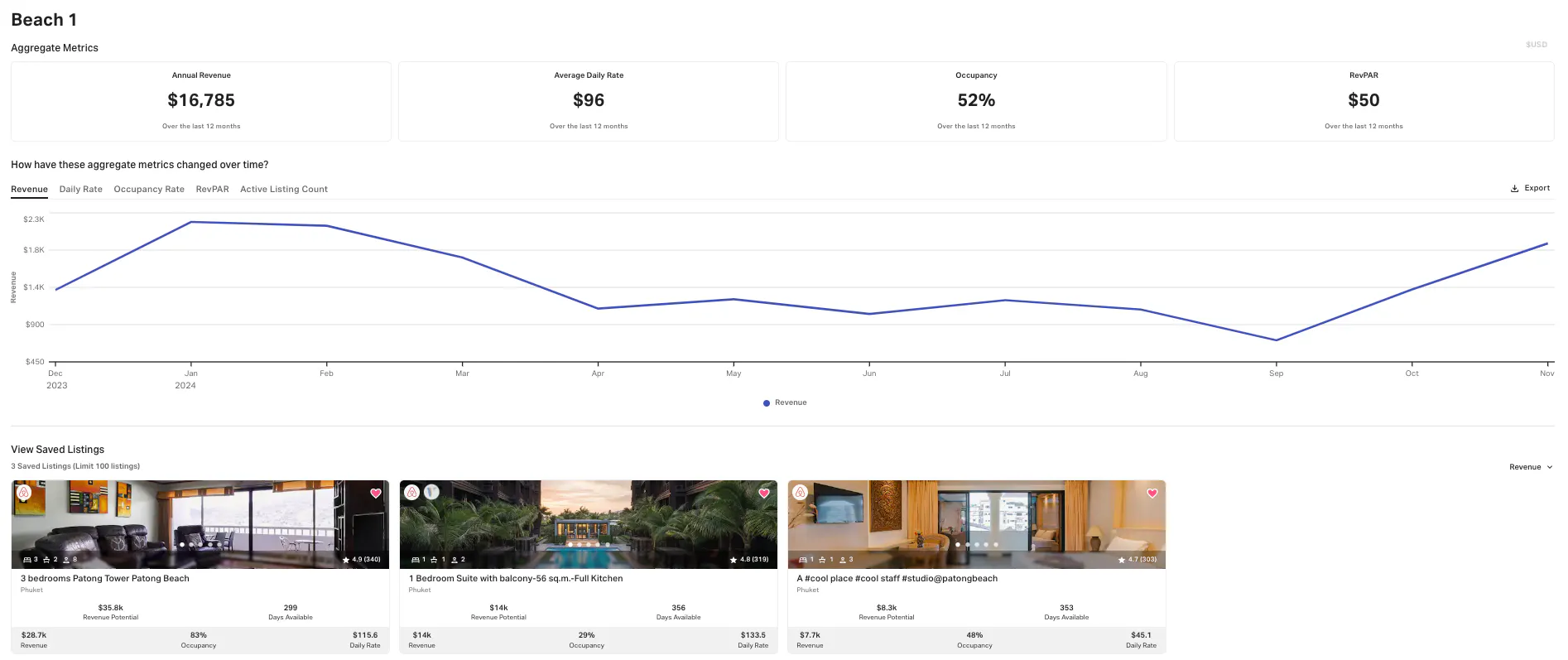
This saved list serves as a set of comps that may not be in your exact market, but meet the specific criteria you’re looking for.
ARTICLE SUMMARY
Learn how to maximize your Airbnb revenue with data-driven strategies, expert insights, and top tools for effective pricing and adapting to market changes.
Bram Gallagher
AirDNA Director of Economics and Forecasting
Bram Gallagher is an Economist at AirDNA, specializing in uncovering insights that drive smarter short-term rental decisions. He put his Ph.D. in Economics from the University of Georgia to work researching and forecasting hotel data with CBRE prior to joining AirDNA, as well as teaching economics at a number of universities. In his spare time, Bram enjoys making wooden furniture with hand tools.