

 Calculate Revenue
 Research Markets
 Find For Sale Properties
 Compare My Listing
 STR Revenue Calculator
 Custom Comp Sets
 Submarket Insights
 Custom Search Filters
 Rate Recommendations
 Performance Benchmarking
 Competitor Comparison
 Owner Contact Details
 Property-level performance data
 Tourism Insights
 Real Estate Investment Analytics
 About Us
 Sales
Sales Support
 Press
PressAirbnb Travel Trends 2025: A Summer Full of Surprises
Published: September 10, 2025
Last updated: September 11, 2025

Jamie Lane
Key Takeaways
- Canadians staying close to home reshaped Airbnb summer travel trends. By July, cross-border trips were down 35%, with northern U.S. markets seeing international demand plunge as much as 50%.
- More supply means tougher competition. U.S. short-term rental supply hit a record 1.76 million listings in June, leaving Airbnb occupancy down even as bookings grew 5% in July.
- Luxury listings are holding strong, despite shifts in international travel trends. While budget listings could see occupancy fall about 3% this winter, luxury properties are forecast to grow nearly 2% in October and slip only 1–2% later in the year.
Talk to any group of hosts about this summer and you'll hear wildly different stories. Some saw bookings slow way down, others noticed a shift in their usual guest mix, and a few had their best season ever. These aren't random outcomes—they're the result of specific Airbnb travel trends that have unfolded more unevenly than anyone anticipated.
Earlier this year, we mapped out the short-term rental trends we expected to define 2025. While we got the big picture right, the reality created more divergent host experiences across different markets and property types. We analyzed the data to understand what drove these differences and what it all means for the rest of the year.
Canada Is Dragging Down International Demand
Canadian travelers have long been the lifeblood of many U.S. border markets: filling Vermont cabins in the fall, booking lake houses in Washington during the summer, and crossing into upstate New York for long weekends. For hosts in those regions, Canadians weren’t just visitors. They were regulars.
Unfortunately, this summer, Canadians have been a real drag on travel demand to the U.S. (and if they were here, they’d probably apologize for it).
By June, Canadian travel to the U.S. (land and air combined) was down 27% year-over-year. In July, the decline deepened to 35% fewer trips across the border. Short-term rentals felt it immediately: bookings from Canadian guests fell 35% in June and then plunged 45% in July.
For hosts in markets near the border with Canada, demand basically dropped off a cliff.
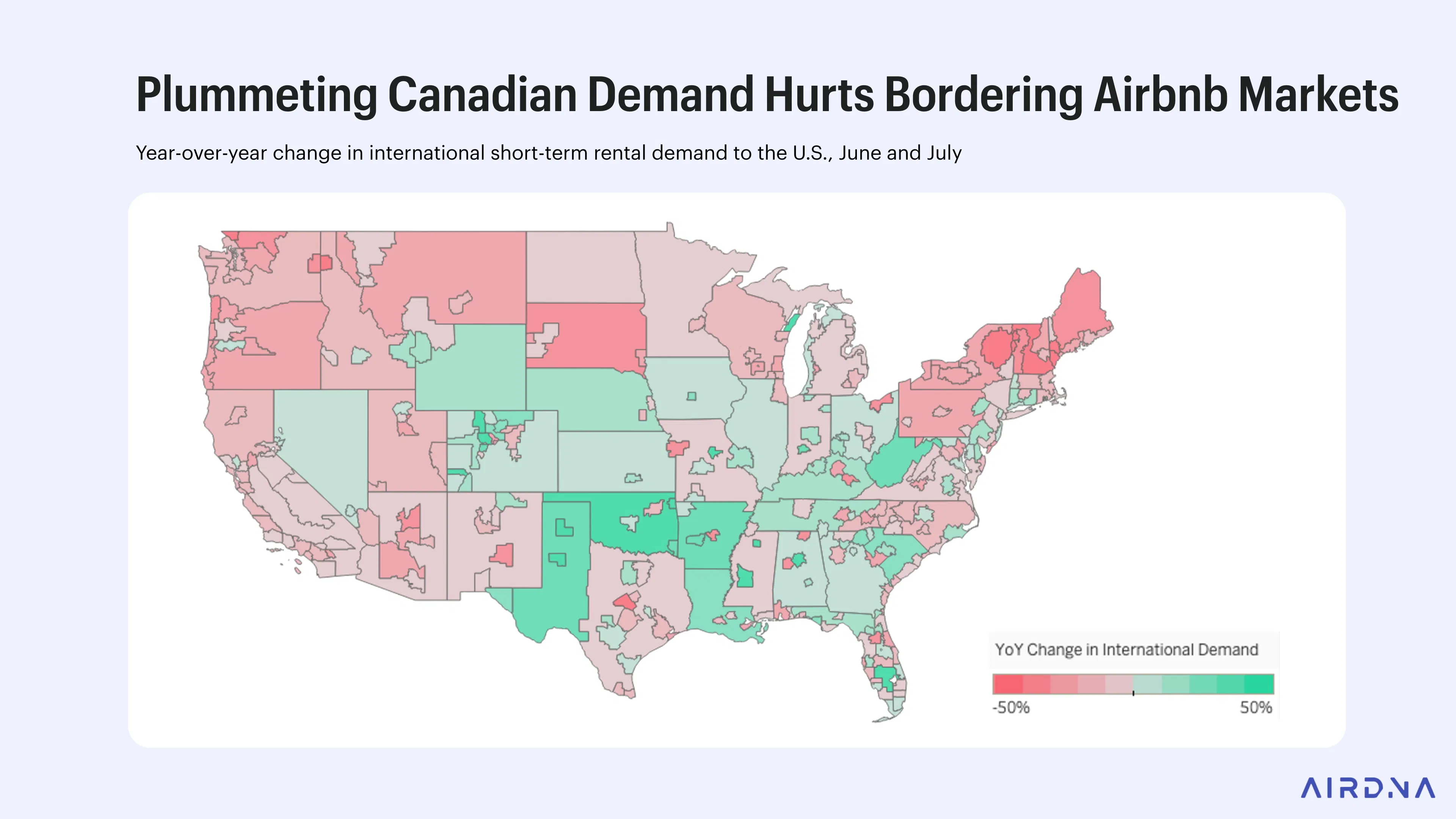
Here’s where the pullback has been most severe, according to AirDNA’s data analysis:
- Burlington, Vermont: -52.6%
- Maine Beaches: -52.6%
- Vermont/New Hampshire corridor: -43.1%
- Coeur d’Alene, Idaho: -45.2%
- Bellingham, Washington: -41.6%
- Adirondacks, New York: -40.6%
- Spokane, Washington: -39.0%
So what’s behind the slowdown? Experts point to a weakening Canadian dollar, which stretches travel budgets further when that dollar doesn’t go as far in the U.S. On top of that, there’s growing political unease (in part sparked by aggressive rhetoric and tariffs) which is nudging Canadians toward domestic getaways.
If you’re in a market that once relied on Canadian guests, it’s time to recalibrate. Focus on U.S. drive-to travelers, experiment with shorter minimum stays to capture weekend bookers, and highlight local draws like foliage, festivals, or seasonal escapes. The demand is still out there. It’s just coming from a little closer to home.
Research Airbnb Markets
Gain insights into the revenue and occupancy trends in your market.
Overall Demand Is Surging, but Airbnb Bookings Are Down
International travel is down, but overall bookings are up. If that sounds confusing, let us explain.
On the surface, 2025 looks like a strong year for Airbnb U.S. travel demand. In July, U.S. listings saw more than 5% year-over-year growth in bookings, fueled almost entirely by domestic travel. That uptick in domestic travel was enough to offset a 15%+ decline in international demand, including that sharp drop in Canadian visitors.
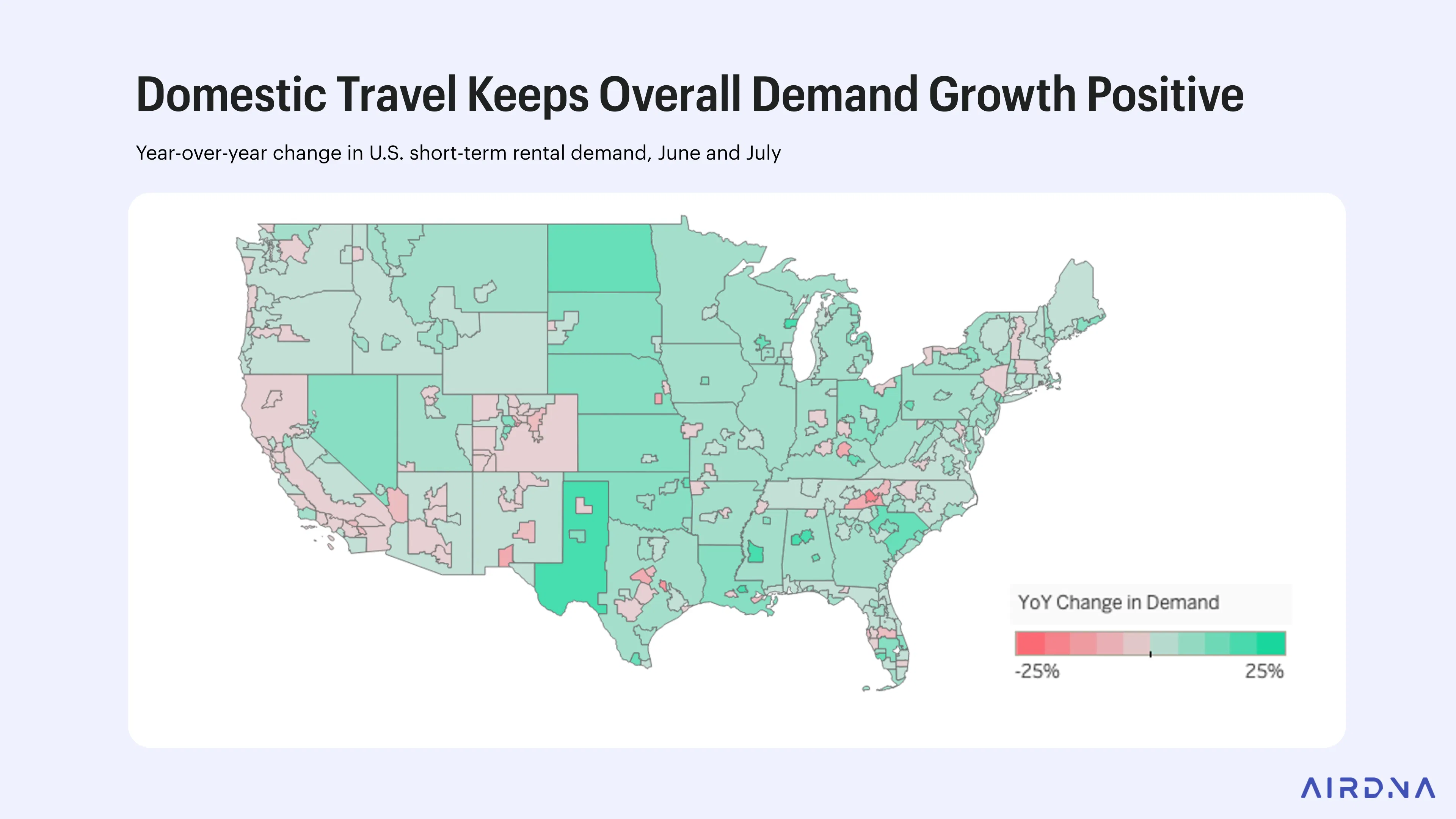
Despite that growth, however, many hosts have seen fewer nights filled this summer. This led to Airbnb occupancy being down across much of the country.
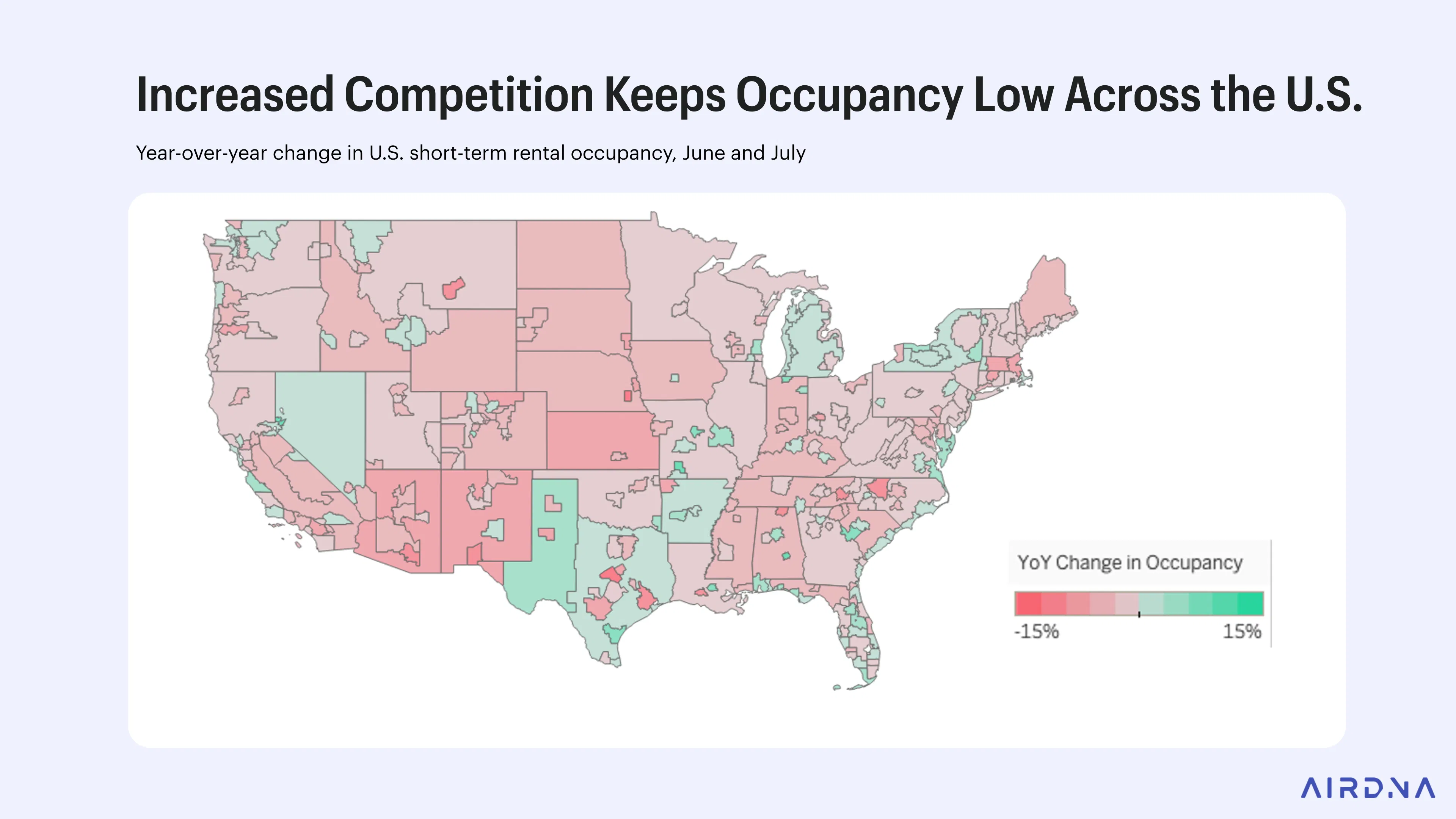
The issue isn’t demand. It’s the competition. With more listings than ever, the same bookings are getting divided up.
In June, the number of active short-term rentals in the U.S. hit a record 1.76 million, up 6.1% year-over-year. That growth has been especially sharp in:
- Small towns and rural areas, up 16%
- Mid-size cities, up 10%
- Major metros like New York City, Boston, Philadelphia, Dallas, and Houston, each up 10% or more
When Airbnb supply and demand get out of balance, even busy markets can start to feel soft. It’s a reminder that even in growth years, an Airbnb slowdown can show up when supply gets ahead of demand.
This isn’t just happening on Airbnb. Hotel stays, TSA travel volume, and hospitality job growth also slipped slightly in July. While the slip was less than 1% year-over-year, it’s still a noticeable shift compared to the strong growth seen earlier in 2025. Back in January and February, overall travel was growing at 1–1.5%, even in the off-season.
While more guests are traveling, they’re doing so in a market that’s getting more crowded.
Still, there are bright spots. Revenue is holding up, thanks to higher nightly rates:
- Average Daily Rates (ADR) rose nearly 7% year over year
- Revenue per Available Room (RevPAR) climbed 5-6%, even with lower occupancy
Heading into fall, demand growth is expected to keep building:
- 5.1% year-over-year (YOY) in September
- 5.6% YOY in October
- 4.8% YOY in November
For hosts, today's challenge isn’t finding guests, it’s capturing them. That means you must price strategically, refine your listing, and adjust to how today’s guests are booking. While demand is still growing, performance is no longer guaranteed.
Luxury Listings Are Most Likely to Stay Booked
Not every price tier is riding the same wave right now. Luxury properties are the clear standout. According to AirDNA occupancy pacing data, they’re the only tier expected to see year-over-year growth this fall, with October on track for nearly a 2% bump in occupancy. Even in August, only luxury and upscale listings managed to post gains, while budget and mid-tier rentals slipped.
The outlook for winter is softer across the board, but luxury is still proving more resilient. Budget properties could see occupancy fall by about 3% year-over-year in November and December, while luxury and upscale are forecast to dip just 1–2%. In other words, high-end hosts aren’t immune to seasonal cooling, but they’re losing less ground.
So why are luxury listings holding stronger? Part of the answer is simple: luxury bookings tend to stick. About 42% of luxury properties enforce strict or super strict cancellation policies, compared to just 28% of budget rentals. When guests lock in a luxury stay, they’re less likely to back out and leave hosts scrambling to fill last-minute gaps. Add in the fact that high-end trips are usually tied to milestones, family gatherings, or group getaways, and you get reservations that are harder to shake.
How to Respond to 2025 Airbnb Travel Trends
We’ve unpacked a lot: Canadians pulling back, record supply creating tougher competition, and luxury listings holding steadier than budget stays. The big question now is . . . what should you do with all of this information?
The answer isn’t to panic. It’s to adapt. Hosts who take these shifts seriously and make small, intentional adjustments are the ones who will keep calendars full and revenue strong in the months ahead. Here are some ideas on how to respond to these Airbnb travel trends:
1. Dial in your localized strategy
National trends are useful, but they only go so far. What really matters is how demand plays out in your submarket. A border town, a ski region, or a city neighborhood can all move very differently from the national average. That’s why zooming in on local data is key (AirDNA can help with that!)
Start by watching the events calendar. Festivals, concerts, and big game weekends can create short bursts of demand you don’t want to miss (be sure to check out our list of Airbnb host event strategies). Don’t forget to track your comp set: which listings are getting booked, how fast, and at what price. If new supply is popping up nearby, you’ll want to adjust early. That could mean lowering minimum stays to attract weekenders, flexing rates for event-driven demand, or leaning on promotions to stay competitive.
2. Focus on revenue, not just nights booked
It’s easy to get discouraged by a softer occupancy rate, but that’s not the full picture. With ADR and RevPAR climbing in 2025, many hosts are actually earning more overall, even with a few more empty nights. Review your nightly rates and make sure they’re aligned with real-time demand, not just what your competition is doing. Think about ways to increase per-stay value too, like offering add-ons, extended stays, or weekday discounts to keep revenue flowing.
3. Revisit your cancellation policy
Luxury and upscale listings are pacing ahead in part because they’re less exposed to last-minute cancellations. If you’re losing nights at the eleventh hour, consider whether your Airbnb cancellation policy is too loose. Moving from flexible to moderate, or setting stricter terms during peak demand periods, can help protect your calendar. Guests who are serious about booking will stick with you, and you’ll reduce the risk of scrambling to fill unexpected gaps.

4. Think beyond the summer season
Summer isn’t the only time to shine. Demand is forecast to keep growing into the fall, with September, October, and November all pacing above 5% year-over-year. That’s your opportunity to catch travelers looking for foliage trips, weekend football games, or quick shoulder-season escapes. Refresh your listing photos to highlight cozy spaces, firepits, or seasonal attractions. Update your calendar now so you’re visible when those planners start searching.
5. Stay flexible and informed
The market is moving fast. What worked last summer may not hold this year or even this season. The best way to stay ahead is to keep checking your local data, testing new settings, and adjusting as you go.
AirDNA’s monthly market reviews are a great way to track these shifts as they happen. They give you a quick read on demand, occupancy, and rates in your area.
Try Our Vacation Rental Pricing Tool
Use Dynamic Pricing to optimize your pricing strategy.
ARTICLE SUMMARY
Explore the latest Airbnb travel trends for 2025. Learn why some hosts had slow summers, how guest patterns shifted, and what to expect for fall bookings.
Jamie Lane
AirDNA Chief Economist
He is responsible for data analysis, thought leadership, and leveraging advanced analytical techniques to provide new insights into short-term rental market trends. Native to Atlanta and an Airbnb host himself, Jamie enjoys cycling, mountain biking, backpacking, running, and playing in a dart league in his free time.
