


European Review February 2026: ADR Shows Early Recovery But Supply Still Outruns Demand
Published: March 19, 2026
Last updated: February 23, 2026

Camilo Schmid Rivas
Key Takeaways
- Supply maintained its positive trend, with available listings surpassing demand significantly, which ultimately led to occupancy declines across the continent. Despite that, ADR increased for the first time since July 2025, with RRI remaining strong and reaching a 10.2% YoY growth.
- The impact of ongoing conflicts in Iran is starting to be felt in Europe, with higher cancellation rates in southern European countries like Turkey and Cyprus.
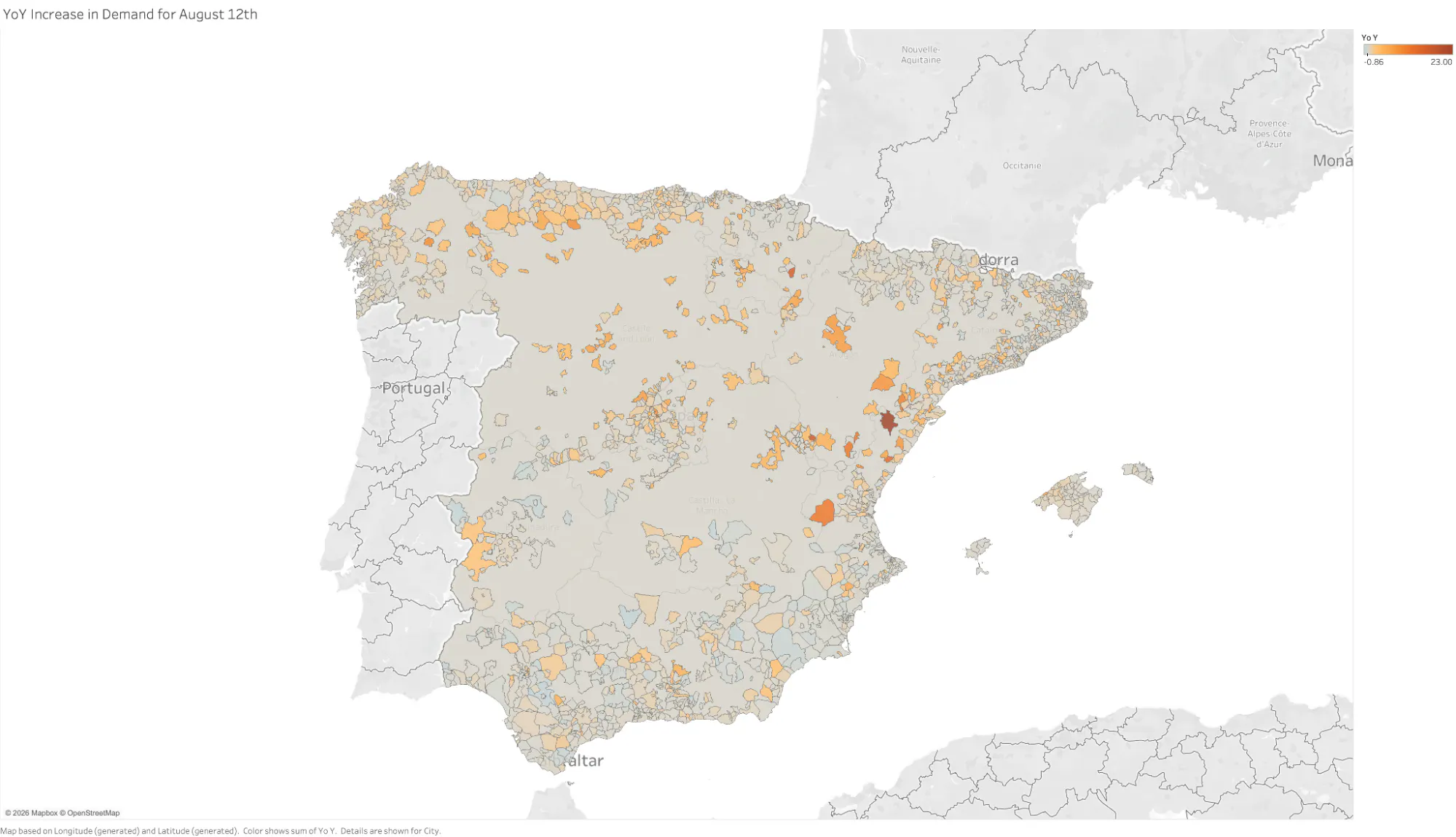
- The solar eclipse on August 12th, 2026, is already causing major year-over-year increases in demand in both Iceland and inland Spain.
Supply increased steadily by 3.3%, while demand declined across Europe in February, causing occupancy to drop 4.1%. Supply continues its steady recovery from the lowest point of 0.6% YoY growth seen in July 2025, indicating a more stable growth rate across Europe in the upcoming year. While demand nights still decline, increasing shoulder- and summer-season travel suggests a shift in European travel patterns, with demand becoming more concentrated between May and September. The overall decline in RevPAR of 3.1% was mitigated as ADR grew by 0.4%. Additionally, the Repeat Rent Index (RRI) continued to rise, reaching its highest YoY gain since October 2023, indicating ongoing pricing power for Europe’s seasoned operators.
The impact of the conflicts in the Middle East has started to be felt in Europe, especially in southern nations, where cancellation rates have increased significantly. Both Turkey and Cyprus stand out, as recent developments in the conflict have led to a jump in cancellations.
At a Glance: February 2026 STR Performance in Europe
- Available listings reached 3.3 million, an increase of 3.3% YoY
- Demand Nights declined by 4.5% YoY to a Total of 24.9 million
- Average daily rates (ADR) increased for the first time since July by 0.4% YoY to €119.7
- Average occupancy rate declined to 57%, down 3.4% YoY
- Revenue per Available Rental Night (RevPAR) decreased by 3.1% YoY to €68
February 2026 saw available listings continue their positive momentum, increasing by 3.3% to 3.3 million. Demand declined by 4.5%, driving occupancy down across the continent to 57%, a decrease of 3.4% year over year. Despite supply outpacing demand, average daily rates (ADR) grew slightly by 0.4%, softening the RevPAR decline, which sat at €68 for February.
The State of the European Economy
As the conflict in Iran grows, uncertainty rises, especially with oil and gas prices driving inflation up. Europe seems more vulnerable to the ongoing conflict than other regions. Oxford Economics indicates that price increases will be uneven, with inflation in Europe projected to be 0.5% to 0.6% higher by year-end than earlier predictions, as seen in the graph below. Despite this rise in inflation, the ECB is unlikely to raise interest rates, as inflation has stayed close to the 2% medium-term target since mid-2024, and energy prices are expected to stabilize by Q3.
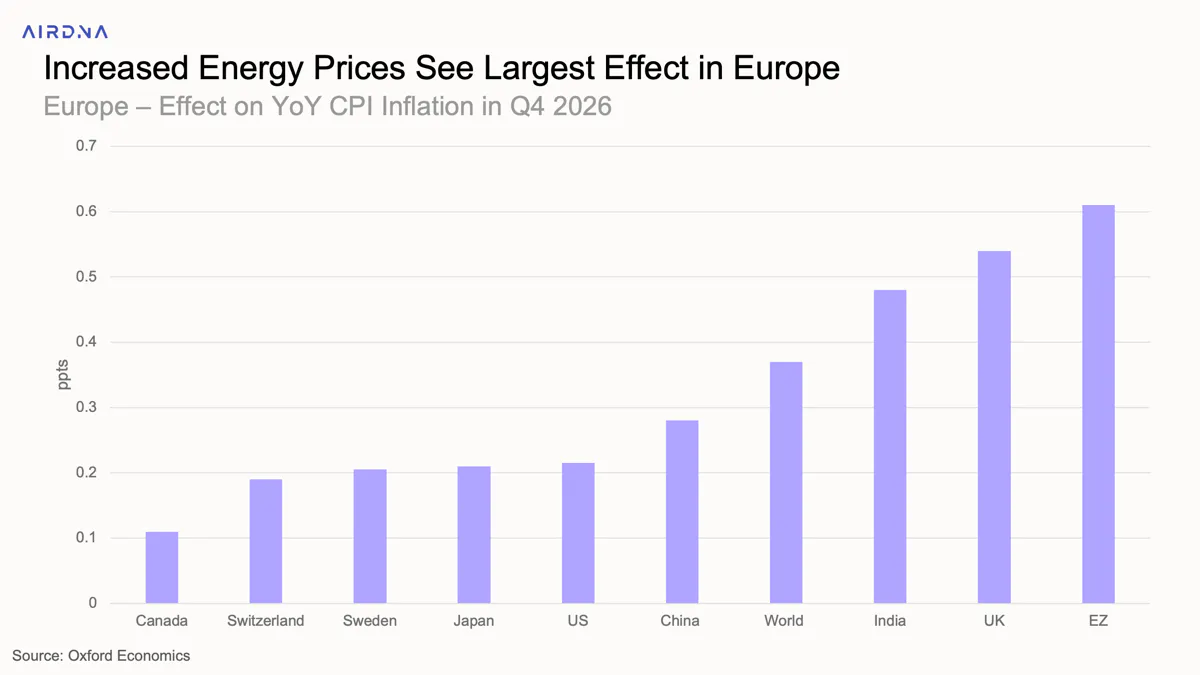
Despite the conflict not being expected to have long-term consequences, it is expected to impact the short term. With cold temperatures still lingering in Europe, combined with supply issues and rising gas prices that heat most European homes, travelers will be more cautious with their travel expenses, especially in the short term. As inflation and unemployment remain stable, the ECB is also expected to keep its target interest rate stable, at around 2.15%.
New Listings See Year-Over-Year Growth
New listings, which track properties entering the market for the first time, slowed significantly in 2025, following the strong supply expansion that defined 2024. January 2026 saw a minor YoY increase of 0.5%, with momentum continuing into February, where new listings grew by 1.8%. Although still much lower than the growth seen in 2024, this remains a positive sign. Despite supply not growing at the same rates seen in 2024, the current recovery in new listings and available listings suggests that Europe may enter a period of slower, although stable, growth.
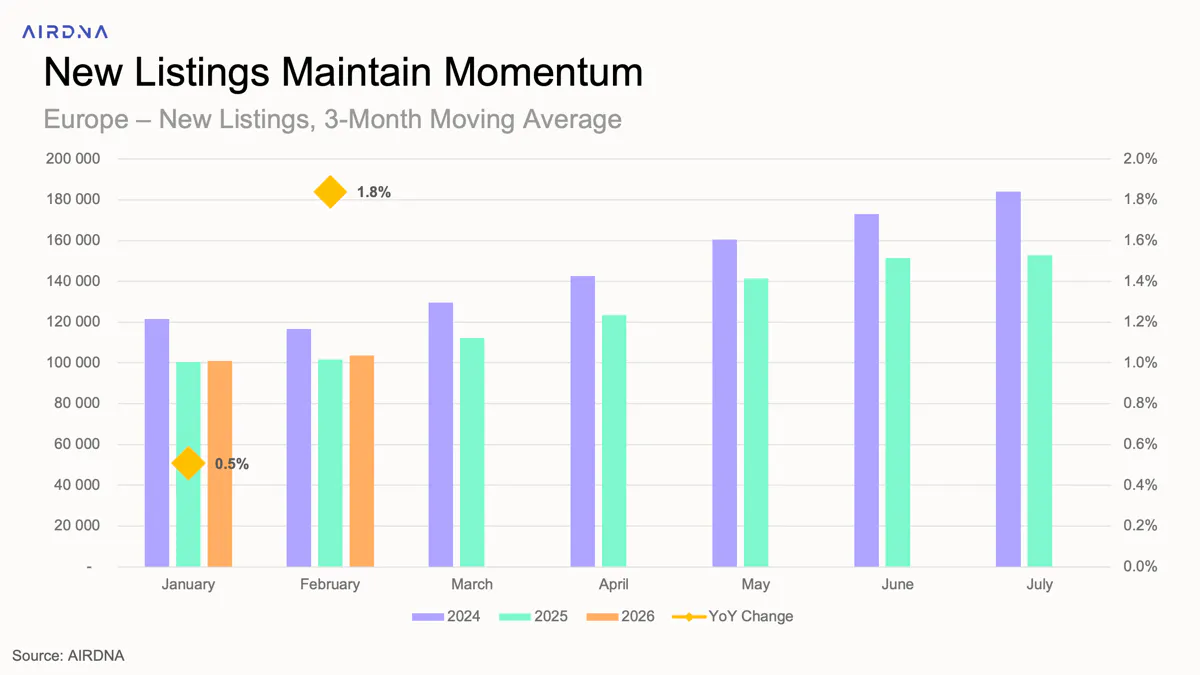
Examining Europe’s top 20 countries reveals contrasting trends. Denmark experienced a significant rise in new listings, with nearly 7,000, 5,000 more than in February 2025. The UK market saw 15,000 new listings in February 2026, which was 3,500 more listings than in 2025. Conversely, Spain's new listings dropped sharply, with nearly 6,000 fewer, a 46% year-over-year decrease due to stricter regulations.
Demand Nights & Nights Booked
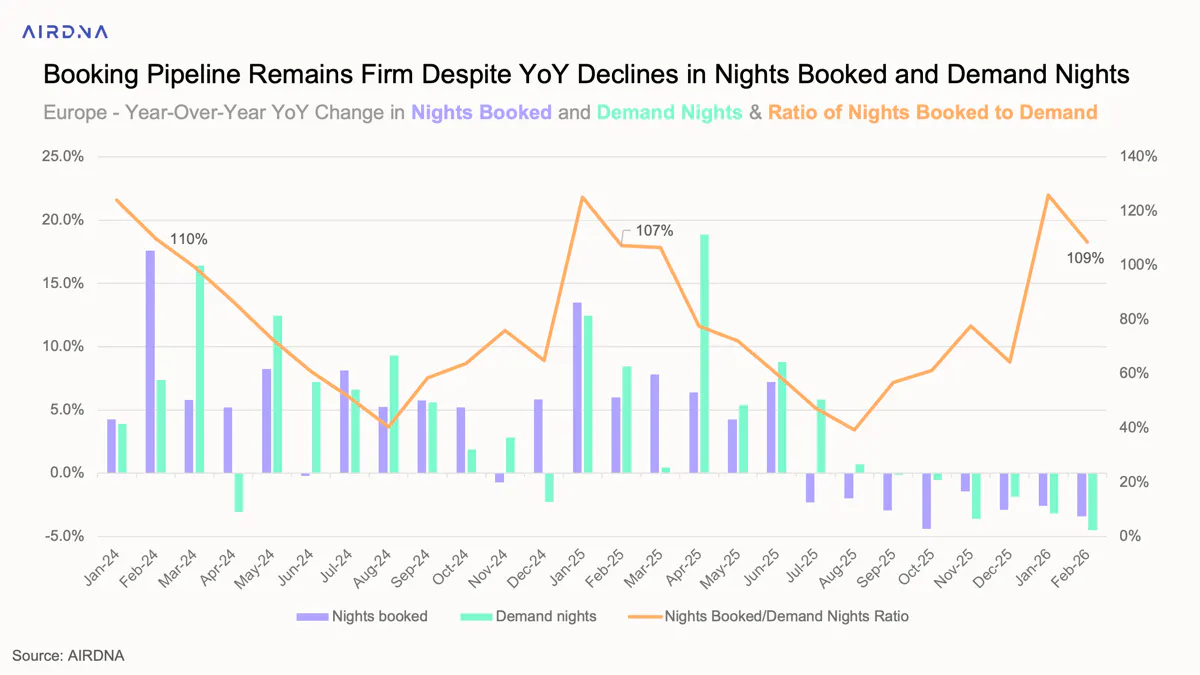
January began with a 3.2% decline in Demand Nights for February. The downward trend persisted, with Demand Nights dropping by 4.5% to 24.9 million nights. Nights Booked, which includes reservations made during the reporting month for stays in current or future months, also declined in both January and February by 2.6% and 3.4%, respectively.
Another way to view the current situation is by examining the ratio of Nights Booked to Demand Nights. This ratio exhibits a clear seasonal cycle each year: It peaks from January through March (1.0–1.26) as guests book in advance for spring and summer, then steadily declines during the peak travel months of June through August (0.38–0.61), when more nights are consumed than booked, before gradually increasing again in Q4. Post-COVID, the February ratio has stabilized within a narrow 1.00–1.10 range, just below the peak in January when most bookings are made.
In February 2026, the ratio was 1.09, meaning that for every 100 nights actually stayed, 109 new nights were booked, resulting in a +2.1M night pipeline surplus in February. While both metrics declined year over year (nights booked by 3.4%, demand nights by 4.5%), realized stays dropped more sharply than new reservations, causing the ratio to increase by 1.2% from February 2025 (1.07). This suggests that although overall travel volumes have decreased after years of above-trend post-COVID growth, forward booking activity remains healthy and is improving relative to current consumption, indicating that the European short-term rental market is normalizing, with more concentrated summer and shoulder-season travel rather than weakening.
Supply Grows In Europe's Top Nations
In February, the number of available listings grew by 3.3% compared to the same month last year, reaching a total of 3.3 million listings. This represents the highest year-over-year growth since June 2025, when listings increased by 3.5%, followed by the lowest growth of just 0.6% in July 2025.
As supply growth gained momentum, demand nights saw their largest YoY decline since March 2021, with a decline of 4.5%, leading to significant occupancy declines across the continent, with occupancy dropping by 3.4% compared to 2025 and 0.9% compared to 2024.
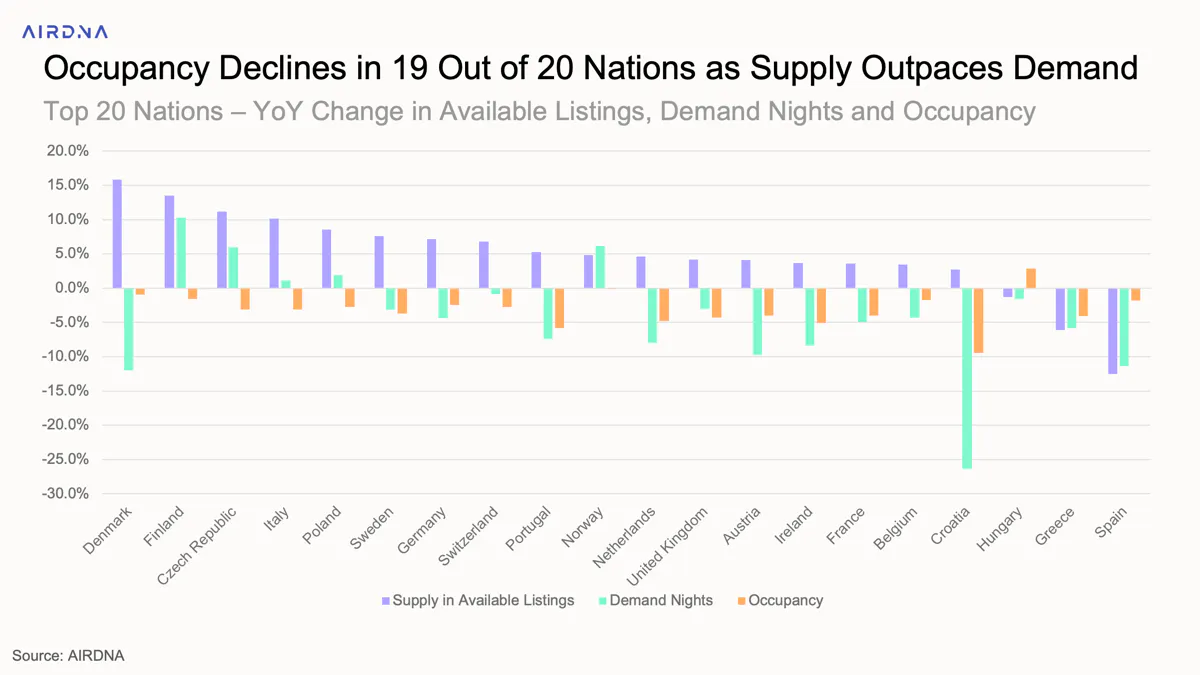
Looking at supply growth and its effect on occupancy at a country level, the story is the same. Among Europe’s top 20 nations, the following saw the biggest increase in available listings:
- Denmark (15.8%)
- Finland (13.5%)
- Czech Republic (11.2%)
- Italy (10.2%)
Among the fastest-growing nations, we continue to see Nordic countries and the Czech Republic outperforming their European peers, similar to last month when these three nations also ranked among the top three for the largest year-over-year gains. This current trend could be due to more lenient regulations in Nordic countries compared to mature markets like Spain or Italy, but it might also reflect a trend of increased off-season travel to secondary destinations by cost-conscious travelers.
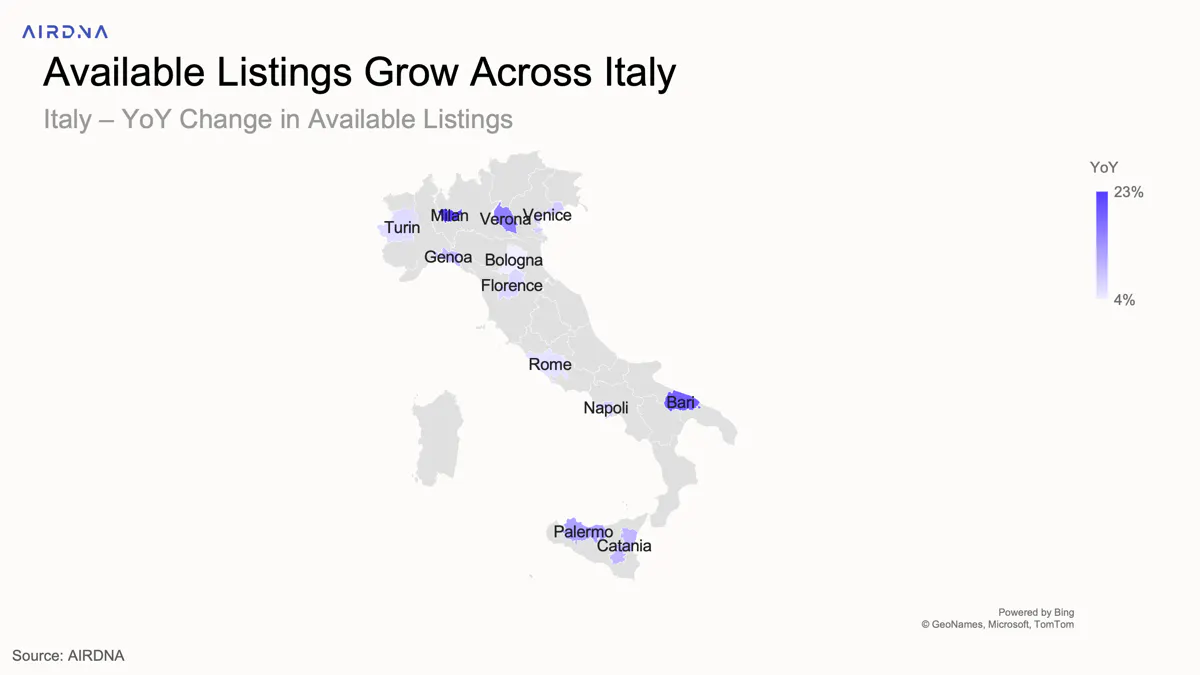
Italy stands out, as February marks the largest year-over-year increase in available listings since September 2024 and is only the second month in the past 13 that has not experienced a decline in listings, with January 2026 being the other. This follows tighter regulations that hampered growth across Italy in 2025, but it seems that operators are now able to adapt to these rules, driving a wave of growth. The growth varies across Italy, with major markets including Milan (23%), Bari (19%), and Verona (16%) seeing gains.
On the other hand, only three major nations experienced declines in available listings in February. Hungary saw a small decrease of 1.3%, after being one of the few nations to grow during January. Greece's available listings declined again after a -6.9% drop in January, now down by -6.1% in February. Spain recorded the largest year-over-year decrease among Europe’s top 20 nations for the second consecutive month, with a -12.5% decline. Among the major markets, the following stand out: Madrid (-12%), Barcelona (-6%), Valencia (-13%), Marbella (-10%).
Occupancy Declines in Most Nations as Supply Growth Reccelerates
In February 2026, occupancy rates declined in 19 out of Europe’s 20 top countries, with only Hungary (+2.9%) increasing its bed occupancy compared to the previous year. This overall drop was mainly caused by a sharp decline in traveler demand, especially in leisure-focused markets like Croatia, where demand nights fell by 26.4%, resulting in a 9.4% decrease in occupancy, the worst in Europe. Countries such as Spain (-11.4%), Denmark (-12.0%), and Austria (-9.7%) also experienced significant demand drops, directly impacting their occupancy levels.
Interestingly, even in regions where traveler demand increased, such as Finland (+10.3%), Norway (+6.2%), and the Czech Republic (+6.0%), the rise in bookings was not enough to improve their overall occupancy rates, with supply increasing in Finland (13.5%), the Czech Republic (11.2%), and Norway (4.8%), where active listing nights also grew by 6.3%.
ADR Recovers As RRI Continues Growing
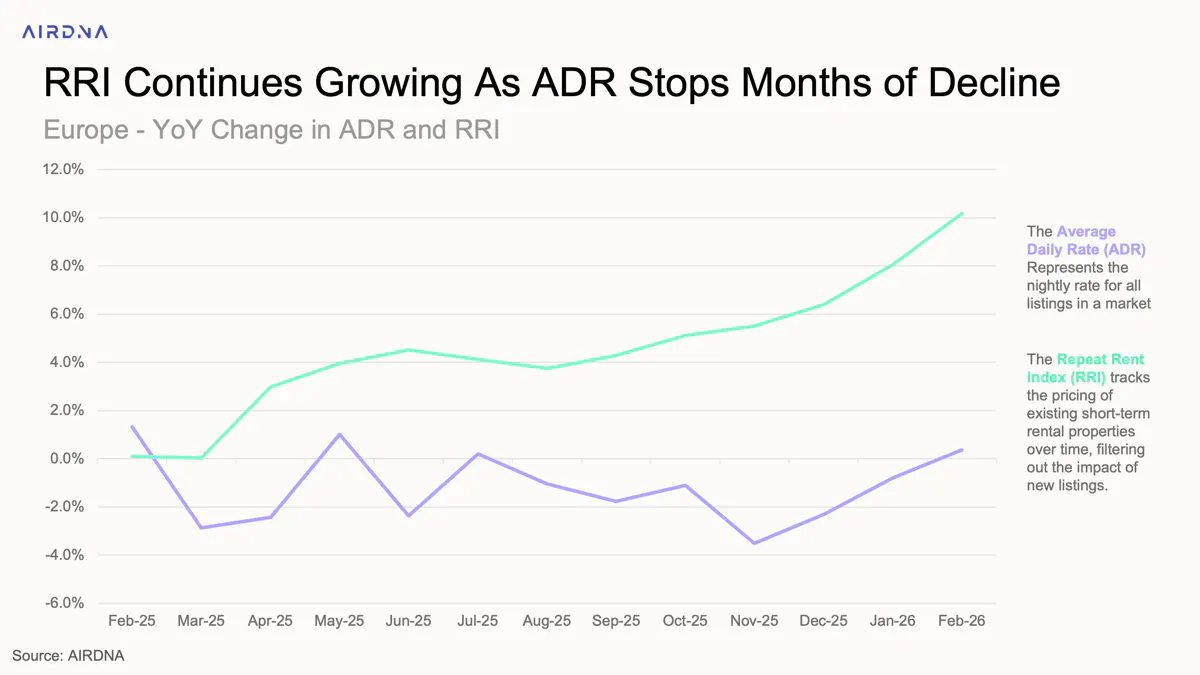
Average daily rates (ADR) in Europe returned to positive territory in February 2026, rising 0.4% year over year. This marks a notable shift from the previous six months, when ADR had been consistently down by an average of 1.7% between August and January.
Alongside this modest return to rate growth, the Repeat Rent Index (RRI), which tracks pricing changes among existing operators and excludes the impact of new listings, presents an even stronger picture. RRI has continued its steep ascent since April 2025, surging to 10.2% year-over-year growth in February, its highest level in over a year.
Over the past year, ADR and RRI have largely moved in different trajectories. While ADR spent most of late 2025 in negative territory before turning positive in February 2026, RRI recovered from a stagnant start in early 2025 and has maintained an unbroken streak of accelerating year-over-year growth.
This widening gap suggests that established listings are commanding significant pricing power, driving robust rate growth independent of new supply. It also continues to reflect the impact of recent regulations that have steadily removed lower-priced or non-compliant listings from the market, artificially elevating the overall price floor.
The Impact of Conflicts in Iran on Southern European Nations
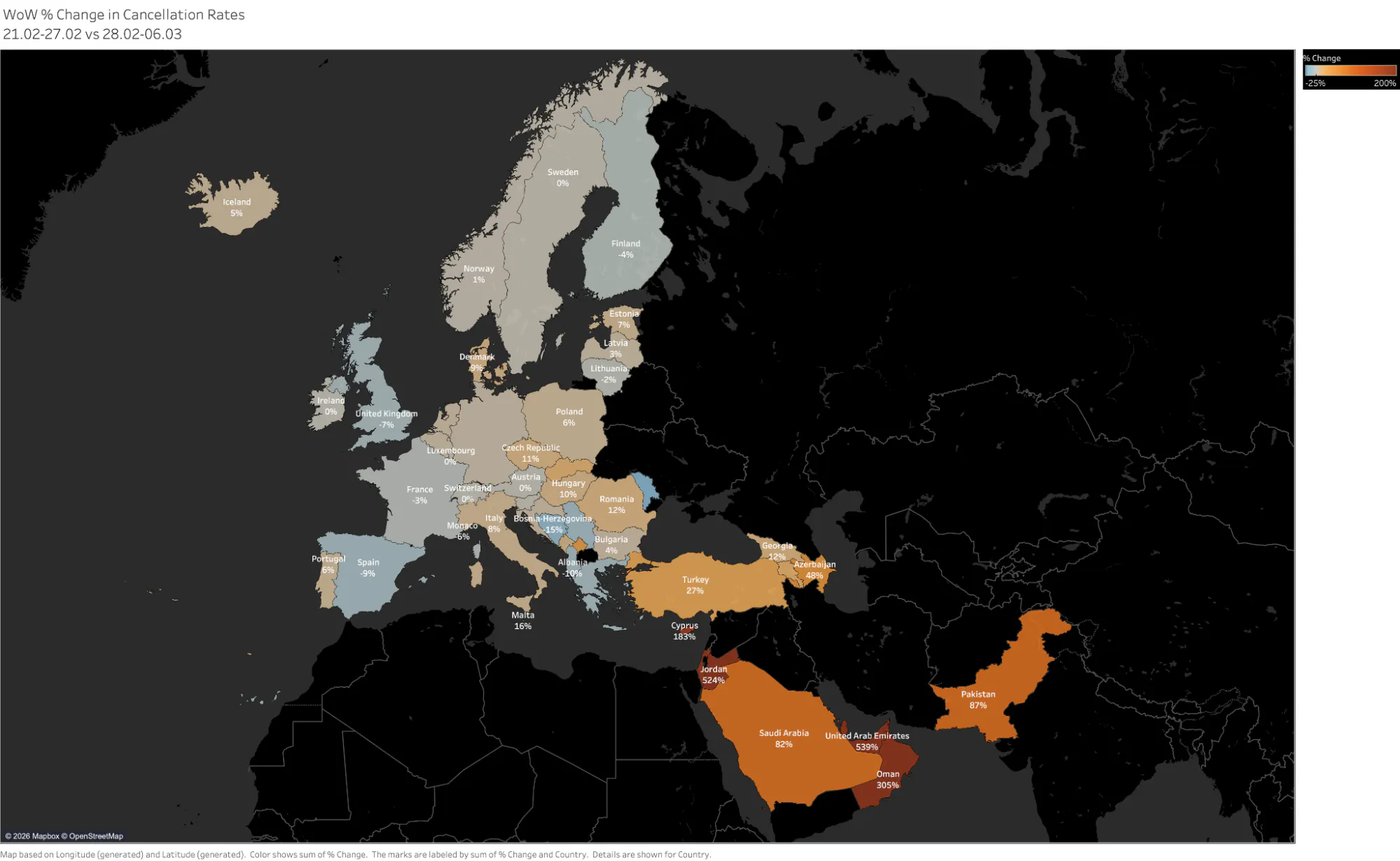
Following the outbreak of conflict in late February, short-term rental markets across the Middle East saw a sharp increase in week-over-week cancellation rates. To measure this, we tracked the total number of nights canceled divided by the total gross nights booked. Comparing the baseline period (February 21–27) to the immediate conflict window (February 28–March 6), panic cancellations wiped out bookings in transit and proxy zones, with the United Arab Emirates experiencing an unprecedented 539% spike. Nearby hubs also saw large increases in cancellation rates, including Jordan (+524%), Qatar (+502%), Oman (+305%), and Israel (+195%).
However, the impact was not limited to the Gulf region. The data shows a significant ripple effect spreading into the Eastern Mediterranean and Southern Europe. Cyprus, a key neighboring country and a nation that recently experienced bombings, saw cancellations jump by 183%. Similarly, Turkey experienced a 27% rise in cancellation rates as the conflict expands, indicating that traveler anxiety is already affecting regions connecting Europe and the Middle East.
Solar Eclipse on the 12th of August
The upcoming summer eclipse in Europe, which will be visible on August 12, has already started to intrigue travelers, with increased demand seen in both Spain and Iceland, the countries on the main path of the eclipse. Demand in Iceland is pacing 135% higher than for the same date in 2025, with this effect seen across the country, but especially in Reykjavik, where most short-term rental supply is located. Looking at other nations, we see spikes in demand in Denmark, Hungary, and Poland, with strong summer demand, although these spikes are unlikely to be related to the solar eclipse.
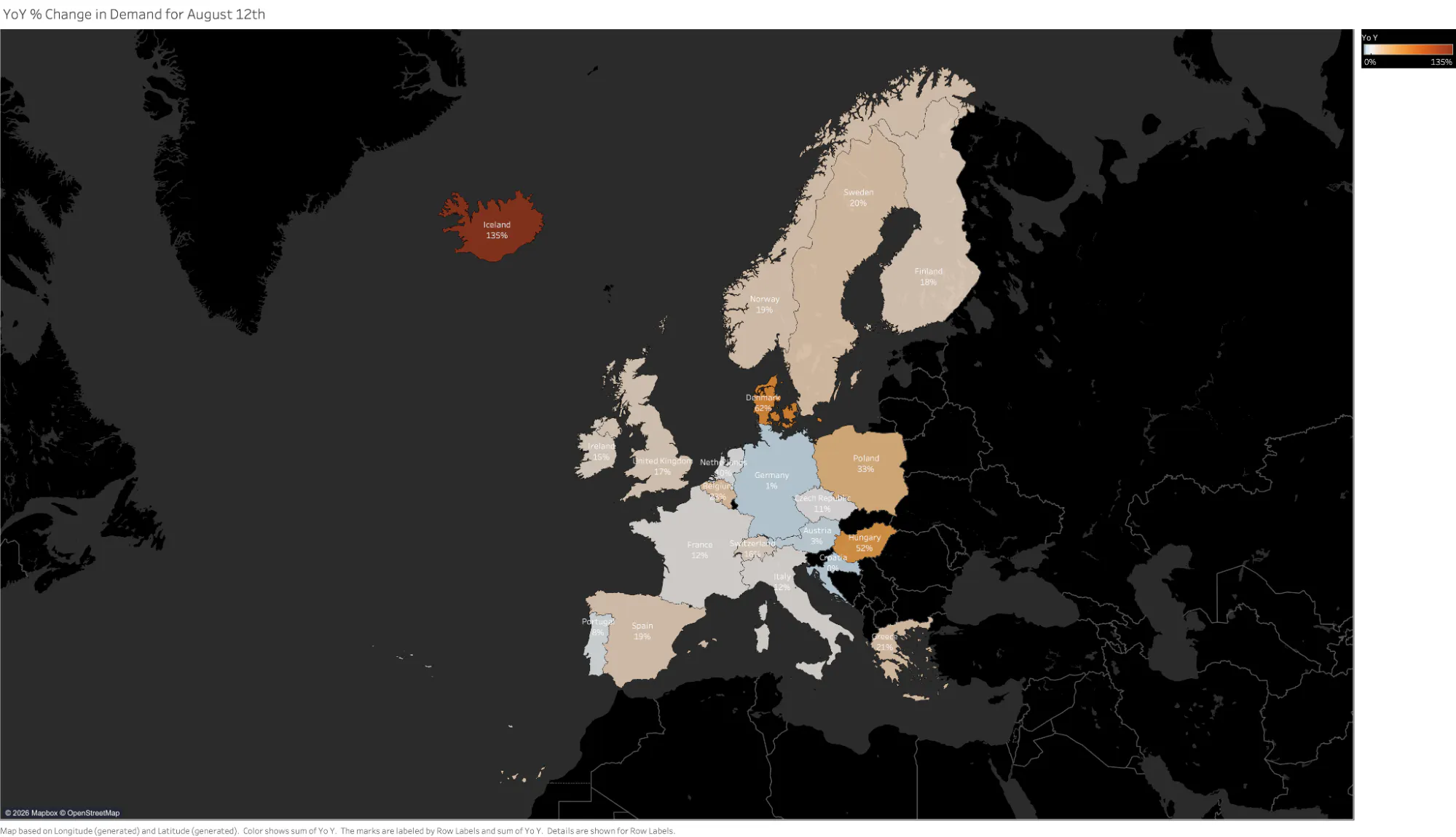
Spain, the second country along the direct path of the eclipse, has also seen gains for August 12, with demand rising by 19%. Although the total demand isn't as high as in Iceland, it's important to note the significant size difference, with Spain having 280,000 more listings than Iceland. On top of this, Spain has experienced a decline in listings, as regulations led to widespread delistings across the country, with budget listings dropping 12% YoY in 2025. This hampers demand, especially since Spain is becoming a more accessible option for travelers to experience the eclipse. At the city level, several inland destinations stand out for their notable increases in demand:
- Zaragoza +688%
- Valladolid +532%
- Logroño +517%
- Leon +400%
ARTICLE SUMMARY
In February 2026, supply growth continued to outpace declining demand, driving occupancy down across the continent. ADR returned to positive territory while RRI strengthened further, signaling continued pricing power among established operators despite shifting seasonal travel patterns.
Camilo Schmid Rivas
Senior Research Analyst
Camilo Schmid Rivas is a Senior Research Analyst at AirDNA who brings a uniquely well-rounded perspective to short-term rental analytics. With a background that spans investment, real estate, and business analysis—including roles at Stayery and Sollers Consulting—Camilo has worn many analyst hats, each sharpening his ability to turn complex data into clear, actionable insights. A graduate of École hôtelière de Lausanne, he now channels his multidisciplinary expertise into uncovering trends that drive smarter STR decisions. In his free time, he enjoys playing tennis or scuba diving in or around Barcelona.
