The Harry Styles Residency Effect: Amsterdam Demand Rose 13%, New York's Barely Moved
Published: August 25, 2026
Last updated: October 22, 2026

Bram Gallagher
Harry Styles's Together, Together tour breaks the usual pattern. Rather than a single night in each city, it settles in for weeks at a time, and Styles has centered the run on three cities. The heaviest concentration is New York City, New York, where he will play 30 shows: around 45% of the entire tour.
He is not the first to try extended engagements. Bad Bunny played 31 dates in San Juan, Puerto Rico from July through September 2025, and that residency split into two parts. The locals-only shows in July produced little effect, which is what you'd expect when locals are the only ones allowed in. The general admission run in August and September was different. On top of the underlying growth trend, it lifted demand an incremental 15% across the entire San Juan market.
New York City complicates the comparison. San Juan's short-term rental (STR) market was growing quickly, while New York City's has been in gradual decline since enhanced regulations eliminated many STRs in October 2023. So how has the Styles tour affected demand so far, and how much extra demand should New York City expect?
At a Glance
- Harry Styles's Together, Together tour is built around multi-week residencies rather than single nights, with 30 New York City shows making up around 45% of the tour.
- Amsterdam recorded the largest lift, with demand around concert dates running an additional 13.0% above the May and June average.
- That is roughly the same boost Bad Bunny's San Juan residency produced in 2025 (+15%).
- London's demand lift was smaller at +8.2%, in a market around thirteen times the size of Amsterdam's.
- New York City's own demand is pacing just around 2% higher, held back by a supply base skewed toward medium-term stays.
- Jersey City and Newark, New Jersey are absorbing the overflow, with demand pacing +7.8% and ADR +5.5%.
How We Isolated the Residency Effect
For a single concert or a handful of them, finding a control is straightforward. Average the weekend before and the weekend after and you have a reasonable picture of typical performance. The dates sit close together, so seasonal effects stay small.
An engagement that occupies much of the high season, as Together, Together does, is harder. Here we produced a deliberately conservative estimate by comparing concert dates against the average of the months surrounding and including them. Including the concert dates in the control raises the comparison average, which pushes our estimate down. The alternative, comparing concert dates against non-concert dates alone, has its own problem: the dates were not chosen at random and skew toward weekends. We would rather err toward caution and report a lower bound for the true effect.
Two caveats on the markets themselves. Amsterdam, London, and São Paulo, Brazil have finished their runs, while some Mexico City dates and all of the New York City shows still rely on on-the-books pacing. And São Paulo and Mexico City are short engagements at four and six shows, so they are not strictly comparable with the long residencies.
Amsterdam Recorded the Biggest Lift, at 13.0% Extra Demand
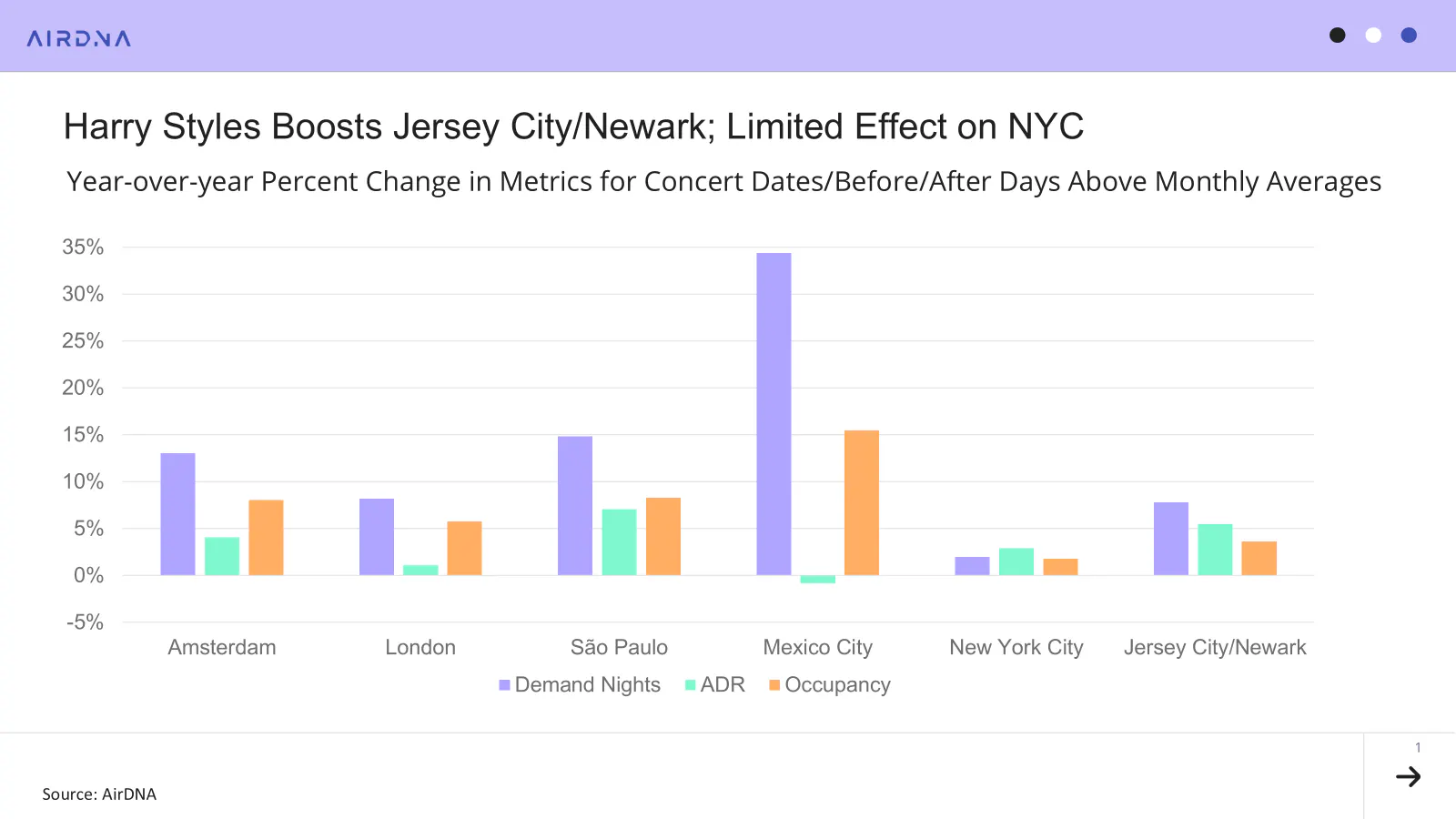
Among the long engagements, Amsterdam came out on top. Across the 21 days of concerts plus the days either side, daily demand ran an additional 13.0% above the overall May and June average. That is roughly the same size boost Bad Bunny produced in San Juan. Average daily rate (ADR) benefited too, rising an additional 4.1% above the two-month average, which was itself already up 9.9%. Occupancy gained 8.0%.
London was more muted, in a market around thirteen times the size of Amsterdam's. Demand still lifted an additional 8.2% around the Styles performances. ADR moved just 1.1% (+3.1% on concert dates against +2.0% for the June and July average).
New York City Barely Moved, and Jersey City Took the Overflow
New York City is one of the largest markets in this analysis, but many of its listings are only available for medium-term stays of 30 days or more, and a good share of those are not particularly active. Demand is pacing only around 2% higher on concert dates than the August through November average, using four months for comparison because there are so many performances. Occupancy gains are similar, since supply is barely growing in New York City. ADR is up an additional 2.9% on concert dates.
Nearby Jersey City and Newark, New Jersey tells a different story. Fresh off housing 2026 FIFA World Cup travelers, that market is happy to take concert-goers who want the STR experience while visiting the city. Demand pacing there looks more like London's, up 7.8% on concert days against the four-month average. Occupancy is up only 3.6% as the market keeps adding available listings, and ADR is pacing to be the strongest gain among the extended-residency markets, at +5.5%.
Mexico City's 34.4% Gain Reflects Low Season, Not a Bigger Effect
Mexico City's +34.4% demand increase looks like the blockbuster of the group, but the concert dates fall outside its high season, which typically runs February, October, and November. Large percentage gains come easier when a city is not already near capacity. Without the compression that comes with playing peak months, ADRs stayed flat.
There are also five times as many concerts planned in New York City as were played in Mexico City, which means the Jersey City and Newark demand gain covers 60 days rather than 13.
What an Extended Residency Means for Hosts
An extended residency appears to give demand more room to spread out. The aggregate numbers look smaller as a result, but consistent gains over a couple of months help operators accumulate more revenue than rushing to provide and price the perfect single weekend.
FAQs
When does Harry Styles's Madison Square Garden residency start?
The New York City leg of the Together, Together tour runs 30 dates at Madison Square Garden between August 26 and October 31, 2026. It is the tour's only U.S. stop, and those 30 shows account for around 45% of the entire tour.
Which cities are on the Together, Together residency run?
Our analysis covers five host markets: Amsterdam, London, São Paulo, Mexico City, and New York City. Amsterdam, London, and São Paulo have already finished their runs. Amsterdam, London, and New York City are the long engagements, while São Paulo and Mexico City are short at four and six shows respectively.
How much does a concert residency lift short-term rental demand?
Based on the markets in this analysis, an extended residency lifts daily demand by roughly 8% to 13% above the surrounding months. Amsterdam gained an additional 13.0% and London an additional 8.2%. Bad Bunny's 2025 San Juan residency produced a comparable +15% for the general admission portion of the run.
Why didn't New York City's short-term rental market gain more from 30 shows?
New York City's supply base is the constraint, not the demand. Enhanced regulations eliminated many short-term rentals in October 2023, and much of what remains is only available for stays of 30 days or more, with a good share of those listings inactive. Demand is pacing around 2% above the August through November average, and supply is barely growing, so occupancy gains are similar.
How does AirDNA measure a concert's effect on rental demand?
For a single event, we average performance in the week or weekend before and after to build a baseline. For a residency spanning much of the high season, we compare concert dates against the average of the months surrounding and including them. That control includes the concert dates themselves, which raises the comparison average and makes the resulting estimate a conservative lower bound.
ARTICLE SUMMARY
Harry Styles's Together, Together tour trades single-night stops for multi-week residencies, including 30 shows in New York City. AirDNA compared short-term rental performance on concert dates against the surrounding months in each host market. Amsterdam recorded the largest lift, with demand up an additional 13.0% and ADR up 4.1%. New York City's own market barely moved at around 2%, while neighboring Jersey City and Newark, New Jersey picked up the overflow at +7.8% demand and +5.5% ADR.
Bram Gallagher
AirDNA Director of Economics and Forecasting
Bram Gallagher is an Economist at AirDNA, specializing in uncovering insights that drive smarter short-term rental decisions. He put his Ph.D. in Economics from the University of Georgia to work researching and forecasting hotel data with CBRE prior to joining AirDNA, as well as teaching economics at a number of universities. In his spare time, Bram enjoys making wooden furniture with hand tools.