Calculate Revenue
 Research Markets
 Find For Sale Properties
 Compare My Listing
 STR Revenue Calculator
 Custom Comp Sets
 Submarket Insights
 Custom Search Filters
 Rate Recommendations
 Performance Benchmarking
 Competitor Comparison
 Owner Contact Details
 Property-level performance data
 Tourism Insights
 Real Estate Investment Analytics
 About Us
 Sales
 Support
 Press
What Are the Most Common Gap Nights in Short-Term Rentals?
Published: November 16, 1926
Last updated: October 16, 2026

Linda Rollins
Every gap between bookings is a night your property could have earned money and didn’t. Most hosts know their calendar has gaps. Fewer know which gaps keep showing up, or how to set the discounts and minimum stay adjustments that will actually fill them.
To find out, we looked at every 2025 checkout from full-time hosts in the 50 largest US markets and what came next: another guest the same day, or a gap. Which gap nights hosts face depends on where the property is, the time of year and the size of the home. Below, we break down gaps by market, season and bedroom count, along with the pricing strategies you can use to fill them.
Key Takeaways
- Lone Sundays lead: a single open Sunday is the top gap in 32 of 50 markets.
- Getaways leave empty midweeks: in mountain, lake and leisure-city markets, weekends book and Sunday through Thursday doesn’t.
- Busy cities leave single nights: about 40% of gaps in Boston and San Jose are one night.
- Gaps grow as demand slows: Gatlinburg’s empty midweeks double from 17% at peak to 35% in low season.
- Bigger homes need deeper weekday discounts: 4–5 bedroom homes are left with more empty midweeks than smaller ones.
The Most Common Gap Night Is a Lone Sunday
Across the 50 largest US markets, the most common gap for full-time hosts is a single open Sunday night, left between a weekend stay that checks out Sunday and a Monday check-in. It’s the most common gap in 32 of those 50 markets. Close behind are Sunday through Thursday and Sunday through Wednesday, when the weekend books and the week doesn’t. None of the 10 most common gaps start on a Friday or Saturday, because weekend nights typically get booked.
Gap night terms used here
- Gap nights: nights left open between one guest’s checkout and the next guest’s check-in.
- Back-to-back: the next guest arrives the day the last one leaves, with no gap at all.
- Single night (orphan night): one open night between two stays. It’s often too short to book under a two- or three-night minimum stay.
- Empty midweek: three to five weeknights left open between two stays, starting Sunday or Monday and ending Wednesday or Thursday. Sunday through Thursday is the classic version: the weekend books, the week doesn’t.
Getaway Markets Leave Empty Midweeks, Busy Cities Leave Single Nights
The chart below plots the 50 largest US markets by how often full-time hosts’ gaps in 2025 were a single night or an empty midweek.
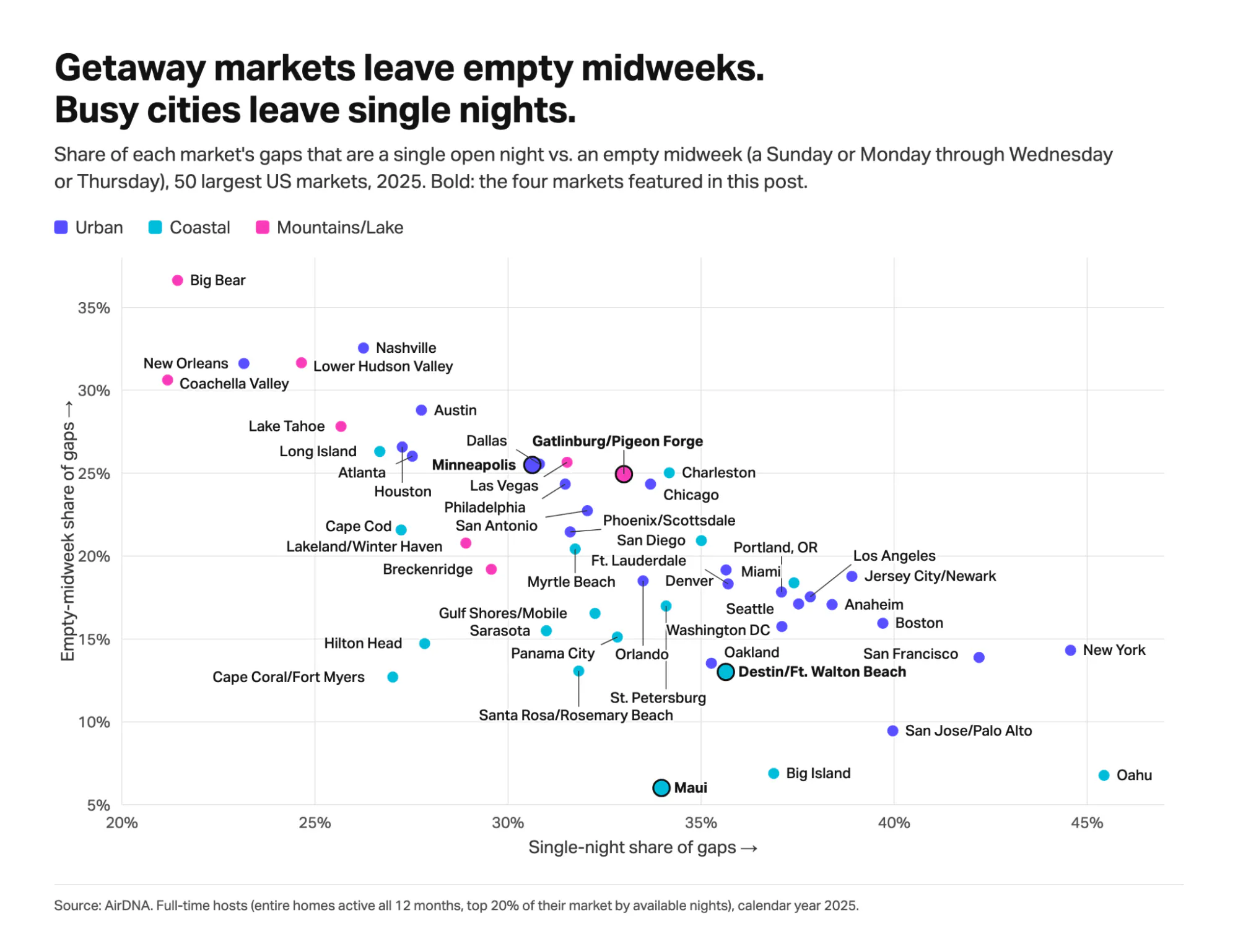
Mountain and lake getaways sit at the top. These run mainly on weekend trips, so the weekdays between them are what’s left open. More than a third of Big Bear’s gaps are an empty midweek, and a quarter of Gatlinburg/Pigeon Forge’s.
Cities split by how busy they are. Among the 25 cities in the top 50, those with higher occupancy tend to have more single-night gaps. When business travel fills the week and leisure travel fills the weekend, the only openings left are usually single nights. In busy cities like San Jose/Palo Alto and Boston, about four in ten gaps are a single night. Cities that run more on weekend leisure trips look like getaway markets instead. About a third of gaps in Nashville and New Orleans are an empty midweek, and a quarter in Minneapolis.
Hawaii sits at the bottom. Stays there are long. As our length of stay analysis found, about a third of reservations in Maui and Oahu run a week or longer, compared with about one in 10 in most of the 50 largest US markets. Because those trips run straight through the week, empty midweeks are rare. What’s left between long trips is often a single night. About a third of Maui’s gaps are a single night, and in Oahu it’s 45%, the highest share in the top 50.
Gulf and Atlantic beach markets fall between the extremes on single nights and empty midweeks. Where they stand out is weekend and long gaps. More of their gaps include a weekend night than in cities or mountain markets, because beach stays often change over on Saturdays and Sundays. They also have the most gaps of eight nights or more, as their slow months leave long stretches between bookings.
Gap Nights Get Longer as Markets Move From Peak to Low Season
Even within the same market, gaps change with the season. As occupancy falls from peak to shoulder to low season, fewer stays turn over back-to-back, the typical gap gets longer and gaps of eight nights or more become more common. We tracked that shift in four markets with very different calendars: Minneapolis, Gatlinburg/Pigeon Forge, Destin/Ft. Walton Beach and Maui. The same pattern held in all four. Each market’s year is split into peak, shoulder and low season based on its own occupancy.

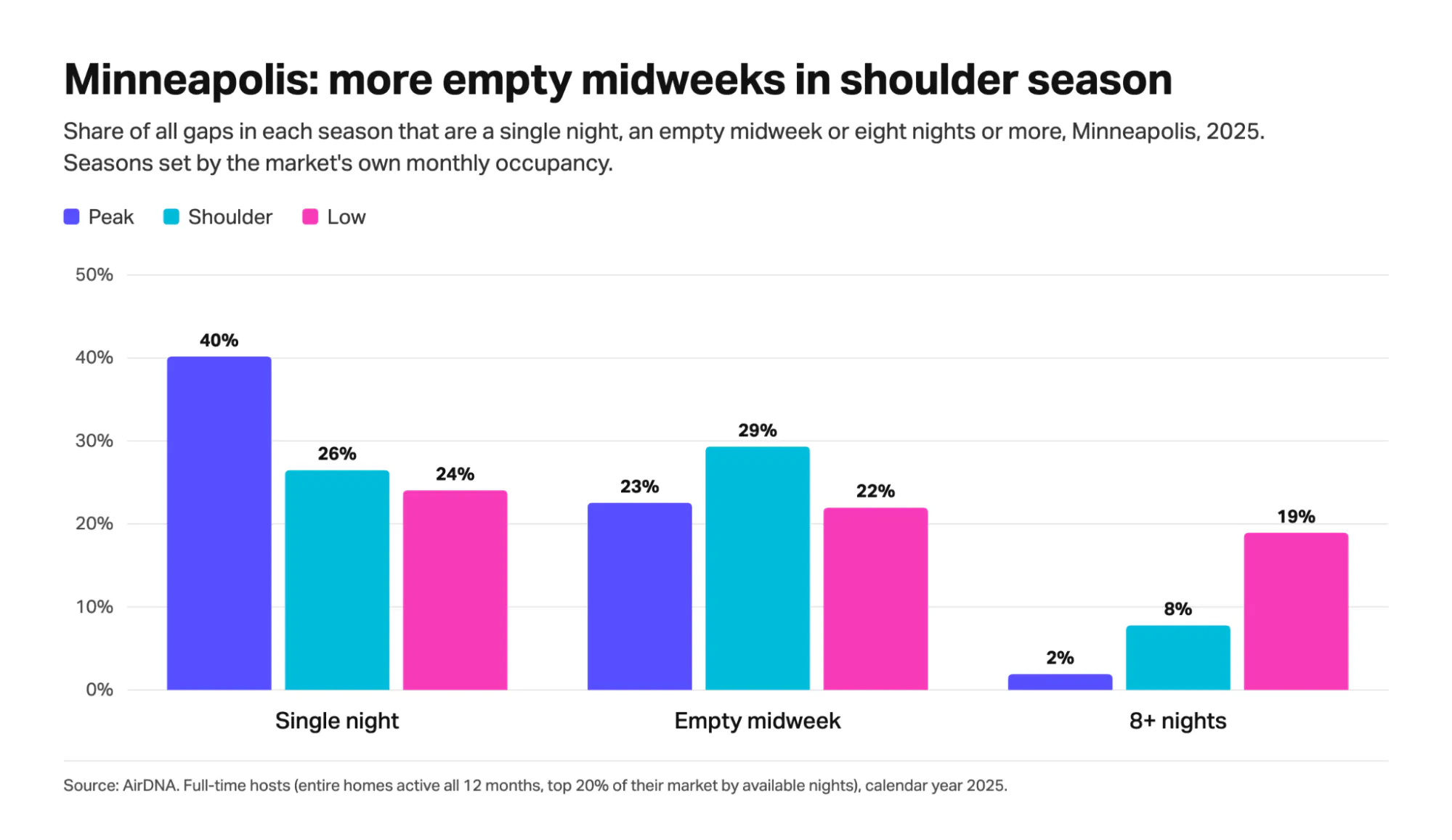
Minneapolis: more empty midweeks in shoulder season
From May through August, Minneapolis calendars fill up, and most gaps are short. Four in ten gaps are a single night, with a lone Sunday the most common gap, and nearly half of stays turn over back-to-back. In the shoulder season (March, April and September through November), the three most common gaps are all weekday stretches: Sunday through Thursday, Sunday through Wednesday and Monday through Wednesday. Once summer travel fades, the weekends still book and the week doesn’t, the same problem a mountain getaway faces. In the low season (January, February and December), long gaps take over: nearly one in five gaps runs eight nights or more, and those long gaps make up more than half of all empty gap nights.
What it means for hosts: In Minneapolis, weekday gaps need the most attention in the months before and after summer. Moving from peak into shoulder season, consider discounting weekday gaps and shortening the minimum stay to attract weekday travelers once summer demand fades.

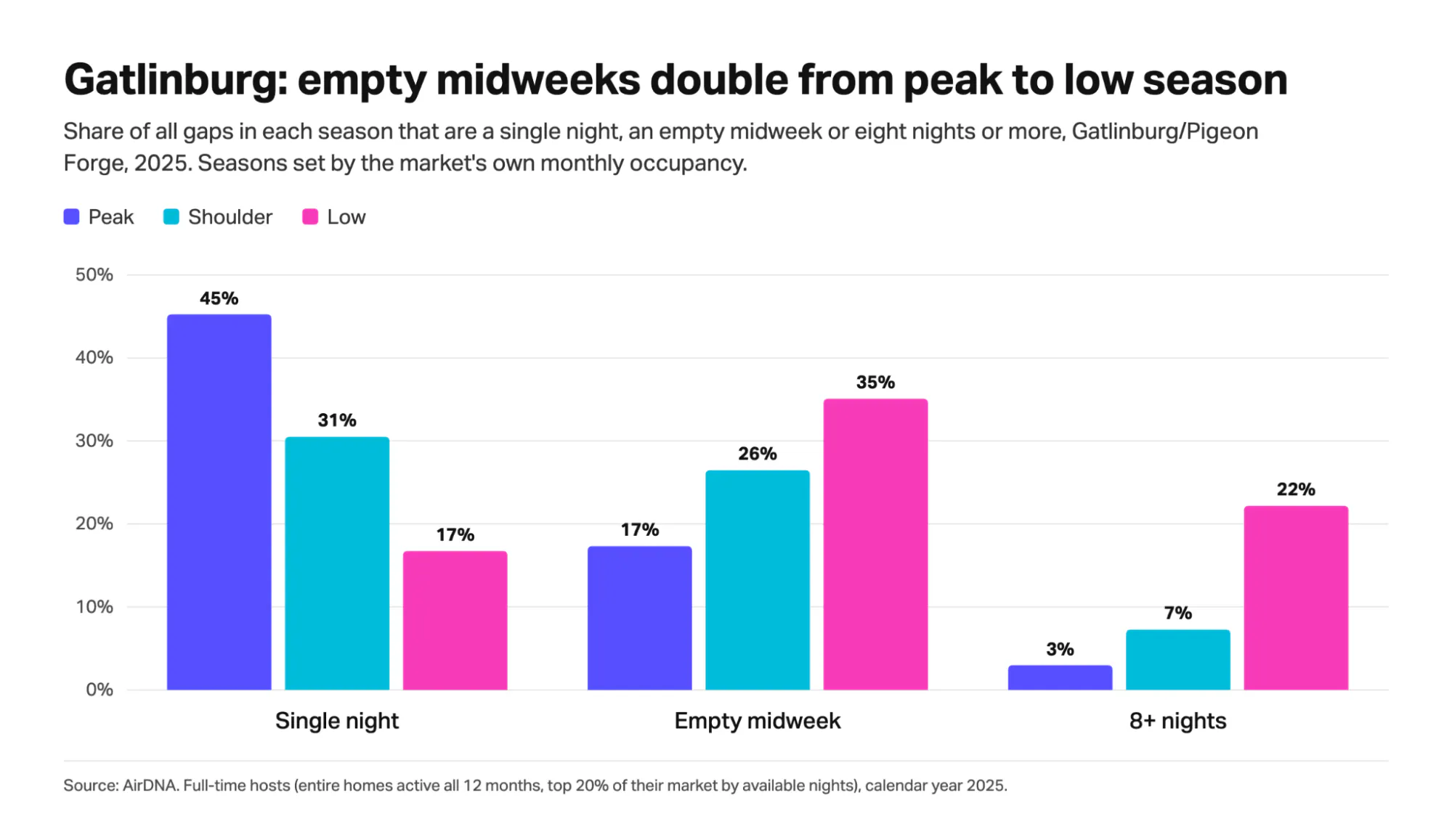
Gatlinburg: empty midweeks double from peak to low season
In peak months (March, June, July and October), Gatlinburg/Pigeon Forge’s gaps are mostly short, too. More than half of stays turn over back-to-back, and when there is a gap, almost half are a single night. Once peak season ends, weekday demand drops off while weekend trips keep coming. In the shoulder season, Sunday through Thursday becomes the most common gap, and empty midweeks grow from 17% of all gaps in peak season to 26%. By January and February, empty midweeks reach 35% of gaps, and more than one in five gaps lasts eight nights or longer. Winter weekends in the Smokies still sell. The weekdays between them are what’s left.
What it means for hosts: As the season slows, Gatlinburg hosts should offer deeper discounts and shorter minimum stays on weekday gaps in the shoulder season, and larger discounts heading into January and February, when low demand makes bookings hard to capture.
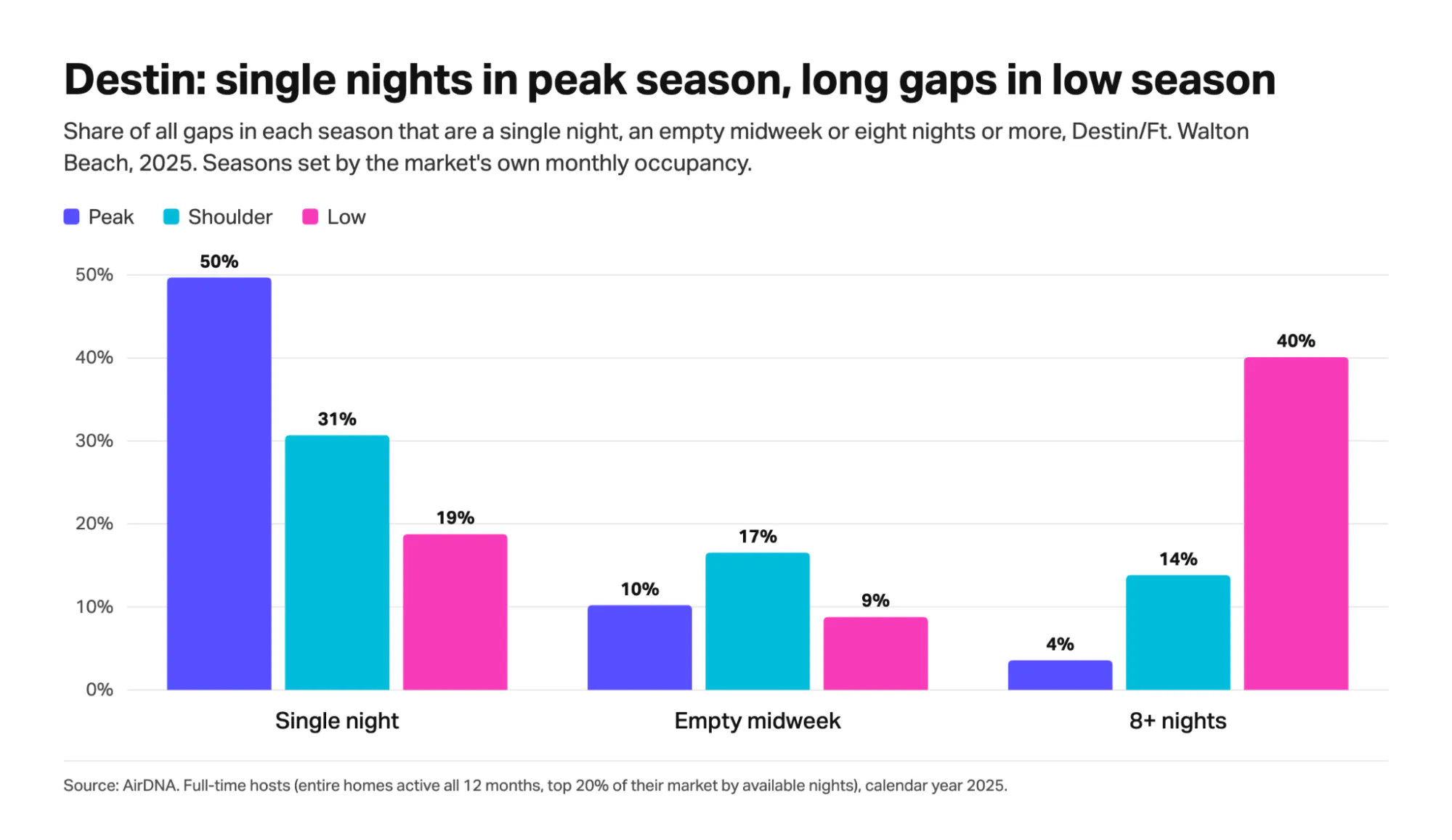
Destin: single nights in peak season, long gaps in low season
Destin/Ft. Walton Beach has the biggest swing of any top-50 market. In peak months (March and May through July), occupancy is 78%, six in ten stays turn over back-to-back, and half of all gaps are a single night. The three most common gaps are all single nights: a lone Sunday (12% of gaps), a lone Saturday (9%) and a lone Friday (8%).
During peak demand months, Destin runs on week-long stays that change over on Saturdays and Sundays. In 40% of cases, a lone Saturday follows a Saturday-to-Saturday stay, and the next guest arrives on Sunday for a stay of four to six nights. A lone Friday is usually the night before a long stay that starts on Saturday: 66% of the time, the next guest checks in Saturday for five to seven nights.
In the shoulder season (February, April and August through October), lone Fridays and Saturdays are still common, but more weekdays go unbooked. Empty midweeks rise from 10% of all gaps in peak season to 17% in shoulder season. The low season (January, November and December) is a different market. Occupancy drops to 34%, four in ten gaps run eight nights or more, and those long gaps make up 84% of all empty gap nights.
What it means for hosts: In Destin, the shoulder season is when hosts should adjust both price and minimum stay. As more of the week goes unbooked after summer, discounting weekday gaps and shortening the minimum stay gives those nights a better chance to book. The low season is different. Most empty nights then sit in stretches of eight nights or more, which reflect low demand overall, so short-gap discounts do little and broader pricing changes matter more.

Maui: single nights lead in every season
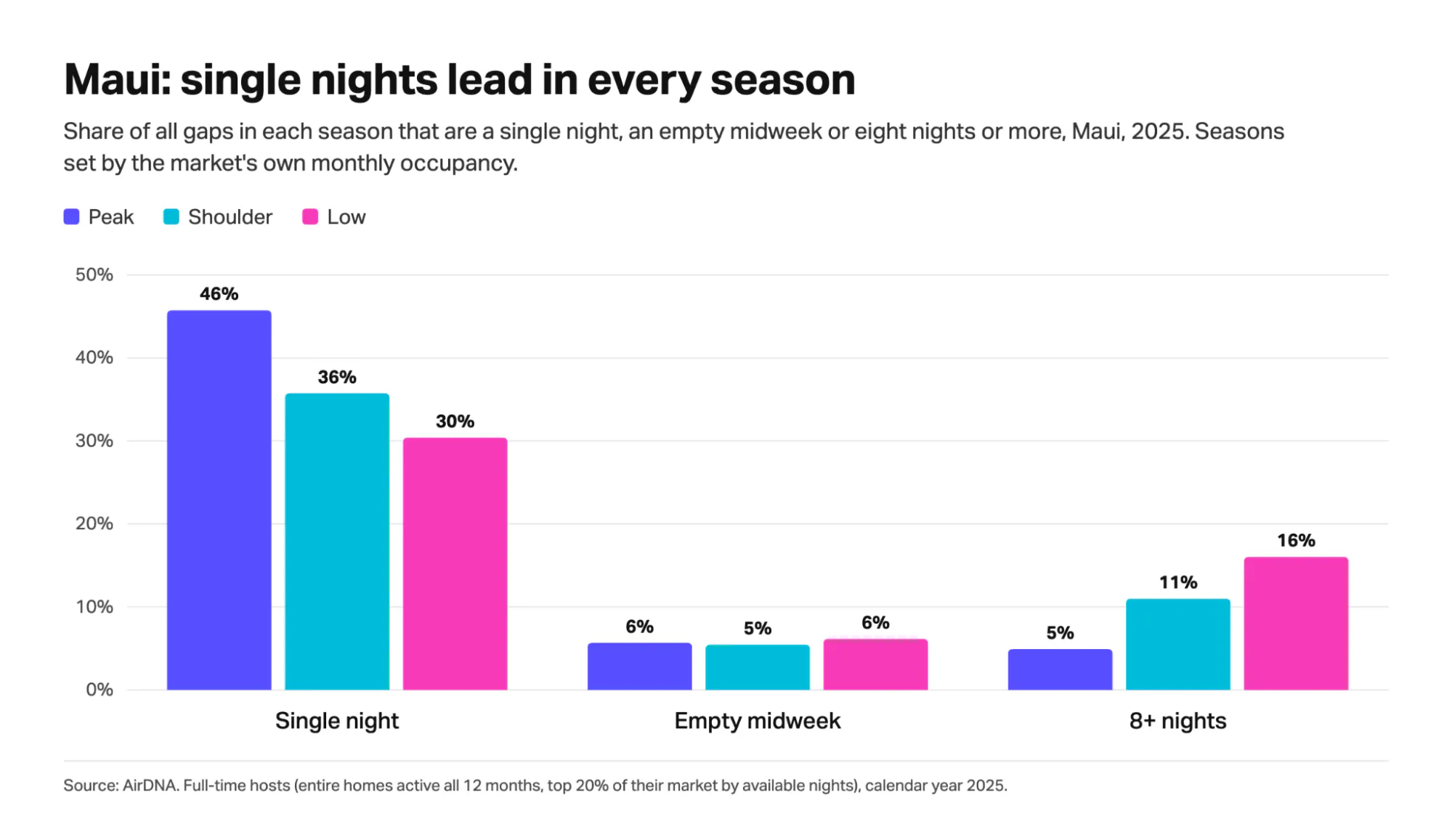
Maui is the least seasonal of our four markets. Occupancy only falls from 77% at peak (January through March) to 60% in the low season (April through November), and a single night is the most common gap in every season. Why so many single nights? In Maui, long trips start and end on every day of the week, and one night gets stranded when one guest’s checkout and the next guest’s check-in don’t quite line up. In a third of Maui’s single-night gaps, the stays on both sides last five nights or more. Since long trips run straight through the week, empty midweeks stay rare, at about 6% of gaps in every season, the fewest in the top 50.
What it means for hosts: Because Maui’s gaps aren’t tied to the day of the week, hosts should discount any short gap between two stays and shorten the minimum stay around it, so the stranded nights can book.
The takeaway: Every market needs its own strategy for filling gaps, and that strategy has to change with the seasons. A shorter minimum stay that fills lone nights in Destin’s peak season won’t help with the empty midweeks Gatlinburg sees in the shoulder season. Match your discounts and minimum stays to the gaps your market actually leaves, and adjust them as demand shifts.
What Are the Most Common Gaps in Your Market?
Use the dashboard below to look up the most common gaps in any of the 50 largest US markets. For peak, shoulder and low season, it shows the five most common gaps among full-time properties in 2025 and the share of stays that turned over back-to-back.
Bigger Homes Are Left With More Empty Midweeks
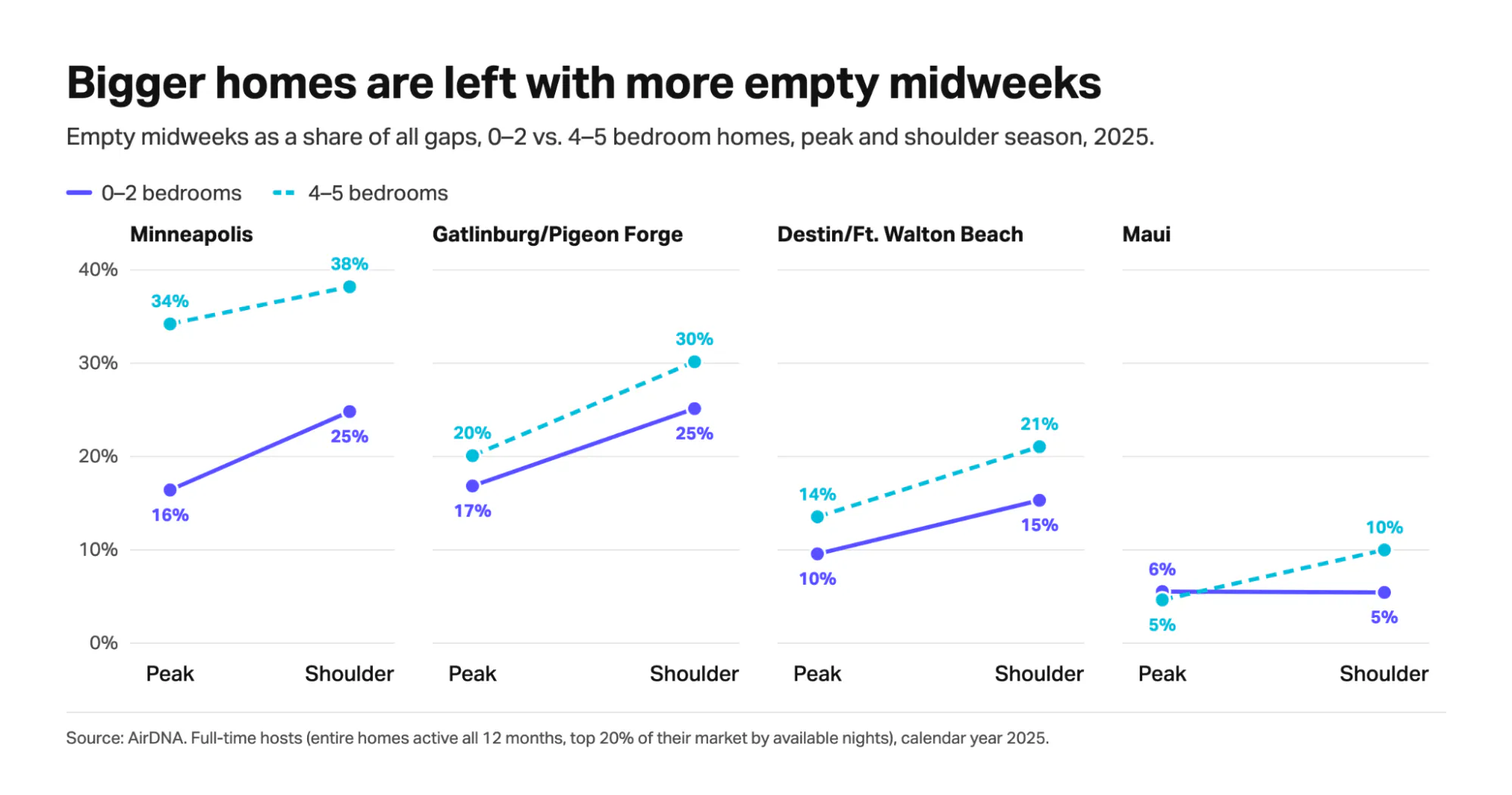
Gaps also look different depending on the size of your property. The clearest difference shows up when we compare empty midweek gaps for 0–2 bedroom homes with 4–5 bedroom homes. In Minneapolis, Gatlinburg/Pigeon Forge and Destin/Ft. Walton Beach, 4–5 bedroom homes are left with more empty midweeks than 0–2 bedroom homes in both peak and shoulder season. Maui, where empty midweeks are rare for any size of home, is the exception.
Why do bigger homes have more gaps midweek? It comes down to who books them. Smaller homes attract weekday guests like business travelers, couples and solo travelers. Larger homes rely mostly on groups, who tend to travel on weekends and holidays, so there are far fewer guests to fill the weekdays in between.
Minneapolis shows the biggest difference. Even in peak season, empty midweeks make up 34% of gaps at 4–5 bedroom homes, compared with 16% at smaller homes. By the shoulder season, it’s 38% of big-home gaps, compared with 25% at smaller homes. Big homes there run mostly on weekend group trips.
In Gatlinburg/Pigeon Forge, the difference opens up as the season slows. In peak season, 4–5 bedroom and 0–2 bedroom cabins see about the same share of empty midweeks, 20% and 17% of gaps. By the shoulder season, that grows to 30% for 4–5 bedroom cabins, compared with 25% for 0–2 bedroom cabins.
Destin/Ft. Walton Beach shows the same pattern on a smaller scale, since its week-long stays already cover most weekdays. In peak season, empty midweeks make up 14% of gaps at 4–5 bedroom homes, compared with 10% at 0–2 bedroom homes. In the shoulder season, that rises to 21% for larger homes and 15% for smaller ones.
In Maui, empty midweeks stay rare for every size, at about 5% to 6% of gaps. Larger homes do see a slight uptick in the shoulder season, when empty midweeks reach 10% of their gaps, compared with 5% at smaller homes.
The takeaway: The right strategy for filling gaps depends on the size of your home as well as the season. Larger homes are left with more empty midweeks and fewer single nights, so they need deeper weekday discounts and shorter weekday minimum stays, especially in the shoulder season. Smaller homes aren’t immune to empty midweeks, but they usually need a lighter touch.
How Do Gap Night Rules Increase Bookings?
Gap night rules increase bookings by making the open nights between stays easier to book. A gap night rule is a pricing setting that kicks in automatically when a gap opens, lowering the nightly rate, shortening the minimum stay, or both, so nights that wouldn’t book on their own have a better chance to fill. Many hosts use them, and pricing tools like Adapt let you set up gap night rules for any size gap and choose the minimum stay and price discount or premium for those nights.
Are gap night rules effective at increasing bookings? Our research on full-time hosts across the US suggests they are. Hosts who use sophisticated pricing tools, varying their price and minimum stay and setting calendar rules for gap nights, booked about two more nights a month than hosts with static prices, because they filled more of their gaps and turned longer gaps into shorter ones. Two nights a month may not sound like much, but at the average US nightly rate, it adds up to more than $6,000 a year.
How Do You Find and Fill the Gaps in Your Own Calendar?
If you’re a host, looking back at the gaps in your calendar is a great place to start building your gap night strategy. It shows you which gaps come up most often, and which gap night rules could help you fill more of your calendar. Here’s how:
- List every checkout from the last 12 months. Look at the gap after each one, name it by its checkout day and the last empty night before the next check-in, and count how often each kind of gap shows up. For example, a gap that starts after a Monday checkout and runs until a Thursday check-in is a Monday–Wednesday gap.
- Group your gaps so you can spot patterns. What share of your gaps are single nights? Empty midweeks (a Sunday or Monday through Wednesday or Thursday)? Gaps of a week or longer? And how does that change by season?
- Set gap night rules to match the patterns you see. If three-night gaps in the middle of the week are common in the fall and spring, that may be a sign to set up weekday gap night rules for those seasons. If you often see an orphaned Saturday night on your calendar, consider lowering your Saturday minimum stay to one night. Our length of stay by day of week analysis found that 27% of Saturday check-ins in the US are one-night stays.
When a gap night isn’t worth filling
Some gaps cost more to fill than they earn. If a turnover costs $125 to clean and restock and a discounted single night nets $100 after fees, booking it loses money. Fill a gap only when the discounted rate covers the turnover with room to spare. Two-night gaps usually do. Single nights are the ones to check.
How Do You Set Up a Gap Night Rule in Adapt?
With a revenue management system like Adapt, you can set up gap night rules and start closing the gaps in your calendar.
Say three-night gaps keep showing up on your calendar once the busy season ends. You might set up a 3-night gap rule. Whenever a three-night gap opens between two bookings, the rule drops nightly rates by 10% and lowers the minimum stay from three nights to one or two, so shorter trips can fill it.
You can also choose which days a rule applies to. Your 3-night gap rule can apply only when the gap falls on weekdays, so weekend gaps keep their own pricing.
And you can set the lead time window a rule applies in. Say you only want to discount a gap once you’re within 45 days of check-in. That’s usually good practice. Discounting nights while you’re still far out discounts demand that might book anyway at full price. Waiting until you’re inside your booking window means you only discount once you actually need to.
Not sure which rules to use? You don’t have to build them from scratch. Pick a pricing strategy and Adapt sets your gap night rules to match that goal automatically:
- Smart Yield optimizes your RevPAR, balancing nightly rate and occupancy to earn the most per night.
- Volume Builder prices at market and leans on discounts to keep occupancy high.
- Steady Earner fills early at a slightly lower rate for predictable income.
- Premium Hold is for hosts who would rather have an empty night than a cheap one.
Beyond gap night rules, Adapt updates your prices every day to match real-time market demand, so they move with your market from peak into shoulder and low season. Every calendar gap is revenue you’re losing, and Adapt helps make sure the price and minimum stay for each night on your calendar are set to maximize your bookings.
FAQs
What is a gap night in a short-term rental?
A gap night is an unbooked night, or run of nights, between one guest’s checkout and the next guest’s check-in. In AirDNA’s 2025 data for full-time hosts in the 50 largest US markets, the most common gap is a single open Sunday between a weekend stay and a Monday check-in.
What is an orphan night?
An orphan night is a single open night between two stays. It’s often too short to book under a two- or three-night minimum stay. Single nights make up about four in ten gaps in busy cities like Boston and San Jose/Palo Alto, and 45% of gaps in Oahu.
Which gap nights are hardest to fill?
Empty midweeks, three to five weeknights starting Sunday or Monday, are the classic hard-to-fill gap in getaway markets. More than a third of Big Bear’s gaps are an empty midweek, and in Gatlinburg/Pigeon Forge they reach 35% of gaps in January and February.
How do you avoid one-night gaps between bookings?
Use gap night rules that lower the minimum stay to one night and discount the open night when a single-night gap appears. A lone Saturday is a good candidate, since 27% of Saturday check-ins in the US are one-night stays. Hosts who vary price and minimum stay with rules like these booked about two more nights a month than hosts with static prices.
When is a gap night not worth filling?
When the discounted rate doesn’t cover the turnover. If cleaning and restocking cost $125 and a discounted single night nets $100 after fees, booking it loses money. Two-night gaps usually cover the turnover. Single nights are the ones to check.
About the Data
This analysis uses AirDNA data for calendar year 2025 across the 50 largest US short-term rental markets. It includes full-time hosts only: entire-home listings that were active all 12 months, in the top 20% of their market by nights available to book, with a current minimum stay of 14 nights or less.
A gap is the run of open nights between one guest’s checkout and the next guest’s check-in. Each gap is named by its first and last open night, so a guest who checks out Monday followed by a guest who checks in Thursday leaves a Monday–Wednesday gap. Same-day turnovers count as back-to-back, with no gap. Nights the host blocked are not counted as open, and gaps split up by blocked nights are left out of the gap counts. Each gap is counted in the month of the checkout that opens it.
Seasons are set by each market’s own 2025 occupancy, based on all listings in the market. Months in the top third of the market’s occupancy range are peak, months in the bottom third are low, and the rest are shoulder.
ARTICLE SUMMARY
AirDNA analyzed every 2025 checkout from full-time hosts in the 50 largest US markets to find the most common gap nights between bookings. A single open Sunday leads, empty midweeks dominate getaway markets and shoulder seasons, and bigger homes are left with more weekday gaps. Here’s how to match gap night rules to the gaps your market actually leaves.
Linda Rollins
Senior Research Analyst
Linda Rollins is a Senior Research Analyst at AirDNA and a self-managing short-term rental host, which means she understands the market as both an analyst and an operator. She writes research and blogs for AirDNA and for Adapt, its revenue management tool, making her work a go-to resource for investors trying to find and size up the right opportunities, and for operators looking to understand changing market dynamics and find concrete ways to improve occupancy, rates, and guest experience. Her data is regularly cited in major news outlets, and she has a knack for bringing both the numbers and the story behind them. In her free time, Linda enjoys spending time with her family, traveling, and looking for good eats.