

 Calculate Revenue
 Research Markets
 Find For Sale Properties
 Compare My Listing
 STR Revenue Calculator
 Custom Comp Sets
 Submarket Insights
 Custom Search Filters
 Rate Recommendations
 Performance Benchmarking
 Competitor Comparison
 Owner Contact Details
 Property-level performance data
 Tourism Insights
 Real Estate Investment Analytics
 About Us
 Sales
Sales Support
 Press
PressU.S. Review January 2026: Bookings Warm Up as Western Ski Markets Endure Snow Drought
Published: February 17, 2026
Last updated: February 18, 2026

Bram Gallagher
Key Takeaways:
- Bookings are up 5.5% year-over-year (YoY0 in January and forward pacing is strong into spring and summer, supported by events like the 2026 World Cup.
- Supply growth continues to outpace demand, pushing occupancy down 1.5% YoY to 48.4%, even as ADR and RevPAR post modest gains.
- Market performance is diverging by destination type, with strong growth in small cities, coastal markets, and eastern ski destinations, while western ski markets lag due to poor snow conditions.
January offered an early pulse check on how 2026 is shaping up for U.S. short-term rentals. Bookings accelerated, supply growth reawakened, and regional performance diverged sharply, particularly in weather-dependent ski markets. At the same time, strong spring break pacing and World Cup-driven summer demand are setting the stage for a year that may look steadier and more competitive than the last.
At a Glance: Key U.S. STR Performance Metrics for January 2026
- Revenue per Available Rental (RevPAR) increased 2.1% year-over-year (YoY) to $119.27
- Available listings reached 1.68 million, a 4.2% increase YoY
- Demand nights were up 2.5% in December
- Occupancy averaged 48.4%, down -1.5% YoY
- Average Daily Rates (ADR) climbed to $246.62, up 3.6% from last year
- The Repeat Rent Index (RRI) rose 4.4% YoY
- Total nights booked were up 5.5% from January 2025
Economic Outlook
Economic data in January came in stronger than expected. Total employment increased by 130,000 jobs, the largest monthly gain since December 2024, and just 50,000 short of the total jobs added in all of 2025. As a result, unemployment edged down to 4.3% from 4.4%. Inflation also eased, with the Consumer Price Index rising 2.4% year-over-year, down from 2.7% in December. This is evidence that the impact of the April 2025 tariff increases continue to fade.
Despite this progress, inflation remains above the Federal Reserve’s 2% target, and continued strength in the labor market may delay further interest rate cuts. While the Fed reduced rates at the end of 2025, mortgage rates have only edged down slightly. They fell from 6.16% to 6.10% in January, according to Freddie Mac.
Looking ahead, Oxford Economics expects mortgage rates to remain near 6.1% over the next year, as current short-term rates are close to “neutral” levels that are neither expansionary nor contractionary. Further rate cuts may be limited or short-lived, particularly if inflationary pressures persist.

Lower mortgage rates should help ease conditions in the housing market and support continued STR investment, though not at the pace seen after pandemic restrictions were lifted. Additional support may come from fiscal measures, including tax benefits from the recent budget plan and infrastructure spending rolling out over the year.
AirDNA expects occupancy to remain relatively soft in 2026 as supply growth slightly outpaces demand. However, there is meaningful upside risk compared with 2025 that’s driven by potential productivity gains from AI and broader efficiency improvements. These could support income growth without adding inflation.
Major events will also support demand. The 2026 World Cup is expected to boost travel, particularly as a favorable exchange rate makes the U.S. more attractive to European travellers. Tighter tourism controls in parts of Europe may further redirect demand toward U.S. destinations.
Listing Growth Reaccelerates After a Slowdown
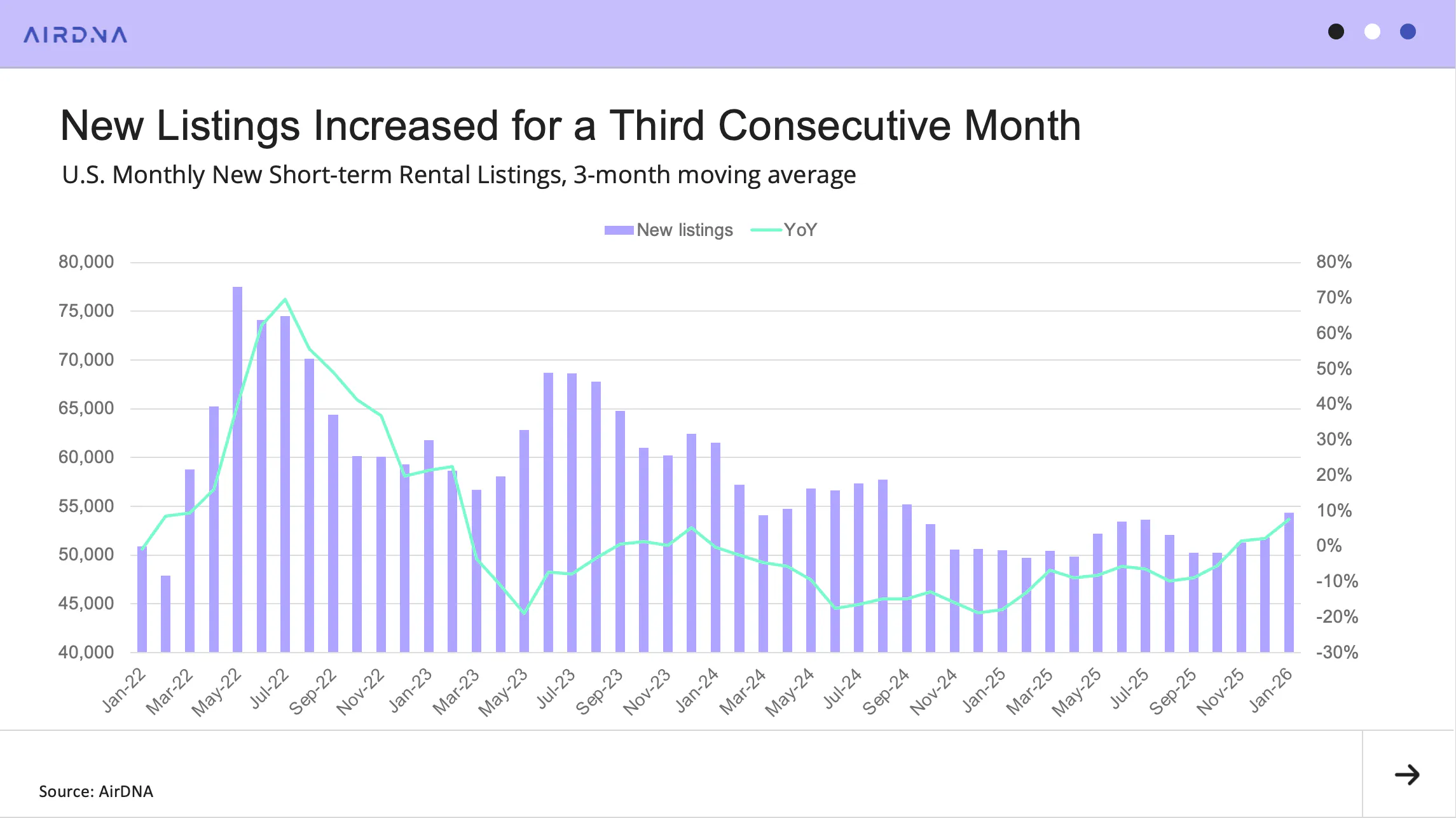
After a prolonged decline following the record highs of 2021, new listing growth bottomed out in mid-2025 and has gradually recovered since. In January, available listings rose 4.2% year over year, supported by renewed growth in new listings.
New listings increased 7.6% in January, marking a third consecutive month of growth after nearly two years of year-over-year declines. With supportive economic conditions in place, AirDNA expects this acceleration in supply to continue through 2026.
Demand and Bookings Show Early-Year Momentum
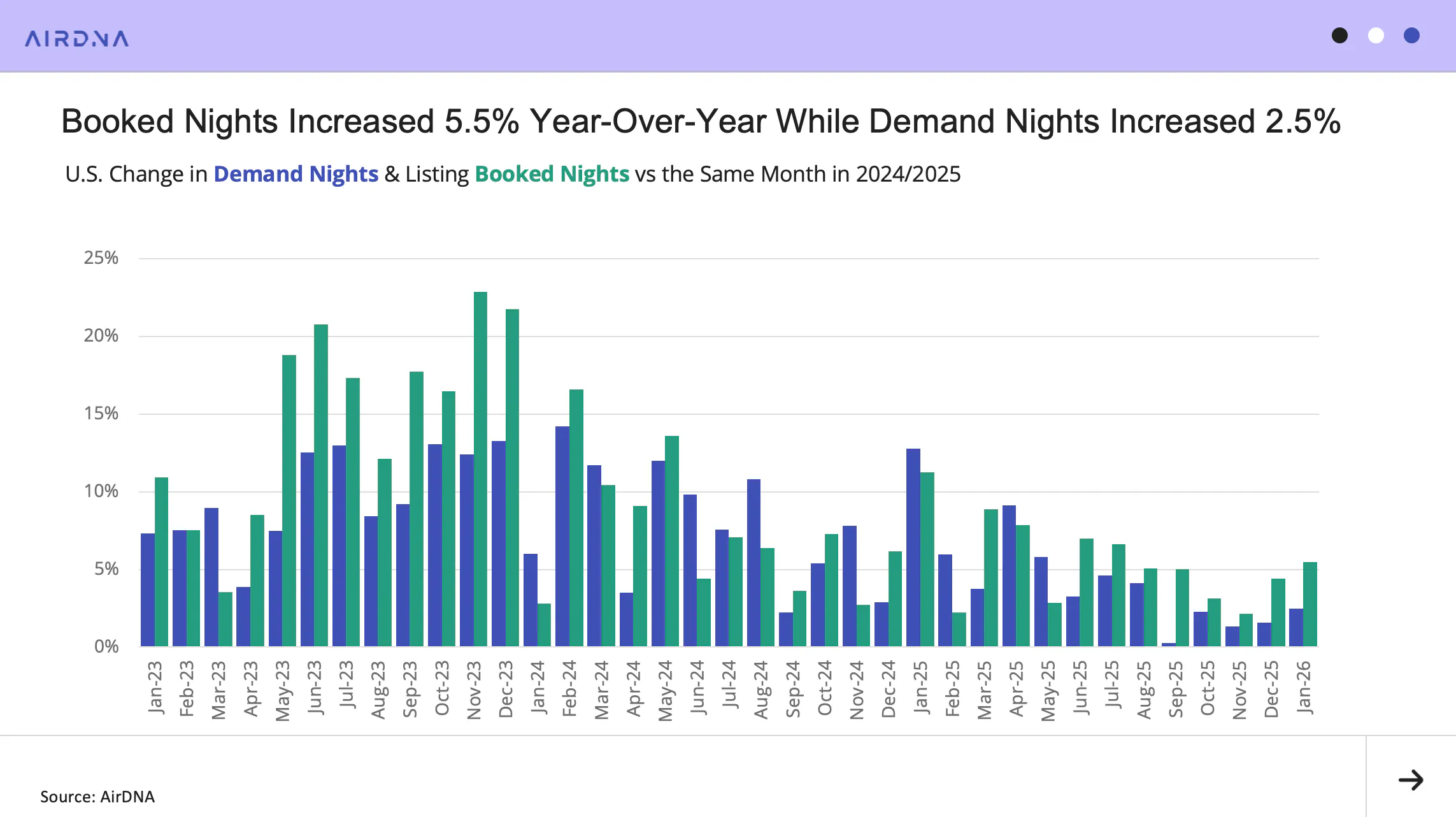
January is a key month for short-term rental bookings, typically accounting for 9–10% of total annual bookings. New year budgets and winter travel planning often prompt guests to begin booking spring and summer trips early, meaning January momentum can set the tone for the year ahead.
In 2026, bookings in January rose 5.5% year over year. This is fastest growth pace since July and the second consecutive month of acceleration, signaling a positive start for demand.
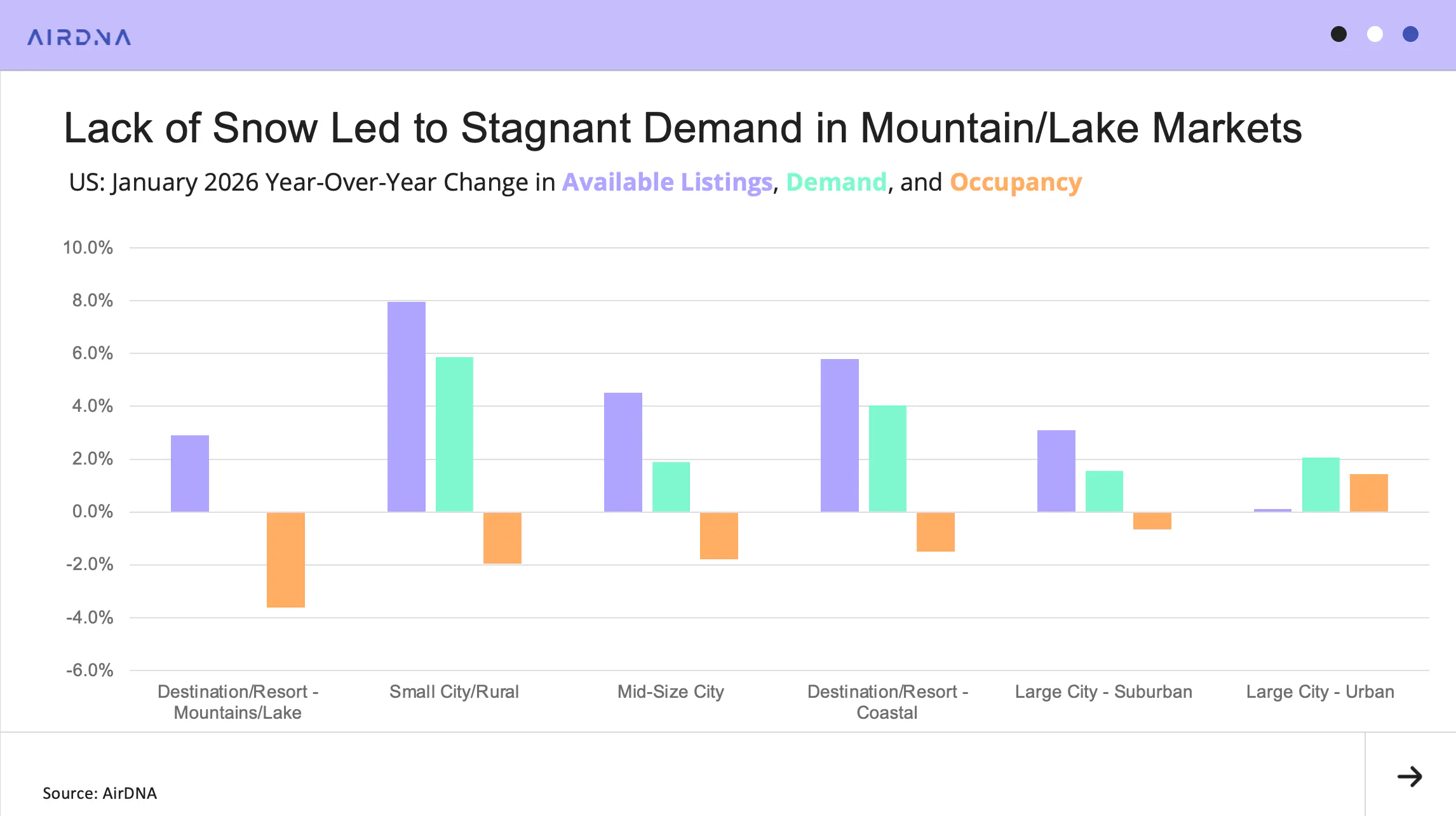
Nights stayed increased 2.5% year-over-year (YoY), though performance varied by location type. Small City/Rural destinations led demand growth, with nights stayed rising nearly 6% YoY. Coastal markets follow at 4% growth. Mountain/Lake destinations lagged behind, with demand largely flat.
Learn from your competitors
Without reliable rental comps, you're making pricing decisions in the dark. Use real data to compare your listing performance to similar properties and discover your true market position.
Ski Markets Lag as Weather Disrupts the Season
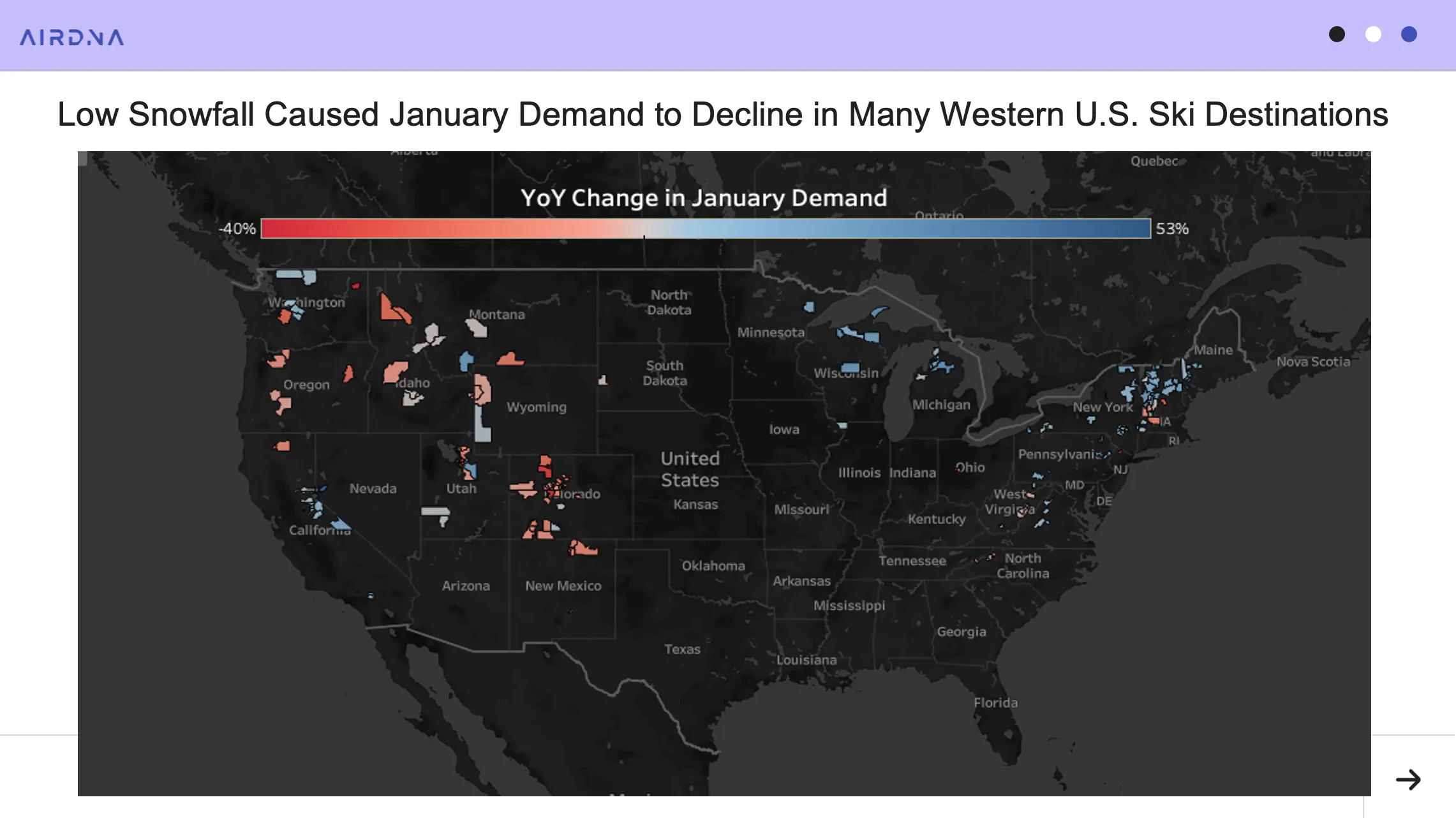
Unseasonably warm temperatures and dry conditions led to record-low snowpack across many western ski destinations in January, contributing to flat demand in mountain resorts. With slopes only partially open, short-term rental demand declined year over year in several markets.
Colorado and Utah ski destinations saw the steepest drops, with demand falling more than 10% YoY in markets such as Telluride, Steamboat Springs, Winter Park, and Taos.
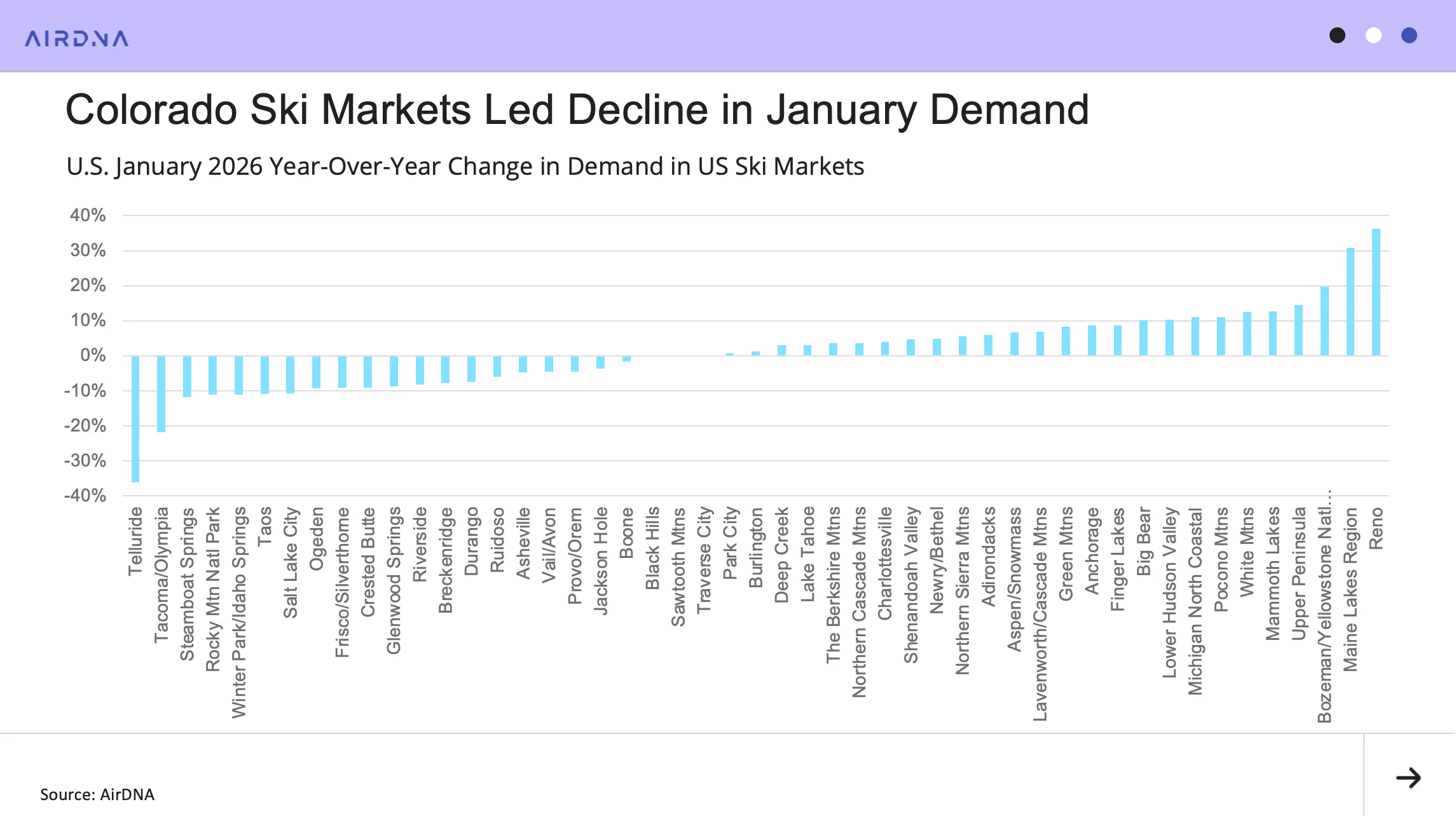
While the performance on western ski slopes suffered, performance on eastern ski slopes was generally stronger. Popular ski destinations in New York, New Hampshire, Vermont, and Maine saw more than 10% YoY demand night growth in January.
Occupancy Softens as Supply Outpaces Demand
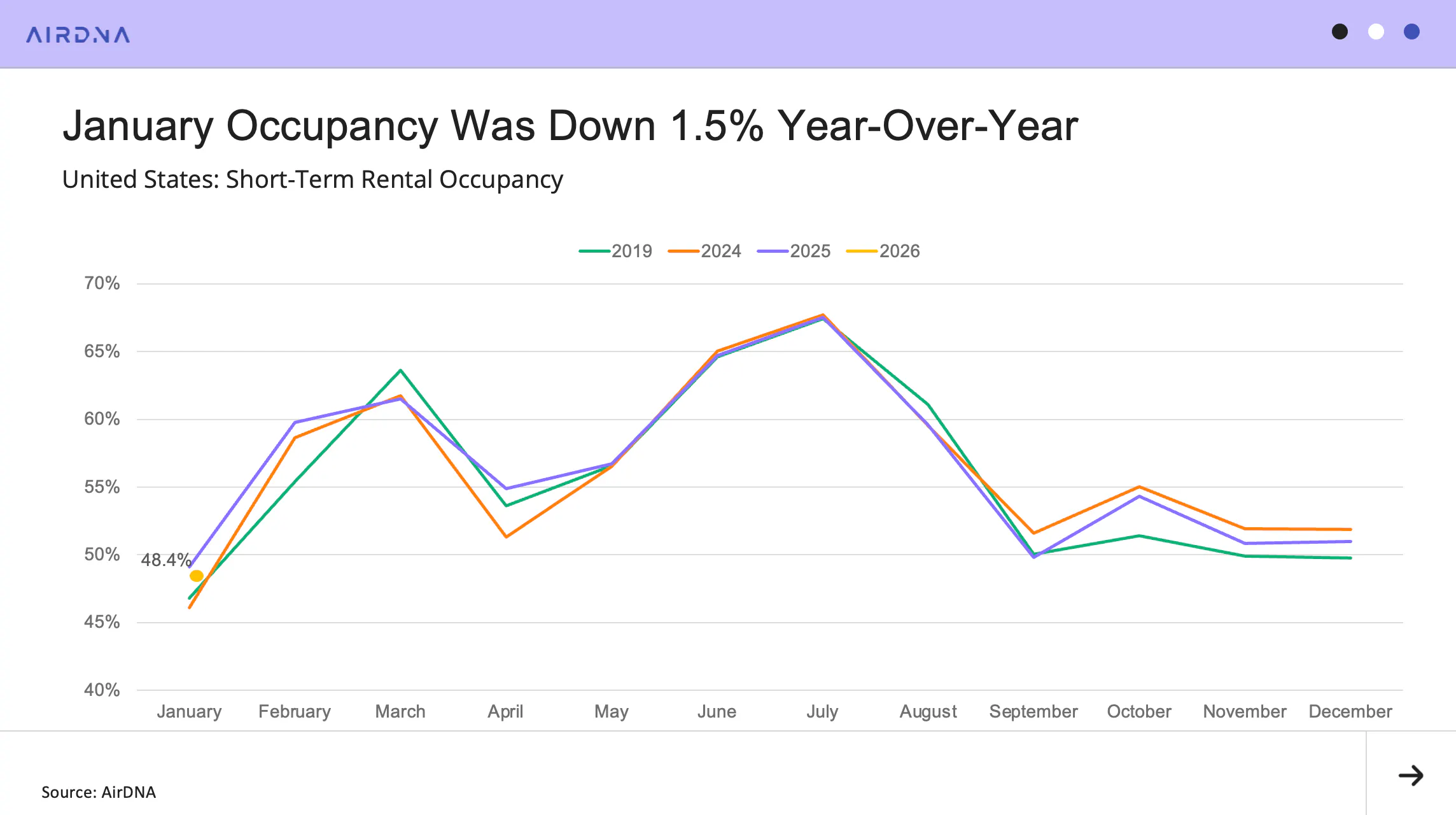
As listing growth edged ahead of demand in January, occupancy fell 1.5% year-over-year (yoY) to 48.4% across U.S. markets. This continues a pattern of YoY declines that began in August 2025, when available listings started to recover.
At the same time, low consumer confidence, persistent inflation, and the prolonged government shutdown weighed on demand growth. Despite this, January occupancy remained above both January 2024 and 2019 levels.
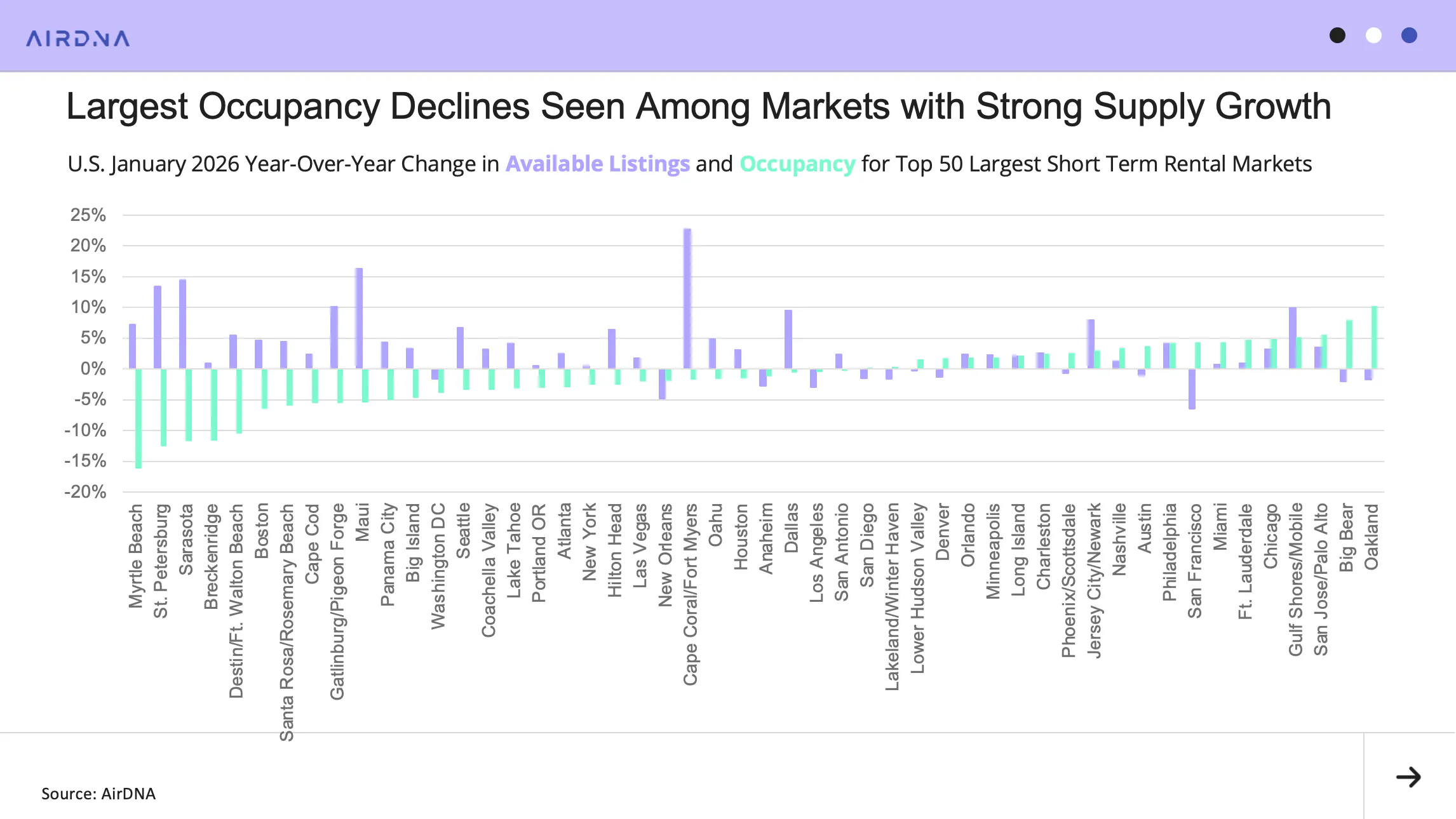
Markets with the fastest supply growth generally saw the largest occupancy declines. Several Florida beach destinations were among the weakest performers, where listing growth of 5–15% YoY placed downward pressure on occupancy.
Forward Pacing Signals Strong Spring and Summer Demand
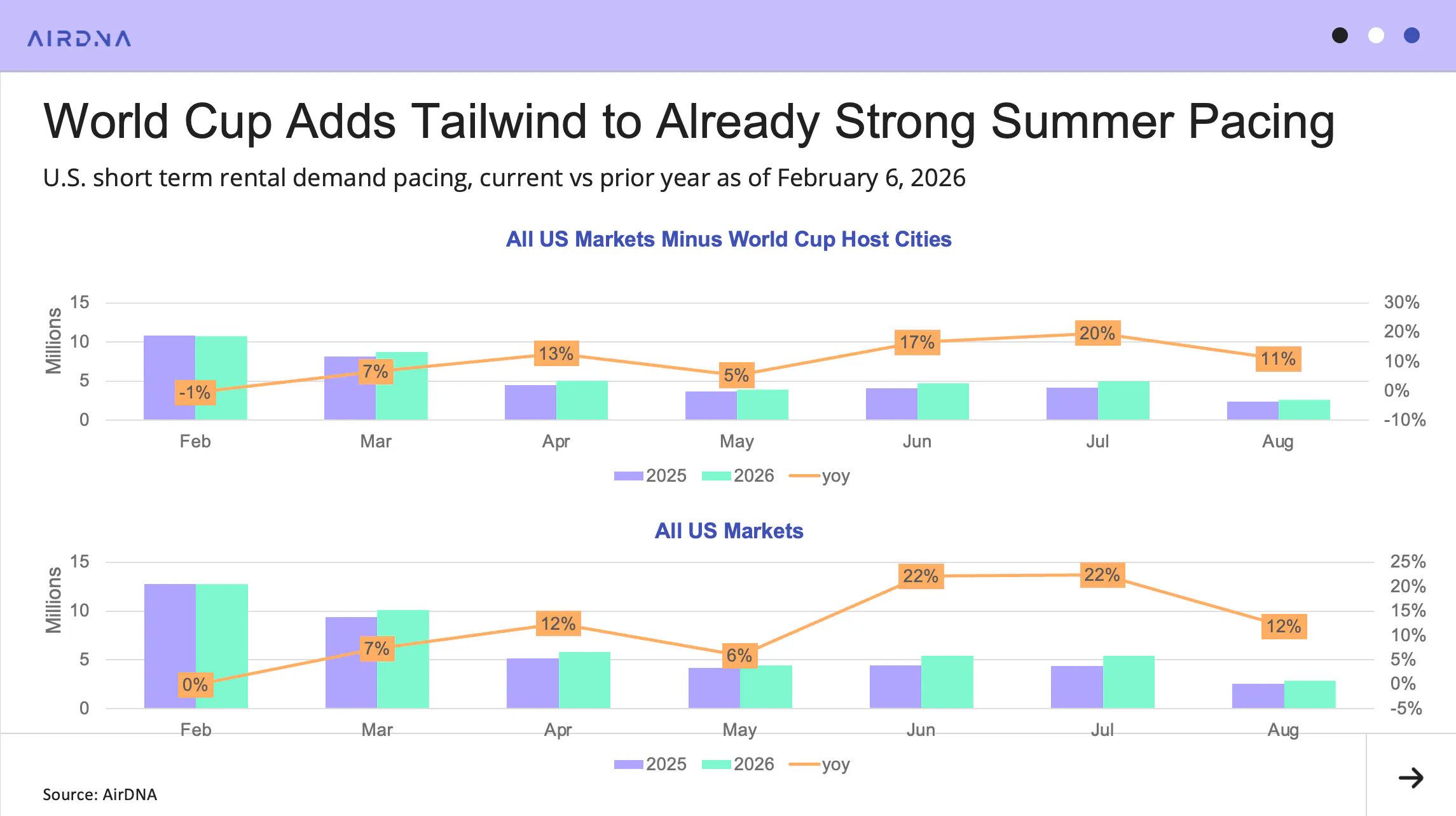
Looking ahead, demand pacing remains a bright spot. March bookings are up 7% year-over-year (YoY) and April bookings are up 12%, pointing to steady spring demand.
Summer demand is also strengthening, supported by the upcoming World Cup. Bookings for June and July are up 22% YoY, with strong gains in host markets such as Philadelphia, Los Angeles, Miami, Dallas, Kansas City, Seattle, and Atlanta. Even when excluding these host cities, pacing remains solid. June bookings are up 17% and July bookings are up 20%, indicating broad-based demand growth across U.S. markets.
Get reliable data for smarter investment decisions
AirDNA allows you to handpick the active short-term rentals that align with your investment criteria and shows you exactly how a similar property performs in the real world.
Lead Times Continue to Shorten Across Segments
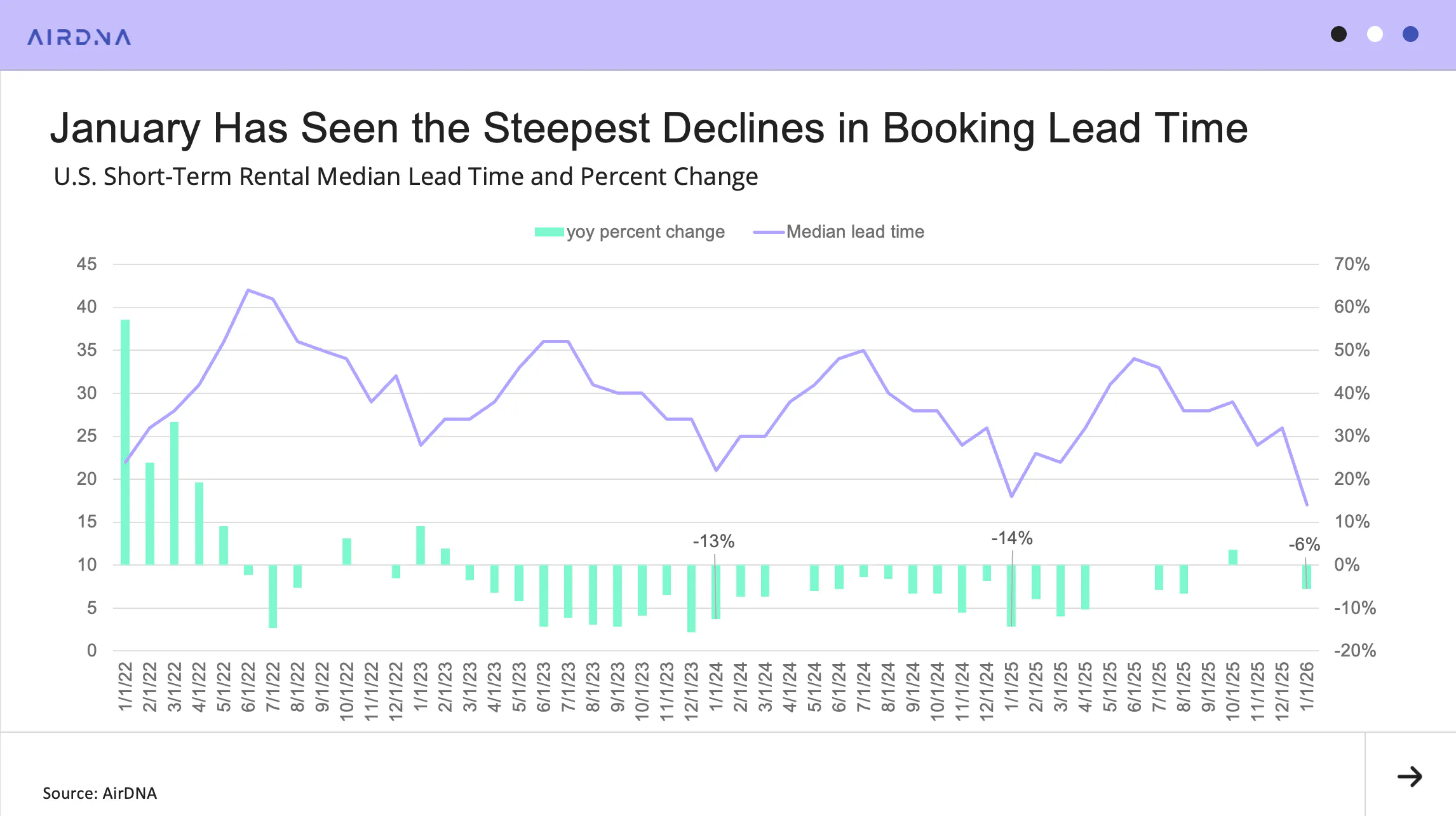
Lead times continued to decline in January, extending a multi-year trend. Median lead time fell from 21 days in January 2024 (down 13% YoY) to 18 days in January 2025 (down 14% YoY), and declined again to 17 days in January 2026, a further 6% year-over-year decrease.
However, since May, changes in lead time have moderated. Declines are smaller than the previous year and there are periods of stability. October even saw a slight increase in lead times, the first since January 2023.
Shorter lead times are most pronounced in lower price tiers. In January, 30% of budget stays and 28% of economy stays were booked within five days of arrival. Upscale and luxury properties also saw a meaningful share of last-minute bookings, though at lower levels. 24% of upscale stays and 22% of luxury stays are booked within five days.
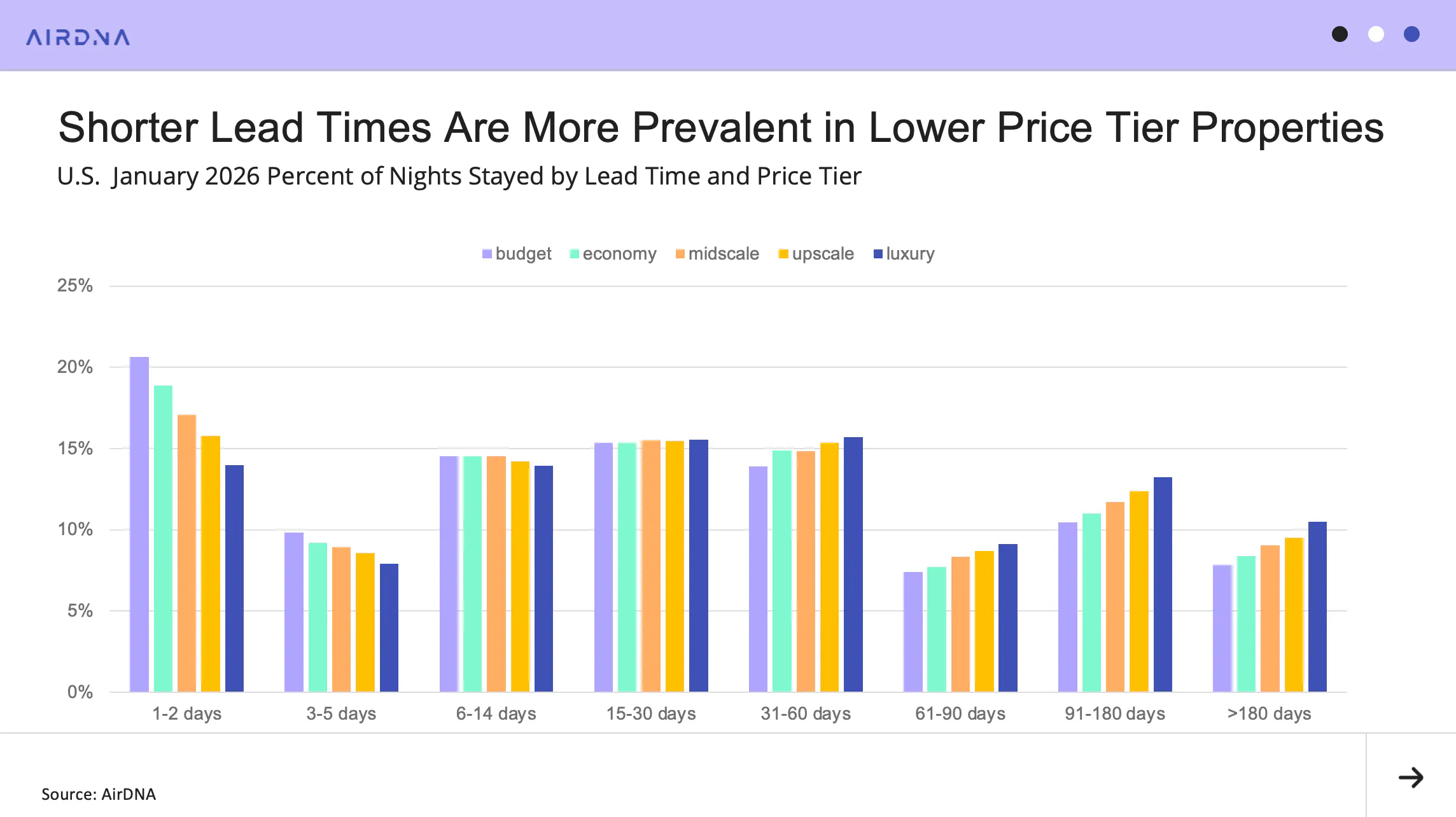
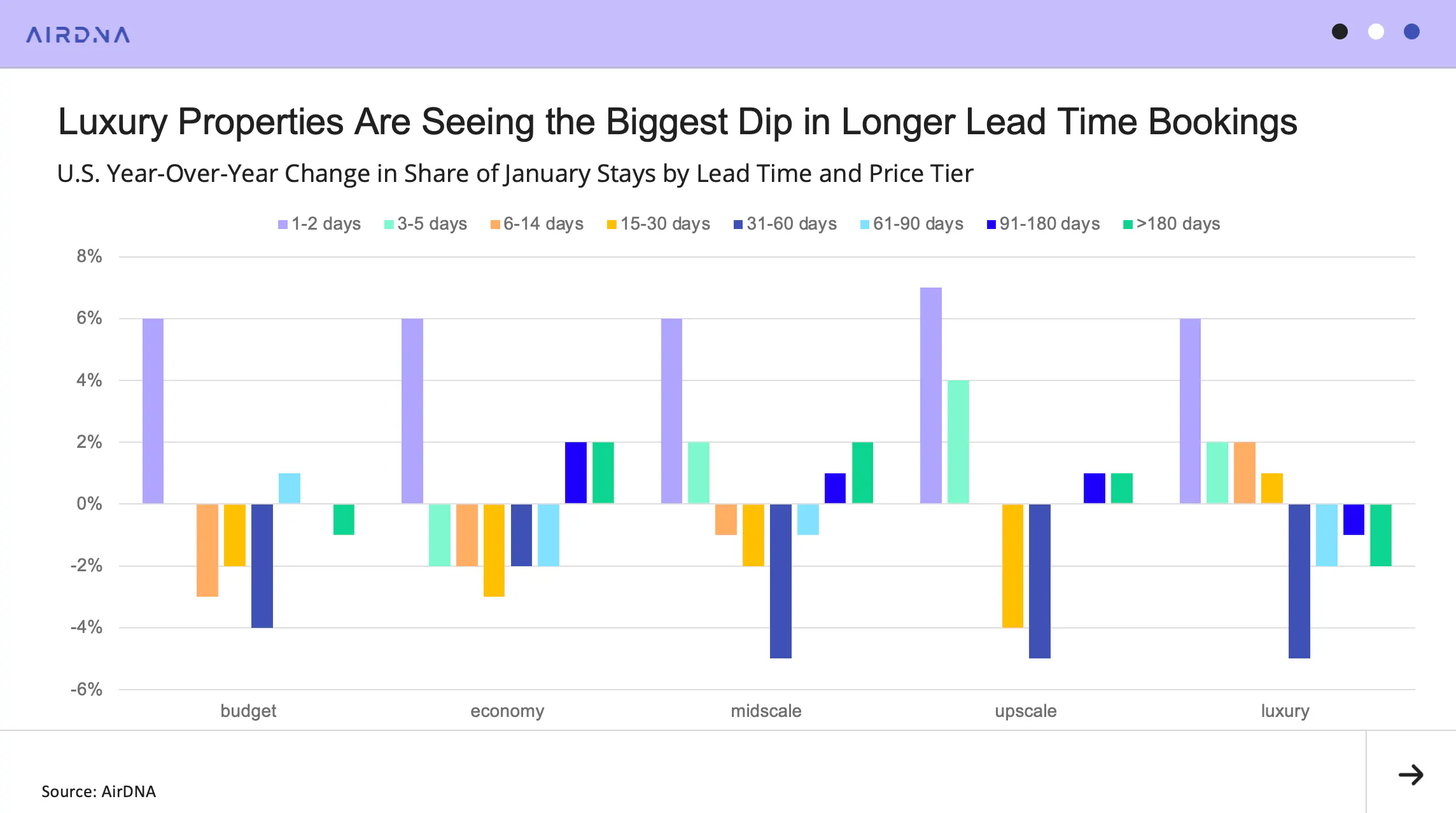
At the same time, luxury properties continue to capture the largest share of longer lead-time bookings, with one third of stays booked more than two months in advance. However, luxury also saw the steepest year-over-year decline in longer lead-time bookings. Stays booked more than 30 days in advance lost share.
In contrast, economy, midscale, and upscale segments saw an increasing share of bookings made more than three months in advance, suggesting a growing mix of early planners alongside last-minute travellers.
Spring Break Travel Patterns and Market Leaders
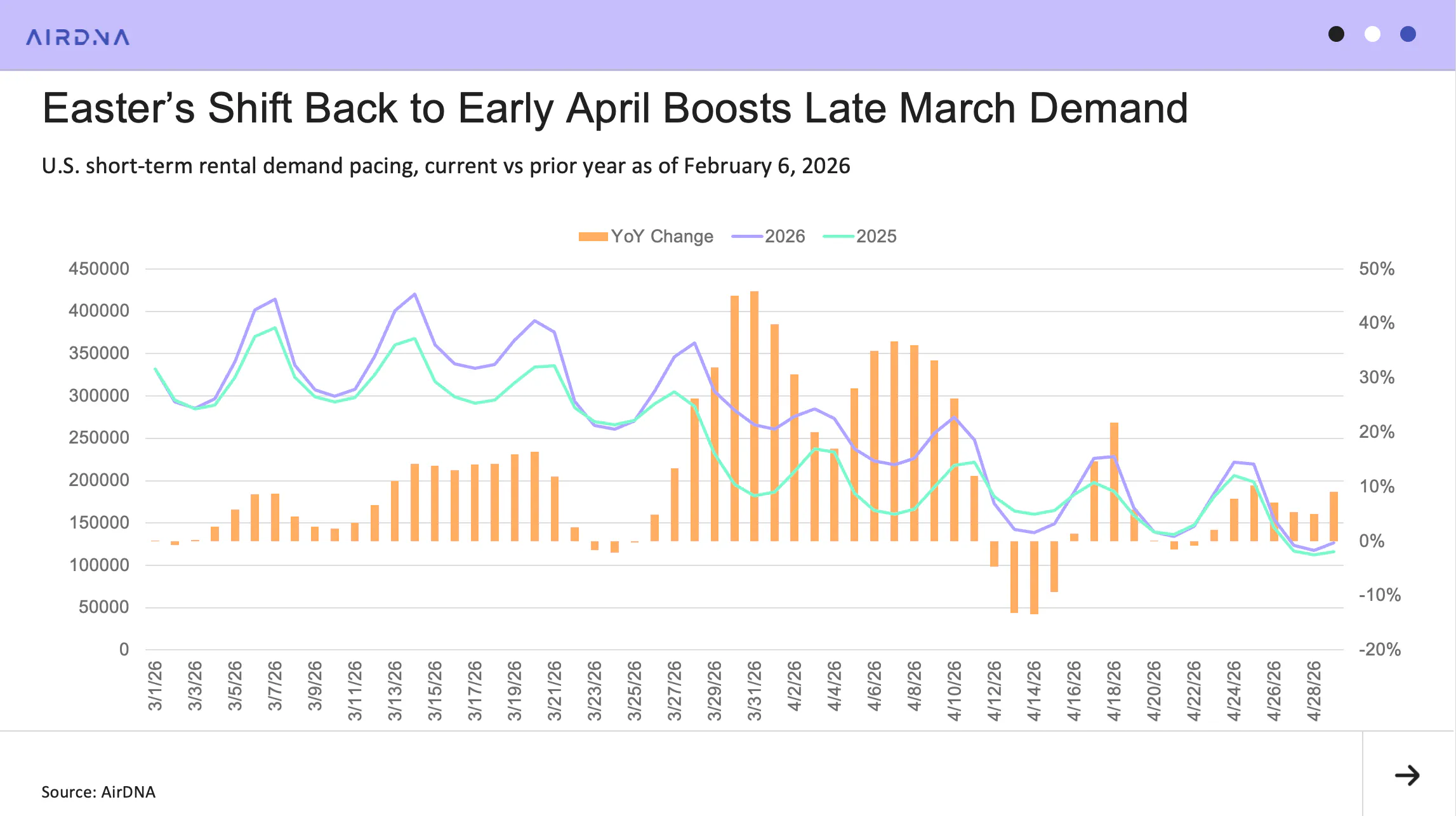
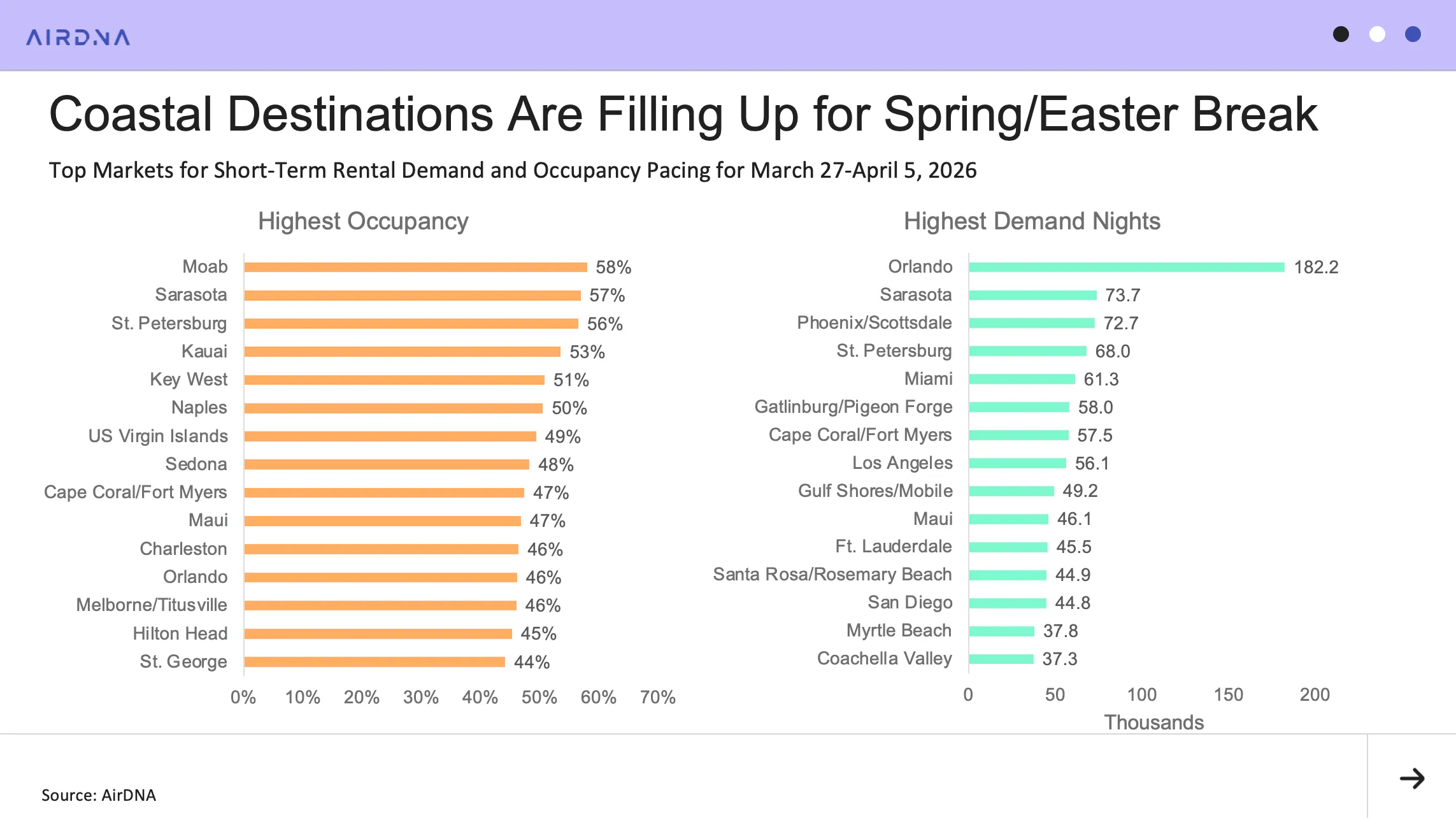
Spring break demand is showing strong pacing across both March and April, as Easter shifts back to early April after falling later in the calendar last year. Over the past few years, spring break travel has moved between March and April depending on the calendar. In 2026, demand is spread across both months, supporting strong pacing in each.
Coastal destinations are leading in both demand and occupancy, with Florida markets along the western coast of the peninsula seeing especially high occupancy. These markets had been recovering from recent hurricane impacts. Cape Coral and Fort Myers, which were heavily affected by Hurricane Ian, now have approximately 3,500 more listings than in August 2022, before the storm.
Alongside beach rentals, adventure destinations are also gaining traction. Moab has moved to the top of the list in recent weeks, suggesting that many spring break travellers are combining traditional beach trips with outdoor and activity-focused travel.
More nights booked, less guesswork
Discover how your listing stacks up on occupancy, seasonality, and lead time. Compare with top-performing rentals nearby.
ARTICLE SUMMARY
In January 2026, U.S. demand and bookings showed early-year momentum while supply continued to expand, putting pressure on occupancy. Strong forward pacing into spring and summer, supported by the 2026 World Cup, points to continued growth despite softer occupancy levels.
Bram Gallagher
AirDNA Director of Economics and Forecasting
Bram Gallagher is an Economist at AirDNA, specializing in uncovering insights that drive smarter short-term rental decisions. He put his Ph.D. in Economics from the University of Georgia to work researching and forecasting hotel data with CBRE prior to joining AirDNA, as well as teaching economics at a number of universities. In his spare time, Bram enjoys making wooden furniture with hand tools.
