


Airbnb Weekend vs. Weekday Pricing: How Occupancy Should Set Your Rates
Published: July 31, 2026
Last updated: October 22, 2026

Linda Rollins

Key Takeaways
- Occupancy patterns, not fixed calendar rules, determine when weekend premiums make sense.
- Markets with strong seasonal swings, like Gulf Shores and Gatlinburg, require different pricing strategies throughout the year, while steady-demand markets like Maui do not.
- Dynamic pricing works best when it adapts to changing demand, allowing rates to reflect current market conditions rather than static pricing rules.
In Gulf Shores, Alabama, weekend nights in January book for 10–15% more than weekdays. By July, that premium has almost disappeared.
The calendar hasn't changed. Demand has.
In the quieter winter months, travelers mostly book short weekend breaks, so Friday and Saturday nights command a clear premium. By summer, longer vacations fill the entire week, weekday occupancy catches up, and the pricing gap largely disappears.
The same principle applies in every short-term rental market. The rates you're able to charge on any given night aren't determined by whether it's a Friday, a holiday, or the middle of July. They're determined by demand. When occupancy rises, guests compete for fewer available properties and rates can follow. When demand softens, pricing power falls with it.
In this report, we'll look at three very different markets to show how occupancy shapes pricing throughout the year, and why understanding your local demand patterns is the key to maximizing revenue. We'll also show how AirDNA Adapt automatically adjusts rates as those patterns change, so your pricing reflects the market you're in rather than a fixed set of rules.
How Demand Changes Throughout the Year
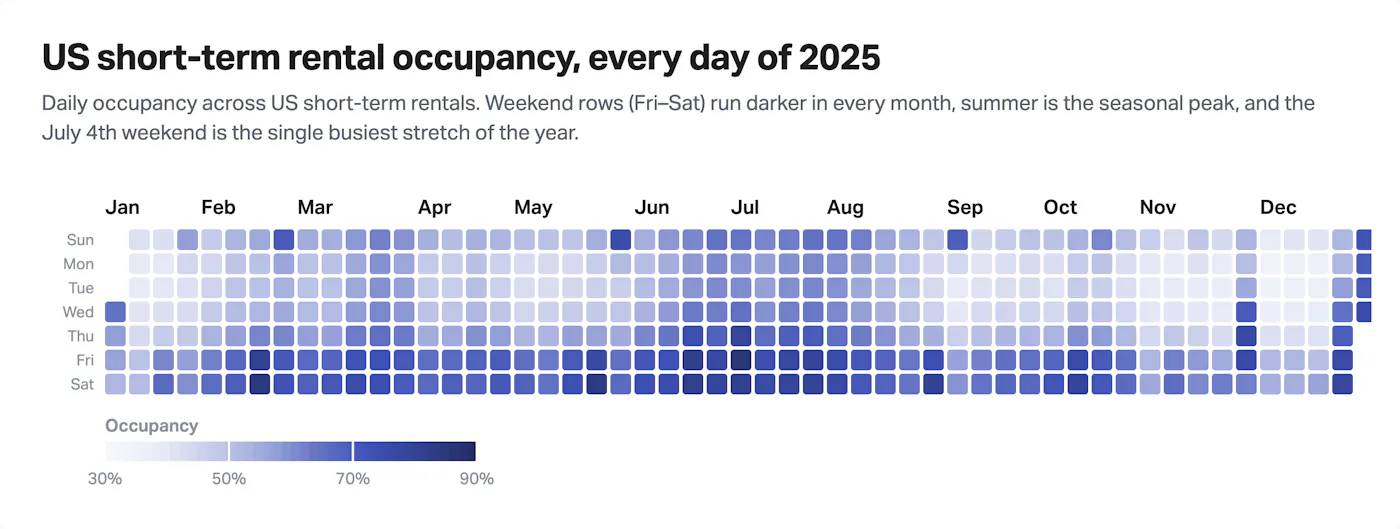
Travel demand changes day to day and month to month. Looking at daily occupancy across U.S. short-term rentals in 2025 reveals three clear patterns:
- Friday and Saturday are the busiest nights of the week. Weekend occupancy consistently outpaces weekdays throughout the year.
- June and July are peak season. Occupancy reaches its highest levels during the summer, with weekday demand approaching weekend levels. January, by contrast, is one of the slowest months of the year.
- Holidays create demand spikes. July 4 was the busiest day of 2025, with occupancy reaching 86%. Presidents' Day weekend, Memorial Day, Labor Day, Thanksgiving, and Christmas also drive strong demand across U.S. short-term rentals.
These are national patterns, but occupancy trends vary considerably from market to market. To understand how those differences influence pricing, we analyzed three distinct markets and how their occupancy patterns shape the rates hosts can command.
Gulf Shores, AL: Weekend Premiums Come and Go With the Seasons
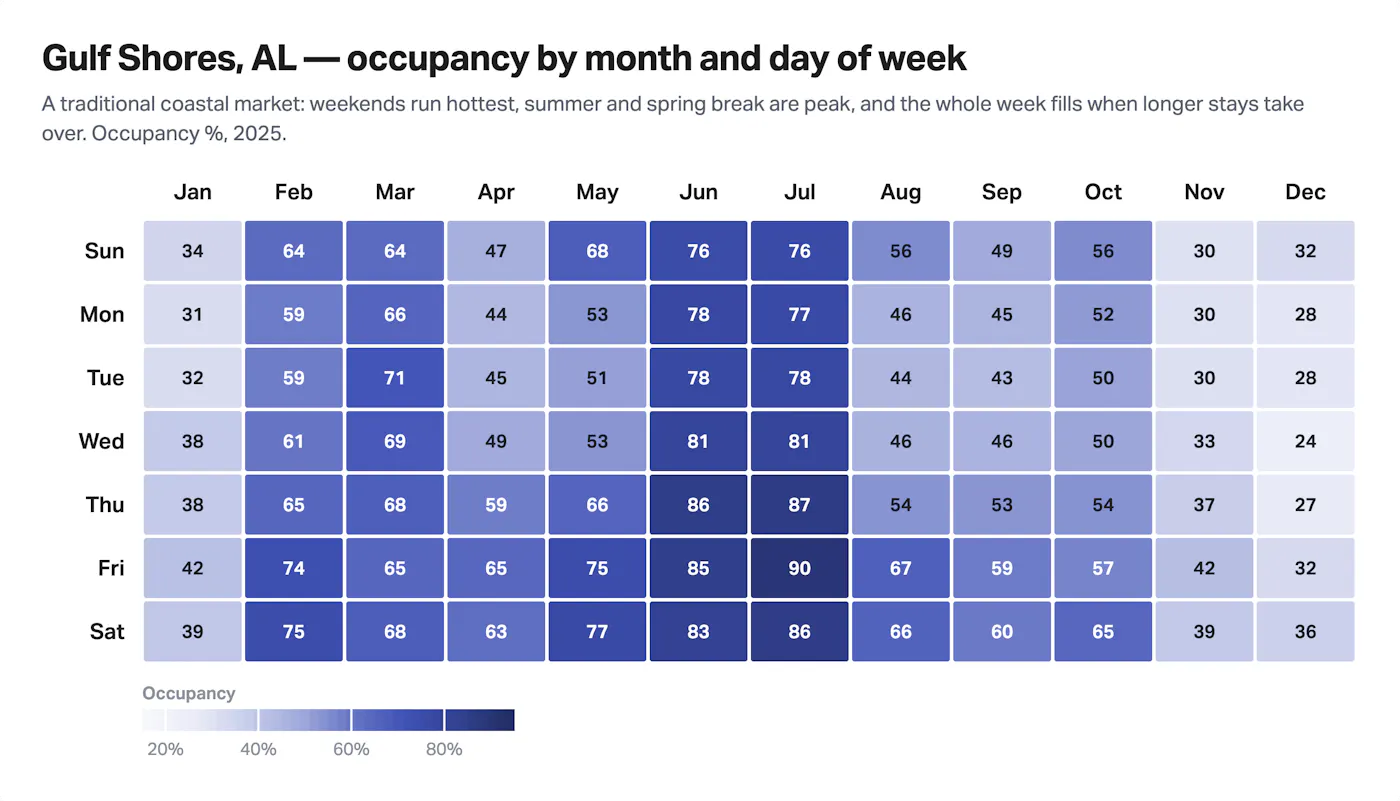
Gulf Shores is a traditional coastal vacation market, and its occupancy trends closely mirror those of many U.S. beach destinations. Fridays and Saturdays consistently have the highest occupancy, while demand peaks during the summer months and spring break.
During the peak demand periods of March, June, and July, longer stays become more common and weekday occupancy rises to nearly match Friday and Saturday levels. During slower months such as November and December, however, weekend occupancy runs 20-40% higher than weekdays.
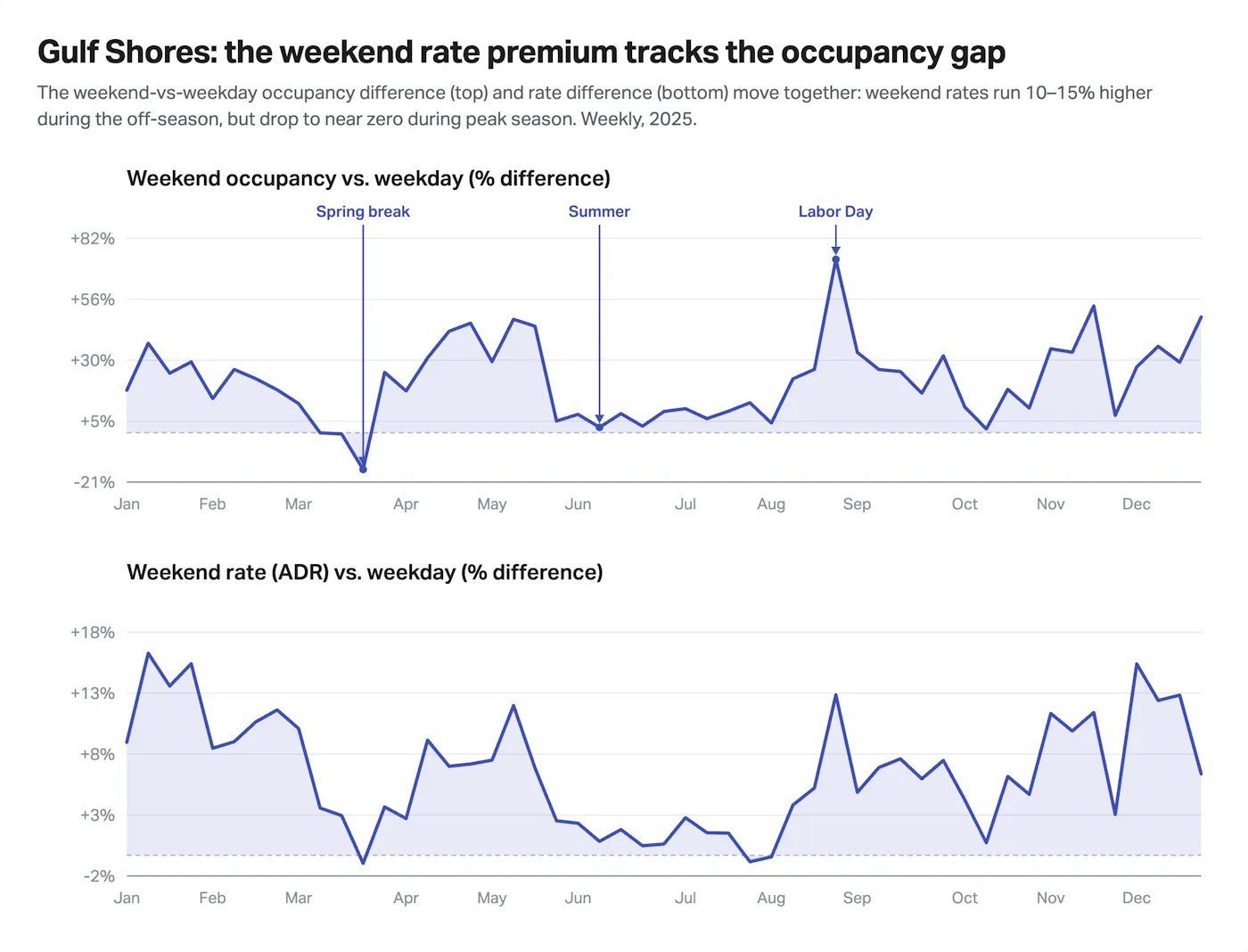
That pattern is reflected in booked rates. During peak season, when weekday and weekend occupancy are similar, the difference between weekday and weekend rates is negligible, at less than 5%. In November, December, and January, by contrast, weekend rates run 10-15% higher than weekdays, reflecting the much stronger weekend demand. Labor Day is a good example, with elevated weekend occupancy supporting a significant rate premium over the weekdays leading into the holiday.
Booking mix also plays an important role. In March, June, and July, stays of five nights or longer account for more than 40% of reservations. A Sunday-to-Sunday booking spreads one nightly rate across the entire stay, making a Saturday look no more expensive than a Tuesday. In January, shorter weekend trips dominate, so Friday and Saturday nights are booked independently and their premium becomes much more visible.
The pricing takeaway: In the off-season, the weekend premium does the heavy lifting, with Friday and Saturday nights supporting rates 10-15% higher than weekdays. During peak season, the weekday/weekend split matters less than setting the right rate for the week as a whole.
Gatlinburg, TN: Weekend Demand Doubles in Winter
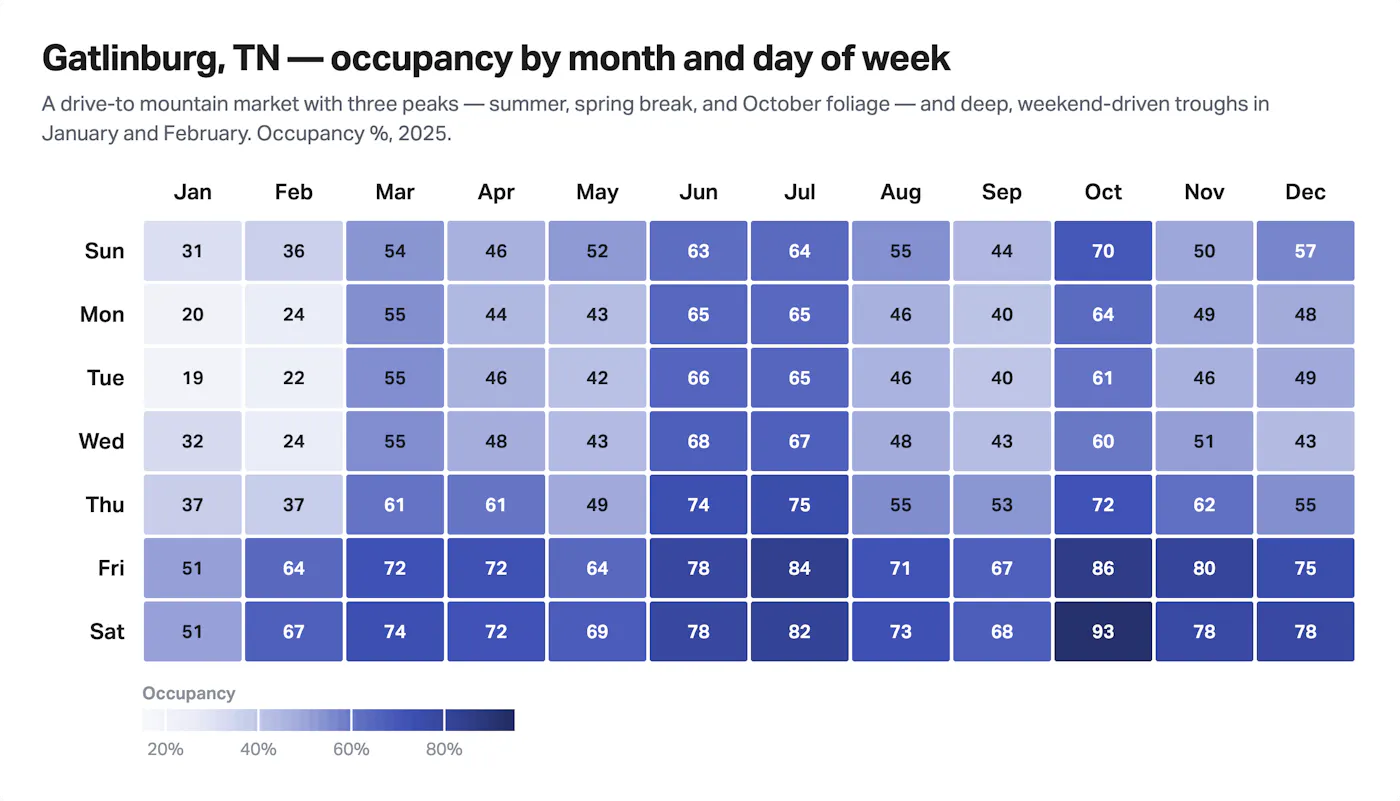
Gatlinburg sits at the doorstep of the Great Smoky Mountains and is a drive-to mountain market fed by weekend travelers. Like Gulf Shores, Fridays and Saturdays have the highest occupancy rates throughout the year. Gatlinburg's occupancy peaks three times during the year: in June and July, during spring break, and in October during its foliage season. During these peak demand periods, weekday occupancy climbs toward weekend levels and the occupancy gap shrinks to less than 20%. During the low season months of January and February, however, the gap widens, with weekend occupancy roughly doubling weekday occupancy.
The occupancy gap is reflected in booked rates. In the peak months, with demand strong on weekdays and weekends alike, the weekend rate premium falls below 10%. In January and February, however, weekend rates run 20-30% higher than weekday rates, matching weekend occupancy that runs roughly double weekday levels.
Booking mix plays its part in Gatlinburg, too. In the summer months, stays of 5+ nights hit their annual high, accounting for roughly 30% of June and July reservations and blending weekend rates into the rate of a longer trip. March and October are a little different. Stays during foliage season are shorter than in the summer, so the narrowing rate gap comes from hosts being able to charge similar rates on weekdays and weekends because demand remains high throughout the month.
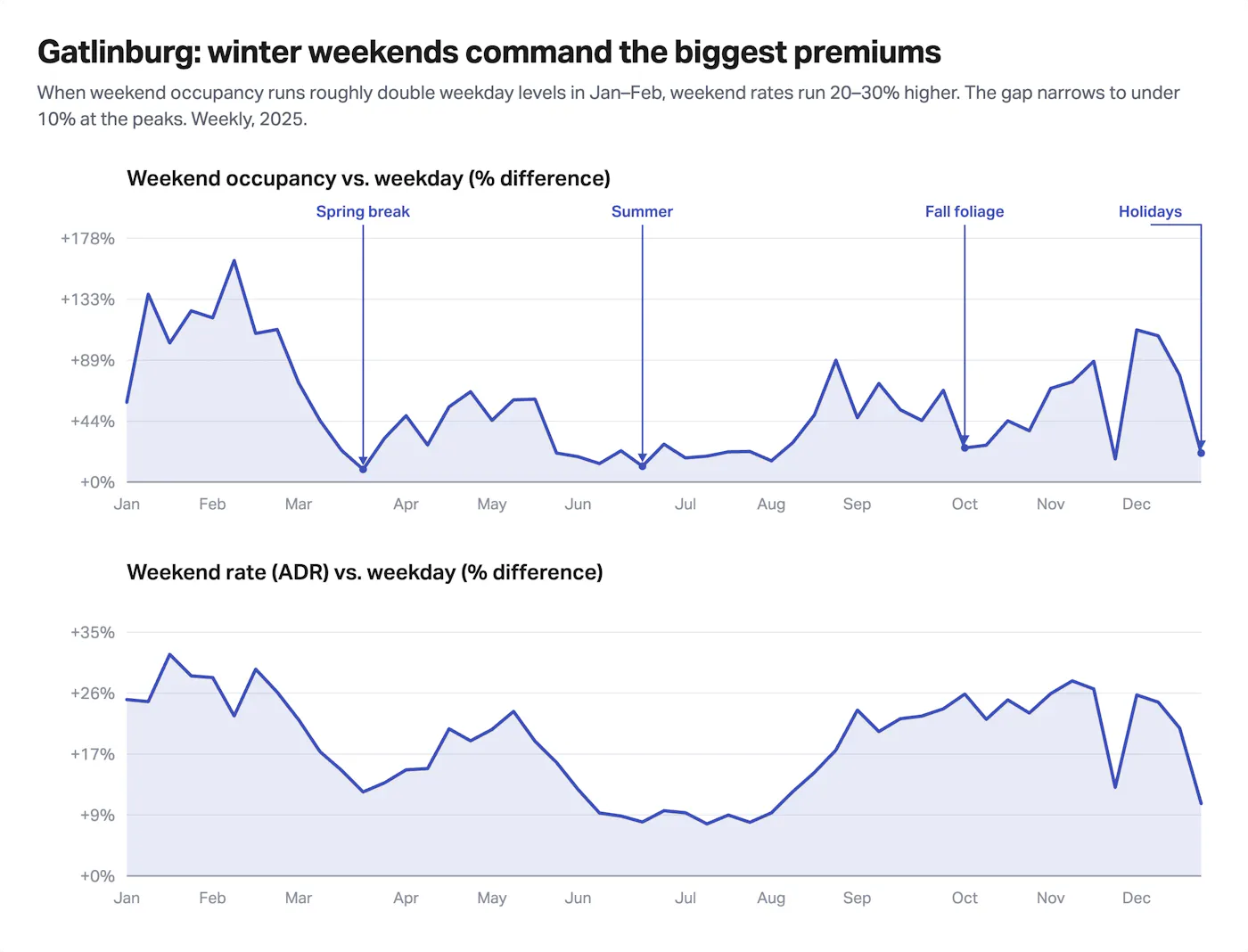
Then there's December, which shows two different occupancy patterns. During the weeks between Thanksgiving and Christmas, the differences in weekend and weekday occupancy and rates are significant. Locals and regional travelers are taking weekend trips, not week-long vacations. But during Thanksgiving week and Christmas week themselves, guests book longer holiday stays and the rate gap collapses. The right pricing approach in Gatlinburg doesn't just change month to month. In December, it changes week to week.
The pricing takeaway: Gatlinburg's weekend premium works hardest in the winter trough, when two- and three-night getaways are the market and the data supports premiums of 20-30%. At the peaks, longer stays take over and the overall rate level matters more than the weekend split. December demands both playbooks in a single month: weekend-trip pricing between the holidays and pricing for longer stays during the holidays.
Maui, HI: The Market Where Weekend Premiums Barely Exist
In Gatlinburg and Gulf Shores, demand is highly seasonal, swings between weekdays and weekends, and pulls rates along with it. So what happens when travel demand isn't very seasonal?
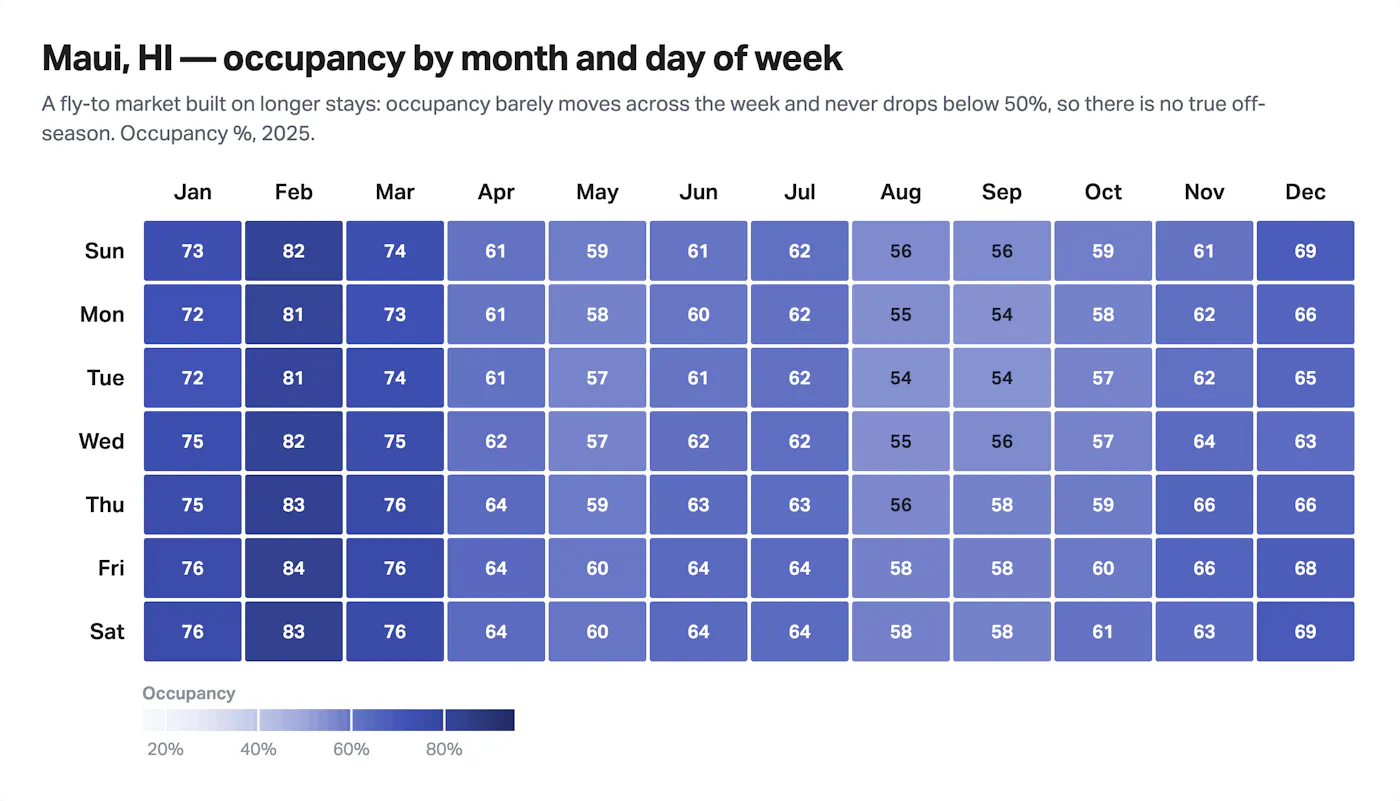
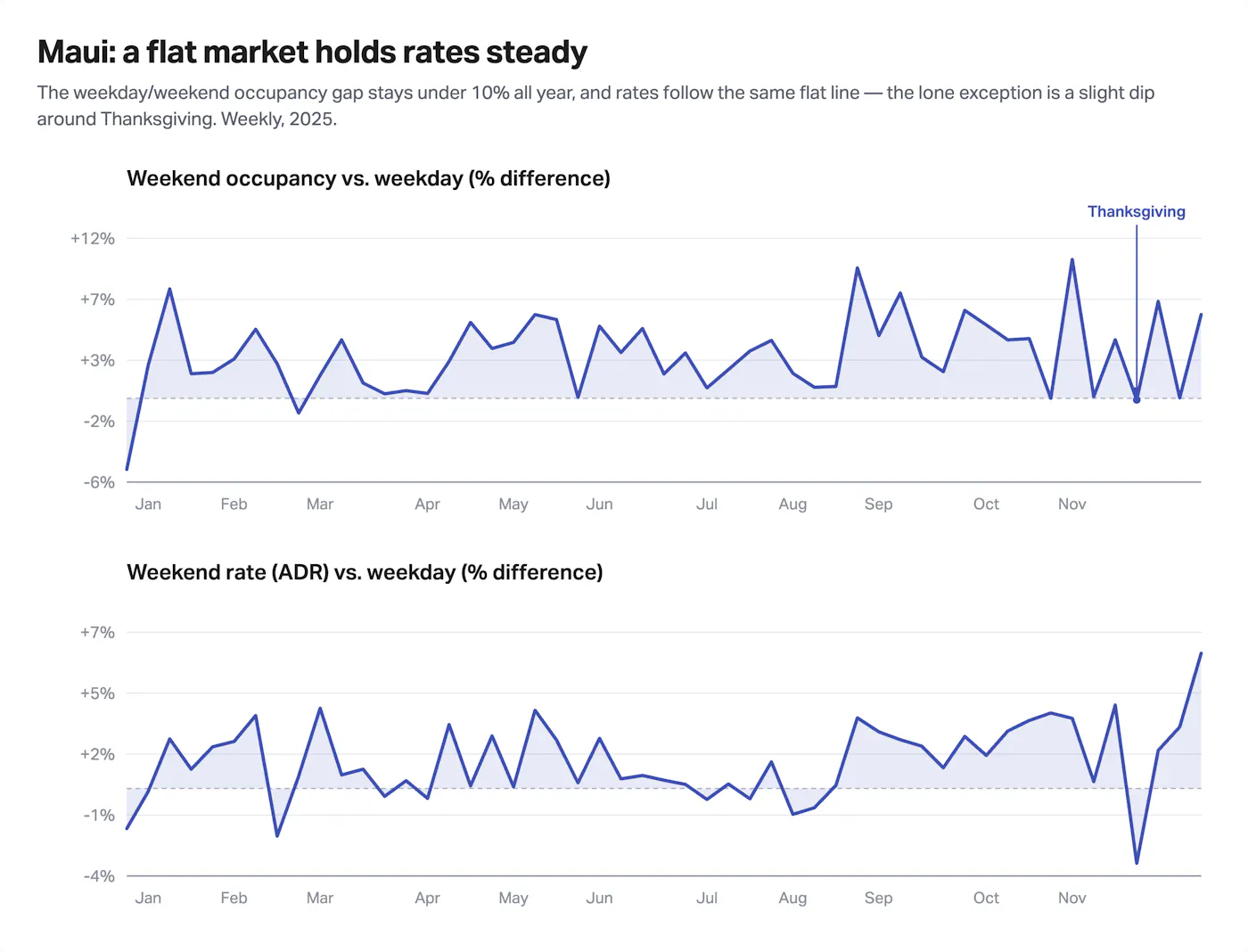
Maui is a good example. As a fly-to destination where guests book longer stays year-round, its occupancy curve is remarkably flat. Occupancy peaks in the first three months of the year and bottoms out in August and September, but it never falls below 50%, so there's no true off-season. And the weekday/weekend gap barely exists. In 2025, the difference between weekday and weekend occupancy was under 10% every week of the year.
Flat occupancy is reflected in flat rates. Weekend rates run less than 4% above weekday rates for most of the year. The one exception is Thanksgiving. Occupancy during the weekdays leading up to Thanksgiving is actually stronger than Thanksgiving weekend, resulting in weekend rates falling below weekday rates.
In Maui, longer stays aren't a seasonal phenomenon. They're the market. Stays of 5+ nights account for the majority of reservations in every month of 2025, making up 53% to 60% of bookings throughout the year. When most guests book a string of nights that spans weekdays and weekends alike, every day of the week fills at a similar rate, and rates follow the same flat pattern.
The pricing takeaway: The same logic that tells Gulf Shores and Gatlinburg hosts to adjust their weekend premiums tells a Maui host to hold rates steady. A host who imports a mainland pricing strategy built around large weekend premiums is pricing against their market's demand.
Meet Adapt: Pricing That Reads Your Market's Demand for You
Three markets, three different pricing playbooks, one common thread: rates follow demand. The challenge is keeping up. Demand shifts day to day, week to week, and month to month, and pricing needs to shift with it.
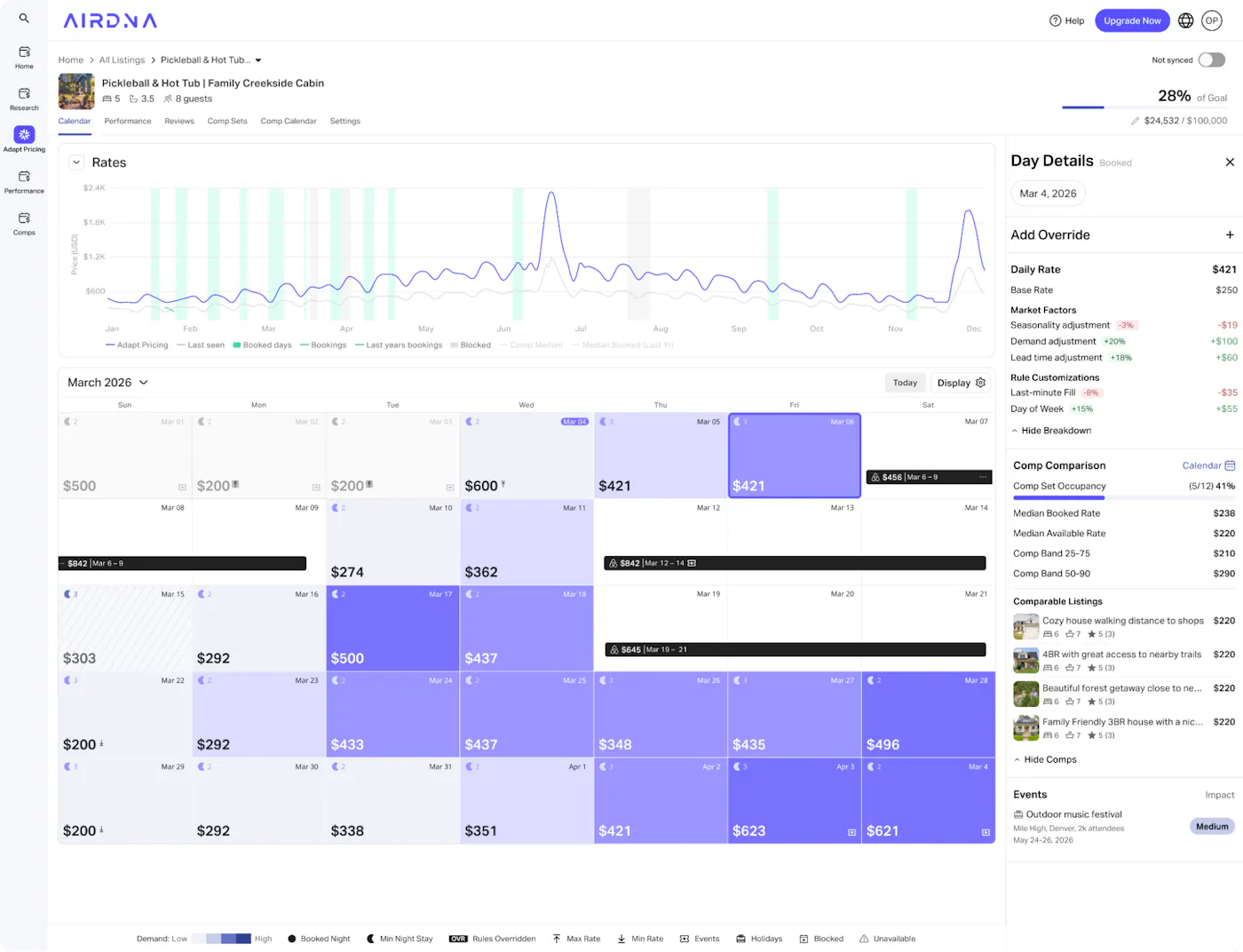
AirDNA Adapt is our dynamic pricing tool, powered by the same market data behind this analysis. It starts with a base price based on what comparable listings in your market are earning, then adjusts rates automatically based on seasonal demand, booking pace, holidays, local events, and other market signals.
That means it captures the same patterns we've explored throughout this article. In markets like Gatlinburg, it widens weekend premiums when short weekend trips dominate demand. In Gulf Shores, it eases those premiums during the summer, when longer stays blur the distinction between weekdays and weekends. And in Maui, where demand stays consistent throughout the week, it keeps weekend premiums low.
It also adjusts as demand changes. If bookings are coming in faster than usual, rates increase to match. If demand softens, rates adjust before occupancy starts to fall.
Whether your market has pronounced seasonal swings or relatively steady demand, Adapt keeps your pricing aligned with what your market is actually doing, not what it was doing last month or last year.
FAQs
Why do weekend rates vary so much between markets?
Weekend premiums depend on how demand behaves in each market. In destinations like Gatlinburg, where short weekend trips are common during the off-season, Friday and Saturday nights command much higher rates than weekdays. In markets like Maui, where guests book longer stays throughout the week, weekday and weekend demand are much more balanced, so weekend premiums are minimal.
Should I always charge more for weekends?
Not necessarily. Weekend pricing should reflect your market's booking patterns rather than a fixed rule. In some markets, weekend premiums are largest during the off-season and shrink during peak periods when demand is strong throughout the week. In others, they remain small all year because guests book longer stays.
How does AirDNA Adapt set nightly rates?
Adapt uses market data to automatically adjust your pricing based on seasonal demand, booking pace, holidays, local events, and other market trends. Instead of relying on fixed pricing rules, it updates your rates to reflect how demand is changing in your market.
ARTICLE SUMMARY
Weekend premiums depend on how demand changes throughout the year and from one market to another. Using examples from Gulf Shores, Gatlinburg, and Maui, we explore how occupancy influences pricing and what successful dynamic pricing looks like.
Linda Rollins
Senior Research Analyst
Linda Rollins is a Senior Research Analyst at AirDNA and a self-managing short-term rental host, which means she understands the market as both an analyst and an operator. She writes research and blogs for AirDNA and for Adapt, its revenue management tool, making her work a go-to resource for investors trying to find and size up the right opportunities, and for operators looking to understand changing market dynamics and find concrete ways to improve occupancy, rates, and guest experience. Her data is regularly cited in major news outlets, and she has a knack for bringing both the numbers and the story behind them. In her free time, Linda enjoys spending time with her family, traveling, and looking for good eats.
Related






Get started with AirDNA today.
Powerful, easy-to-use tools that help hosts and investors succeed in the short-term rental market.
Try for free