


Airbnb Smart Pricing: How It Works and When You Might Need to Level Up
Published: August 7, 2026
Last updated: October 22, 2026

Meagan Faryna

Key Takeaways
- Airbnb Smart Pricing is a simple way to automate rates. It adjusts nightly prices within the limits you set using demand, booking activity, and other signals available within Airbnb.
- The right tool depends on what you’re trying to optimize. Airbnb Smart Pricing may suit hosts who want straightforward automation, while more advanced hosts may want to balance occupancy, ADR, RevPAR, events, minimum stays, and booking risk more deliberately.
- AirDNA Adapt takes the strategy beyond one platform. It uses visible comps and broader market context to manage pricing across Airbnb, Vrbo, and Booking.com, while explaining what’s influencing each recommendation.
If you've spotted the Smart Pricing toggle in your Airbnb dashboard, you've probably wondered whether to trust it. Flip it on and let Airbnb handle your rates? Or keep control and set prices yourself?
Airbnb Smart Pricing automatically raises or lowers your nightly rate within the minimum and maximum prices you set, based on Airbnb's own signals like demand and booking activity. It's free, it's built in, and for many hosts it's a great way to automate pricing without adding another tool to their stack.
However, Airbnb Smart Pricing may not be for every host in every season of their business. As your strategy develops or your listings expand to other channels, you may want more say over your comps, your minimum stays, and the reasoning behind each price change. At that point, Airbnb Smart Pricing might not be the best fit.
In this guide, we'll cover how Airbnb Smart Pricing works, how to set it up properly, and when a dedicated tool like AirDNA Adapt might make more sense.
What Is Airbnb Smart Pricing?
Airbnb Smart Pricing is Airbnb’s built-in dynamic pricing tool. It automatically adjusts your nightly rates within the minimum and maximum prices you choose, using signals from activity on the Airbnb platform.
Dynamic pricing simply means that rates move as the value of a night changes. A busy holiday weekend may support a higher price, while a slower weekday with plenty of nearby availability may need a more competitive one. Instead of leaving the same rate in place for weeks or months, Smart Pricing updates future dates as Airbnb’s demand signals change.
You still set the guardrails and can override individual dates. Other decisions (such as minimum stays, discounts, and the broader goals behind your Airbnb pricing strategy) remain in your hands. The role of Airbnb Smart Pricing is to automate the nightly rate changes within Airbnb.
How Does Airbnb Smart Pricing Work?

Airbnb Smart Pricing automatically raises or lowers your nightly rate based on demand for your listing and area. You choose a minimum and maximum price, and Airbnb updates future dates within that range.
Airbnb says Smart Pricing considers hundreds of factors, although it doesn’t publish its exact formula or show how much weight each signal carries. The tool is essentially trying to estimate how valuable and competitive each available night is likely to be.
Airbnb Smart Pricing looks at signals available within the platform, including:
- Your listing: Details such as its location, property type, amenities, and past booking activity.
- Demand in your area: How much interest Airbnb is seeing for a particular date.
- Booking activity: Whether guests are actively booking similar stays nearby.
- Timing: How far away the check-in date is and how demand changes as it approaches.
- Local market conditions: How competitive your listing appears compared with other options in the area.
When demand appears stronger, Smart Pricing may increase the rate. When demand is weaker or a date is approaching with less booking activity, it may lower the price to help the listing stay competitive. This means two nights in the same week can receive different prices.
Your minimum and maximum prices act as guardrails, and you can change them at any time. You can also override Smart Pricing for individual nights or date ranges without turning the feature off completely.
Other pricing settings may affect the final amount a guest pays. Promotions can bring the price below your Smart Pricing minimum, while weekly, monthly, and trip-length discounts take priority. Smart Pricing also needs to be turned off before you can use weekend pricing or professional hosting rule-sets.
In other words, Airbnb Smart Pricing handles your day-to-day nightly rates, while you remain responsible for the limits, discounts, stay rules, and broader pricing strategy.
How Do You Set Up Airbnb Smart Pricing?
You can turn on Airbnb Smart Pricing from your listing calendar in just a few steps. The more important part is choosing limits and settings that reflect your property, market, and pricing goals.
- Open your listing calendar.
On desktop, go to Calendar and select the listing you want to update. - Open your price settings.
Click Price settings, then find Smart Pricing under your base price. - Set a realistic minimum price.
Choose the lowest nightly rate you’re comfortable accepting after accounting for cleaning, turnover, operating costs, and the value of the stay. Avoid setting the minimum too low simply to encourage bookings. - Give your maximum price room to move.
Your maximum should allow Smart Pricing to respond to high-demand dates, holidays, and local events. A ceiling that’s too low can limit your ability to capture stronger demand. - Review important dates before switching it on.
Check holidays, festivals, conferences, graduations, and other events that could increase demand. You can set custom prices for individual nights or date ranges if you don’t want Smart Pricing controlling them. - Check your discounts and promotions.
Early-bird promotions may bring the guest’s final price below your Smart Pricing minimum. Weekly, monthly, and trip-length discounts can also override the Smart Pricing rate. Weekend pricing can as well. - Review any existing pricing rules.
Smart Pricing overrides professional hosting rule-sets. You’ll also need to turn it off if you want to use Airbnb’s weekend pricing feature. - Turn Smart Pricing on and save.
Enter your minimum and maximum prices, enable the toggle, and click Save. - Monitor the first few weeks.
Review how rates change across weekdays, weekends, events, and slower periods. Pay attention to dates that book unusually quickly, remain open longer than expected, or frequently need manual overrides.
Keep in mind that Airbnb Smart Pricing shouldn’t be treated as a set-it-and-forget-it feature. Your minimum, maximum, discounts, and custom prices should be reviewed as demand, costs, and your broader Airbnb pricing strategy change.
Is Airbnb Smart Pricing Good?

For most serious hosts, no. Airbnb Smart Pricing is easy to use, but its simplicity comes at the cost of flexibility and pricing accuracy.
Airbnb Smart Pricing can be a good option for hosts who want simple, built-in automation. It’s free to use, takes only a few minutes to set up, and can help prevent rates from staying unchanged while demand moves around them.
Airbnb Smart Pricing is often a good fit for hosts who:
- List only on Airbnb
- Manage one or a small number of properties
- Want fewer pricing settings to manage
- Are comfortable letting Airbnb choose the market signals and comparable listings behind its recommendations
- Mainly want help keeping nightly rates competitive
However, it’s not a tool that suits every host. Airbnb Smart Pricing is less suitable if you:
- List on multiple platforms, such as Airbnb, Vrbo, and Booking.com
- Want greater control over which comparable properties influence your rates
- Need visibility into why your prices are changing
- Want to optimize revenue around local events, seasonality, and market trends
- Manage a growing portfolio where pricing decisions have a bigger financial impact
- Prefer a pricing strategy that balances occupancy, ADR, and revenue based on your business goals rather than Airbnb's defaults
How accurate is Airbnb Smart Pricing?
Airbnb Smart Pricing is generally accurate for setting competitive baseline rates, but it's not always the most effective tool for maximizing revenue.
Airbnb says Smart Pricing uses hundreds of factors related to your listing and area, so its recommendations can reflect real changes in demand and booking activity. However, Airbnb doesn’t show the exact formula, which listings it considers most comparable, or how much influence each signal has.
That means a recommended price can be reasonable without being the best possible price for your specific strategy. The system may recognize that demand is rising, for example, but it may not fully account for a renovation, an unusually strong amenity, a local event, or the fact that you’re willing to wait longer for a higher-value booking.
It’s also worth separating accuracy from fit. A price can be competitive for the wider Airbnb market but still not fit your property, costs, risk tolerance, or revenue goals. The more useful questions are:
- Does the rate reflect the properties guests genuinely compare with yours?
- Does it account for what’s happening beyond Airbnb?
- Does it leave enough room to capture peak-demand dates?
- Does it support your preferred balance between occupancy and nightly rate?
- Can you understand why the rate changed?
Airbnb Smart Pricing may be enough when convenience matters most and your pricing needs are relatively simple. However, hosts who want more control over comp sets, more visibility into rate changes, or one strategy across Airbnb, Vrbo, and Booking.com may eventually need a dedicated dynamic pricing tool.
When You Might Need More than Airbnb Smart Pricing
Airbnb Smart Pricing can be a great fit when you want simple pricing automation inside Airbnb. However, as your short-term rental portfolio grows, you may reach a point where you need your pricing strategy to do more.
A dedicated dynamic pricing tool may make sense when you:
- List on Airbnb, Vrbo, or Booking.com and want one strategy across multiple online travel agencies (OTAs)
- Manage a growing portfolio and need a more consistent way to price each property
- Want more visibility into which listings are being used as your comps
- Need pricing and minimum stays to work together around gap nights and high-demand dates
- Want to respond more deliberately to events, holidays, and sudden spikes in demand
- Want broader market context beyond activity on a single platform
- Want to price toward a specific goal, such as higher occupancy, higher rates, or optimized RevPAR
- Prefer more control over how much booking risk you’re willing to take
- Want to understand what’s driving each rate before deciding whether to step in
At that stage, it’s less about replacing Smart Pricing and more about expanding your pricing setup to match the way your business now operates, which is what third-party dynamic pricing tools like AirDNA Adapt are built to do.
Airbnb Smart Pricing vs. AirDNA Adapt

Airbnb Smart Pricing and AirDNA Adapt are both dynamic pricing tools, but they’re designed for different levels of pricing complexity.
Smart Pricing offers convenient automation inside Airbnb. You set your price range, and Airbnb adjusts nightly rates using demand and booking signals from its platform.
AirDNA Adapt starts with the market, not just your listing. You choose the strategy for each property, and Adapt uses relevant comps, demand, seasonality, and booking patterns to turn that strategy into daily rates while explaining what’s influencing each recommendation.
While Airbnb Smart Pricing is a great tool, AirDNA Adapt helps you:
- Keep pricing consistent across channels. Manage rates across Airbnb, Vrbo, and Booking.com from one strategy, rather than updating each platform separately.
- Work with the tools you already use. Adapt connects with your PMS or channel manager, so you can improve pricing without changing your day-to-day workflow.
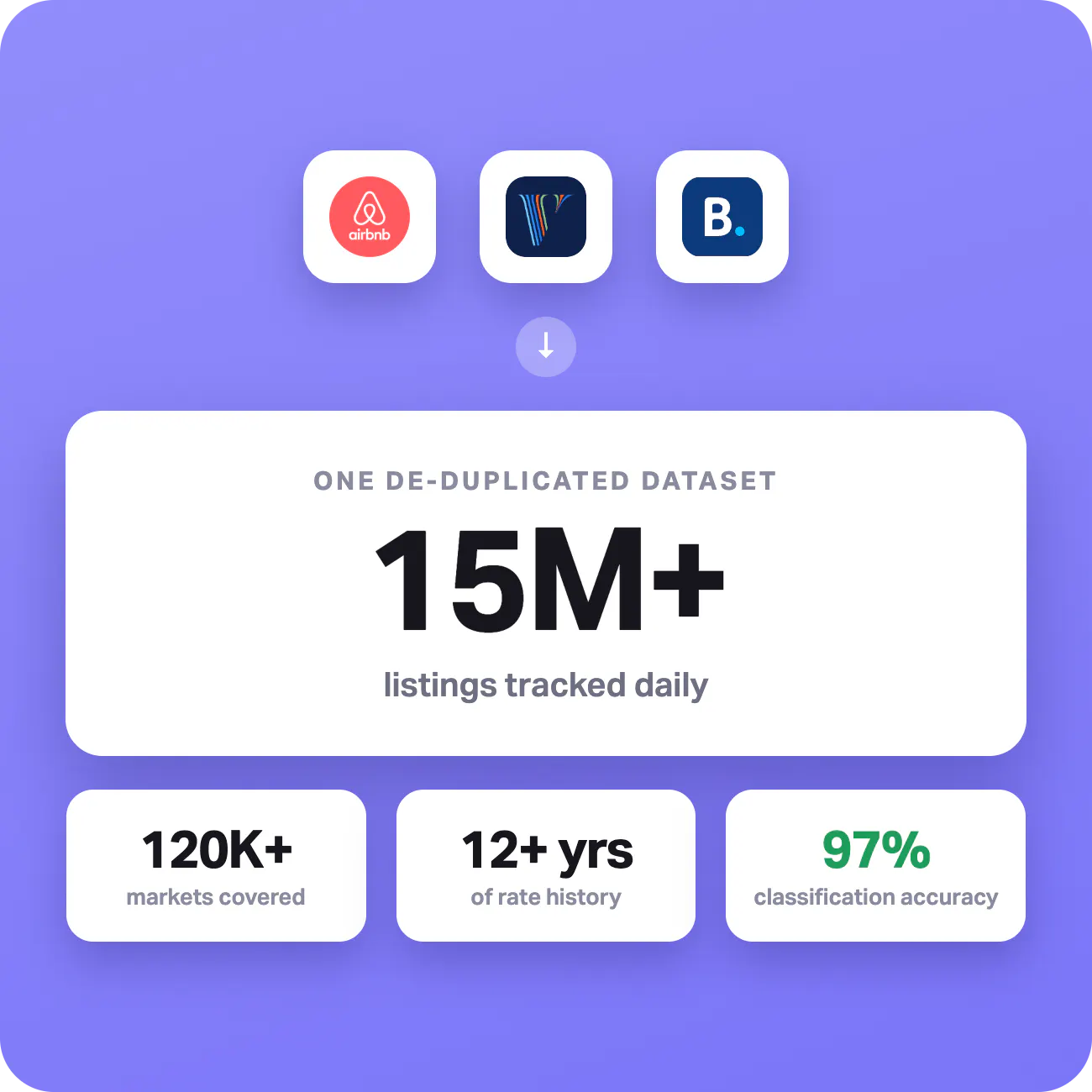
- See the comps behind your rates. Adapt uses AirDNA data from more than 15 million active listings across over 120,000 markets to help identify the properties guests are most likely to compare with yours.
- Balance occupancy with stronger rates. Instead of simply trying to fill every night, Adapt looks at demand, booking patterns, nearby availability, and comp performance to help you make the most of each date.
- Manage more than nightly prices. Minimum stays, gap nights, events, and changing demand can all work together, reducing the need for layers of manual rules.
- Stay in control as you grow. You set the strategy and decide how much booking risk you’re comfortable with. Adapt handles the daily adjustments, explains what’s influencing each rate, and still lets you step in when needed.
Hosts can try Adapt free for 14 days and see how its recommendations compare with their current pricing approach.
| Capability | Airbnb Smart Pricing | AirDNA Adapt |
|---|---|---|
| Channels | Airbnb | Airbnb, Vrbo, and Booking.com |
| PMS or channel manager connection | Native to Airbnb | Connects pricing to your existing stack |
| Comp-set visibility | Selected within Airbnb’s system | Comps you can see, manage, and customize |
| Pricing levers | Nightly rate | Rates, minimum stays, gap nights, and events |
| Portfolio management | Managed by listing | One strategy across a portfolio |
| Where the strategy operates | Inside Airbnb | Across channels and connected tools |
| Rate explanations | Limited visibility into individual signals | Shows what’s influencing recommendations |
Frequently Asked Questions
How do I turn Airbnb Smart Pricing on or off?
Open your Airbnb calendar and select the listing you want to update. Go to Price settings, choose Smart Pricing under your base price, set your minimum and maximum rates, and use the toggle to turn it on or off. Changing the setting won’t affect pending or confirmed reservations.
Can I override Airbnb Smart Pricing?
Yes. You can set a custom price for one night or a range of dates without turning Smart Pricing off across the rest of your calendar. This can be useful for holidays, local events, or dates where your own market knowledge suggests a different rate.
AirDNA Adapt also allows hosts to stay in control of important dates while showing what’s influencing each pricing recommendation.
Does Airbnb Smart Pricing change minimum stays?
No. Airbnb Smart Pricing adjusts nightly rates, but minimum-stay requirements are managed separately.
Hosts who want pricing and minimum stays to work together around demand, events, and gap nights may prefer a dedicated tool like AirDNA Adapt.
Is Airbnb Smart Pricing worth it?
It can be worth using if you want free, straightforward pricing automation within Airbnb. It’s especially useful for hosts with a small number of listings and relatively simple pricing needs.
As your business grows, you may want more control over comps, wider market context, or one pricing strategy across several channels. That’s where a tool like AirDNA Adapt may be a better fit.
Can I use Smart Pricing with another dynamic pricing tool?
It’s generally best to use one system as the source of truth for your rates. When a tool like AirDNA Adapt is connected to your listing through a supported integration, Airbnb Smart Pricing should usually be turned off so the two systems don’t overwrite each other’s prices.
Can I price Vrbo and Booking.com listings too?
Airbnb Smart Pricing only manages rates within Airbnb. AirDNA Adapt can carry one pricing strategy across Airbnb, Vrbo, and Booking.com through supported property management systems and channel managers.
What’s the difference between Smart Pricing and dynamic pricing?
Dynamic pricing is the broader method of adjusting rates as demand and market conditions change. Airbnb Smart Pricing is one dynamic pricing tool built directly into Airbnb.
Dedicated platforms such as AirDNA Adapt can add broader market data, cross-channel pricing, visible comps, minimum-stay controls, and explanations behind each recommendation.
ARTICLE SUMMARY
Wondering if Airbnb Smart Pricing is enough? For many hosts, the answer is yes. This dynamic pricing tool automates nightly rates without a complicated setup. This guide walks through how Airbnb Smart Pricing works, how to set it up properly, and the signs you've outgrown it.
Related



Get started with AirDNA today.
Powerful, easy-to-use tools that help hosts and investors succeed in the short-term rental market.
Try for free