

 Calculate Revenue
 Research Markets
 Find For Sale Properties
 Compare My Listing
 STR Revenue Calculator
 Custom Comp Sets
 Submarket Insights
 Custom Search Filters
 Rate Recommendations
 Performance Benchmarking
 Competitor Comparison
 Owner Contact Details
 Property-level performance data
 Tourism Insights
 Real Estate Investment Analytics
 About Us
 Sales
Sales Support
 Press
PressAirbnb Instant Book: Should You Enable It?
Published: June 7, 2024
Last updated: September 25, 2026

Bram Gallagher
Key Takeaways:
- Airbnb Instant Book simplifies the booking process for both hosts and guests, offering instant gratification and potentially boosting revenue.
- Before turning on Instant Book, hosts should consider its downsides, such as limited control over guests and the risk of last-minute cancellations.
- While Instant Book doesn't significantly increase bookings, it can still improve revenue potential, especially for smaller properties with fewer bedrooms.
Hosts often use the Instant Book feature on Airbnb—which allows guests to make reservations immediately without submitting a request—because it’s quick, clean, and convenient, without even realizing the untapped revenue potential it holds.
Though Airbnb hosts covet Instant Book’s streamlined approach to guest communication, whether or not to use it really comes down to this: does the feature actually impact how much you earn? If so, by how much?
The short answer is that enabling Instant Book can easily increase short-term rental revenue. The longer answer is that there’s a lot to know about Airbnb Instant Book and how to use it effectively. Let’s dive in.
Should I Use Airbnb Instant Book?
If you want more context on Instant Book before reading further, check out the section on What Is Instant Book? at the end of this article or access it through the Index on the right hand side.
Wondering whether to use Airbnb Instant Book? The data says yes, but the nuanced answer is: it depends.
Here’s how to use vacation rental data to assess whether Instant Book is right for your unique rental property:
- Analyze your short-term rental market. Get a feel for the area’s median ADRs and occupancy rates based on percentile in the market, as well as things like seasonality and the regulatory climate.
- Review average minimum stays in your market. Is your market more of a one-night destination, or do travelers tend to spend upwards of a week or a month? If it’s the latter, would you rather respond to booking requests manually?
- Assess your short-term rental revenue potential. Do top-performing nearby properties use Instant Book? If so, how much are they earning? If they’re out-earning your property, you might consider how Airbnb Instant Book could boost your revenue.
- Run some tests: Spend one month with Instant Book enabled, one month without it, and determine which option makes the most sense.

Pros of Airbnb Instant Book
By design, Instant Book should make the booking process faster and more convenient for guests. Here are some of the benefits of using Airbnb Instant Book:
Adds Convenience
As any experienced STR host will tell you, guest communication is one of the most time-consuming aspects of property management. Enabling Instant Book removes the initial (and many times only) point of contact from the equation to save you time.
Instant Book is also super convenient for travelers, particularly guests making last-minute travel plans or looking for a quick and easy booking process.
Automates Booking Responses
Using Airbnb Instant Book removes the risk of missing a guest inquiry and being labeled as an unresponsive host, which could drop your listing in Airbnb search rankings. Instant Book can also help you become a Superhost, which requires a 90% response rate.
Improves Search Results
Because Airbnb’s ranking algorithm is highly linked to response rate, enabling Instant Book pushes properties towards the top of the search results pages. More visibility = more bookings.
Better Customer Experience
According to a report from VRM Insider, travelers spend an average of just 59 seconds on booking sites—which makes first impressions all the more valuable. The quicker a guest can book, the better their experience will be.
Boosts Occupancy
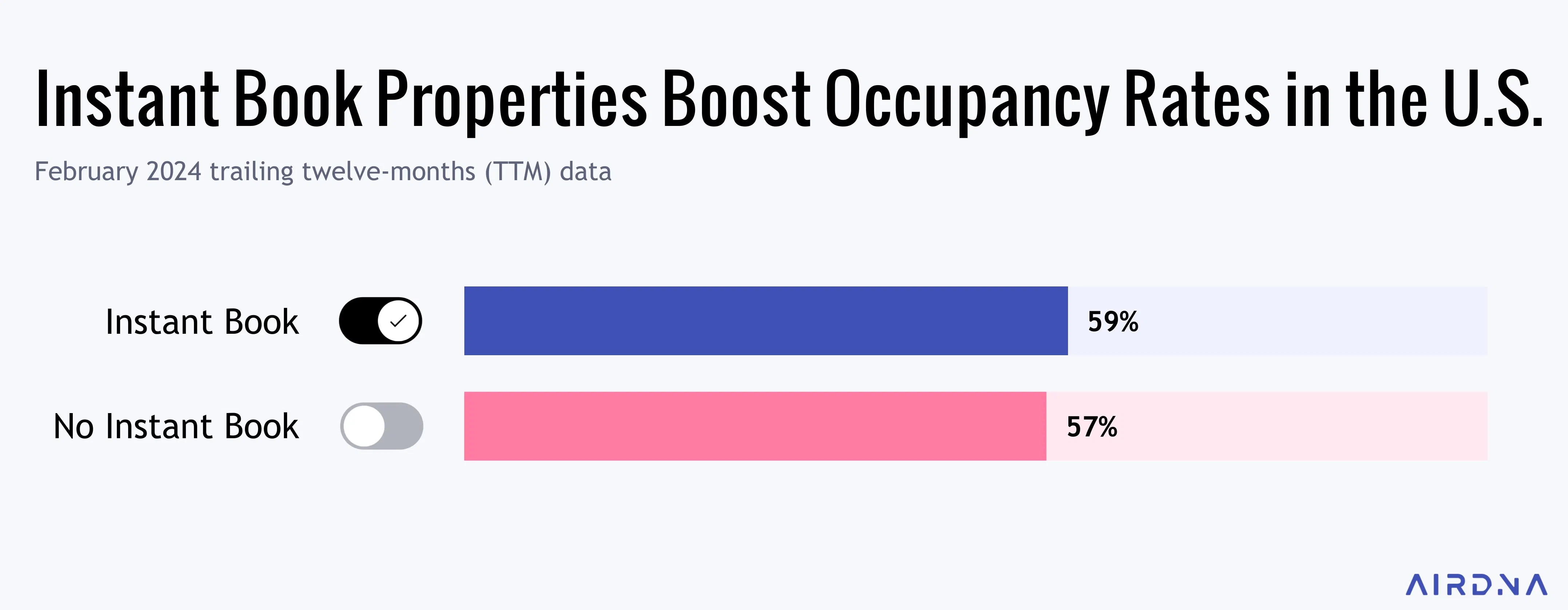
According to AirDNA data, Airbnb properties in the United States that enabled Instant Book had 3% higher occupancy rates than their non-Instant Book competitors in the last year.
Higher ADR and RevPAR
Beyond occupancy, Airbnb Instant Book can also help hosts boost their average daily rates (ADR) and revenue per available rental (RevPAR). Increasing both of these metrics has a positive impact on the STR’s overall revenue and profitability.
Instant Book properties had 7% higher ADRs and 10% higher RevPARs than non-Instant Book properties in the last year.
Higher rates among Airbnb Instant Book properties may be the result of Instant Book being more prevalent among professionalized hosts, who tend to charge higher rates on average.
Here’s a quick snapshot showing how ADRs and RevPARs differ between listings with and without Airbnb Instant Book:
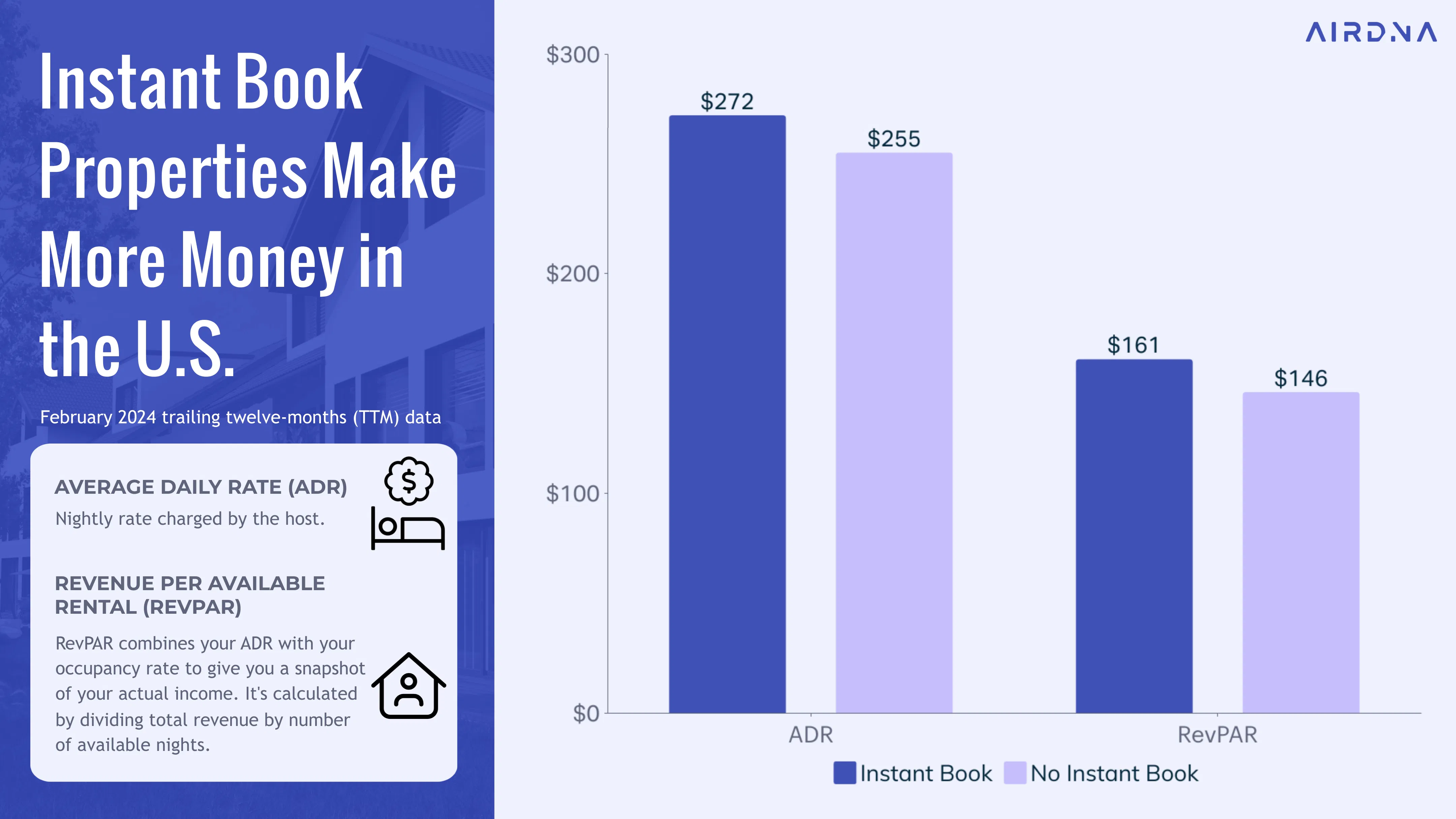
Listings with Instant Book enabled earn $17 more per night and $15 more per available room than listings without this feature.
Cons of Airbnb Instant Book
While many hosts consider Airbnb Instant Book to be a positive and convenient feature, there are some potential downsides to consider before turning it on.
- Limited Control for Hosts: With Instant Book enabled, any guest who meets the host’s basic requirements can book their property without any prior communication or screening. As a result, you could end up with less-than-perfect guests who don’t respect the property or adhere to house rules.
- Less Committed Guests: Instant Book offers instant gratification, which comes with a downside: cancellations. Guests might book your property instantly to secure a spot, but later cancel if they find a different property better suited to them.
- Potential for More Party-Going Guests: Guests seeking a place to party might be more likely to book a vacation rental with Instant Book enabled to avoid being screened by the host.
How Does Airbnb Instant Book Work?
When you turn on Instant Book, guests who meet your requirements can simply select their desired dates and click the "Book Now" button to reserve your space. It’s convenient for guests because they don’t have to message you first or wait around for you to approve them. It also means you don't have to worry about responding to booking requests or approving guests.
To use Instant Book, you'll need to set your requirements for guests. For example, you can require that guests have a verified phone number, email address, and payment method. You can also set your own rules for things like check-in and check-out times, number of guests, and length of stay.

How to Customize Instant Book Settings
If you’re hesitating to turn Instant Book on, you might be comforted to know that you can set some guardrails by customizing your Airbnb Instant Book settings.
To customize your Instant Book settings, go to your Airbnb account settings and click on "Instant Book." From there, you can set your requirements for guests and adjust your availability settings.
Here are some tips to customize your settings and mitigate risk when using Instant Book:
- Require Identity Verification: You can require guests to complete Airbnb’s identity verification process before allowing them to reserve your STR with Instant Book.
- Set a Minimum Stay: You can limit Instant Booking to only guests who have completed at least one stay through Airbnb.
- Set a Maximum Guest Limit: Avoid renting your vacation rental to parties with more than a certain number of guests.
- Require Positive Reviews: To ensure you only rent to trustworthy guests, you can require them to have a certain number of positive reviews.
- Create a Pre-Booking Message: Hosts can create a preset message with questions for guests to answer before they can book.
- Require Advance Notice: Avoid last-minute bookings by requiring a certain amount of time as advance notice.
How Many Airbnb Hosts Use Instant Book?
39% of Airbnb listings have Instant Book enabled.
Airbnb Instant Book is less common among houses than apartments. 43% of Airbnb apartments and condos have Instant Book, while only 37% of Airbnb houses have Instant Book enabled.
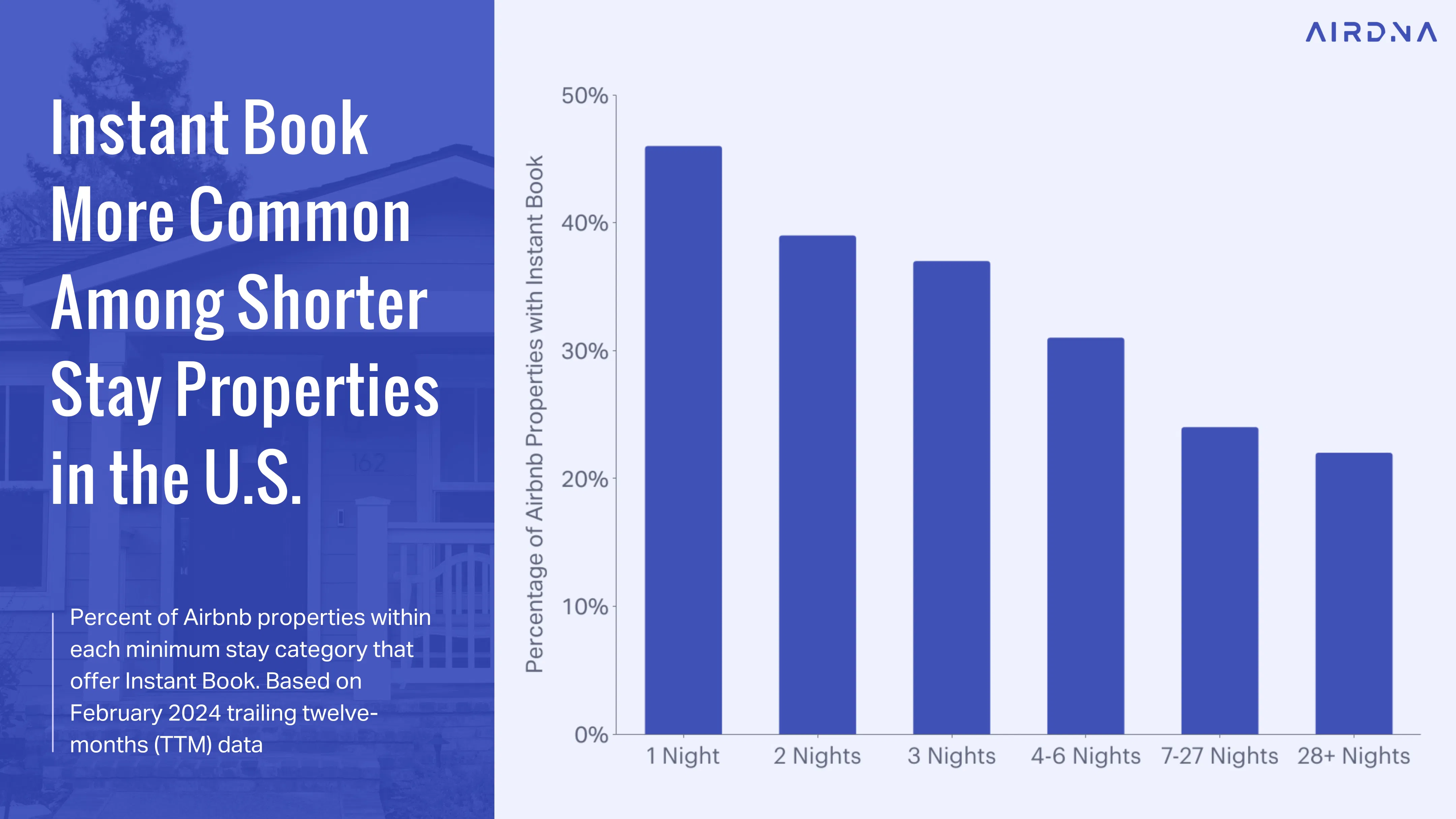
Properties with longer minimum stay policies are also less likely to offer Airbnb Instant Book. 46% of Airbnb properties with one-night minimum stay policies have Instant Book. Meanwhile, only 24% of properties with minimum stay policies of 7-27 days have Instant Book enabled. Among properties with minimum stay policies of 4 weeks or more, that percentage drops down to 22%.
Short-term rental (STR) regulations also have an effect on Airbnb Instant Book and how much it’s utilized by hosts in a given area. In New York City where new regulations have severely limited STRs offering stays under 30 days, only 21% of properties have Instant Book enabled.
The following markets are notable for the small fraction of properties that have Instant Book enabled:
- Dayton, Ohio (19%)
- Long Island, New York (19%)
- Oakland, California (18%).
On the other hand, these markets have the highest percentages of Airbnb Instant Book properties:
- Lincoln City/Newport, Oregon (75%)
- Broken Bow Lake, Oklahoma (71%)
- Moab, Utah (71%)
What Is Airbnb Instant Book?
Airbnb Instant Book is a feature that allows guests to book your short-term vacation rental without waiting for your approval.
Think of Instant Book as the magic button that gives your guests instant gratification by letting them book your property with just a click. So, while you're binge-watching your favorite show, eager travelers who just can’t wait to experience your space could be making bookings. It's the ultimate convenience for both hosts and guests, making the booking process smoother and more effortless than ever.
As an added bonus, Airbnb Instant Book has been shown to help increase bookings, boost revenue, and make your listing more visible to potential guests.

FAQ
How to turn off Airbnb Instant Book?
If you try Instant Book and decide it isn't right for you, you can turn it off at any time. Simply go to your Airbnb account settings and click on "Instant Book." From there, you can toggle the Instant Book feature on or off.
Does Instant Book Increase Bookings?
Yes! According to AirDNA data, properties with Airbnb Instant Book experience a 3% higher occupancy rate compared to listings without this feature.
ARTICLE SUMMARY
Explore the benefits and drawbacks of enabling Airbnb Instant Book for hosts. Learn how Instant Book can impact revenue potential, occupancy rates, average daily rates, and revenue per available rental.
Bram Gallagher
AirDNA Director of Economics and Forecasting
Bram Gallagher is an Economist at AirDNA, specializing in uncovering insights that drive smarter short-term rental decisions. He put his Ph.D. in Economics from the University of Georgia to work researching and forecasting hotel data with CBRE prior to joining AirDNA, as well as teaching economics at a number of universities. In his spare time, Bram enjoys making wooden furniture with hand tools.
