Calculate Revenue
 Research Markets
 Find For Sale Properties
 Compare My Listing
 STR Revenue Calculator
 Custom Comp Sets
 Submarket Insights
 Custom Search Filters
 Rate Recommendations
 Performance Benchmarking
 Competitor Comparison
 Owner Contact Details
 Property-level performance data
 Tourism Insights
 Real Estate Investment Analytics
 About Us
 Sales
 Support
 Press
Airbnb Shoulder Season Tips: 10 Ways to Get More Bookings and Revenue
Published: October 16, 2026

Linda Rollins
Your summer is booked solid. Your winter is quiet, and you’ve made peace with that. But the months in between are harder to figure out. Some weeks fill on their own. Others sit open until the last minute, and you’re left wondering: should I drop my price, wait it out, or change something else?
That in-between stretch is shoulder season. Guests are still traveling in shoulder season, just fewer of them, and they travel differently than peak season guests do. The hosts who do well in shoulder season are the ones who adjust to those guests instead of running their summer playbook all year.
What Is Shoulder Season?
Shoulder season is the travel period between a destination’s peak season and its off-season, when demand is lower than at peak but high enough that pricing and calendar choices make a real difference. In the U.S., overall short-term rental demand peaks in June and July, and shoulder season generally runs from March to May in the spring and August to October in the late summer and fall, with a dip in September. But that isn’t true in every market.
In Gatlinburg, for example, shoulder season is March through May, August and September, and November and December. In steady year-round markets like Maui, the busy and slow months are so close together that there’s hardly a shoulder season at all.
The easiest way to find your shoulder season is to look at your market’s occupancy, or how full its rentals are, each month. The months at the top are your peak season, the months at the bottom are your off-season, and the months in between are your shoulder season. Both shoulder season and off-season mean fewer bookings than peak, but they call for different strategies. In the off-season, many nights will go unbooked no matter what you do. In shoulder season, there’s still real demand to compete for, so small changes to price, minimum stays, and your listing can win bookings that would otherwise go to another host.
Shoulder Season Rates Fall Up to 37% in Some Markets and Barely Move in Others
Every market slows down after peak season, but how much it slows, and in what way, varies considerably. In some markets, shoulder season means fewer guests and lower average daily rates (ADR). In others, ADRs hold steady and the main change is how many nights get booked. Here’s how 2025 shoulder months compared with peak months on both occupancy and nightly rates in six markets:
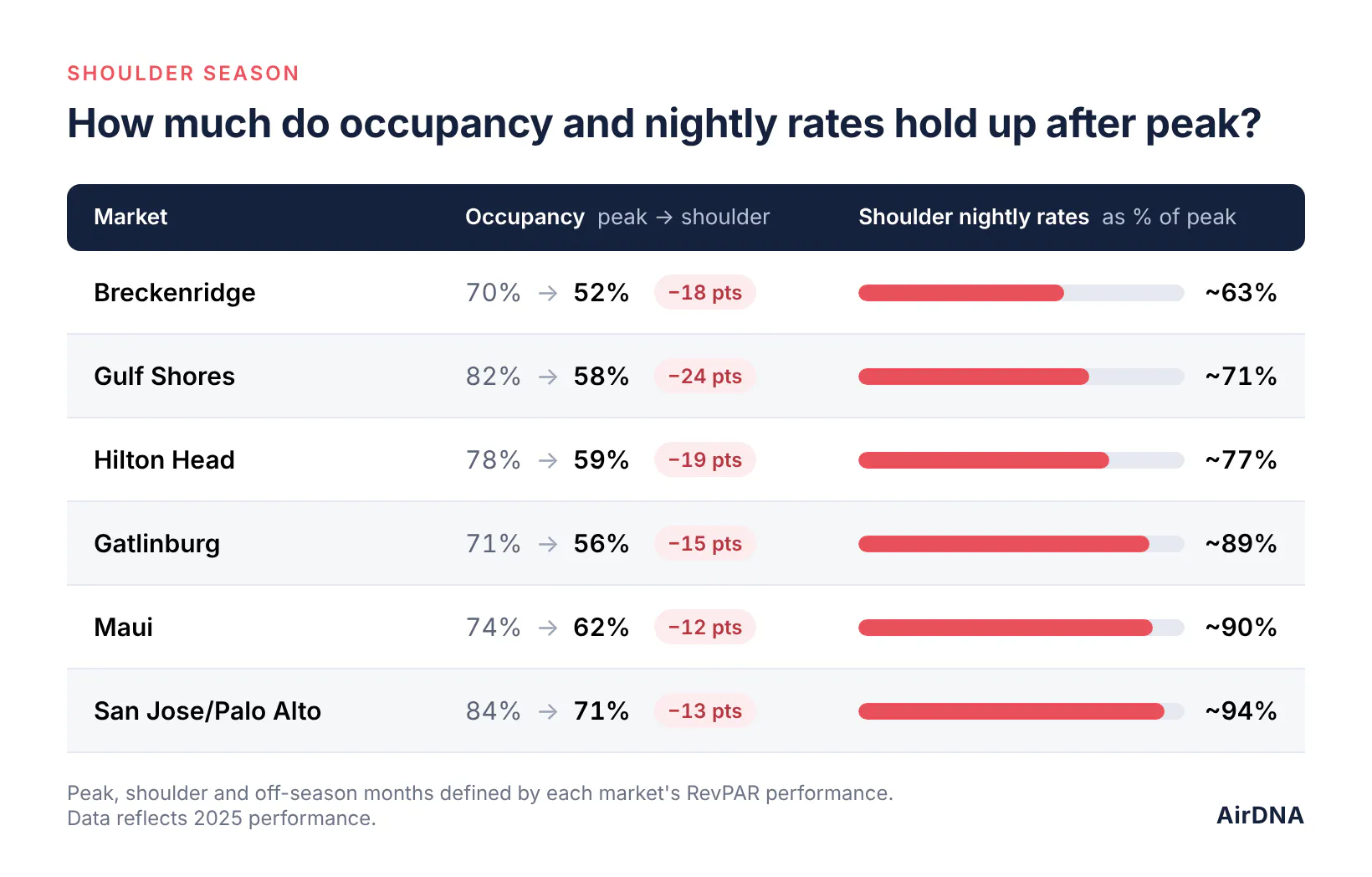
In Breckenridge and Gulf Shores, occupancy and ADRs both drop sharply, with shoulder season nightly rates running about 30% to 37% below peak. These are highly seasonal markets, where demand is concentrated in a ski season or a summer beach season, and fewer travelers are willing to pay peak prices once it ends.
In Gatlinburg, Maui, and San Jose/Palo Alto, ADRs barely move, staying at about 90% of peak. The dip there is mostly fewer booked nights. These markets tend to draw guests year-round, whether for mountain weekends, winter sun, or business travel, so the rate the market will bear stays close to peak even as occupancy eases. Hilton Head falls in between, with shoulder rates at about 77% of peak.
A 30% shoulder season discount makes sense in Breckenridge, but it would be a mistake in Maui. In a market where rates hold, a deep cut mostly lowers your price on nights that would have booked anyway, and the better move is filling the empty nights with the tips below.
10 Tips to Get More Shoulder Season Bookings and Revenue
Whether your market loses more on occupancy or on rate, the goal is the same: capture the demand that’s there without giving away more than you need to. Shoulder season guests are still searching; they just book later, favor certain nights, and need a reason to pick your place. Here are 10 tips to maximize your shoulder season bookings and revenue, at a glance:
- Know your booking window before you discount. Watch your prices closely in the weeks when most guests book, and don’t discount too much before then.
- Discount the nights that sit empty, often weekdays. Keep weekend rates closer to what the market will pay.
- Don’t underprice local events. Price event dates to match demand.
- Adjust your minimum stay for shoulder season. Match it to the trips guests are actually booking.
- Fill gap nights between bookings. Lower the rate and minimum stay on those nights.
- Offer length-of-stay discounts. Give guests a reason to stay a night or two longer.
- Refresh your listing photos and amenities for the season. Show off what’s great about this time of year.
- Partner with local businesses. Give guests a reason to pick your place.
- Market to past guests. They’re your easiest bookings.
- List your rental on more booking channels. More places listed means more guests see it.
Watch: How to price your rental in slow and shoulder seasons
How Should I Price My Short-Term Rental in Shoulder Season?
1. Know your booking window before you discount
When hosts see open dates on their calendar a few months out, many start discounting right away. In shoulder season, that’s often a mistake. Shoulder season guests tend to book closer to their trip than peak season guests do, so an open week two months out isn’t necessarily a problem. The guests for that week may not have started looking yet. In Breckenridge, for example, more than a third of shoulder season nights in 2025 were booked in the last four weeks before the stay, compared with under a quarter during peak demand months.
Your booking window is the stretch of time before a check-in date when most guests in your market book. Before your booking window opens, don’t discount too much: dropping your price months ahead mostly gives a discount to guests who would have booked anyway. Once a date is inside the window, pay closer attention to your prices and adjust if it’s still open. Pricing tools like Adapt do this for you, holding rates on dates that are still far out and adjusting based on market booking trends as they get closer.
Read more: Airbnb Occupancy Curves: How to Know When to Hold Your Rates and When to Cut

2. Discount the nights that sit empty, often weekdays
A lot of shoulder season advice says to cut rates by 10% to 20%. The problem with cutting every night is that a flat discount also lowers the price on nights that would have booked at full price.
In peak season, strong demand throughout the week fills the whole calendar. In shoulder season, you might notice that more guests come just for the weekend, so Friday and Saturday still book while Sunday through Thursday sit open.
That means your weekdays and weekends need different discounts. Put the deeper discount on the weeknights that are sitting empty, and keep weekend rates closer to what the market will pay. And check your own calendar first: if your empty nights fall somewhere else, that’s where your discount belongs.
Read more: Airbnb Weekend vs. Weekday Pricing: How Occupancy Should Set Your Rates
3. Don’t underprice local events
In shoulder season, when demand is slower, it’s even more critical to get the most out of events that come into town, like festivals, races, concerts, sporting events, and conferences. Guests traveling for an event have fixed dates, so they’re usually less price-sensitive than other shoulder season guests.
Find out which events are coming to town well in advance, and mark those dates on your calendar. Price event dates higher and consider a longer minimum stay since demand is strong enough to support it.
Setting event prices once isn’t enough, though. Keep an eye on how your market is booking for those dates as the event gets closer. If comparable listings are filling up fast, you may have room to raise your rate. If bookings are slower than expected, you can ease your price or minimum stay as the dates approach. Our new pricing tool, Adapt, can detect high-demand events early on and continuously adjust your price around booking trends as the dates approach.
How Should I Set Minimum Stays and Calendar Rules in Shoulder Season?
4. Adjust your minimum stay for shoulder season
Many hosts set one minimum stay policy and never change it. Our research on minimum stays found that about 60% of short-term rental hosts in the top 50 U.S. markets use the same minimum stay all year.
The right minimum in shoulder season depends on the booking behavior of your guests. In many markets, more guests take quick weekend trips. In Hilton Head, for example, week-long stays are the most common booking in peak season. In shoulder season, stays get much shorter: trips of three nights or fewer make up more than 40% of bookings, up from a third of stays during peak months of demand. In a market like Hilton Head, a longer minimum stay in shoulder season means your listing never shows up in search results for those shorter trips, and dropping to a 2-night minimum opens your calendar. However, in a market like Maui, longer stays dominate all year, so a longer minimum can still make sense.
When you do shorten your minimum, there is a trade-off: shorter stays mean more turnovers and more cleanings, but in shoulder season that usually beats an empty calendar.
Read more: Airbnb Length of Stay: How to Set Minimum Stays That Match Your Market
5. Fill gap nights between bookings
A gap night is an unbooked night, or stretch of nights, that sits between two existing reservations. Gap nights are hard to sell in any season, and shoulder season tends to have more of them because bookings are more spread out.
Across the year, our gap night research shows that U.S. hosts who use a revenue management system (RMS) have about two fewer empty nights per month than hosts using fixed pricing, largely because they fill more gap nights. To fill those nights, hosts using an RMS lower the price of gap nights and let guests book a shorter stay.
When there is a gap between bookings in your calendar, drop the minimum stay for those nights and trim the rate. A two-night gap that books at a lower price may be better than one that sits empty. Pricing software like Adapt can help you set rules that adjust the rate and minimum stay on gap nights automatically.
6. Offer length-of-stay discounts
If you discount your market’s most common reservation length, you are offering a price cut on demand you would have gotten anyway. But setting a length-of-stay discount a night or two above the most common length gives guests a reason to book longer than they planned and helps you fill your calendar in slower seasons. If most of your market books three nights, a discount that starts at four or five nights is what moves them up. Cleaning costs don’t change with an extra night, so that night is close to pure margin.
How Do I Attract More Guests in Shoulder Season?
7. Refresh your listing photos and amenities for the season
Most cover photos show a rental at its best summer moment: the pool in July, the deck in full sun. A summer photo doesn’t sell an October stay. Swap in photos that fit the season and update your listing description to match. Highlight the foliage in the fall, the fireplace, the hot tub, the cozy reading nook, fast Wi-Fi for guests who want to work remotely, or the pet-friendly yard. Small extras like streaming services or board games can also tip a shoulder season guest your way.
8. Partner with local businesses
Shoulder season travelers are often looking for a reason to pick one weekend over another. Partnering with local businesses, like a restaurant, spa, winery, or tour company, on a package deal or a guest perk can give them that reason and set your rental apart from similar listings.
9. Market to past guests
Past guests are the easiest shoulder season bookings to win. Send past guests a note about shoulder season: smaller crowds, lower prices, and the things that are better when it isn’t peak season. A small returning-guest discount can be enough to turn a good memory into a new reservation.
10. List your rental on more booking channels
The more places a listing shows up, the more potential guests will see it. If you’re only on one booking platform, consider adding another, and keep your calendars synced to avoid double bookings. Uplisting can help you manage your bookings across multiple platforms and offers a direct booking site, which can help you build repeat business that doesn’t depend on any one platform.
Read more: Why You Should List Vacation Rentals on Multiple Sites
Shoulder Season Is Where the Extra Revenue Is
Peak season fills itself. Shoulder season is where the hosts who adjust pull ahead: knowing when their guests book and pricing for it, adjusting minimum stays to match how guests are booking, filling the gaps others leave empty, and pricing events for what they’re worth. Small changes across a few months add up to a stronger year.
A revenue management system like Adapt can help you maximize bookings and revenue in every season. Adapt can price each night based on the rates of similar properties in your market, how far out the date is, local events, and how your market is booking currently. It can also set your minimum stay policy for each day of the week and adjust both your rates and minimum stays when a gap opens between bookings, so your calendar keeps working even when demand is slower.
FAQs
What is shoulder season for short-term rentals?
Shoulder season is the travel period between a destination’s peak season and its off-season. Demand is lower than at peak but still strong enough that your pricing, minimum stays, and listing decide whether you win a booking or another host does.
When is shoulder season in the U.S.?
Across the U.S., short-term rental demand peaks in June and July, so shoulder season generally runs from March to May and from August to October, with a dip in September. It varies by market: in Gatlinburg it covers March through May, August and September, and November and December, while steady year-round markets like Maui have hardly any shoulder season.
Should I lower my Airbnb prices in shoulder season?
It depends on your market. In 2025, shoulder season nightly rates ran about 63% of peak in Breckenridge and 71% in Gulf Shores, but about 89% to 94% of peak in Gatlinburg, Maui, and San Jose/Palo Alto. Where rates hold, discount only the nights that sit empty, often weekdays, instead of cutting every night.
What minimum stay should I use in shoulder season?
Match it to the trips guests are booking. In Hilton Head, trips of three nights or fewer make up more than 40% of shoulder season bookings, up from a third in peak months, so a 2-night minimum opens your calendar. In Maui, longer stays dominate all year, so a longer minimum can still make sense.
How do I get more bookings in shoulder season?
Learn when guests in your market book before you discount, put deeper discounts on empty weeknights, price local events for demand, shorten minimum stays where trips get shorter, and fill gap nights between reservations. Seasonal photos, local partnerships, outreach to past guests, and listing on more booking channels help you win the guests who are still searching.
ARTICLE SUMMARY
Shoulder season is the stretch between a market’s peak season and its off-season, when demand dips but is still worth competing for. Using 2025 AirDNA data for six U.S. markets, this guide explains what shoulder season is, how much nightly rates and occupancy fall after peak, and 10 tips to get more shoulder season bookings and revenue through pricing, minimum stays, and marketing.
Linda Rollins
Senior Research Analyst
Linda Rollins is a Senior Research Analyst at AirDNA and a self-managing short-term rental host, which means she understands the market as both an analyst and an operator. She writes research and blogs for AirDNA and for Adapt, its revenue management tool, making her work a go-to resource for investors trying to find and size up the right opportunities, and for operators looking to understand changing market dynamics and find concrete ways to improve occupancy, rates, and guest experience. Her data is regularly cited in major news outlets, and she has a knack for bringing both the numbers and the story behind them. In her free time, Linda enjoys spending time with her family, traveling, and looking for good eats.