


The Benefits of Dynamic Pricing for Every Kind of Host
Published: November 10, 2026

Camilo Schmid Rivas

Price is the lever a short-term rental host can adjust every day, and the tools that automate it, once used mainly by large property managers, are now within reach of any host with a single listing. AirDNA analyzed how US hosts priced their homes in the twelve months to September 2026 to answer two questions: how widely dynamic pricing has been adopted across host sizes and calendar types, and whether homes priced dynamically earned more than homes with fixed or occasionally adjusted rates. The goal is to show where the benefits of dynamic pricing show up, with particular attention to single-listing hosts and seasonal homes, as dynamic pricing becomes available to hosts of all sizes.
Dynamic pricing has moved into the mainstream of the US short-term rental market: in the twelve months to September 2026, 39.1% of US entire homes on Airbnb and Vrbo priced dynamically, either actively managing their rates or running them through an algorithmic revenue management system, while only 13.1% kept the same price all year.
Adoption still rises with portfolio size, from 24.4% of single-listing hosts to 61.2% of hosts with 100 or more listings, but the returns are strong regardless of size. Among homes available most of the year, single-listing hosts who priced dynamically saw RevPAR +11.2% higher than similar homes with static or manual prices, in line with operators of 21-99 listings (+10.7%). The pattern held nationwide: single-listing hosts who priced dynamically had higher RevPAR than their static and manual peers in 91 of the 100 largest US markets. Seasonal homes on algorithmic pricing also recorded higher occupancy (+2.8 points) and RevPAR (+2.7%) than static pricers.
Five Ways Hosts Set Prices, and Two of Them Are Dynamic
AirDNA’s price variability index scores every listing from 0 to 100 on how finely, how often, and by how much its nightly rates change across the calendar. The index groups hosts into five pricing types:
- Static pricing: properties that keep the same price all year.
- Manual pricing: hosts that generally hold the same price but occasionally make manual adjustments.
- Rule-based pricing: hosts that use set rules to vary their price and calendar settings based on day of week, season, or days from check-in.
- Actively managed pricing: hosts that use rules to vary pricing but are also actively monitoring booking performance in the market and making adjustments.
- Algorithmic pricing: hosts that use a revenue management system (RMS) such as AirDNA’s Adapt, where pricing is fully algorithmic and rates for every calendar date are recalculated daily in response to booking trends in the market.
Throughout this piece, dynamic pricing refers to the last two types: actively managed pricing and algorithmic pricing.
Most US Hosts Already Vary Their Prices, and 39% Price Dynamically
Dynamic pricing reached 39.1% of US entire homes in the twelve months to September 2026, split almost evenly between actively managed pricing (19.0%) and algorithmic pricing (20.1%). A further 18.3% of homes used rule-based pricing, so 57.4% changed their rates in a structured way, compared to 29.6% that adjusted prices only occasionally and 13.1% that kept one price all year. Among the 100 largest US markets, adoption was highest in Gatlinburg/Pigeon Forge, Tennessee (69.8%) and Charleston, South Carolina (61.3%), and lowest in New York City (16.4%) and Long Island, New York (12.2%).

Large professional operators were the strongest adopters, as they manage pricing to maximize performance more closely than casual hosts do. Smaller hosts adopted less, possibly because many do not see dynamic pricing as necessary for one or two homes, but the rest of this piece shows that the RevPAR gains are there for them too. Single-listing hosts are the largest group in the market, with 35.6% of US available listings on average over the twelve months to September 2026. Only a quarter of their homes were priced dynamically in that period, so the largest group of hosts is also the one with the most room to adopt.
Single-Listing Hosts Earn +11.2% More RevPAR, as Much as Large Operators
Among US homes available most of the year, those priced dynamically recorded RevPAR +11.1% higher in the twelve months to September 2026 compared to static or manual pricers in the same market, with the same bedroom count, channel mix, and host size. Almost all of the difference came from occupancy, which was +5.4 points higher, while ADR was only +0.5% higher. That pattern is consistent with dynamic pricers trimming rates on dates that are hard to sell and holding them where demand is strong, so the average nightly rate barely moves while more nights sell.
The return rose with each step up in pricing sophistication: compared to static pricers, RevPAR among full-time homes was +2.6% higher for manual pricers, +5.7% for rule-based, +7.1% for actively managed, and +19.9% for algorithmic pricers, whose occupancy was +7.6 points higher.

Portfolio size made little difference to the payoff: single-listing hosts with full-time homes gained as much from dynamic pricing as operators with 21-99 listings, and more than those with 100 or more, possibly because the statically priced homes run by large operators are professionally managed too. For small hosts, the implication is that the tools large operators have adopted pay off just as well on a single home.
Seasonal Homes Benefit Too, Most at the Edges of the Season
Even a home that is open only a few months a year can gain from dynamic pricing: seasonal homes that priced dynamically recorded higher occupancy than static and manual pricers, and those on algorithmic pricing also recorded higher RevPAR. Seasonal homes, which open for a continuous run of months each year, priced dynamically less often than full-time homes in the twelve months to September 2026: 28.6% compared to 41.2%, with part-time homes at 19.3%. Part of that gap reflects how pricing is measured, as a home closed for months shows fewer prices to compare. Among homes with a similar number of bookable dates on the calendar, seasonal homes priced dynamically as often as full-time homes (38.9% compared to 39.1%), which suggests seasonal hosts adopt the tools as readily as full-time hosts once their calendars are open.
For seasonal homes, the RevPAR gain came from algorithmic pricing: compared to static pricers in the same market, bedroom count, channel mix, and host size, seasonal homes on an RMS recorded occupancy +2.8 points higher and RevPAR +2.7% higher. Dynamic pricers as a whole also filled more nights, with occupancy +2.0 points higher than static and manual pricers, but at an ADR −2.8% lower, so their RevPAR only matched those pricers.

The occupancy gap was widest at the edges of the season, when a fixed rate is most likely to miss the market: seasonal homes priced dynamically were +4.1 points more occupied than static and manual pricers in September 2026 and +3.7 points in October 2025. For seasonal hosts, the implication is that dynamic pricing lengthens the season they can sell, and a full RMS is the tier that converts those extra nights into higher revenue per available night.
Single-Listing Hosts Gain in 91 of the 100 Largest US Markets
Single-listing hosts hold 35.6% of US available listings but price dynamically least often (24.4%), so AirDNA tested whether their RevPAR gain holds market by market, not only nationally. In the twelve months to September 2026, single-listing hosts who priced dynamically earned higher RevPAR than similar static or manual homes in 91 of the 100 largest US markets, with a median gain of +11.4%.
Staying static costs more as markets adopt: single-listing dynamic pricers gained a median +13.3% in RevPAR in the third of large markets with the highest adoption, compared to +11.4% in the third with the lowest. Gatlinburg/Pigeon Forge, Tennessee, the market with the highest adoption (69.8%), shows the extreme: its single-listing dynamic pricers earned RevPAR +31.3% higher than their static and manual peers.
The Benefits of Dynamic Pricing Hold Even in Seasonal Markets
Seasonality matters because a home that opens for only part of the year has fewer nights on which pricing can make a difference. To test whether that removes the benefit, AirDNA grouped the 100 largest markets into thirds by their share of seasonal homes, meaning homes open for a continuous run of months each year.
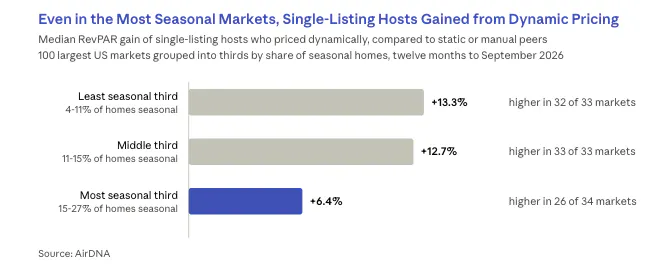
Single-listing dynamic pricers came out ahead in 26 of the 34 most seasonal markets, compared to 32 of 33 in the least seasonal, so a shorter season reduced the RevPAR gain without removing it. The nine markets where dynamic pricing did not lead to higher RevPAR were mostly high-priced, seasonal leisure destinations, such as Long Island, New York, Park City, Utah, and Cape Cod, Massachusetts. There, single-listing homes had a median ADR of $435, nearly double the $230 in the other 91 markets. Where demand peaks in a short, expensive season, a well-set fixed rate can already capture much of the RevPAR, leaving dynamic pricing less to add.
Even there, RevPAR is only part of the return: dynamic pricing tools can also set minimum stays by date, which can mean fewer turnovers and lower cleaning costs for the same revenue. For a host running one home, in a year-round city or a seasonal beach town, the market data point the same way: dynamic pricing was linked to higher RevPAR in the large majority of US markets.
Six in Ten US Homes Still Have Room to Adopt Dynamic Pricing
Across the US short-term rental market, dynamic pricing paid off in the twelve months to September 2026 well beyond the professional operators who adopted it. Full-time homes priced dynamically earned RevPAR +11.1% higher than comparable static and manual homes. Single-listing hosts gained as much as operators with 21-99 listings and came out ahead in 91 of the 100 largest markets. Seasonal homes on algorithmic pricing filled more of their season and earned more per available night.
Most US homes still have room to adopt: six in ten (60.9%) did not price dynamically, including 285,000 full-time homes run by single-listing hosts. Algorithmic pricing, linked to the largest RevPAR gain (+19.9% among full-time homes), reached only 9.7% of single-listing homes compared to 31.7% for hosts with 100 or more listings. For these hosts, using pricing tools that respond daily to the market is the clearest route to higher occupancy and RevPAR, whatever the size of their portfolio or the length of their season.
Tips From Adapt’s Founding Revenue Manager
Jessica Spinks is Adapt’s founding revenue manager. Before joining AirDNA’s Adapt, she spent more than eight years pricing vacation rentals for professional operators: as Director of Revenue Management at Casago, Lead Senior Revenue Manager at Rented, and Senior Revenue Manager at Awayday Vacation Rentals. Here is her advice for hosts who have not made the switch yet.
“If you’re still setting prices by hand, here’s how I’d think about making the switch.”
If you run one or two homes
- You’re not too small for this. Single-listing hosts who price dynamically see gains as big as operators with dozens of homes.
- Start with one home. If you have two or three, try a pricing tool on one and compare it with the others over a few months.
- Pick a tool you’ll actually use. You don’t need every feature, just one that updates your rates daily and lets you set a minimum price.
- Set your guardrails first. Before you switch it on, decide your lowest and highest acceptable rates and your minimum stay. If you’re worried about prices running too high or too low at certain times of year, most tools let you set different limits for date ranges you choose, like peak season or the slow months, so you stay in control all year.
- Give it a full season before you judge it. A couple of weeks won’t show you how it handles your busy and quiet periods.
- Think of it as time back. Repricing every day is the part most hosts skip because it’s tedious, and it’s exactly what a tool takes off your plate. That leaves you more time for the work that grows your business, like improving your listing or talking with guests, and more time for life outside it.
If your home is seasonal
- A short season is a reason to adopt, not a reason to skip it. With fewer nights to sell, every one of them counts more.
- Switch it on before your season opens. Guests book peak weeks months ahead, and that’s when your price matters most.
- Let it handle the edges of your season. The weeks around your peak are the hardest to price by hand, and the place a tool earns its keep.
- Leave it running whenever you’re open. You get competitive rates on every open date without watching the calendar.
- Use it for more than price. Most tools also adjust minimum stays automatically. They hold out for longer bookings when dates are far away, then loosen up as dates get closer to fill gaps in slower periods.
“Dynamic pricing isn’t just for the big operators anymore. The tools work for hosts with one home or one season, and the results show it. If you run one or two homes yourself, the hours you get back from not updating your calendar by hand can be worth as much as the extra money, if not more.”
FAQs
What are the benefits of dynamic pricing for short-term rental hosts?
Higher occupancy and higher RevPAR. Among US full-time entire homes in the twelve months to September 2026, homes priced dynamically earned RevPAR +11.1% higher than comparable static or manual pricers. Almost all of the gain came from occupancy, +5.4 points higher, while ADR was only +0.5% higher.
Is dynamic pricing worth it for a host with one listing?
Yes, according to AirDNA data. Single-listing hosts with full-time homes who priced dynamically earned RevPAR +11.2% higher than similar static or manual homes, in line with operators of 21-99 listings (+10.7%), and came out ahead in 91 of the 100 largest US markets.
Does dynamic pricing work for seasonal vacation rentals?
Seasonal homes on algorithmic pricing recorded occupancy +2.8 points higher and RevPAR +2.7% higher than static pricers. The occupancy gap was widest at the edges of the season: +4.1 points in September 2026 and +3.7 points in October 2025.
How many US hosts use dynamic pricing?
In the twelve months to September 2026, 39.1% of US entire homes on Airbnb and Vrbo priced dynamically, split between actively managed pricing (19.0%) and algorithmic pricing (20.1%). Adoption rose from 24.4% of single-listing hosts to 61.2% of hosts with 100 or more listings.
What is the difference between rule-based and algorithmic pricing?
Rule-based pricing varies rates with set rules, such as day of week, season, or days from check-in. Algorithmic pricing uses a revenue management system such as Adapt, which recalculates the rate for every calendar date daily based on booking trends in the market. Among full-time homes, algorithmic pricers earned RevPAR +19.9% higher than static pricers, compared to +5.7% for rule-based pricers.
ARTICLE SUMMARY
AirDNA data on US entire homes in the twelve months to September 2026 shows the benefits of dynamic pricing reach hosts of every size: single-listing hosts who priced dynamically earned RevPAR +11.2% higher than static or manual pricers, as much as large operators, and came out ahead in 91 of the 100 largest US markets.
Camilo Schmid Rivas
Senior Research Analyst
Camilo Schmid Rivas is a Senior Research Analyst at AirDNA who brings a uniquely well-rounded perspective to short-term rental analytics. With a background that spans investment, real estate, and business analysis—including roles at Stayery and Sollers Consulting—Camilo has worn many analyst hats, each sharpening his ability to turn complex data into clear, actionable insights. A graduate of École hôtelière de Lausanne, he now channels his multidisciplinary expertise into uncovering trends that drive smarter STR decisions. In his free time, he enjoys playing tennis or scuba diving in or around Barcelona.
Related






Get started with AirDNA today.
Powerful, easy-to-use tools that help hosts and investors succeed in the short-term rental market.
Try for free