Best Places to Invest in a Short-Term Rental with $250-400K
Published: January 27, 2026

Jamie Lane
Key Takeaways
- A $250-400K budget can work well for short-term rental (STR) investing when home prices, demand, and yield are in balance.
- The most profitable STR opportunities in this price range tend to come from markets with steady, repeatable demand.
- AirDNA helps investors assess where to buy an Airbnb by looking at yield, revenue potential, and pricing together.
A $250-400K budget puts short-term rental (STR) investors in a practical but demanding part of the market. There are plenty of opportunities, but the wrong market can quickly limit returns. At this level, knowing where to buy an Airbnb matters just as much as what you buy.
For investors looking to buy a vacation rental property at this budget, success often comes down to demand quality. Markets driven by predictable, consistent travel from a diversified guest base will perform best.
To identify the best places to buy a short-term rental with a $250-400K budget, we used AirDNA data to analyze regions where purchase prices, demand, and income potential are aligned. The markets that made the cut are places where your investment dollars go furthest.
What to Consider When Investing in an Airbnb With $250-400K
With up to $400K to invest, you have options but not unlimited margin. At this price point, small differences between markets can have an outsized impact on performance, so it’s important to focus on the factors that actually move returns.
We recommend considering:
How much demand supports the market
Strong short-term rental markets in this range tend to have repeatable demand. That might come from year-round travel, steady weekend visitation, or multiple demand drivers like universities, healthcare, or access to golf courses. Markets that rely on a few peak weekends are probably going to struggle to deliver consistent results.
Income potential relative to purchase price
Looking at revenue alone can be misleading. A market with lower top-line revenue might still outperform if the cost of entry is reasonable. Comparing income potential to price helps you see whether the numbers actually make sense or only work on paper.
Seasonality and booking patterns
Some markets deliver big seasonal spikes but quiet off-months. Others don’t peak as high, but stay active throughout the year. Understanding how bookings spread across the calendar helps set realistic expectations for cash flow and operating costs.
Local regulations and operating constraints
Short-term rental rules can change a lot from one city or neighborhood to the next, even within the same state. Before you buy, make sure you understand what’s allowed, how permitting works, and whether the rules are likely to stick.
Our Methodology for Ranking the Best Places to Invest with a $250-400K Budget
To find the best places to own an Airbnb at the $250-400K price range, we started with the basics: price, then performance.
First, we used AirDNA’s For-Sale Properties data to narrow in on markets where investors can realistically find homes within this budget. From there, we looked at how properties in those areas perform as vacation rental investments. Instead of looking at top-line revenue alone, we compared income potential to home price to determine yield. This paints a clearer picture of how a property might perform relative to purchase price.
All data reflects market conditions as of December 2025 and is intended to show relative performance, not guarantees. As with any investment vacation property, results will vary based on the specific home, its location, and how it’s operated.
Best Places to Invest in a Short-Term Rental for $250-400K
With a $250-400K budget, the most profitable short term rental markets are the ones where home prices are balanced by demand. The locations below offer a mix of attainable purchase prices and income potential that still holds up at this price point.
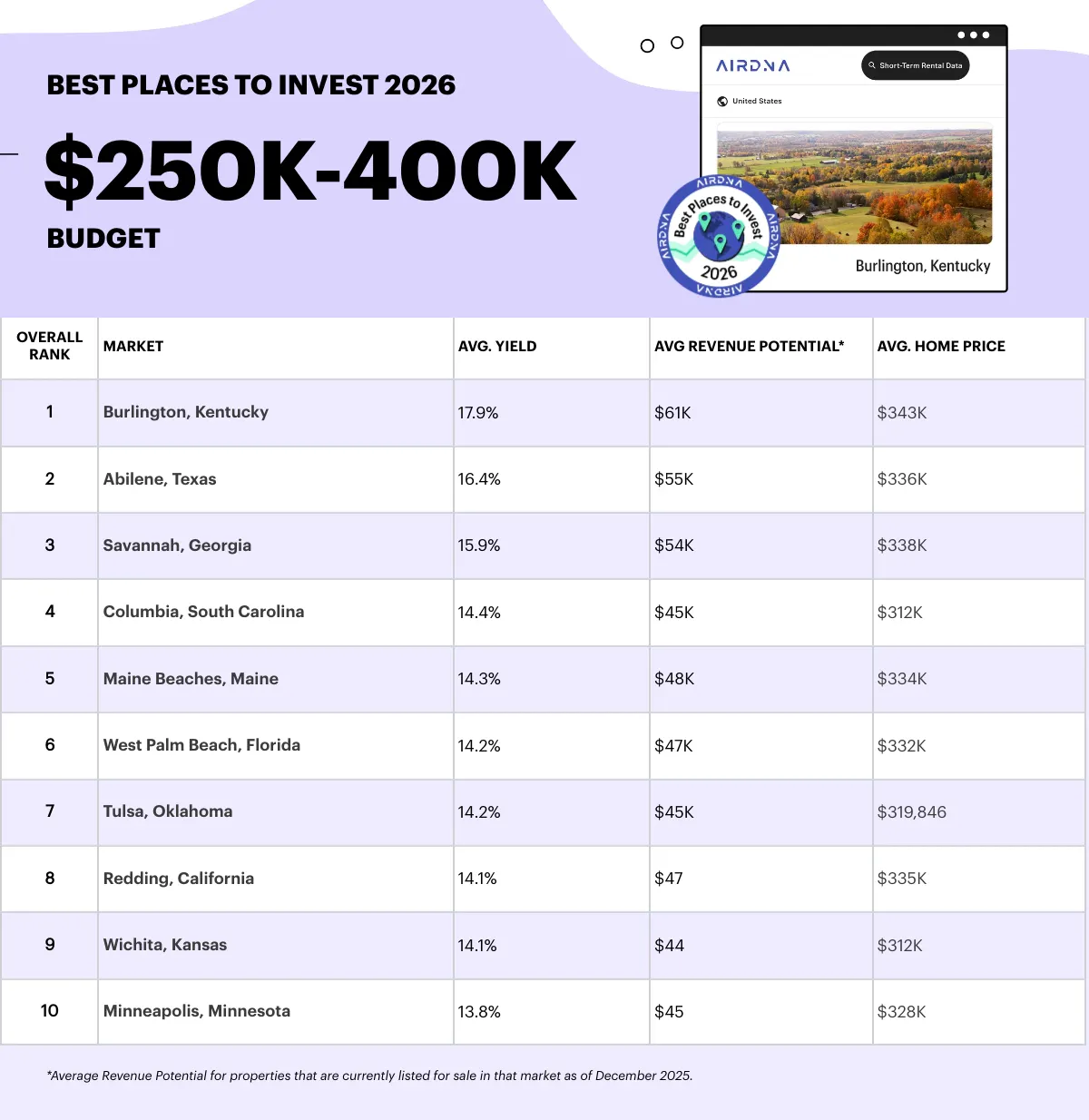
Remember that performance inevitably varies from asset to asset. Factors like location, layout, condition, amenities, and local regulations will impact a specific property’s yield.
1. Burlington, Kentucky
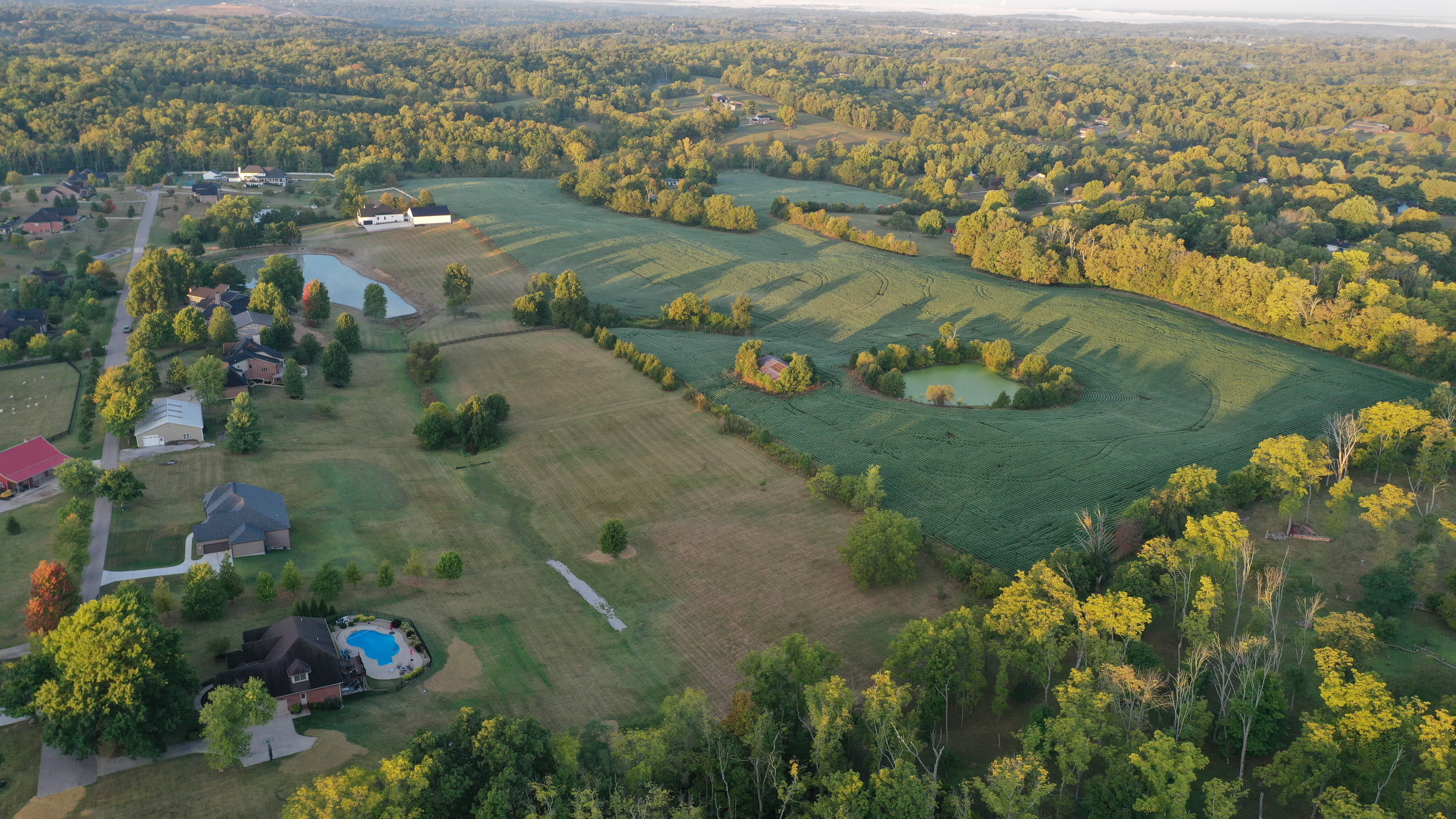

Burlington offers a rare mix of an affordable buy-in and near-18% gross yield, with returns driven by income rather than assumptions about appreciation. It’s a practical market where investments work because diverse demand pairs with affordable home prices.
Notably, demand comes from a mix of everyday travel, not one-off tourism. Families visit for outdoor attractions like Idlewild Park, heritage travelers stay near the Dinsmore Homestead, and Boone County Cliffs State Nature Preserve draws weekend visitors. Larger events at the Boone County Fairgrounds create occasional booking spikes, while nearby regional attractions make Burlington a convenient place to stay. All together, this supports steady demand throughout the year.
With an average home price of just under $344K, revenue potential is impressively high at $61,517. That strong income-to-price relationship gives investors more breathing room on expenses and margins that hold up even if bookings fluctuate.
Regulations:
Boone County provides a defined framework for short-term rentals, including clear operational rules (for example, STRs cannot operate in non-dwelling structures like RVs, tents, garages, or boats). Overall, the environment reads as structured but workable for investors.
2. Abilene, Texas
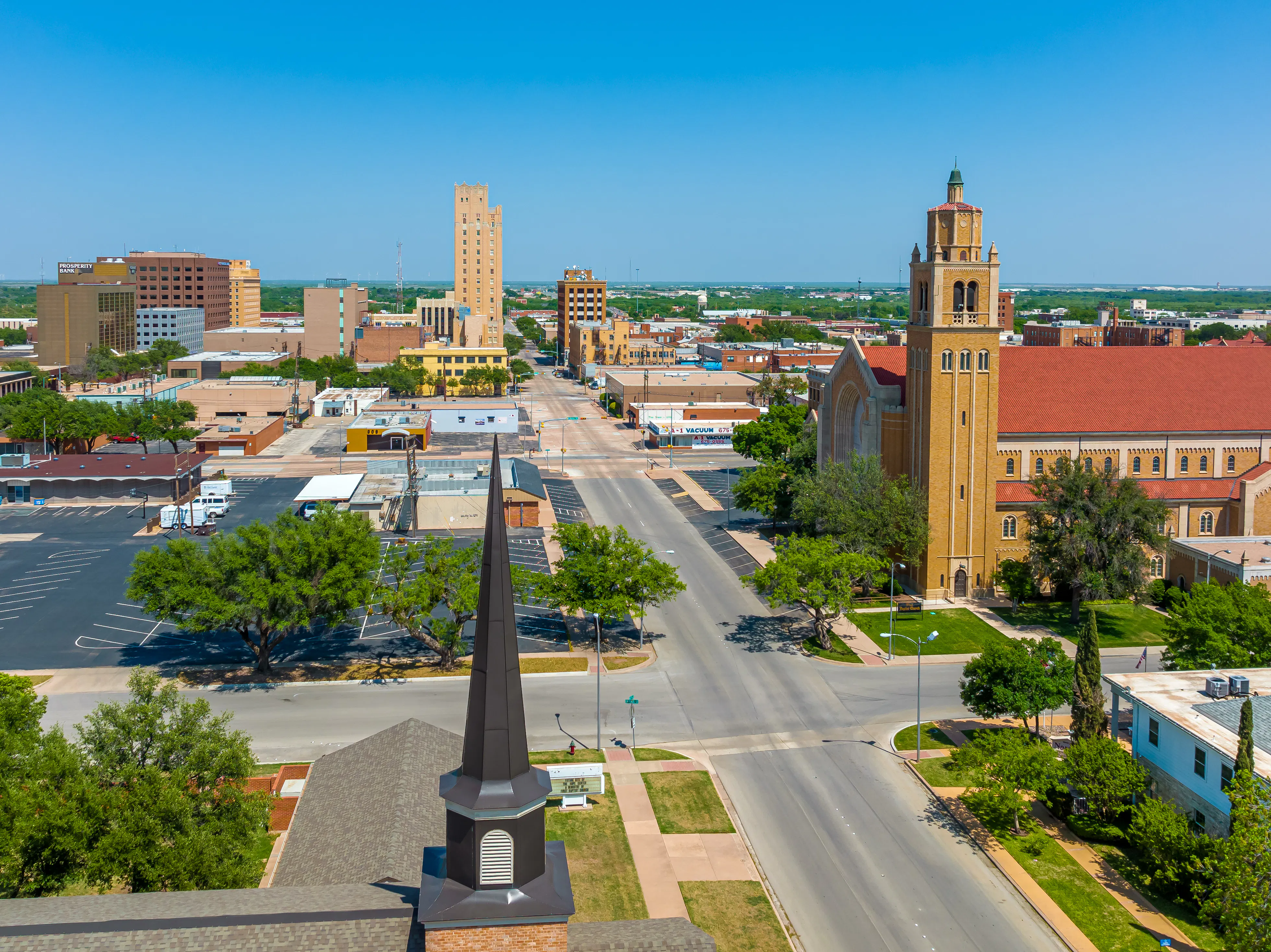

Abilene is #2 best place to invest (BPTI) in homes priced between $250-400k and it's also second for BPTI overall.
It stands out as a secondary Texas market with unusually strong cash-flow potential, driven by steady, real-world demand rather than tourism or vacationers. The city’s role as a regional hub for military, education, and healthcare creates a reliable stream of guests that shows up throughout the year.
Demand comes from multiple directions: Dyess Air Force Base brings in visiting families, trainees, and contractors. Six local colleges, including Abilene Christian University, generate parent visits and graduation stays. Hendrick Medical Center is one of the region’s largest employers, drawing short-term and extended stays from patients and their families. Layer in Abilene’s Downtown Cultural District, museums, live music, and the zoo, and you get a market where bookings aren’t tied to a single season or attraction.
From a numbers standpoint, the market holds up. Homes only cost about $336K on average but annual revenue potential exceeds $55K, resulting in a whopping 16.4% average yield. With returns like that, investors have room to absorb operating costs and still maintain attractive margins.
3. Savannah, Georgia


Savannah, Georgia pairs strong year-round demand with accessible entry pricing, giving investors a clear path to cash flow. This city consistently attracts leisure travelers who want to stay close to the historic core and are willing to pay for location.
Demand is diverse across seasons and trip types. Savannah’s iconic architecture, walkable districts, restaurant scene, museums, and easy coastal day trips keep demand steady beyond a handful of peak weekends.
Savannah boasts a relatively affordable average home price of $338K—but given the city’s popularity, STR hosts can still commend premium nightly rates. Average revenue potential is $53,830, which means average yield here is 15.9%. That’s a standout gross yield that provides cushion against seasonality, rate shifts, and rising operating costs.
Regulations:
Savannah allows short-term vacation rentals but regulates them with a defined framework, including rules on where and how they can operate. Vacation rentals are permitted within the short-term vacation rental overlay district, which includes the Downtown, Victorian, and Streetcar local historic districts.
Prospective hosts must submit an application and secure an STVR (short-term vacation rental) certificate. Fees include a one-time $400 application fee and an annual $250 renewal fee.
4. Columbia, South Carolina


Columbia, South Carolina offers steady, year-round short-term rental demand at a relatively accessible price point. It’s a market built on everyday travel spanning government, medical, business, and family visits.
Family attractions like Riverbanks Zoo & Garden, cultural draws like the South Carolina State Museum, and easy access to rivers, parks, and Lake Murray give guests reasons to visit throughout the year. Downtown Columbia’s growing mix of restaurants, shopping, and community events supports repeat stays and helps smooth seasonality beyond major event weekends.
From a numbers perspective, Columbia remains approachable for STR investors. Average home prices are just over $312K (a manageable buy-in), while $45,022 in revenue potential signals consistent booking opportunities. A 14.4% average yield makes Columbia attractive for investors who want consistent performance without a high acquisition cost.
Regulations:
Columbia requires both a Short-Term Rental Permit and a Business License prior to allowing occupancy. Investors should also monitor local reporting on potential rule updates (e.g., minimum night requirements).
5. Maine Beaches, Maine
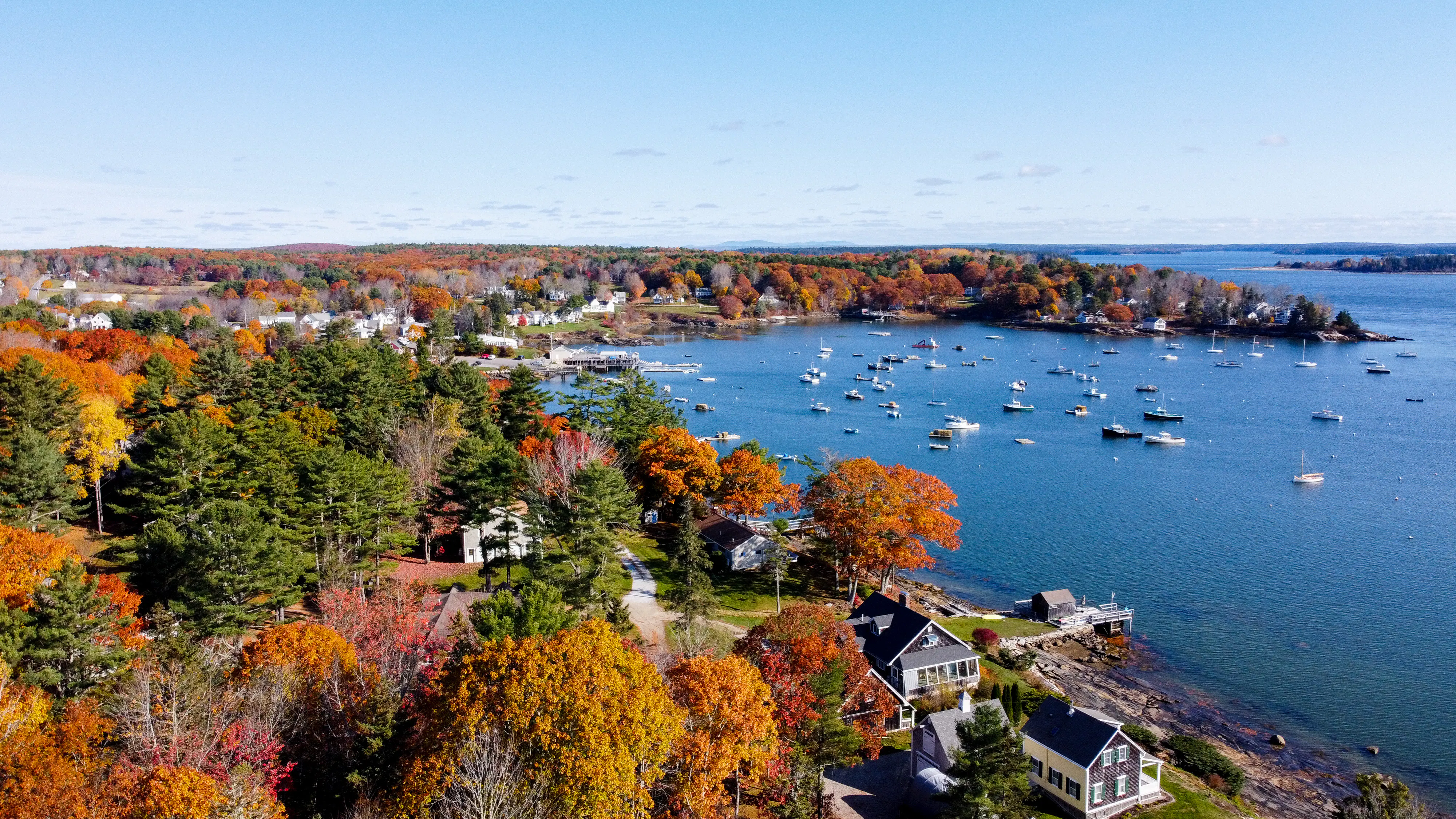

“Maine Beaches” is an AirDNA-defined region that includes Sanford, Waterboro, Biddeford, Kennebunkport, Wells, Ogunquit, and part of Portsmouth, New Hampshire. This market captures classic New England coastal demand across each town, combining summer pricing power with enough shoulder-season activity to support strong short-term rental performance.
Demand is driven by the full Maine coast experience. Guests come for beaches, lighthouse touring, whale watching, fishing charters, paddling, and walkable seaside towns. In peak summer, that translates into premium nightly rates. Outside of summer, fall foliage, spring coastal travel, and food-forward trips help keep bookings moving when purely seasonal beach markets often slow.
This region is surprisingly approachable for a coastal market. Average home prices are around $334K, which is low for coastal New England. With $47,785 in revenue potential, investors here enjoy a 14.3% average yield. That income-to-price balance is notable for a beach market and gives investors flexibility to invest in features that matter here, like outdoor spaces, parking, and pet-friendly layouts.
Because this market spans several micro-locations, investors also gain optionality. Different towns appeal to different guest types, allowing investors to target quieter retreats, family-friendly beaches, or more walkable coastal hubs while still tapping into the same broad demand base.
Regulations:
Vacation rental regulations in Maine are determined at the local level, so it’s impossible to summarize the entire region’s regulatory environment. For example, the City of Biddeford doesn’t have a permit or licensing program for STRs, while Kennebunkport has structured short-term rental regulations with a capped number of STR licenses per year.
Investors looking at this region should contact the city or town where they plan to invest to get specific details before buying.
How to Find the Best Markets to Invest In at Any Budget
Start with price, then evaluate performance
Use AirDNA’s For-Sale Properties data to reveal markets with listings in your budget. Use the Listing Price filter to set a price range with upper and lower limits.
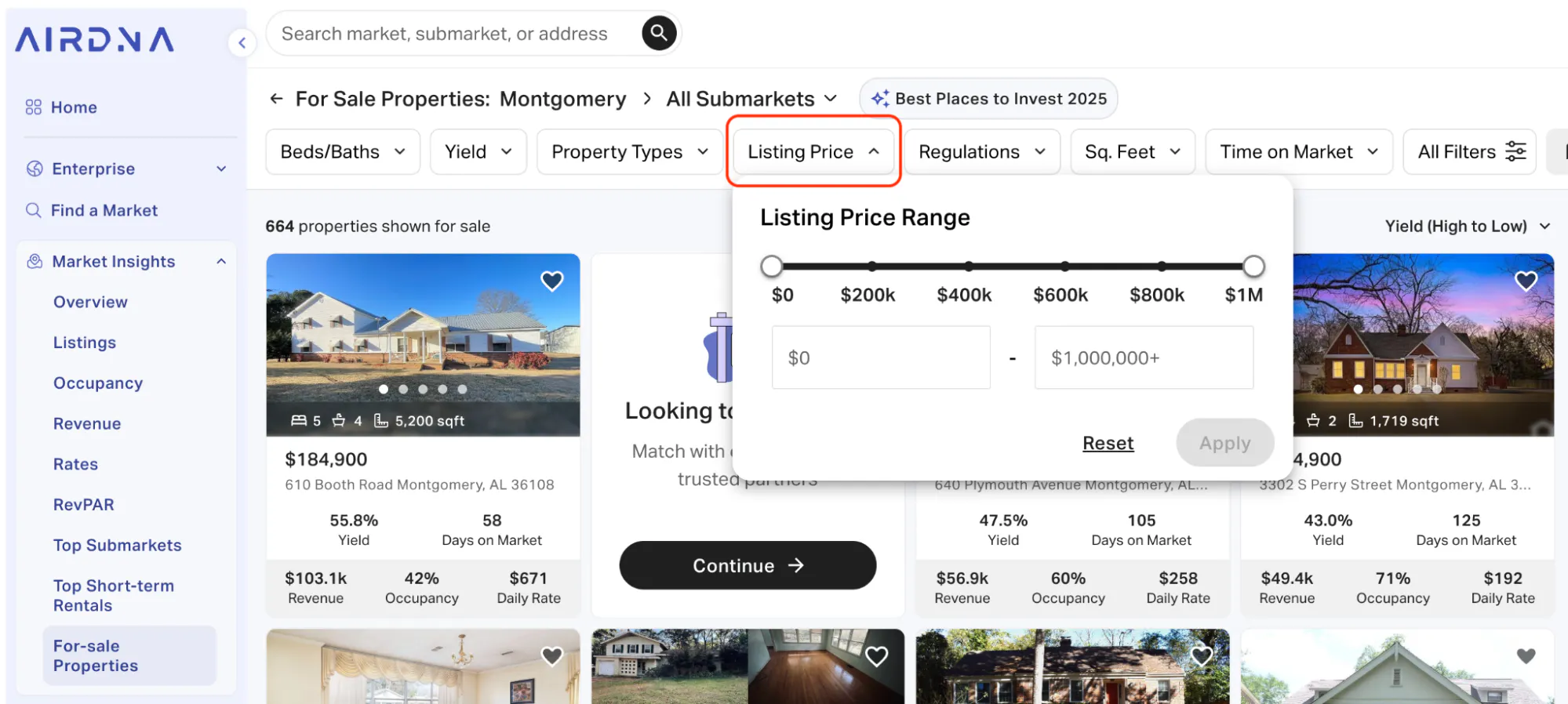
Once you’ve identified for-sale properties in your price range, it’s time to assess how those properties actually perform.
- Compare how much income similar-priced markets can realistically generate
- Focus on yield, not just headline revenue numbers
- Prioritize markets with steady demand over those that only peak at certain times
Use yield to stress-test affordability
A lower price tag doesn’t automatically mean a better short-term rental investment. Yield helps put income potential in context by showing how revenue stacks up against what you pay for the property.
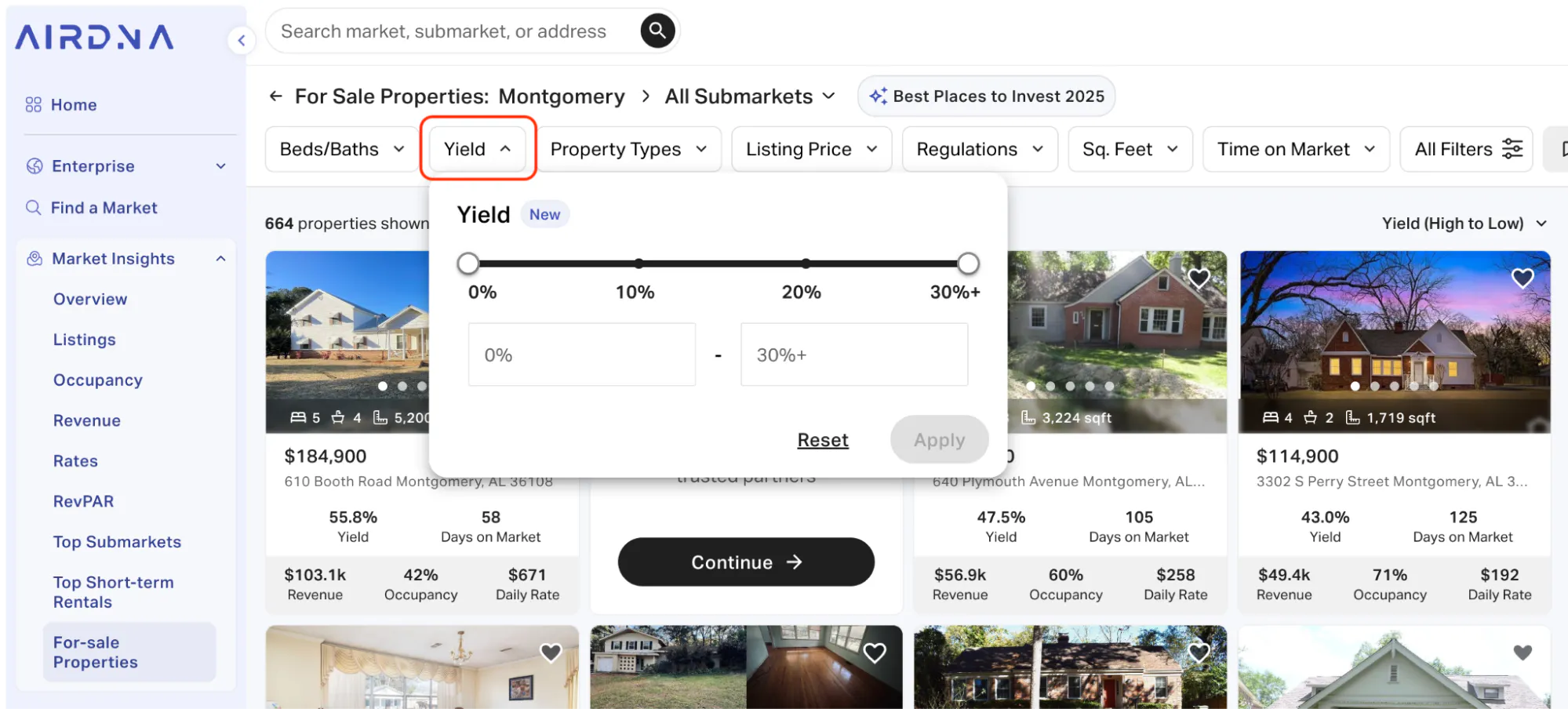
Setting a minimum yield makes it easier to filter out markets where “cheap” homes don’t actually perform.
Set a lower limit using the yield filter to only show properties that meet your desired yield. Find this filter in the For-sale properties tab.
FAQs
Is $250–400K a good budget for a short-term rental investment?
Yes, this budget can work well in markets where home prices and demand are still aligned. Investors at this level can usually access established destinations or strong regional markets without relying on luxury pricing or peak-season spikes to make the numbers work.
What types of Airbnb markets perform best in the $250-400K price range?
Markets with repeatable, everyday demand tend to perform best. That includes places supported by a mix of leisure travel, regional attractions, events, universities, healthcare, or business travel, rather than markets that depend on a short high season.
How competitive are STR markets in the $250-400K range?
Competition varies widely by city and neighborhood. Some markets have a high number of active listings, which means standing out through location, layout, and design becomes more important. Reviewing supply alongside demand helps set realistic expectations.
ARTICLE SUMMARY
For short-term rental investors working with a $250–400K budget, market choice matters. This guide uses AirDNA data to identify U.S. markets where the average for-sale home falls within this price range and is paired with strong short-term rental revenue potential.
Jamie Lane
AirDNA Chief Economist
He is responsible for data analysis, thought leadership, and leveraging advanced analytical techniques to provide new insights into short-term rental market trends. Native to Atlanta and an Airbnb host himself, Jamie enjoys cycling, mountain biking, backpacking, running, and playing in a dart league in his free time.