Christmas and New Year’s 2026: The Holiday Calendar Is Boosting Long Weekends
Published: October 27, 2026

Bram Gallagher
Christmas and New Year’s both open a weekend in 2026, and U.S. short-term rental demand for the holidays is already pacing 6.4% ahead of last year. Using AirDNA’s short-term rental data, we break down which nights are driving the gain, why three- and four-night stays are growing fastest, and which of nine New Year’s Eve markets come out ahead when the holiday lands on a weekend.
Key Takeaways
- U.S. booked demand nights for Dec 21 to Jan 6 are 6.4% ahead of last year as of Oct 14, led by Dec 24 to 26 and Dec 31.
- Friday and Saturday nights in New Year’s week are pacing 30.7% ahead, while the other five nights are down 1.3%.
- Three- and four-night stays are growing fastest, with Christmas week 3-night stays up 35% and 4-night stays up 29%.
- When Dec 31 lands on a weekend, the occupancy boost shrinks in eight of nine markets, but rates usually rise further.
- Las Vegas and Nashville gain the most from a weekend New Year’s Eve, while the national effect nets to about zero.
Holiday Bookings Are Pacing 6.4% Ahead as Both Holidays Open a Weekend
Christmas Day falls on a Friday this year, compared to a Thursday in 2025. New Year’s Eve falls on a Thursday, compared to a Wednesday in 2025, which puts New Year’s Day on a Friday. Both holidays now open a weekend, so a three- or four-night trip needs no days off.
As of Oct 14, booked demand nights for Dec 21 to Jan 6 total 4.05 million, compared to 3.81 million a year ago, up 6.4% (Figure 1). The strongest dates are Dec 24 to 26 (+11% to +14%) and Dec 31 and Jan 1 (+12% and +10%). Christmas week, Dec 22 to 28, is 8.0% ahead, and New Year’s week, Dec 28 to Jan 3, is 5.5% ahead.
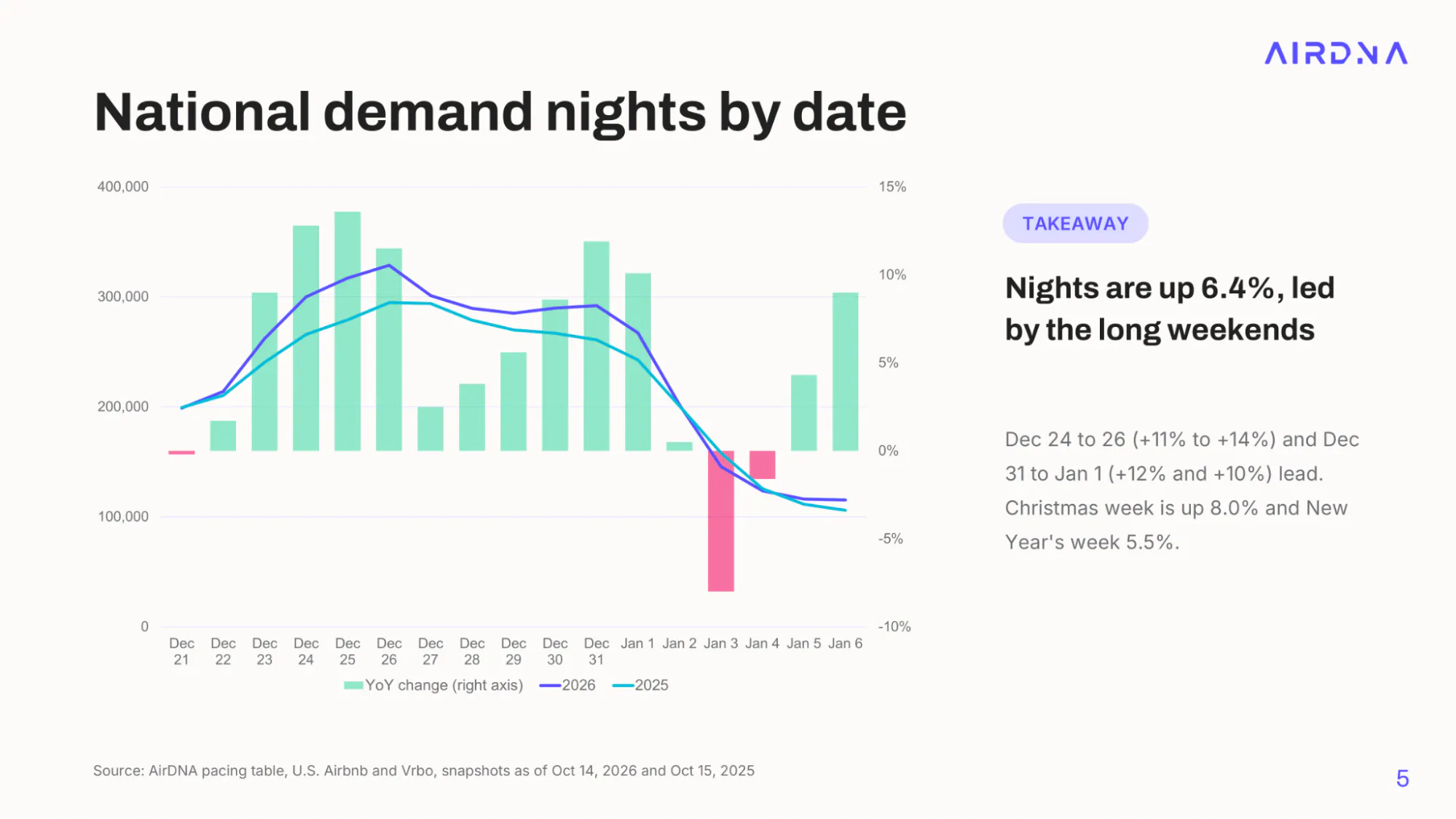
The weekly totals understate the calendar effect, slightly for Christmas but substantially for New Year’s. Friday and Saturday nights tell a different story (Table 1). In Christmas week they are 9.7% ahead, compared to 7.2% for the other five nights. In New Year’s week they are 30.7% ahead while the other five nights are down 1.3%. Last year’s Friday and Saturday nights fell after the holidays, and this year’s are the holidays themselves.
Table 1. Weekly versus weekend pacing, demand nights year over year
| Window | All nights | Fri + Sat nights | Other nights |
|---|---|---|---|
| Christmas week | +8.0% | +9.7% | +7.2% |
| New Year’s week | +5.5% | +30.7% | -1.3% |
Source: AirDNA pacing data, U.S. Airbnb and Vrbo, snapshots as of Oct 14, 2026 and Oct 15, 2025. Calendar-aligned seven-day windows, so each holds one of every weekday.
New reservations checking in are up 18.5%, almost three times as fast as nights, and arrivals bunch on the days before each Friday holiday: Wednesday, Dec 23 is up 51%, Wednesday, Dec 30 is up 44%, and Thursday, Dec 31 is up 34%. Each date is matched to the same calendar date last year, one weekday earlier, using data snapshots as of October 15 and a year ago.
Three- and Four-Night Stays Are Driving Holiday Booking Growth
A Thursday-to-Sunday trip is three nights and a Wednesday-to-Sunday trip is four, so the calendar should show up in stay length. Figures 2 and 3 count reservations by length of stay for reservations with a night in each holiday week, booked by Oct 13 of each year, excluding stays of 28 nights or longer. Demand nights are the nights inside the week on those reservations.
Three- and four-night stays are the peak in both holidays and grow fastest. In Christmas week there are 497,000 reservations, compared to 425,000, up 17%, with 3-night stays up 35% and 4-night stays up 29%. In New Year’s week there are 439,000 reservations, compared to 381,000, up 15%, with 3-night stays up 28% and 4-night stays up 20%.
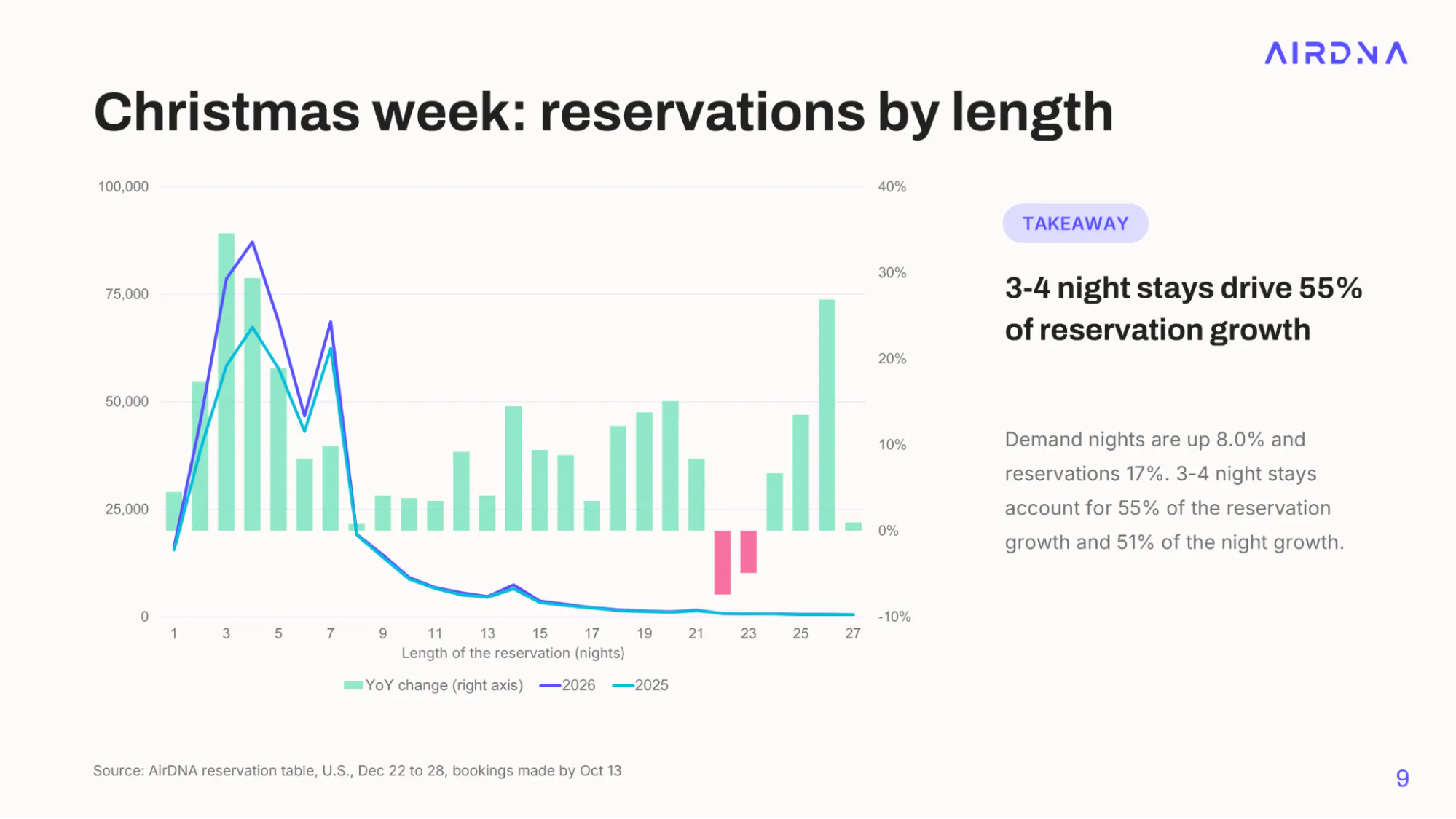
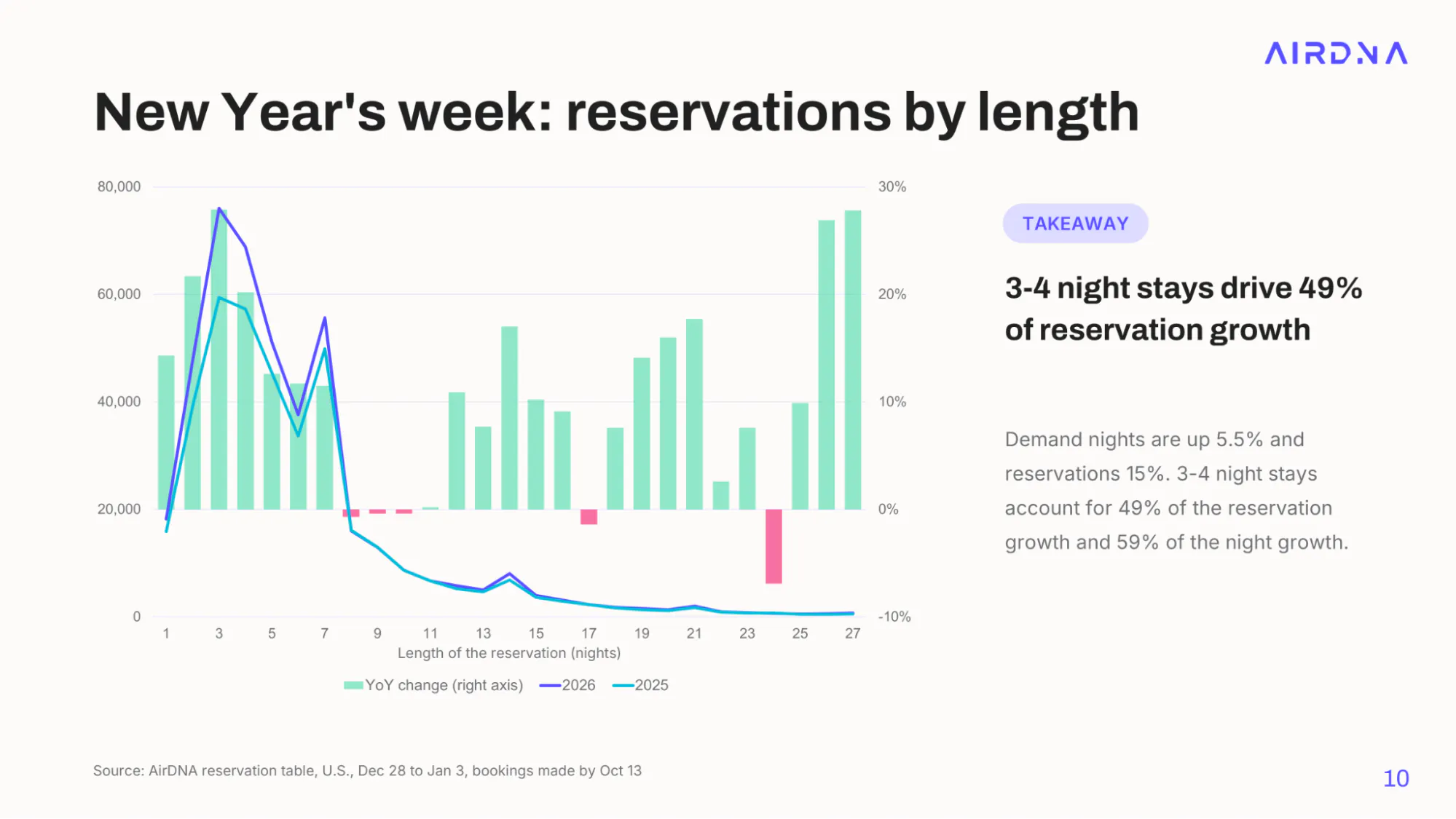
In Christmas week, 3- and 4-night reservations rise from 30% of reservations and 24% of demand nights in 2025 to 33% and 28% in 2026, and they account for 55% of the growth in reservations and 51% of the growth in nights. In New Year’s week their shares rise from 31% and 24% to 33% and 28%, and they account for 49% and 59% of the growth.
The most common reservation for Christmas week is four nights, while the most common for New Year’s is three nights. Both are seeing strong growth, and the effect of timing on the types of reservations seems clear.
A Weekend New Year’s Eve Lifts Rates More Than Occupancy
The reservation data show the calendar reshaping bookings, but not its effect on occupancy, rates and revenue. A holiday lifts demand on its own and weekends lift demand on their own, so we statistically model what happens when the two combine, using this upcoming New Year’s celebration as our test case. Thursday is the closest match to 2026, but Thursday data are too scarce: New Year’s Eve never fell on a Thursday in a usable season, and 2020 is excluded. We therefore use the Friday and Saturday cases, in 2021 and 2022, as the nearest test.
We chose nine large markets known for New Year’s celebrations, each with enough listings and history from 2018 to estimate its own statistical model: Gatlinburg, New Orleans, Nashville, Savannah, New York, Miami, Las Vegas, Chicago and Key West. New York is pooled with Jersey City/Newark (which sits across the Hudson and draws the same Times Square visitors, so demand can shift between the two). The choice is judgmental, not a random sample, so we also run the model nationally as a benchmark. We use daily data for Dec 15 to Jan 15 from 2018 to 2025, skipping 2020. For each market, we examine the effect on occupancy and average daily rate (ADR) separately. We control for season, weekday, and holiday terms for Dec 24 to 25, Dec 30, Dec 31, and Jan 1. We also look at what happens when Dec 31 falls on a Friday or Saturday. New York’s terms can change after October 2023, when its stricter rental rules took effect.
Dec 31 adds 9 to 33 occupancy points and $36 to $113 in daily rate
The Dec 31 effect adds between 9 occupancy points (in Key West) and 33 occupancy points (in Gatlinburg), and adds $36 to $113 to the daily rate. Fridays and Saturdays lift occupancy by 5 to 13 points in six markets, and rates rise on weekends everywhere.
The calendar matters most when the holiday itself lands on a weekend night. When Dec 31 falls on a Friday or Saturday, the occupancy boost is smaller, because the holiday and weekend demand overlap. This overlap is negative in eight markets, by 3 to 12 points, and significant in Gatlinburg, New York, New Orleans, Key West and Chicago. Las Vegas is the exception at +6 points. Las Vegas has a large hospitality market and usually doesn’t run into capacity constraints.
Hosts partly offset the occupancy overlap with price: the ADR overlap is positive in seven markets, significantly in Las Vegas and Miami, and negative in Key West and New York. While the combined occupancy effect is smaller than the sum of the weekend and holiday effects, the combined ADR effect is most frequently higher, as the extra compression drives pricing power higher than either the weekend or holiday alone.
Table 2. Dec 31 effects by market: Dec 31 boost, weekend effect and overlap, nine markets and the U.S.
| Market | Dec 31 occupancy (pts) | Dec 31 ADR | Fri/Sat occupancy (pts) | Overlap occupancy (pts) | Overlap ADR |
|---|---|---|---|---|---|
| Gatlinburg | 32.8 | $87 | 13.3 | -12.3* | +$19 |
| New Orleans | 29.5 | $113 | 8.0 | -7.2* | +$24 |
| Nashville | 28.2 | $94 | 8.7 | -4.2 | +$26† |
| Savannah | 24.5 | $62 | 8.6 | -3.2 | +$17 |
| New York/Jersey City/Newark | 22.7 | $43 | 4.5 | -7.6* | -$10† |
| Miami | 17.0 | $92 | 5.6 | -3.7 | +$38* |
| Las Vegas | 16.2 | $80 | 1.5 | +6.3* | +$58* |
| Chicago | 15.6 | $36 | 5.0 | -5.2* | +$6 |
| Key West | 9.0 | $93 | 1.9 | -6.0* | -$4 |
| United States | 13.6 | $56 | 5.7 | -2.5 | -$2 |
Occupancy in points. * p<0.05, † p<0.10. New York: before October 2023. Source: AirDNA property-day data, nine markets and the U.S., seasons 2018 to 2025 excluding 2020.

Las Vegas and Nashville Gain the Most When New Year’s Eve Falls on a Weekend
To see what a calendar shift is worth, we ask what happens to the whole week when Dec 31 moves from a weekday to a weekend night. Over any seven days each weekday appears once, and the holiday terms are the same whether Dec 31 is a Friday or a Monday, so the weekend, Dec 30 and Jan 1 effects cancel in the comparison. The only term that differs is the overlap.
We estimate revenue per available listing directly, and the gap in a listing’s revenue over Dec 28 to Jan 3 between a Friday and a Monday Dec 31 equals the overlap coefficient in that model. A market wins when higher rates more than make up for the lost occupancy. In Las Vegas a weekend Dec 31 raises both occupancy (+6.3 points) and rate (+$58), so the week unambiguously gains.
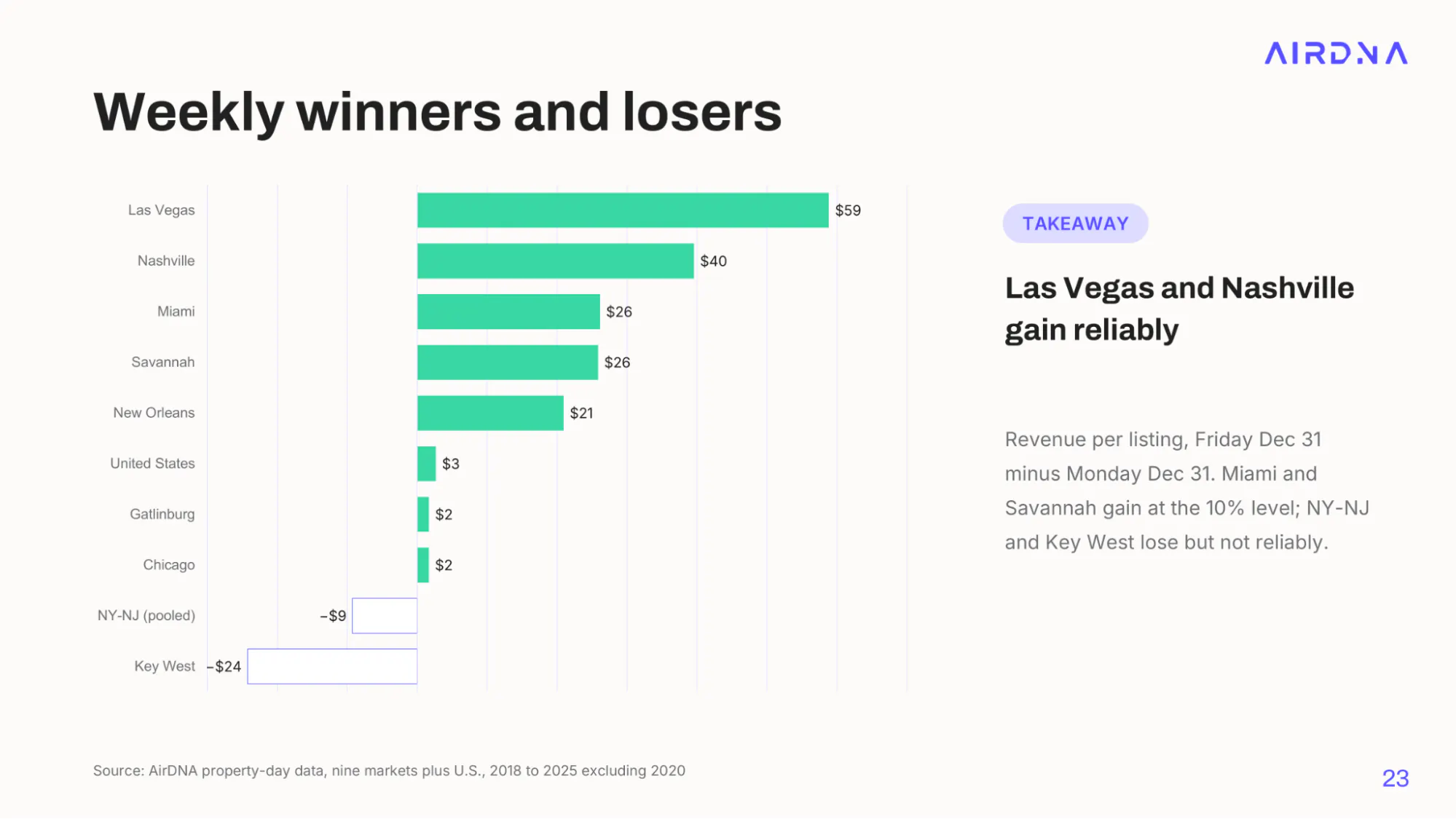
Las Vegas and Nashville gain reliably, and Miami, Savannah and New Orleans generally see benefits from a weekend holiday. New York and Key West lose in point estimate but not reliably, and nationally the effects net to about zero. These estimates show how much the calendar can matter, not a forecast for 2026.
Higher rates and minimum stays capture a weekend holiday
So a host’s ability to capitalize on weekend holidays is not a guarantee but rather depends on that host’s ability to raise prices. Intuitively, if you’re already usually booked on weekends, the holiday doesn’t raise your occupancy and may even leave a Monday unbooked. Higher pricing and a minimum stay policy that encourages three- and four-night stays are the keys to success when events collide with the weekend.
FAQs
What day of the week are Christmas and New Year’s Eve in 2026?
Christmas Day falls on a Friday in 2026, compared to a Thursday in 2025. New Year’s Eve falls on a Thursday, which puts New Year’s Day on a Friday, so both holidays open a weekend and a three- or four-night trip needs no days off.
How far ahead are U.S. short-term rental bookings for the 2026 holidays?
As of Oct 14, booked demand nights for Dec 21 to Jan 6 total 4.05 million, up 6.4% from 3.81 million a year ago. Christmas week is 8.0% ahead and New Year’s week is 5.5% ahead, with Friday and Saturday nights in New Year’s week up 30.7%.
Which stay lengths are growing fastest over the 2026 holidays?
Three- and four-night stays. In Christmas week, 3-night stays are up 35% and 4-night stays are up 29%; in New Year’s week they are up 28% and 20%. Together they account for 55% of Christmas week reservation growth and 49% of New Year’s week reservation growth.
Does a weekend New Year’s Eve increase short-term rental revenue?
It depends on the market. When Dec 31 falls on a Friday or Saturday, the holiday and weekend occupancy boosts overlap, so occupancy gains are smaller, but rates often rise more. Las Vegas ($59 more per listing over the week) and Nashville ($40) gain reliably, while New York and Key West lose in point estimate and the national effect nets to about zero.
How should hosts price New Year’s Eve 2026?
A weekend holiday pays off only for hosts who can raise prices, because listings already booked on most weekends gain little extra occupancy. Higher rates and a minimum stay that encourages three- and four-night stays help capture the long weekend, and dynamic pricing helps rates keep up as the holiday fills.
ARTICLE SUMMARY
Christmas and New Year’s both open a weekend in 2026, and U.S. short-term rental demand for the holidays is pacing 6.4% ahead of last year. AirDNA’s Bram Gallagher breaks down which nights are driving it, why three- and four-night stays are growing fastest, and which of nine New Year’s Eve markets gain when the holiday lands on a weekend.
Bram Gallagher
AirDNA Director of Economics and Forecasting
Bram Gallagher is an Economist at AirDNA, specializing in uncovering insights that drive smarter short-term rental decisions. He put his Ph.D. in Economics from the University of Georgia to work researching and forecasting hotel data with CBRE prior to joining AirDNA, as well as teaching economics at a number of universities. In his spare time, Bram enjoys making wooden furniture with hand tools.