When Guests Book (And When They Don't): What Every Host Should Know
Published: May 7, 2026
Last updated: August 1, 2026

Linda Rollins
Key Takeaways
- Midweek is peak booking time, with most guests reserving stays between Tuesday and Thursday.
- Booking behavior changes by market, season, and property size, so pricing strategies should never be one-size-fits-all.
- The strongest hosts prepare for demand before booking surges happen, not after.
Ever noticed how booking activity seems to arrive in waves? One week, your calendar is buzzing; the next, it’s suspiciously quiet. Turns out, guest booking behavior is surprisingly predictable once you zoom out and look at the patterns.
Guests don’t book randomly. There are certain days, weeks, and seasons when people are far more likely to lock in their trips, whether they’re planning a summer beach holiday six months in advance or panic-booking a city break three days before check-in.
For hosts, understanding those patterns can make a real difference.
Knowing when guests tend to book helps you make smarter decisions about pricing, availability, minimum stays, and promotions before demand starts building. Because the hosts who perform best usually aren’t reacting to demand after it appears. They’re preparing for it in advance.
Using AirDNA data, we looked at exactly when guests are booking throughout the year, what drives those trends, and how booking behavior changes depending on property type, location, and trip style.
Spoiler: Your Guests Are Booking from Their Work Desk
The midweek slump has a silver lining… At least for short term rental hosts.
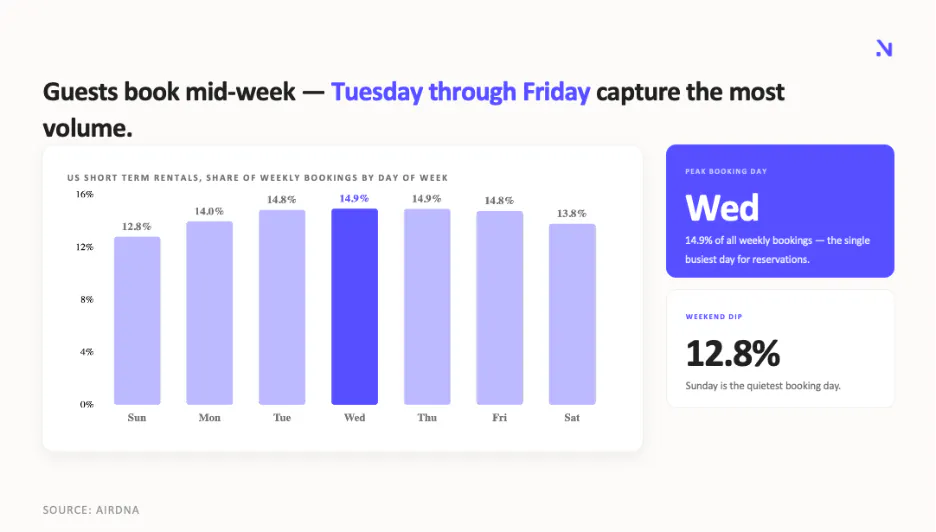
The most popular days for short-term rental bookings are Tuesdays, Wednesdays, and Thursdays, each pulling in about 15% of weekly bookings. Guests aren't sprawled on the couch over the weekend, dreaming of their next getaway. They're sneaking away from spreadsheets mid-week to plan their escape.
Weekends are quieter, but not by a landslide. Sunday brings up the rear, bringing in 12.8% of weekly bookings, and Saturday follows at 13.8%. So, while bookings trickle in every day of the week, there's a real (if gentle) lean toward the workweek.
Host takeaway: Have your listing polished and your calendar updated by Monday night. You want to be in prime shape when the mid-week booking wave rolls in.
The Booking Calendar Is More Front-Loaded Than You'd Expect
In the U.S., March is the single biggest month for STR bookings, while December is the quietest. Broadly speaking, bookings are strongest in Q1 and gradually taper as the year goes on — but your location type shapes this pattern in some pretty distinct ways.
Beach properties: Ride the January wave
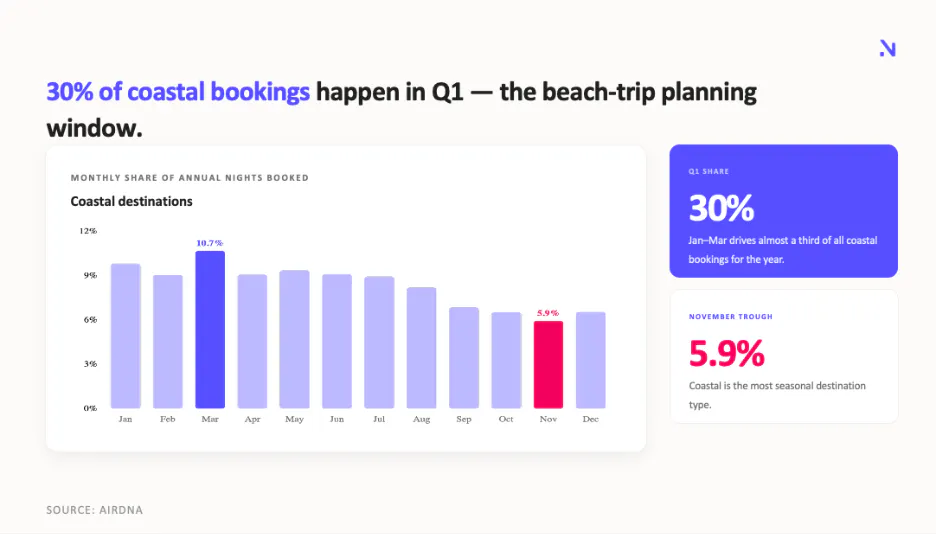
If you host a coastal property, the start of the year is your version of the Super Bowl.
A full 30% of annual beach bookings happen in the first quarter alone, and that share steadily declines through the year. By the time October rolls around, only about 20% of your annual bookings are left to collect.
The message is clear: If your rates and calendar aren't dialed in by early January, you're leaving money on the sand.
Mountain properties: Two seasons, two surges
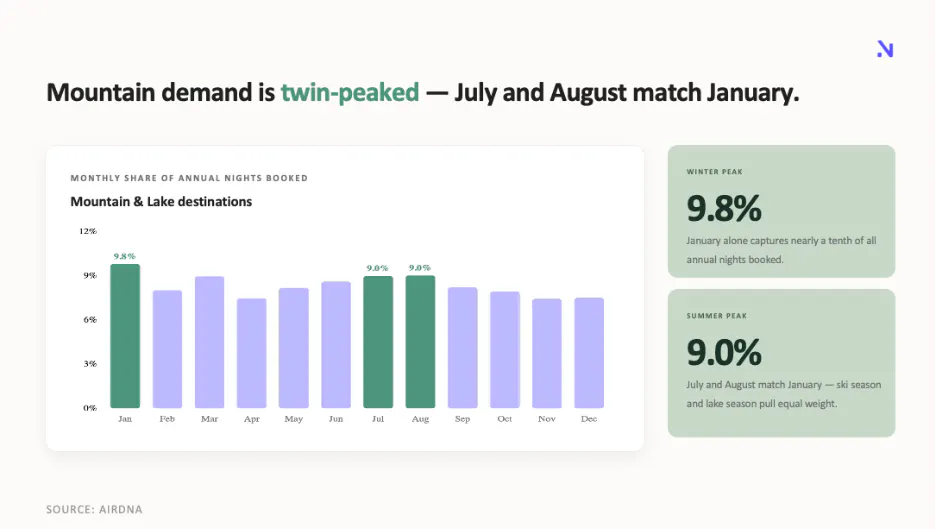
Mountain hosts get two bites at the apple. Ski season drives a strong winter booking spike, and then outdoor leisure demand brings another surge in summer.
If you're in one of these markets, your pricing strategy should account for both windows, because guests will book in waves, not a slow drip.
Urban properties: the most consistent crowd
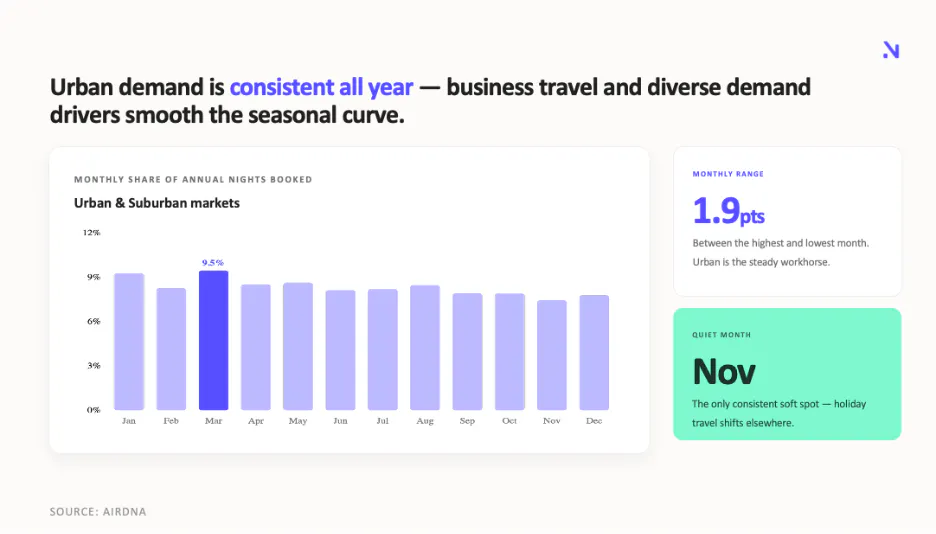
City hosts get a bit of a break from the seasonal rollercoaster.
While you'll still see a concentration of bookings in the first half of the year, urban demand is less tied to seasons, so bookings are spread more evenly throughout.
The Weeks That Make Hosts' Calendars Light Up
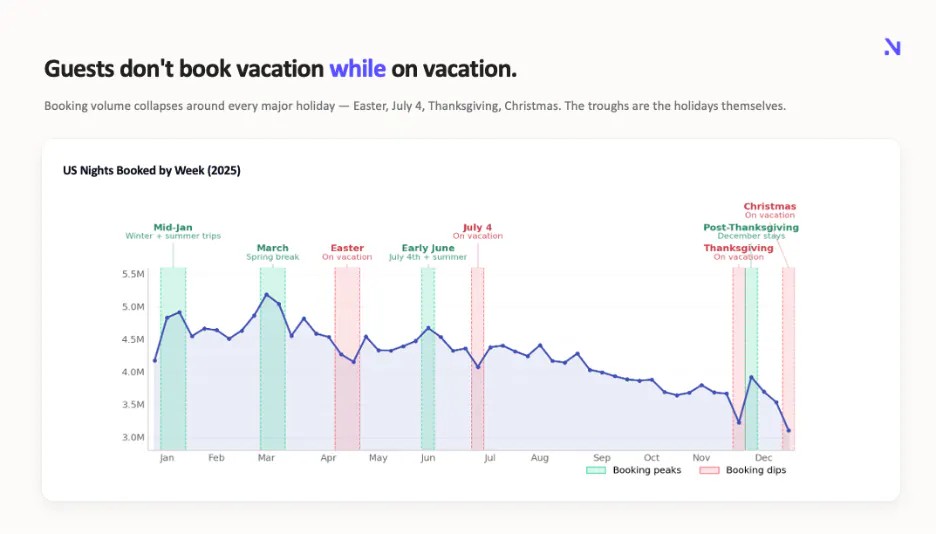
Zoom in even further, and there are specific weeks where booking volume spikes, and the behavior behind each one is surprisingly predictable.
Mid-January: Winter AND summer, all at once
The second and third weeks of January are a goldmine.
Bookings peak here for two reasons at the same time. About 55% of bookings made in mid-January are for near-term winter stays, think January and February getaways, MLK weekend, and Valentine's Day trips.
But another 20% are guests already locking in spring break. The rest? Summer. Yes, in January. Guests are planning months ahead, and they're doing it right after the holidays wrap up.
March: Spring Break mania
The March booking spike is almost entirely driven by guests securing spring break plans.
About 60% of bookings made in March are for March and April stays, with the rest going toward summer. If you're in a spring break destination, this is your moment, and you want your pricing strategy ready before February ends.
Early June: Summer scramble
A spike hits at the beginning of June as guests rush to lock down their summer plans. A remarkable 85% of bookings made in early June are for June through August stays.
The week after Thanksgiving: Holiday mode, activated
After the turkey coma wears off, guests get to book their holidays. About 50% of reservations made the week after Thanksgiving are for December stays, another 25% are for January and February, and a smaller share of early planners start eyeing spring and summer. It's a mini planning frenzy tucked right into the holiday season.
Host takeaway: These booking spikes are predictable, which means your pricing and availability should be ready ahead of them, not after.
And the Weeks When Nobody's Booking? Also Predictable.
Here's the thing about guests: They don't book vacations while they're on vacation.
The weeks with the lowest booking activity cluster around major holidays, like Easter, July 4th, Thanksgiving, and Christmas. Guests are busy enjoying the moment, not planning the next one.
So, if your booking activity goes quiet during those windows, don't panic. It's not you, it's just how people behave.
When do the Early Planners Book?
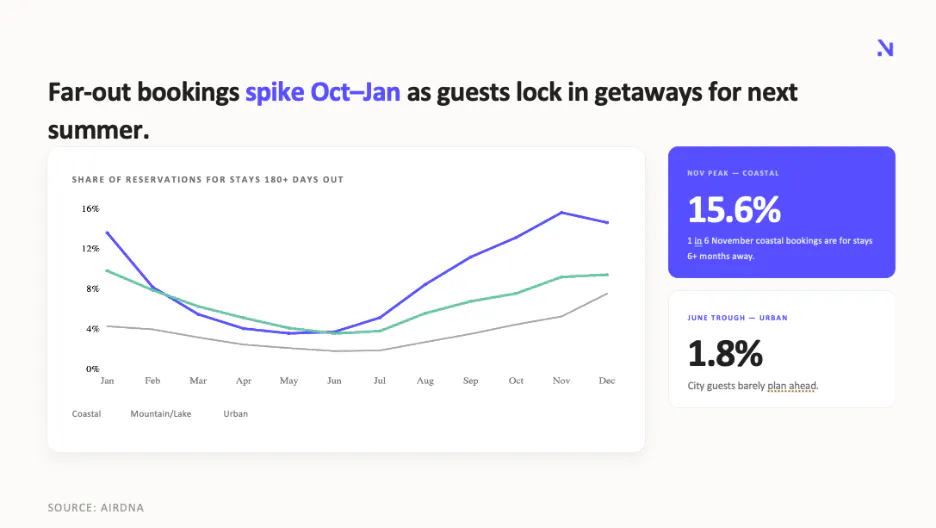
Far-out reservations, bookings made more than six months before the stay, account for about 6% of total bookings. It's a small slice, but these guests are worth understanding.
Far-out reservations spike between October and January, when guests are locking down summer stays well in advance. After January, this behavior drops off sharply; most people simply don't plan their fall and winter travel six plus months ahead.
How pronounced the far-out booking spike is depends on where your property is located. For beach hosts, about 15% of bookings made between October and January are for stays more than six months out. Mountain and rural destinations see around 10% of bookings in October through January fall into that far-out category. Cities see the most muted version of this trend, with about 6% of reservations in those months being for stays six plus months away.
Host takeaway: If you're thinking about early-bird discounts for spring and summer dates, October through January is your window. That's when far-out planners are actively searching — especially for beach properties.
Last-Minute Bookers Have Their Season Too
On the opposite end of the spectrum, last-minute bookings, reservations made within a week of the stay, tend to surge in the last quarter of the year.
Fall is event-heavy: College football weekends, weddings, leaf-peeping trips, Halloween, and fall festivals. These are activities people commit to on much shorter timelines than a summer vacation. Throw in some short-notice holiday planning, and you've got a recipe for a flurry of late bookings.
But not all markets see this equally. In cities, about a third of bookings in Q4 are for stays within a week of booking; city travel is inherently more spontaneous. In mountain and coastal destinations, that percentage drops to 20-25%. Guests heading to those properties tend to plan a bit more in advance, even in the fall.
Property Size Changes Everything
General booking trends are a great starting point, but the specifics of your property’s attributes (such as the number of bedrooms, the amenities on offer, and yes, whether you have a hot tub) is a large factor that impacts how often you see far-out or last minute bookings.
Large coastal properties
If you're hosting a five-plus bedroom property on the coast, October through January is prime far-out booking season. More than 30% of your bookings during that window will be for stays still six or more months away. Last minute guests booking within a week of stay make up just 9% of bookings between October and January.
Small coastal properties
If you're running a studio or one-bedroom coastal property, the October through January window still brings a bump in far-out bookings… just a much smaller one.
8% of bookings will be for stays six months out, while more than a quarter will be from guests booking within a week of their stay. Small property, shorter planning horizon.
Large city properties
In cities, larger properties with five-plus bedrooms see about 10% of their October through January bookings come from far-out planners. That’s a modest number, but it’s significant enough to build your early-bird strategy around. Last-minute bookings account for around 20% of bookings during that same stretch.
Small city properties
For studio and one-bedroom city listings, far-out planners booking between October and January only make up 4% of bookings, but last-minute demand more than makes up for it.
40% of late fall reservations are for stays within a week, which means that your guests are deciding on a Thursday that they want to go somewhere that weekend.
Keeping instant booking on and your calendar fresh could be the difference between a booked weekend and a missed one.
Host takeaway: Your pricing and marketing strategy should reflect your property size, not just your location. Big property? Court the early planners. Small property? Stay ready for the last-minute wave.
The Smartest Hosts Aren’t Guessing
Guest booking behavior is surprisingly consistent once you know what to look for. There are weeks when travelers are actively planning, moments when demand builds quickly, and quieter periods when almost everyone stops searching altogether.
The hosts who perform best aren’t necessarily the ones with the trendiest interiors or the fanciest welcome baskets. They’re the ones who understand when demand is building and adjust their pricing, availability, and strategy before everyone else catches on.
The trends above give you the national picture, but every market behaves a little differently. A beach town in Florida won’t book the same way as a mountain cabin in Colorado or a city apartment in Chicago. Even within the same market, booking patterns can shift depending on your property size, guest type, and seasonality.
That’s where market-level data becomes incredibly useful.
AirDNA’s future booking data helps you see when similar listings in your area are picking up reservations, where demand is accelerating, and when guests are booking earlier or later than usual.
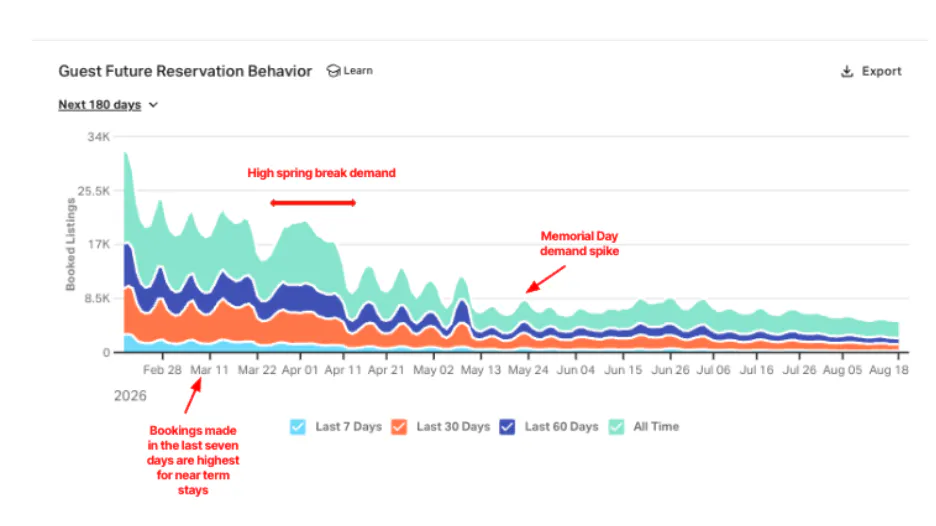
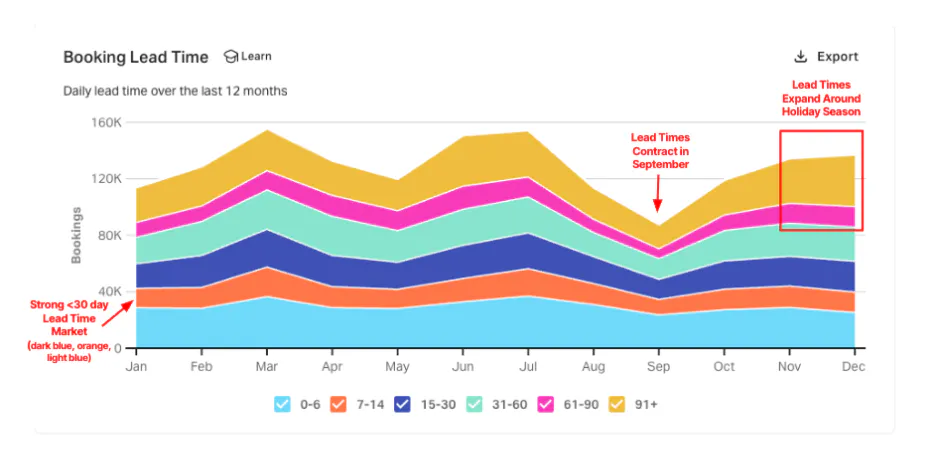
Pair that with our historical lead time data, which tracks the average gap between booking day and check-in, and you'll know exactly when your market attracts the 90-day early birds versus the last-minute scramblers. Together, those metrics will tell you when to lock in your rates, when to hold firm, and when to push. Because the hosts who win aren't the ones who notice the wave, they're the ones who were already priced for it.
FAQs
What day of the week do guests book Airbnbs the most?
Tuesdays, Wednesdays, and Thursdays consistently see the highest share of reservations, as many travelers plan trips during the workweek rather than on weekends.
When do guests usually book summer vacations?
Beach destinations often see a large wave of summer bookings between October and January, while another booking surge typically happens in early June as travelers finalize last-minute summer plans.
Do guests book city stays differently from beach or mountain properties?
Yes. Urban bookings are usually more consistent throughout the year and tend to include more last-minute reservations. Beach and mountain properties often experience stronger seasonal booking waves, with guests planning trips further in advance, especially for peak travel periods.
ARTICLE SUMMARY
AirDNA data breaks down the days, weeks, and seasons when booking activity peaks, how booking behavior changes across beach, mountain, and urban markets, and what hosts can learn from far-out and last-minute reservation trends.
Linda Rollins
Senior Research Analyst
Linda Rollins is a Senior Research Analyst at AirDNA and a self-managing short-term rental host, which means she understands the market as both an analyst and an operator. She writes research and blogs for AirDNA and for Adapt, its revenue management tool, making her work a go-to resource for investors trying to find and size up the right opportunities, and for operators looking to understand changing market dynamics and find concrete ways to improve occupancy, rates, and guest experience. Her data is regularly cited in major news outlets, and she has a knack for bringing both the numbers and the story behind them. In her free time, Linda enjoys spending time with her family, traveling, and looking for good eats.