Airbnb Ratings Explained and Why 4 Stars Doesn’t Cut It
Published: August 1, 2025
Last updated: September 5, 2025

Bram Gallagher
Key Takeaways
- Airbnb allows guests to leave feedback for hosts in the form of reviews and ratings, which are measured on a scale of 1 to 5 stars.
- Airbnb ratings are critical to your success as a host because they impact future guests’ decisions to stay at your property.
- Receiving positive reviews and five-star ratings can help you become an Airbnb Superhost.
- Even a small ratings boost can mean more income. A 0.1-star increase in your average rating can add $100–$200 in monthly revenue in some markets.
Think 4 stars is a great rating on Airbnb? Think again.
For new and experienced hosts alike, Airbnb’s 5-star rating system can feel confusing—and sometimes, downright unfair. A guest might say they “had a great stay” and still leave 4 stars. Another might rave in their written review but knock off points for something minor. So what do these ratings actually mean? And how much do they matter?
In this guide, we’ll break down how Airbnb’s rating system really works, what counts as a “good” rating, and why your score plays such a big role in everything from search visibility to guest trust. Once you understand what guests are evaluating and how Airbnb calculates your overall score, you’ll be better equipped to boost your rating and build a successful listing.
How the Airbnb Rating System Works
Reviews are the lifeblood of Airbnb and give both hosts and guests a chance to share feedback about their experience. Airbnb’s review system combines two parts: a star rating and a written review of up to 1,000 words.
After a guest finishes their stay, they have 14 days to leave their review, which includes detailed written feedback and a 1-to-5 star rating across multiple categories. Because Airbnb uses a double-blind system, hosts and guests can’t see each other’s reviews until both are submitted (or the 14-day window closes), which encourages candid and balanced feedback.
The ratings are based on the following categories:
- Cleanliness
- Communication
- Check-in experience
- Accuracy
- Value for money
- Overall rating
If you’re wondering about the 1–5 star rating meaning on Airbnb, here’s a quick Airbnb rating guide:
- 5 stars: exceeded expectations
- 4 stars: met expectations
- 3 or lower: some level of guest dissatisfaction
When a guest gives 4 or 5 stars in a category, they can choose specific things that stood out—like “easy check-in” or “great amenities.” If they give 1 to 3 stars, they’re also prompted to explain what went wrong. Airbnb’s algorithm is calibrated to reward near-perfect scores, so even a “good” 4-star review can lower your average and hurt your visibility in search. Many hosts report that listings averaging below 4.35 are at risk of removal.
Star ratings for each category (not written reviews) directly impact your overall score, which appears publicly after just three reviews and is calculated as a rolling average. This score influences how you rank in Airbnb search, your eligibility for Superhost status, and how trustworthy your listing appears to future guests.
What Is the Average Airbnb Rating in 2025?
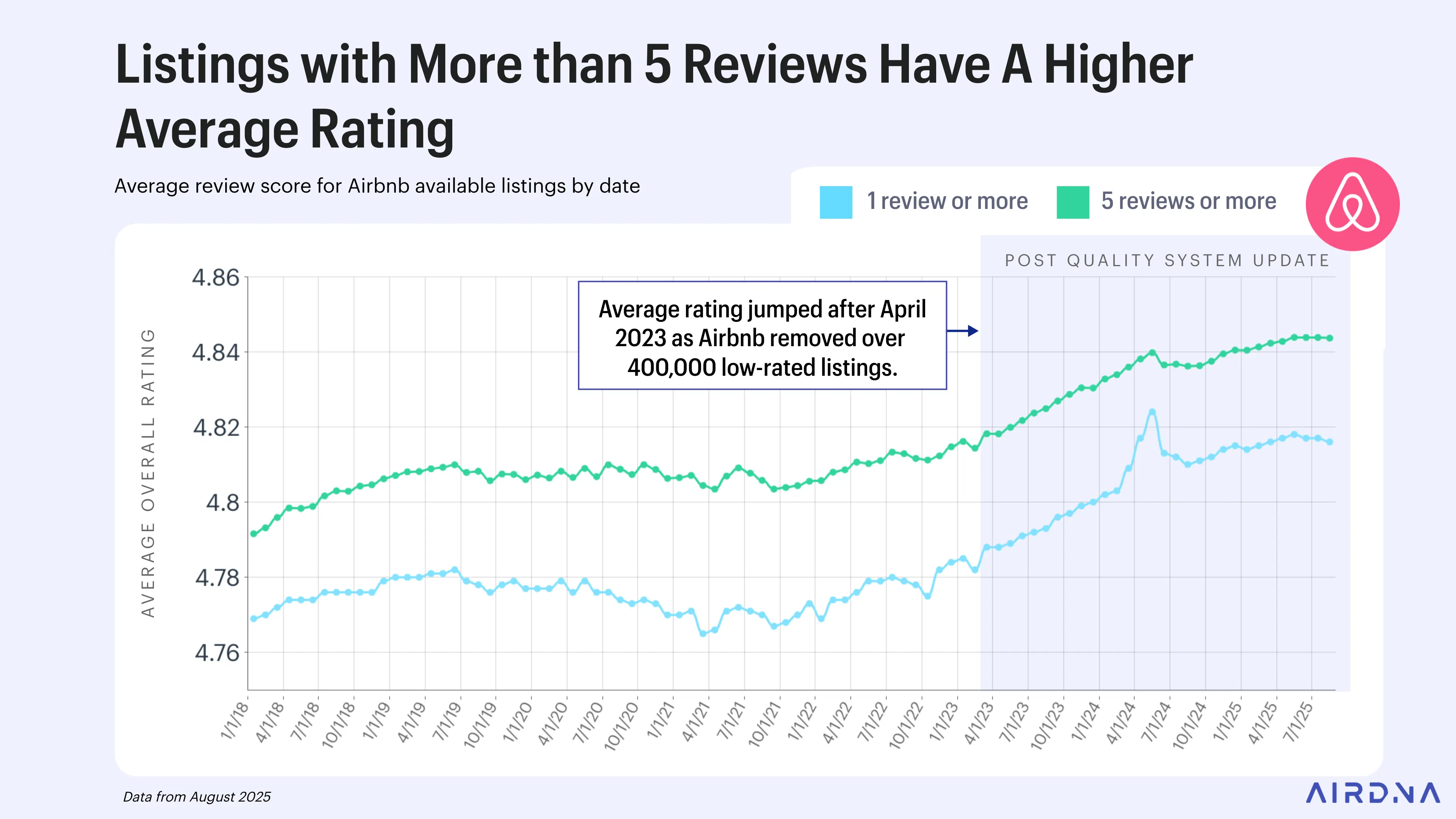
The average Airbnb rating for available listings in the U.S. is currently 4.8 stars.
That average has been steadily rising since 2021, with a sharper increase starting in 2023 when Airbnb rolled out stricter quality standards and removed over 400,000 underperforming listings. While part of the boost comes from better hosting, a big factor is that the lowest-rated properties are simply no longer in the mix and don't drag down the overall average anymore. Keeping your rating above average could be the key to staying competitive, visible, and even alive on the platform.
The average Airbnb rating also changes if you take into consideration how many reviews a listing has. Airbnb listings with 5 or more reviews have a higher average rating than listings with just one review or more. This rating gap has been consistent since 2018, when listings with 5 or more reviews averaged a 4.79 overall rating compared to 4.76 among listings with fewer reviews. Today, the average overall rating for listings with 5 or more reviews is 4.84 compared to 4.81 among listings with less reviews.
You might be wondering if such minute differences between average review scores really matters that much. Even a hundredth difference in your rating could mean the difference between you or a competitor getting favored by Airbnb's search ranking algorithm or gaining Superhost status, especially if you're operating in a competitive market.
Why Are Airbnb Ratings Important?
Airbnb ratings determine a property’s success on the platform in almost all circumstances. Aiming for a 5-star review is key to providing the kind of guest experiences that result in successful short-term rental businesses.
Airbnb ratings impact:
Search visibility
Higher-rated listings get pushed higher in Airbnb search results, giving you a competitive edge without spending on promotion.
Booking rates
Guests rely on Airbnb’s rating system to decide where to book. A high rating signals trust, cleanliness, and reliability. The numerical rating is often the first thing guests look to and use to decide whether it’s even worth reading your reviews.
Superhost status
You need an average Airbnb rating of 4.8 or above to earn or keep Superhost status. Superhosts enjoy greater visibility, marketing boosts, and 28% higher annual revenue potential compared to non-Superhosts.
Revenue
Properties with higher Airbnb ratings tend to attract more bookings and command higher rates, which maximizes earnings. According to AirDNA’s 2025 data, listings with an average rating of 4.9 stars or above earned:
- 4% higher occupancy
- 11% higher Average Daily Rate (ADR)
- 15% more Revenue Per Available Rental (RevPAR)
Hosts with a 5-star rating earned an average RevPAR of $143 per night, compared to just $110 for listings rated below 4.5. Even a seemingly small shift—from a 4.7–4.8 to a 4.9—can add $7 per night to your revenue. That’s an extra $210 per month on a fully booked calendar.
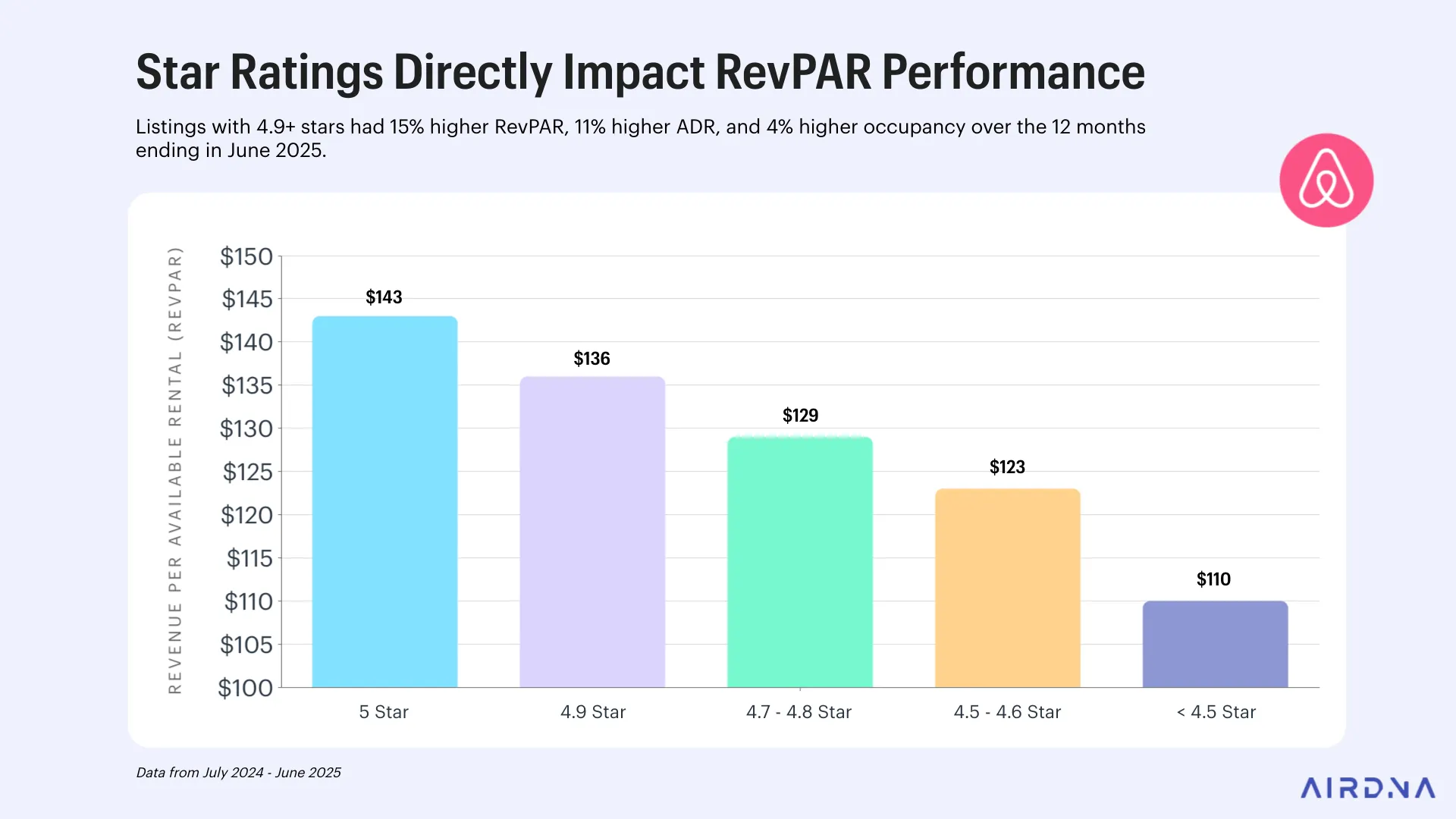
The margin gets wider at the top, where competition is strongest. As you approach a 4.9 or 5.0, every tenth of a star becomes harder to earn, but more rewarding. These gains come not just from increased bookings, but from being able to charge a higher average daily rate.
If you're aiming to increase your revenue, don’t overlook your Airbnb rating. It's one of the few performance levers that directly affects both your visibility and your earnings.
Airbnb Ratings Categories: What They Mean and Why They Matter
Every guest rating on Airbnb is broken into six categories. While they all contribute to your overall score, some carry more weight than others. This is especially true when it comes to your bottom line. Knowing what each one measures (and what guests expect) can help you fine-tune your hosting strategy where it matters most.
Cleanliness
This is one of the most important factors for guests and for your revenue. A small increase in Airbnb cleanliness ratings (even just 0.1 stars) can add $2–$3 to your nightly RevPAR, according to AirDNA data. Guests expect hotel-level cleanliness: spotless floors, fresh linens, and no overlooked corners (be sure to use our Cleaning Checklist if you’re looking to keep up).
Communication
Guests want fast, clear, and friendly communication. That includes pre-arrival instructions, responses to questions, and updates if anything changes. Solid communication can turn a potential complaint into a five-star review.
Accuracy
This rating reflects how well your listing matches reality. Guests expect descriptions, photos, and amenities to line up with what they experience. Even small surprises, like missing items or layout differences, can lead to lower scores.
Location
While you can’t change your address, guests will still rate it based on walkability, neighborhood vibe, and access to attractions. This category doesn’t impact your Superhost status but it can influence booking decisions and written feedback.
Value
This rating is all about perceived bang for the buck. AirDNA data shows value ratings are often lower on higher-priced listings, even when guests are happy. Instead of dropping your rate, focus on showing guests what makes the stay worth it. Highlight your amenities, space, or location benefits.
Check-in
Guests want an easy, stress-free arrival. Confusing instructions or hard-to-find keys are an instant turn-off. Self check-in and clear, step-by-step directions go a long way toward securing five stars here.
You don’t have to be perfect across the board, but dialing in the categories you can control (like cleanliness, communication, and check-in) gives you the best shot at higher ratings, happier guests, and stronger revenue. Small tweaks here can make a big impact over time.
Is 4.75 a Good Airbnb Rating Or Is It Costing You?
On Airbnb in 2025, a 4.75-star rating isn’t quite as competitive as it sounds. According to AirDNA’s latest data, the average rating for booked listings in the U.S. is 4.8. Even a small bump—from 4.75 to 4.85—can add $100–$200 more in monthly revenue, thanks to better placement in search, stronger guest trust, and greater pricing power.
So while 4.75 may feel “good enough,” it could be quietly holding your listing back. The closer you can get to 4.9 or higher, the more you stand to gain.
What a small increase in ratings means for your bottom line
So, how much is a tenth of a rating point actually worth?
To find out, we analyzed Airbnb data from two very different markets: Minneapolis, Minnesota, a metro area with seasonal demand, and Santa Rosa/Rosemary Beach, Florida, a coastal destination with steady year-round bookings. We focused on how increases in average overall and cleanliness ratings affect nightly revenue.
We kept things accurate by controlling for other factors that influence RevPAR—like price variability, property type, Superhost status, number of reviews, and more. That way, we could zero in on the exclusive impact of ratings.
Here’s what we found:
Minneapolis, Minnesota

This metro market sees strong seasonal demand and leans heavily on local tourism. The average rating here is high—4.8 stars—and the competition is tight among established hosts. At this level, even minor increases in your score can have an outsized impact on RevPAR.
Here’s how it plays out:
- +0.1 in overall rating = $3.56 more per night
- +0.1 in cleanliness = $2.96 more per night
- Combined: Nearly $200/month extra
- Superhost status adds $6.05 per night, or $187/month
Santa Rosa/Rosemary Beach, Florida

This coastal resort destination draws steady demand year-round, especially from families and beachgoers. The average rating is slightly lower—4.7 stars—which gives hosts a bit more headroom for improvement. The trade-off is that each incremental gain carries slightly less weight.
Why? A tenth of a percent increase in your rating translates into different dollar earnings depending on whether you’re jumping from a 4.8 to a 4.9, or a 4.7 to a 4.8. In markets where the overall bar is lower, the same rating boost doesn’t move the needle quite as dramatically.
- +0.1 in overall rating = $2.70 more per night
- +0.1 in cleanliness = $1.68 more per night
- Combined: Roughly $130/month
- Superhost status adds $6.57 per night, or nearly $200/month
Why do high-rated listings see bigger revenue gains from small rating increases? It’s because Airbnb rewards improvement relative to your position. In top-tier markets like Minneapolis—where the average rating is already high—guests have more options at the upper end. That means you’re not just trying to look “good,” you’re trying to look better than other already-great listings.
So when you nudge your rating from, say, 4.8 to 4.9, it’s a signal that you’re outperforming other high-rated hosts. Airbnb’s algorithm takes notice, often ranking you higher in search. Guests notice, too. Those small differences can build trust and justify a higher price point.
In markets where the average rating is lower, like Santa Rosa/Rosemary Beach, that same bump still helps, but the competition isn’t as fierce. There’s more room to stand out without being perfect. That’s why a tenth of a point earns you more in high-performing markets. You’re playing in a tighter race, and the rewards for pulling ahead are greater.
We see this in the data, where a one tenth rating increase from 4.8 to 4.9 earns hosts nearly a dollar more per night in Minneapolis than the same rating improvement from 4.7 to 4.8 in Santa Rosa/Rosemary Beach.
How to Check Your Airbnb Ratings
If you want to improve your Airbnb performance, start by understanding your ratings. This means your overall score as well how you’re performing across each subcategory. Here’s how to find them:
Head to your Hosting Dashboard and click Menu. From there:
- Select Insights
- Click Reviews
You’ll see your overall star rating plus category scores like cleanliness, communication, and check-in. Guests can view these too once you’ve received at least three reviews.

Can Hosts Remove Negative Airbnb Ratings?
Short answer: No, you can’t remove a star rating just because it’s low. Airbnb does not allow hosts to delete or contest a guest’s rating unless it violates the platform’s review policy.
That said, Airbnb may remove both the written review and its associated star rating if the content breaks platform rules. This includes:
- Discriminatory language
- Threats, blackmail, or extortion
- Reviews from someone who didn’t stay at the property
- Clearly false, fraudulent, or spammy content
- Violations of Airbnb’s content policy
If one of these applies, hosts can report the review through the platform and request its removal. Even then, though, Airbnb’s decision is final. We cover review removals in-depth in our article on How to Get Airbnb to Remove a Review.
How to Respond to Negative Airbnb Ratings
The way you respond to negative reviews is every bit as important as how you respond to positive ones. You can’t make every guest happy, but you do want to show future guests that you care about their experience.
Make sure to:
- Respond promptly and professionally.
- Thank the guest for their feedback.
- Address specific concerns mentioned in the review.
- Explain any steps you're taking to resolve issues.
- Maintain a respectful tone even if you disagree.
- Avoid making excuses or being defensive.
Negative feedback offers an opportunity to improve your hosting experience and ensure a positive experience for future guests. Promptly and professionally addressing concerns can mitigate the impact of negative reviews and uphold your reputation on Airbnb. Explore our articles on how to get Airbnb to remove a review in certain cases and how to handle common guest complaints.
How to Earn Five-Star Airbnb Ratings
There’s no quick fix for getting five-star Airbnb ratings—just consistently excellent hospitality. Guests reward experiences that are smooth, thoughtful, and true to expectations. That means getting the basics right and adding a little extra where it counts.
Here’s what it takes to earn top marks:
- Provide accurate listing details and up-to-date photos.
- Maintain spotless cleanliness throughout the property.
- Offer clear, step-by-step check-in instructions.
- Respond quickly and helpfully to guest questions.
- Ensure all amenities are working as promised.
- Add thoughtful touches that make the stay feel special (like a welcome basket!)
- Address any issues promptly and professionally.
- Communicate clearly before, during, and after the stay.
From accurate listings to warm welcomes, the path to five stars is paved with consistency and care. We explore how to earn 5-star reviews in more detail in a dedicated article.

Rating Your Airbnb Guests as a Host
After each stay, Airbnb allows you to rate and review your guests. It’s all part of the Airbnb guest rating system, which helps other hosts make informed decisions and keeps the community transparent and trustworthy.
When writing your review, keep it honest but constructive. Highlight positives like good communication or rule-following, and if there were any issues, explain them calmly and professionally.
Not sure what to say? Use one of our ready-to-goAirbnb guest review templates to save time and keep things consistent.
Frequently Asked Questions
How do Airbnb reviews work?
After each stay, Airbnb prompts both guests and hosts to leave a review within 14 days. This double-blind system means neither party can see the other’s feedback until both reviews are submitted or the window closes. The double blind system encourages honest, unbiased input. Guests are asked to rate their experience in specific categories (like cleanliness and communication) and leave written comments. These ratings then feed into your overall score, which affects your visibility in search, your eligibility for Superhost status, and how likely future guests are to book.
What is the rating system on Airbnb?
The Airbnb rating scale lets guests rate their stay from 1 to 5 stars across categories like cleanliness, communication, and check-in. While 5 stars means excellent, anything less—even a 4—can hurt your average and impact search placement or Superhost status. Airbnb calculates your overall score as a rolling average, making it the most important number on your listing.
Is 4.75 a good Airbnb rating?
A 4.75-star average might seem strong, but in 2025, it’s slightly below average for booked listings on Airbnb. It also falls short of the 4.8 threshold needed for Superhost status. While many guests see anything above 4.5 as solid, Airbnb’s algorithm favors top performers, and small differences in your score can significantly impact visibility, trust, and revenue. If you’re sitting at 4.75, tightening up on categories like cleanliness, communication, and accuracy could be enough to push your listing into a more competitive range.
How do I check my Airbnb rating?
To view your Airbnb rating, go to your Hosting Dashboard and click Menu. From there:
- Select Insights
- Click Reviews
You’ll be able to see your overall star rating along with category scores like cleanliness, communication, and check-in. Guests can see these too after you’ve received at least three reviews.
ARTICLE SUMMARY
Learn how Airbnb’s rating system works, what guests are really saying with stars, and why even a 4-star review could be dragging down your visibility and revenue.
Bram Gallagher
AirDNA Director of Economics and Forecasting
Bram Gallagher is an Economist at AirDNA, specializing in uncovering insights that drive smarter short-term rental decisions. He put his Ph.D. in Economics from the University of Georgia to work researching and forecasting hotel data with CBRE prior to joining AirDNA, as well as teaching economics at a number of universities. In his spare time, Bram enjoys making wooden furniture with hand tools.