

 Calculate Revenue
 Research Markets
 Find For Sale Properties
 Compare My Listing
 STR Revenue Calculator
 Custom Comp Sets
 Submarket Insights
 Custom Search Filters
 Rate Recommendations
 Performance Benchmarking
 Competitor Comparison
 Owner Contact Details
 Property-level performance data
 Tourism Insights
 Real Estate Investment Analytics
 About Us
 Sales
Sales Support
 Press
PressThe Effect of the Short-Term Rental Accommodations Act on B.C. Airbnbs
Published: March 11, 2025
Last updated: March 14, 2025

Jamie Zhang
Key Takeaways
- Enacted in February 2024, the Short-Term Rental Accommodations Act restricts rentals to principal residences in 65 British Columbia communities.
- After the Act was implemented, regulated areas of BC saw demand shrink and available listings decline 14%, while year-over-year ADR growth reached 12% by November 2024.
- Unrestricted destinations have thrived, with Kicking Horse, Tofino, and Ucluelet seeing revenue growth between 17% and 40% while major cities like Victoria and Kelowna have lost millions.
Remember when listing a property on Airbnb was as simple as snapping a few photos and writing a catchy description? Those days are firmly in the rearview mirror for hosts across British Columbia. The Short-Term Rental Accommodations Act (STRAA)—legislation that restricts short-term rentals primarily to principal residences in 65 communities across the province—has just passed its one-year anniversary. The STRAA has left a transformed rental landscape in its wake, complete with winners, losers, and a whole lot of market disruption.
For hosts and investors navigating this new terrain, the numbers tell a fascinating story. While some markets have suffered under regulatory pressure, others have flourished in unexpected ways. So, what exactly happened when BC decided to rewrite the rules? Let's dive into the data and discover who's thriving, who's nosediving, and what it means for your investment strategy in 2025.
Research Airbnb Markets
Gain insights into the revenue and occupancy trends in your market.
What Is the Short-Term Rental Accommodations Act?
Imagine having your investment strategy upended overnight by a single piece of legislation. That's exactly what happened when British Columbia unveiled the Short-Term Rental Accommodations Act in February 2024. These new Airbnb rules in Canada, which were announced on February 2nd and implemented just three days later on February 5th, fundamentally altered the playing field for vacation rental hosts and investors throughout BC.
The legislation (also known as Bill 35 BC) aims to address housing shortages by converting short-term rentals back into long-term housing stock. The Act applies to 65 communities across the province, specifically those with populations exceeding 10,000 residents or areas in close proximity to larger population centers.
Key provisions of the Act
The STRAA introduces several restrictions that reshape how short-term rentals in BC operate:
- Only your principal residence (or a secondary suite or ADU on the property) can be listed as a short-term rental in regulated communities.
- Investment properties can no longer host guests for less than 30 days.
- Daily fines for violations now reach $3,000, giving the regulations serious financial teeth.
- Platforms like Airbnb must verify compliance before allowing listings.
- All hosts must register with the province and display official registration numbers.
- Local governments now have stronger enforcement powers, with funding to ensure compliance.
Immediate impact
For cities like Vancouver, which already had Airbnb rules in place, the provincial legislation added another layer of enforcement to existing restrictions. Other cities that had been more permissive suddenly found themselves subject to strict province-wide standards.
The swift implementation left many hosts scrambling to adjust their business models, especially those with multiple properties or units outside their primary homes. While some areas received exemptions (notably several resort communities), the majority of BC's population centers fell under the new regime of British Columbia’s short-term rental regulations.

The Airbnb Market in BC Before the Short-Term Rental Accommodations Act Took Effect
Prior to the regulatory bombshell, British Columbia's short-term rental (STR) landscape had been showing signs of maturity. The province wasn't alone. Across Canada, the post-pandemic STR gold rush had led to predictable consequences: Too many hosts chasing too few guests.
This oversupply had begun putting the brakes on growth even before legislators stepped in. Short-term rental ADR (average daily rate) growth had noticeably downshifted in the post-COVID era, with annualized ADR growth rates settling at 2.7% between 2022 and 2024—a step down from 3.1% growth seen between 2018-2019.
Inflation further complicated the picture for hosts. While nominal year-over-year (YOY) ADR growth between 2023 and 2024 looked respectable at 5%, the real growth rate (adjusted for inflation) was a modest 2.6%. For hosts and investors accustomed to the heady early days of Airbnb business in Canada, these softening trends meant tighter margins and harder-fought bookings.
The situation mirrored trends commonly seen in up-and-coming vacation rental markets, where emerging destinations experience dramatic supply increases followed by inevitable market corrections. British Columbia was experiencing this classic cycle, though regulatory intervention would soon accelerate and amplify those natural market forces.
U.S. tourism and its impact on BC’s short-term rental market
A bright spot in the pre-STRAA landscape was American tourism. A staggering 78% of international visitors to Canada hailed from south of the border, with U.S. travelers proving particularly nimble in their return to Canadian destinations after COVID restrictions were lifted.
This American influx closely tracked currency fluctuations—as the Canadian dollar weakened against the USD, American bookings surged. The relationship between exchange rates and tourism flows created a natural hedge for hosts dealing with uncertainty around Airbnb regulations in British Columbia. Even as domestic guests grew more price-sensitive, American visitors were experiencing effective discounts due to favorable exchange rates.
These currency dynamics provided a crucial buffer against market softening. Properties in tourism hotspots with strong American appeal—like Whistler, Victoria, and Vancouver—continued to demonstrate resilience despite the broader supply glut.
However, this delicate ecosystem was about to face its biggest disruption yet—not from market forces, but from the stroke of a legislative pen. The question wasn't whether the Short-Term Rental Accommodations Act would change the landscape, but rather how dramatically and for whom.
The Impact of the Short-Term Rental Accommodations Act One Year Later
The numbers don't lie: BC's vacation rental market has split into two distinct realities since February 2024. In areas where the Short-Term Rental Accommodations Act imposed strict limits, listings and revenues contracted. Meanwhile, in exempt communities, business boomed.
This stark before-and-after contrast appears clearly in the data. Let's look at exactly how the regulation of Airbnb in Canada, specifically in BC, transformed the market in just one year.
BC Airbnb listings plummeted while Canada's market grew
The most immediate consequence of the Act was a sharp reduction in available inventory. While Canada maintained relatively stable supply levels, British Columbia followed a dramatically different path.
Key findings on listing changes:
- BC experienced negative year-over-year changes in monthly listings from March through December 2024.
- Prior to the STRAA, listing trends between BC and the Canadian average were highly correlated (98%).
- After the regulations, this correlation dropped dramatically to just 43%.
- While the rest of Canada saw modest inventory growth throughout 2024 (0-10% increase in supply), BC's available listings dropped (0 to -10% decrease in supply).
This wasn't a minor correction—thousands of properties vanished from platforms as hosts faced the principal residence requirement. Many multi-property owners were forced to:
- Convert their units to long-term rentals
- Sell their investment properties entirely
- Find creative compliance strategies (some successful, others not)
A demand gap emerged between BC and Canada as a whole
As listings disappeared, a pronounced demand gap emerged between BC and the Canadian average.
BC’s demand nights (the total number of nights booked) declined year-over-year following the Short-Term Rental Accommodations Act, while the rest of Canada experienced positive growth.
Key demand trends following the regulations:
- While Canada maintained positive year-over-year growth in monthly demand nights throughout most of 2024, BC fell into negative territory.
- Before the restrictions, demand growth patterns between BC and Canada were highly correlated (98%). After February 2024, this correlation dropped to just 55%.
- Before STRAA, BC's demand growth actually outpaced the Canadian average.
- Since STRAA, BC has seen a decline in demand nights while the rest of Canada has maintained positive momentum.
How is your STR performing?
Your vacation rental may be amazing, but is it better than your competition? Connect your Airbnb listing to AirDNA to see its Booking Performance Score.
BC’s ADR growth outpaced the national average
Despite the gloomy picture painted by supply and demand metrics, a fascinating counter-trend emerged in pricing. While BC's revenue initially dipped following the regulations, ADR growth in BC began outpacing the national average by September 2024.
The surprising pricing dynamics:
- By November 2024, BC's year-over-year ADR growth hit an impressive 12%.
- This pricing growth occurred even as demand continued to lag.
- The correlation between BC and Canada's ADR growth remained strong (97%), but with BC showing premium growth.
- The ADR increase helped offset what could have been much more significant revenue losses.
For compliant hosts who managed to stay in the game, the regulations inadvertently created a pricing environment more favorable than the pre-regulation days of oversupply.
This pattern of ADR strength amid regulatory tightening is consistent with whatAirDNA has observed in profitable Canadian markets facing supply constraints. When popular destinations see reduced inventory due to BC Airbnb laws or other regulations, the remaining listings often enjoy stronger pricing power.
The Effect of Restrictions on Different Markets
The Short-Term Rental Accommodations Act didn't impact all areas equally. Data reveals a clear divergence between communities subject to restrictions and those exempted from the regulations.
Restricted areas vs. unrestricted areas: a tale of two markets
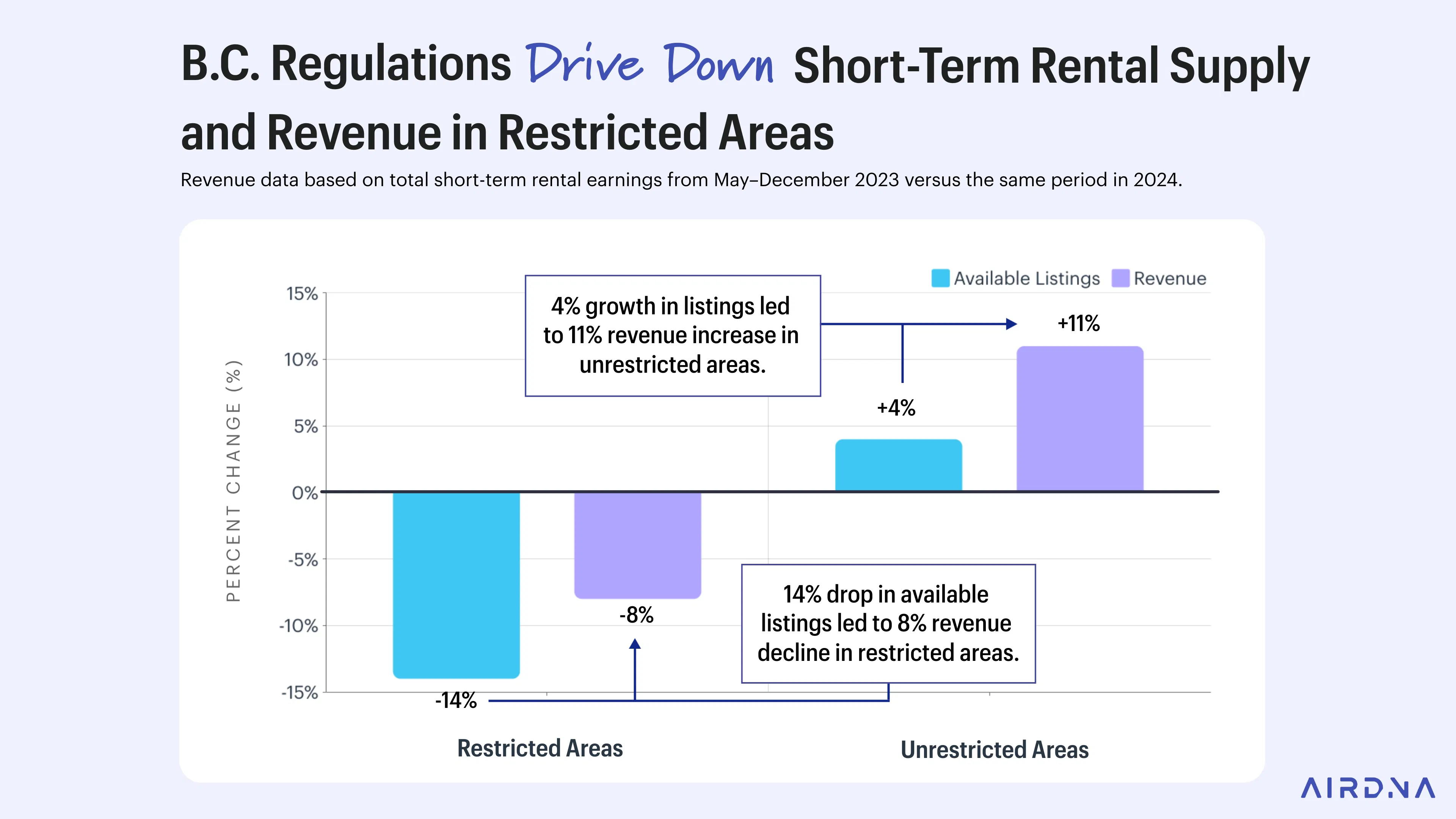
There’s a stark contrast between restricted and unrestricted areas from May-December 2024:
Restricted Areas (principal residence required):
- Available listings dropped by -14% YoY
- Overall revenue declined by -8% YoY
- Total listings fell from 196,000 to 168,000
- Revenue declined from $564M to $519M CAD
Unrestricted areas (no principal residence requirement):
- Available listings increased by +4% YoY
- Revenue grew by an impressive +11% YoY
- Total listings rose from 106,000 to 110,000
- Revenue increased from $381M to $423M CAD
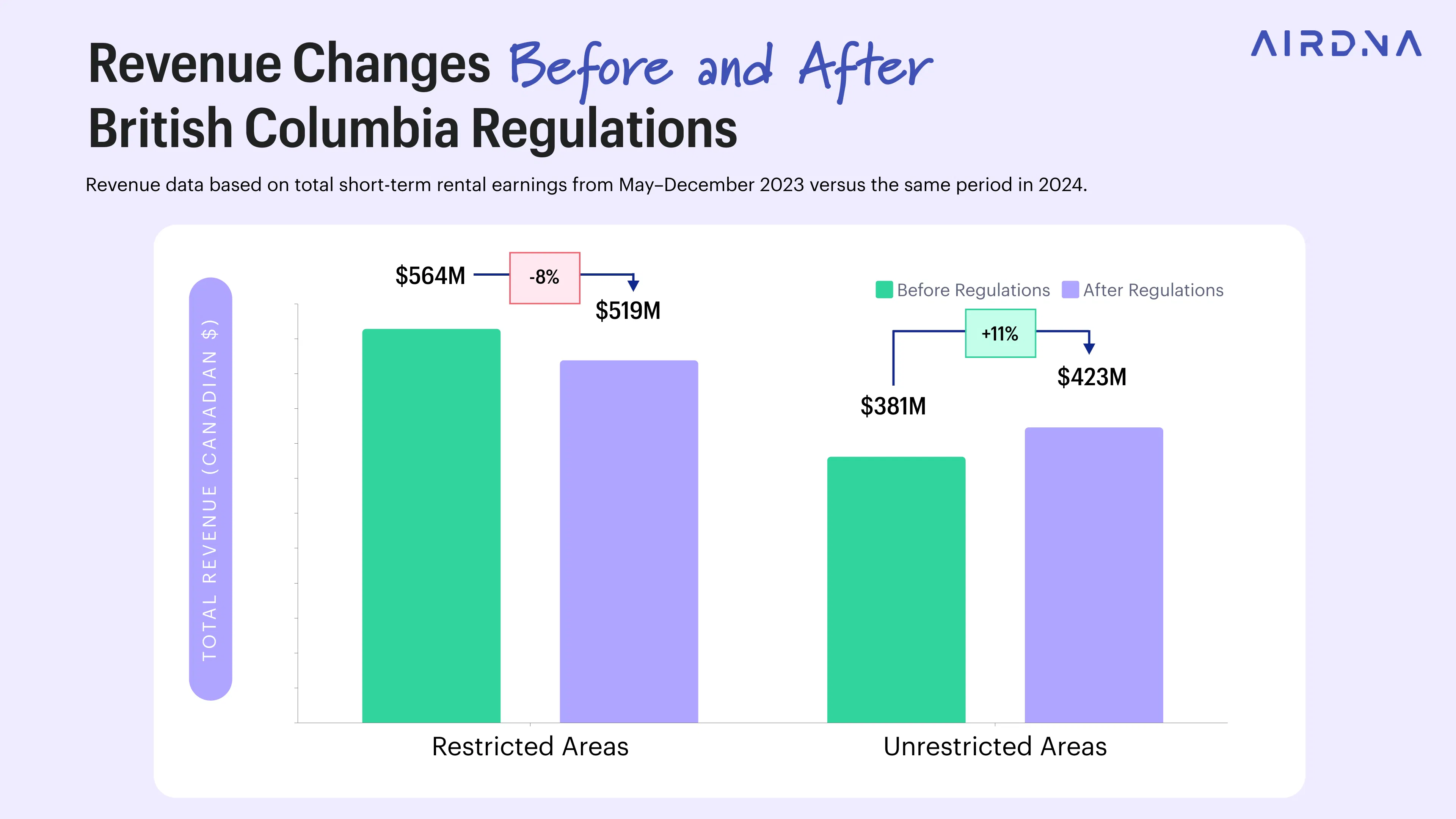
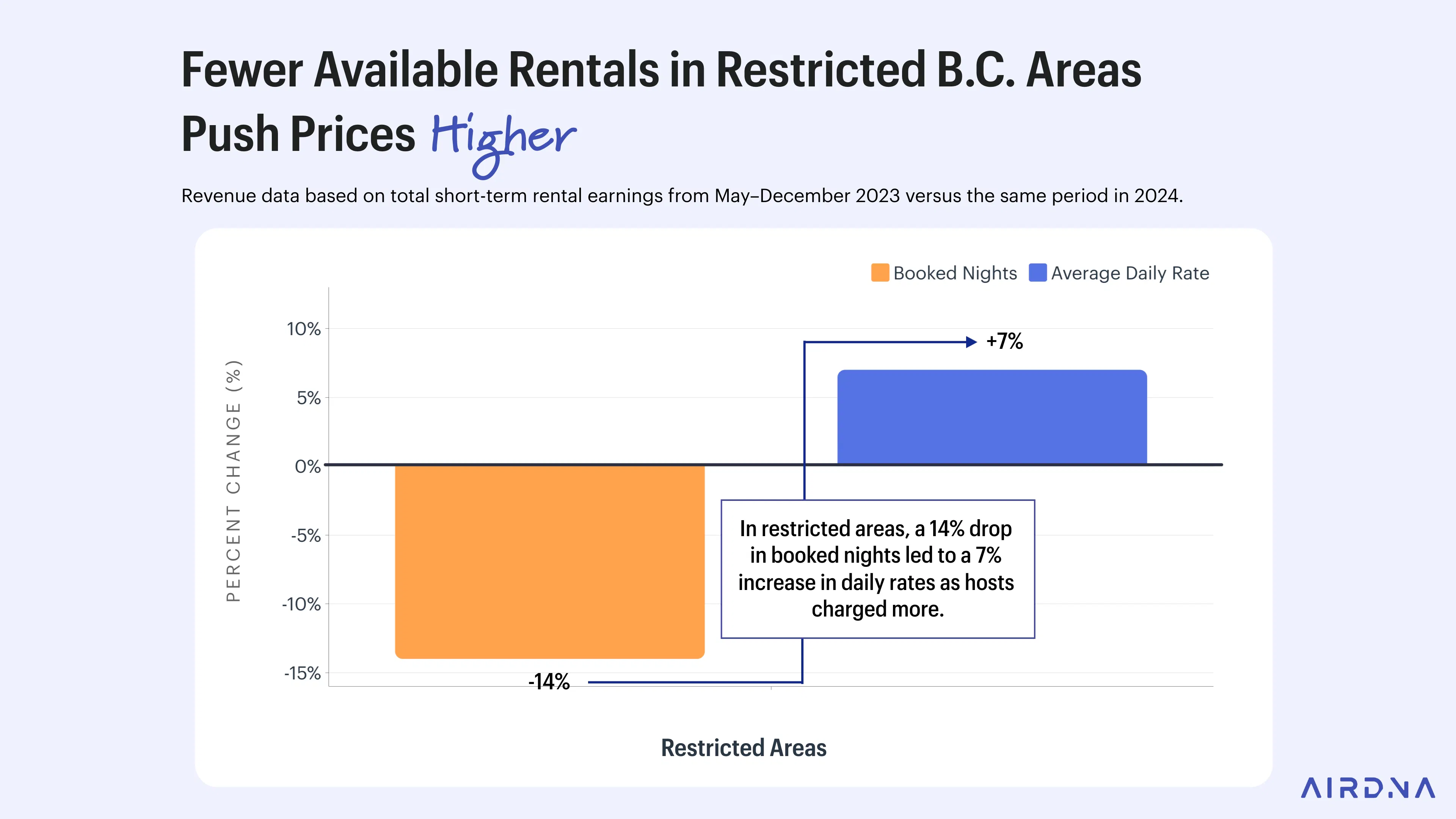
This bifurcation illustrates how dramatically the regulation of Airbnb in Canada can reshape market dynamics. In restricted communities, even as ADR grew by +7% YoY, it couldn't fully offset the sharp 14% decline in demand nights.
Meanwhile, unrestricted areas capitalized on their exempt status, absorbing some of the demand that might otherwise have gone to larger population centers. The contrast provides a compelling case study for how regulations can impact your short-term rental business and underscores the importance of location when investing in vacation rentals.
BC’s biggest revenue losses: Which cities were hit the hardest?
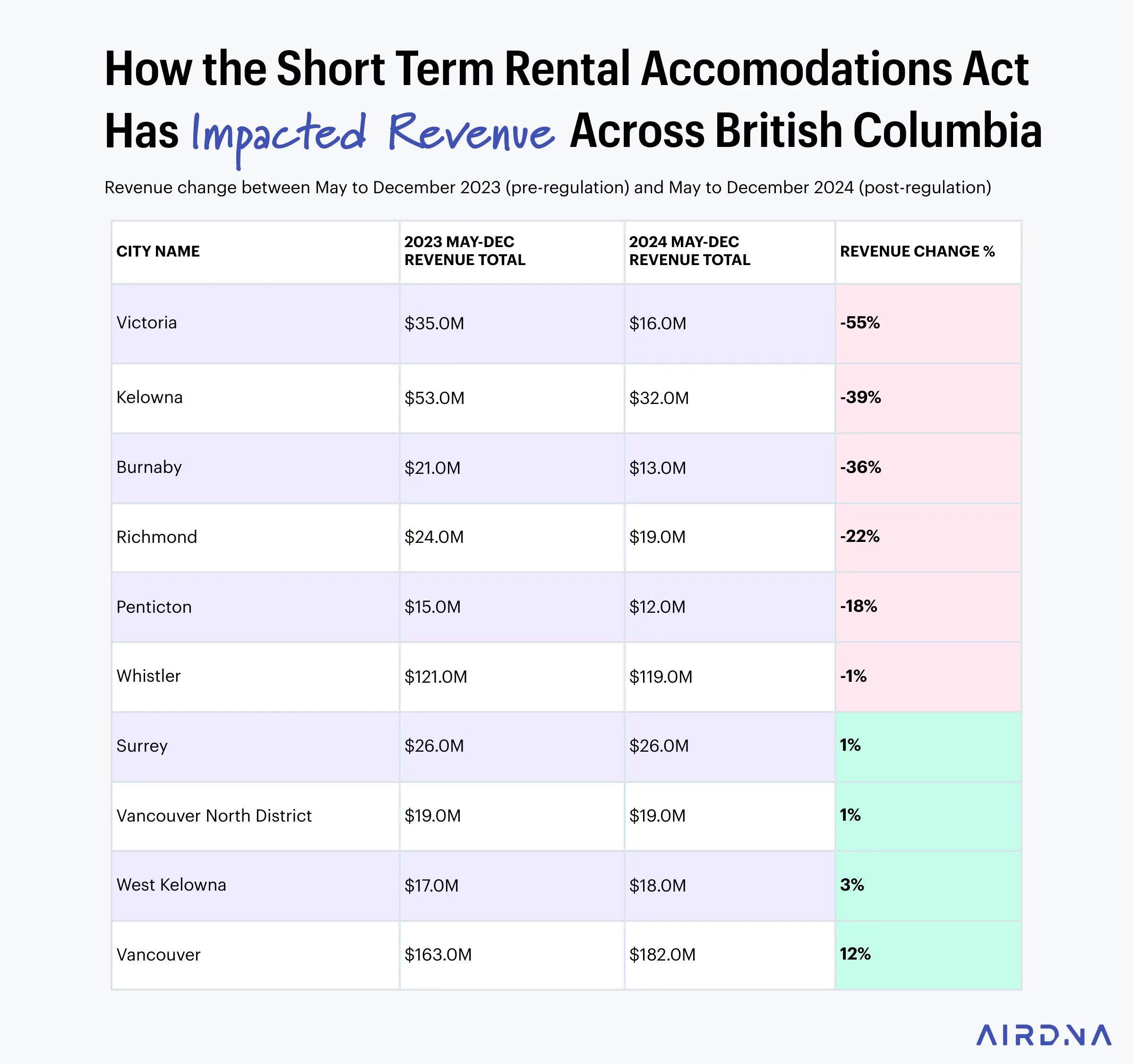
The pain of these regulatory changes wasn't distributed equally. Four cities bore the brunt of revenue losses, collectively accounting for 52 million CAD in revenue declines:
Kelowna: -21M CAD (-39% YoY revenue)
- The Kelowna short-term rental regulations hit this popular vacation destination particularly hard
Victoria: -19M CAD (-55% YoY revenue)
- With short-term rental regulations in Victoria among the strictest enforcement, this city saw the highest percentage decline
Richmond: -5M CAD (-22% YoY revenue)
- The Richmond Airbnb market contracted significantly despite its proximity to Vancouver
Burnaby: -7M CAD (-36% YoY revenue)
- Burnaby Airbnb listings declined sharply as multi-property hosts exited the market
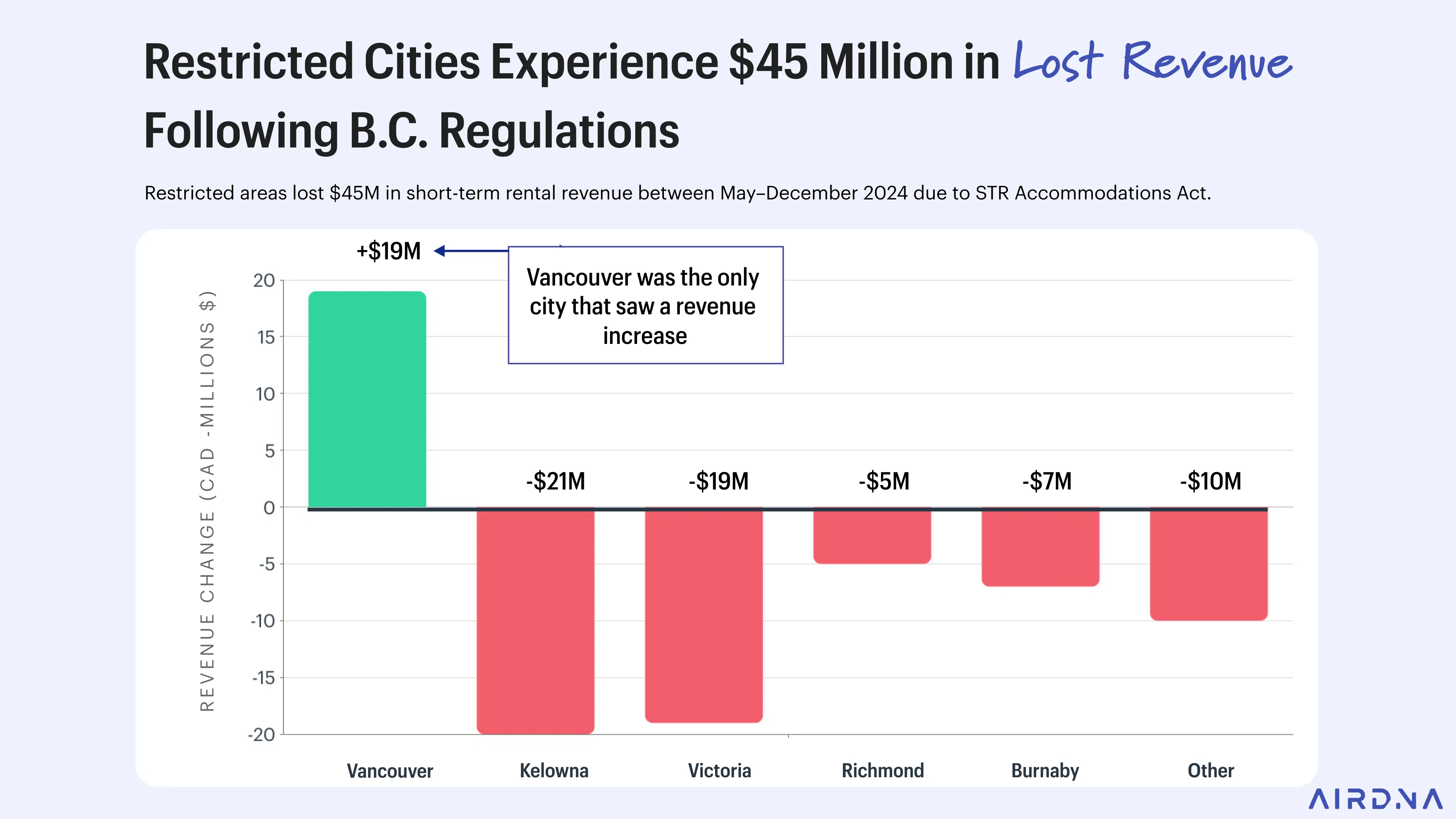
The exception to this trend was Vancouver, which defied expectations by increasing revenue by 19M CAD, despite being subject to restrictions. The reasons behind Vancouver's resilience merit further analysis, but likely include factors such as:
- Higher concentration of primary residence listings before the regulations
- Strong enforcement of existing regulations before the Short-Term Rental Accommodations Act
- Premium pricing power due to high tourism demand
- Sophisticated hosts who successfully adapted their business models
For investors considering the impact of Airbnb regulations in Canada, these city-specific outcomes demonstrate that the effects of regulatory changes can vary dramatically even within the same regulatory framework.

Calculate potential earnings
Understand the investment potential of any address in the world.
Winners and losers: How unrestricted areas prevailed
While restricted communities faced challenging adjustments, unrestricted areas emerged as the potential beneficiaries of BC's regulatory reshuffling. The data may point to a "displacement effect" where demand shifts from regulated to unregulated markets.
The top performers among unrestricted areas saw remarkable revenue growth:
Tofino: +17% YoY (from $21M to $24M CAD)
- The Tofino Airbnb market capitalized on its exemption status and coastal appeal.
Kicking Horse: +40% YoY (from $18M to $25M CAD)
- Kicking Horse Airbnb listings saw the highest percentage growth among major markets.
Ucluelet: +32% YoY (from $15M to $20M CAD)
- The Ucluelet Airbnb market benefited from proximity to popular Pacific Rim attractions.
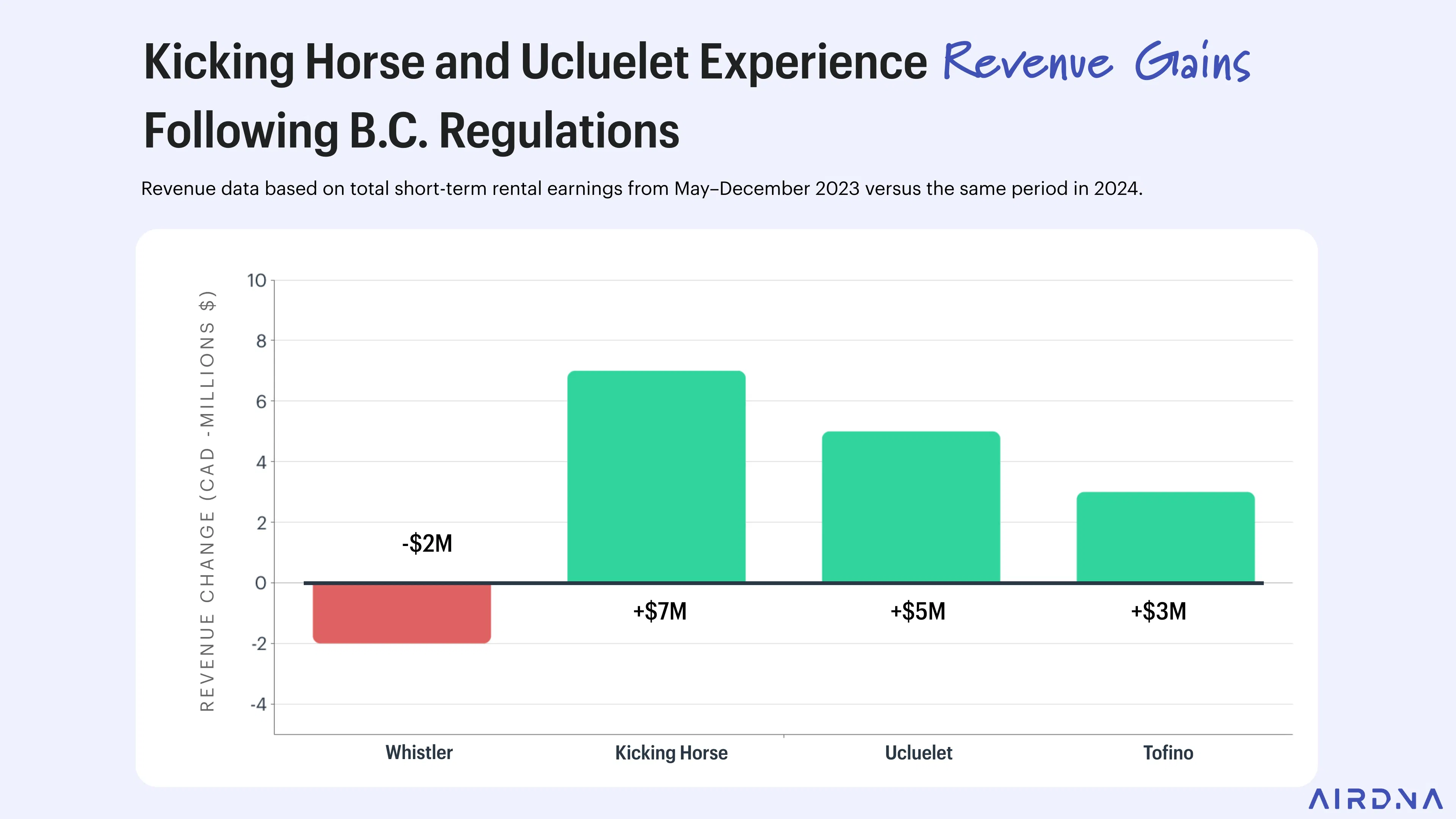
Meanwhile, Whistler Airbnb performance remained surprisingly flat, with revenue declining slightly from $121M to $119M CAD (-1% YoY). Whistler’s stability might reflect:
- A market already operating at or near capacity
- Higher price sensitivity among visitors
- Competition from other ski destinations
- A mature market less able to absorb displaced demand
The success of these unrestricted areas demonstrates how regulatory boundaries can reshape investment opportunities. Communities exempt from the Short-Term Rental Accommodations Act became instant havens for investors seeking to maintain their short-term rental portfolios without principal residence restrictions.
For hosts who pivoted their investments to these unrestricted areas ahead of the regulatory changes, the rewards have been substantial. This pattern of "regulatory arbitrage" is consistent with trends observed in other heavily regulated regions, where demand frequently shifts to adjacent communities with more permissive rules.
The data also reveals another interesting dynamic: The unrestricted areas that performed best were those offering unique natural attractions that couldn't be easily substituted. The strong performance of coastal and mountain destinations suggests that travelers prioritize specific experiences over exact locations—an insight valuable for investors considering up-and-coming vacation rental markets.
What’s Next for Short-Term Rentals in British Columbia?
The long-term effects of the Short-Term Rental Accommodations Act continue to reshape BC's vacation rental landscape. While the initial market shock has largely been absorbed, challenges and opportunities remain for hosts and investors.
How hosts and investors are adapting
Successful STR operators have developed various strategies to navigate the new regulatory environment:
- Shifting to long-term rentals: Many former STR investors have converted their properties to conventional rental units, trading higher nightly rates for more stable monthly income.
- Relocating investments: Savvy investors have pivoted to purchasing properties in unrestricted areas like Tofino, Ucluelet, and resort communities.
- Professionalizing operations: Remaining compliant hosts have upgraded their offerings to justify higher rates, investing in better services and amenities.
- Partnering with property owners: Some former hosts have transitioned to property management roles, overseeing other owners' properties for a fee.
- Going seasonal: A growing trend involves hosts using properties personally during peak periods while renting long-term during off-seasons.
This adaptation reflects a broader trend in the Airbnb business in Canada toward professionalization and compliance-focused operations. Similar patterns have emerged in other highly regulated markets, like those where major hotel destinations compete with Airbnb.
Future regulatory changes to watch
The regulatory landscape continues to evolve, with several developments worth monitoring:
- Enforcement effectiveness: While the legislation is comprehensive, enforcement capacity varies across municipalities. Some areas may struggle to identify non-compliant listings, creating an uneven playing field.
- Provincial registry refinements: The short-term rental registry system may see updates to address loopholes and improve verification.
- Municipal variations: Individual cities may introduce additional requirements beyond the provincial framework, particularly in high-demand areas.
- Policy adjustments: If BC sees a decline in overall tourism revenue, there could be pressure to relax restrictions or introduce exemptions for certain markets.
For STR investors considering future opportunities in BC's vacation rental market, staying informed about these evolving regulations will be critical. The smartest strategy may be maintaining flexibility and diversification across both restricted and unrestricted areas.
The experience in British Columbia provides valuable lessons for investors in other markets facing potential regulatory changes. As more jurisdictions consider similar restrictions, the BC case study offers insights into how markets adjust, where opportunities emerge, and how proactive adaptation can turn regulatory challenges into competitive advantages.

FAQs
How to start an Airbnb business in Canada?
Starting an Airbnb business in Canada requires careful planning and understanding of local regulations. Here’s how to get started:
Research local regulations
- Determine if your desired location requires principal residence status
- Check for municipal licensing requirements and zoning restrictions
- Verify whether your building/HOA allows short-term rentals
Business setup essentials
- Register your business (sole proprietorship, LLC, or corporation)
- Obtain necessary permits and business licenses
- Set up proper accounting and tax tracking systems
- Secure appropriate insurance coverage
Property preparation
- Furnish and equip your property competitively
- Take professional photos and create a compelling listing
- Establish cleaning and maintenance protocols
- Install safety equipment (smoke detectors, fire extinguishers, etc.)
Operations planning
- Develop a pricing strategy based on local market data
- Create guest communication templates and house rules
- Set up a reliable cleaning and maintenance team
- Establish protocols for guest issues and emergencies
Is Airbnb legal in Vancouver?
Yes, Airbnb is legal in Vancouver, but hosts must comply with local regulations. Vancouver's short-term rental regulations (which some people refer to as the Vancouver Airbnb ban) predate the provincial law and are among the most comprehensively enforced in BC. The city actively investigates non-compliant listings and imposes substantial fines.
What are Airbnb rules in Vancouver?
- You can only rent your principal residence (where you live at least 6 months of the year)
- You must obtain a valid business license from the City of Vancouver
- Your license number must be displayed on all listing platforms
- You need to collect and remit the appropriate taxes (Provincial Sales Tax and Municipal and Regional District Tax)
- Entire home listings are limited to a maximum of 30 days per stay when the principal resident is not present
Despite these restrictions, Vancouver's short-term rental market remains active, with revenue actually increasing by $19M in the year following the provincial regulations.
Is Airbnb banned in BC?
No, Airbnb is not banned in BC. However, the Short-Term Rental Accommodations Act significantly restricts how properties can be used for short-term rentals:
- In regulated communities (those with populations over 10,000), short-term rentals are limited to principal residences only.
- Secondary properties in these communities cannot be used for short-term rentals (stays under 30 days).
- Hosts must register with the provincial registry and display registration numbers.
- Fines for non-compliance can reach $3,000 per day.
ARTICLE SUMMARY
British Columbia's Short-Term Rental Accommodations Act reshaped the province's Airbnb landscape, creating both winners and losers. Listings and demand plummeted in restricted cities while exempt destinations like Tofino and Kicking Horse thrived.
Jamie Zhang
AirDNA Data Analyst
Jamie Zhang is a Data Analyst at AirDNA, leveraging her background in data science and analytics to uncover key trends in the short-term rental industry. Before joining AirDNA, she worked as a data analyst at Shanghai Disney, where she specialized in revenue forecasting and financial planning . She holds a Master’s degree in International Economics and International Relations from Johns Hopkins. Jamie enjoys cycling to explore different corners of the city.
