


What Is Benchmarking in Short-Term Rentals?
Published: February 7, 2025

Summary
What is benchmarking?
Benchmarking compares your vacation rental performance to similar properties in your market—it's how you measure up against your competition in areas like occupancy, revenue, and pricing.
Why it matters
By seeing how you stack up against similar properties, you can spot exactly where to improve your performance. Maybe your weekend rates are too high, or you're missing out on summer bookings—benchmarking helps you find and fix these gaps.
Who should know it
Short-term rental hosts, property managers, and real estate investors need benchmarking to stay competitive in this fast-moving market.
Where you’ll see it
Inside AirDNA, you'll find benchmarking tools to compare everything from pricing and occupancy rates to popular amenities and seasonal patterns. You can use benchmarking at any level—whether you want to see how your property compares to rentals next door or understand how an entire city is performing.
Benchmarking Overview
Benchmarking helps short-term rental owners understand where they stand by comparing their performance against similar properties. The key is comparing your property to others that your potential guests are actually considering—because a luxury beachfront condo isn't competing with budget-friendly units inland.
Simply browsing rental sites or guessing what your competition is doing isn't enough—you need data to make smart decisions. How much are similar properties charging during summer weekends? What's their actual occupancy rate? Which amenities are guests booking? AirDNA gives you this data so you can see exactly how you stack up against properties like yours.
Say you notice nearby properties are fully booked during summer while you have gaps in your calendar. Instead of guessing why, you can see exactly what's working for similar rentals—whether it's their pricing strategy or popular amenities that guests love. This makes it clear where you can improve to attract more bookings.
Learn how benchmarking can boost your rentals in our full guide.

Why Is Benchmarking Important?
Benchmarking shows where your property stands in the market and gives you the insights you need to make smart decisions. With benchmarking, you can:
- Choose profitable markets: Spot high-demand areas with lower competition and avoid oversaturated markets.
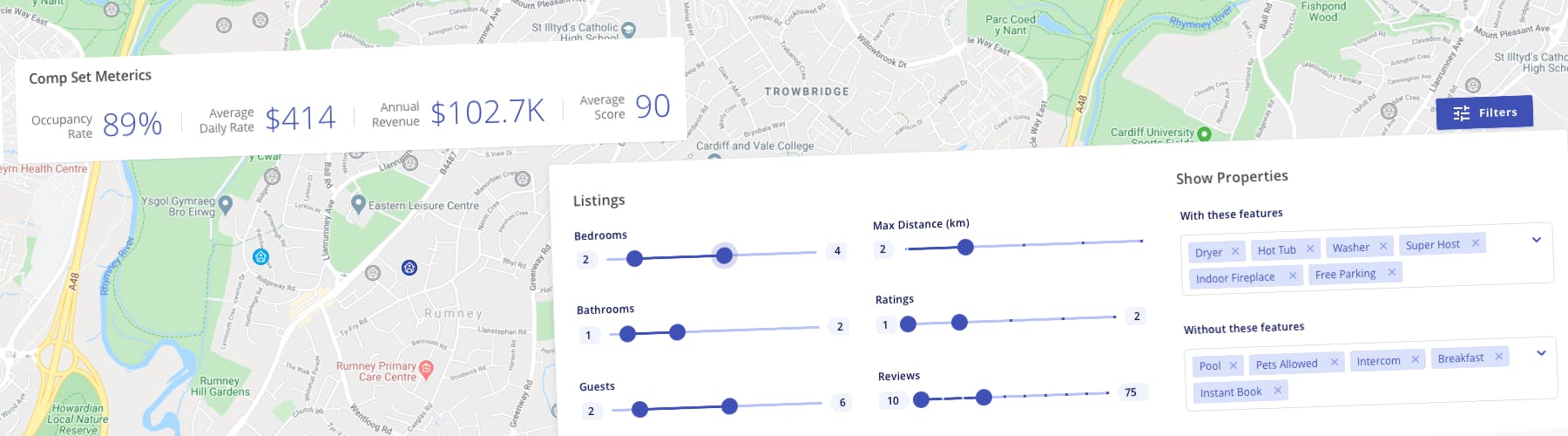
- Identify your competitive set: A competitive set (comp set) includes properties in your area that are similar in size, amenities, and location. Comparing your property against a comp set helps you evaluate its performance against realistic competitors.
- Optimize pricing strategies: Compare rates with competitors, adjust for peak seasons or specific days, and maximize your revenue.
- Improve property features: See which amenities, designs, and property types are attracting the most guests in your area.
- Track performance: Regularly check how your property stacks up against competitors and find areas where you can improve.
With AirDNA’s Property Performance Dashboard, you can track performance and spot new investment opportunities.

How to Use Benchmarking for Short-Term Rentals
Here are some strategies you can use to make the most of benchmarking and improve the performance of your short-term rental properties:
1. Choose the right market
Before buying a property, analyze market trends to find areas with high demand and low competition. This helps you avoid oversaturated regions where supply outweighs demand.
For example, mountain towns might see demand surge in winter for larger cabins, while urban areas tend to have steady bookings for smaller apartments year-round.
See how AirDNA organizes market types to help you find the best opportunities for your short-term rental.
2. Identify top-performing property types
Benchmarking data shows whether smaller units like studios and one-bedrooms or larger multi-bedroom homes attract more guests in that area.
For instance, in desert regions, guests often look for properties with pools, while mountain travelers may prioritize homes with fireplaces.
3. Optimize your rates
By analyzing Average Daily Rates (ADR), occupancy rates, and Revenue perRevPAR) in your market, you can adjust your rates to stay competitive without undervaluing your property.
For instance, if your rates are too high, you could lose bookings, but if they’re too low, you won’t earn as much as you could.
4. Improve property features and amenities
Benchmarking data also reveals what makes competing listings successful. This helps you decide where to improve.
For example, if most competitors offer hot tubs or work-friendly spaces and your property doesn’t, adding these features could significantly boost bookings and revenue.
Another example: in our own AirDNA analysis, we found luxury listings with pools see a RevPAR increase of around 38% compared to those without pools (ready for a dip, anyone?).
5. Monitor and adapt performance
Connect your vacation rental listings to AirDNA to see exactly how your property performs against others in your market. You can compare against similar properties automatically matched to yours, or create a custom set of competitors you want to track. Once connected, you'll see clear comparisons of your rates, occupancy, and revenue—showing you precisely where you're performing well and where there's room to grow.


Get started with AirDNA today.
Powerful, easy-to-use tools that help hosts and investors succeed in the short-term rental market.
Try for free