Airbnb During a Recession: 8 Tips to Recession-Proof Your Business
Published: April 12, 2024
Last updated: September 25, 2026

Bram Gallagher
Key Takeaways
- Airbnb has the potential to thrive during economic downturns by offering affordable accommodations, attracting budget-conscious travelers.
- Hosts can swiftly adjust terms and pricing, adapting to changes in consumer demand during a recession.
- Implementing flexible cancellation policies, supporting longer-term stays, and refining pricing strategies help maintain stability and profitability.
When we asked vacation rental managers what their top concerns were in 2023, most of them said, “Generating revenue during a potential recession.” While the economy was much stronger going into 2024 than many hosts expected, the question remains: how do I navigate Airbnb during a recession, or economic downturn?
After all, Airbnbs represent sizable investments for professional investors and individual property owners alike. Though challenging economic climates can put that investment at risk, they also present an opportunity for vacation rental businesses to innovate and adapt.
By leveraging the right data and insights, you can take control of your business and position it for success during a recession and beyond.
How Will Airbnb Do During a Recession?
How Airbnb performs during a recession depends on various factors. While some may assume that the travel and hospitality industries would suffer during a recession, the reality can be more nuanced.
Historically, Airbnb has demonstrated resilience during economic downturns due to its unique value proposition and flexibility. Airbnb launched during the 2008 recession, and its recession-friendly reputation lives on for travelers and hosts alike. As people look for more cost-effective accommodation options during tight financial periods, Airbnb can offer affordable alternatives to traditional hotels.
Many hosts also find that demand for short-term rentals increases during a downturn as individuals seek to satisfy their travel bug while managing costs. Like with anything, though, there are no guarantees.
The performance of a specific Airbnb during a recession can ebb and flow based on factors such as market conditions, travel restrictions, and consumer behavior. The best thing you can do is stay informed and prepare to adapt.
The Advantages of Airbnb During Recession
Recessions are often synonymous with uncertainty. While this is certainly true for many traditional industries, Airbnbs have unique advantages that can make them more resilient during economic slumps. These include:
1. Flexibility
Airbnb offers hosts the flexibility to adjust pricing, availability, and rental terms quickly in response to changing market conditions. This adaptability can be crucial during economic downturns when consumer preferences and travel patterns may fluctuate. For example, hosts can extend their minimum stay requirements or even switch their properties into long-term rentals with relative ease if the revenue potential becomes higher for longer lease terms.
2. Cost-Effectiveness
Compared to traditional accommodations, Airbnb listings often provide more affordable options for travelers, making them appealing choices during times of financial strain. Guests may opt for Airbnb rentals to save money without compromising on comfort or convenience.

3. Additional Income Stream
For property owners, Airbnb can serve as an additional source of income during a recession. Renting out spare rooms or entire properties on Airbnb allows hosts to generate revenue that can help offset any financial challenges they may face during economic downturns. For this reason, it’s not uncommon for people to start Airbnb businesses during a recession.
4. Diversification
Diversifying income streams is essential for financial stability during recessions. Hosts can diversify their revenue sources beyond traditional long-term rentals or investments by listing properties on Airbnb. Becoming a short-term rental host reduces reliance on any single income stream.
5. Traveler Preferences
When finances are tight, travelers adjust accordingly. Vacationers may be motivated to prioritize budget-friendly destinations, travel during the off-season when accommodations are cheaper, and book shorter stays. All of these behaviors affect short-term rental hosts and their businesses—when their properties will be booked, for how long, and at what price.
Even during recessions, some travelers may prioritize experiences and unique accommodations over traditional hotel stays. Airbnb caters to these preferences by offering a wide range of listings, including unique properties and local experiences, which can attract guests seeking memorable and authentic travel experiences.
Reasons to Start an Airbnb During a Recession
Starting an Airbnb business during a recession can be beneficial for many of the same reasons that make Airbnb so resilient. While more properties entering the market can increase the competition, it can also be a strategic move that capitalizes on:
1. Additional Income: With job security uncertain, Airbnb provides an opportunity to generate additional income or transition to a new career path.
2. Low Startup Costs: Once you have a property, launching an Airbnb requires a relatively low initial investment. Making a property short-term rental-ready is accessible even during economic downturns. Keep in mind that you don’t even need to own a property to get in on Airbnb profits—rental arbitrage allows you to rent out a property long-term, only to re-rent it on a short-term basis to guests.
3. Increased Demand: During recessions, travelers may seek more affordable and unique lodging options, driving up demand for short-term rentals like those offered on Airbnb.
4. Mitigated Financial Risk: Investing in Airbnb properties can diversify your income streams, reducing reliance on a single source of revenue and potentially reducing financial risks associated with a recession.

8 Tips to Recession-Proof Your Airbnb Business
Many people feel like they’re at the economy’s mercy during a downturn. While you can’t control demand, you can take several steps to better ride out the economic wave. Here are some tips to get you started:
#1: Support Longer-Term Stays
What can hosts do in light of the economy? One step is to support longer-term stays. Market them, increase their discounts, and put them front and center.
By offering discounts for extended stays or promoting monthly rentals, you can attract guests seeking temporary housing or a home away from home for remote work. Emphasize the convenience and value of longer stays. Highlight features like fully equipped kitchens, laundry facilities, and dedicated workspaces to appeal to guests looking for comfort and convenience.
#2: Introduce Varying Cancellation Policies
While it may seem counterintuitive to offer more flexible cancellation policies during uncertain economic times, it can benefit your Airbnb business. Many travelers prefer flexibility and peace of mind, which is why listings with flexible cancellation policies tend to rank higher in search results and attract more bookings.
Hosts can cater to a broader range of guests and increase the likelihood of securing bookings for their Airbnb during a recession by offering cancellation policies ranging from strict to flexible. While more lenient cancellation policies may pose a higher risk of cancellations, the increased visibility and booking potential that comes with flexible cancellation options can help offset any potential revenue loss from cancellations.

#3: Refine Your Pricing
Maintaining profitability is a careful balance even in the best of times. During a recession, your goal is to both maximize your revenue and keep your pricing competitive enough to attract newly budget-conscious travelers.
Start by monitoring market trends and adjusting your rates accordingly, offering special promotions or discounts during off-peak seasons to stimulate demand. That can include upselling local business offerings like ATV or city tours to either attract bookings or add revenue streams beyond nightly stays.
Consider implementing flexible pricing models, such as surge pricing during high-demand periods and discounted rates for last-minute bookings, to capitalize on fluctuations in demand and maintain occupancy levels.
#4: Be More Meticulous With Investments
Here at AirDNA, we’re big advocates for making strategic investment decisions. This is all the more important during a recession when a property can really make or break your profitability. Rather than buying any property with a newly affordable price tag, use data to heavily research its revenue potential, run competitors, analyze amenities, and calculate a realistic revenue number.
Don’t overlook property characteristics either. Diversifying your listing portfolio to include a range of property types, private rooms, or shared spaces can help you cater to more traveler preferences and booking needs. Mitigate the risk of putting all your eggs in one property’s basket.
#5: Upgrade Your Property
Increase the value of your property by investing in upgrades and amenities that appeal to guests, such as high-speed internet, fully equipped kitchens, and comfortable furnishings.
Create a welcoming and comfortable environment that exceeds guest expectations and sets your property apart from competitors so you can capture any demand that persists through the downturn. Consider eco-friendly upgrades and sustainability initiatives to attract environmentally conscious travelers and improve the overall guest experience.
#6: Provide Exceptional Service
Focus on delivering exceptional hospitality to your guests to earn positive reviews and build a strong reputation on the platform. Personalize the guest experience by anticipating their needs and preferences, offering local recommendations through an Airbnb guidebook, and providing prompt and attentive communication throughout their stay.
Review guest feedback and use it to continuously improve your service quality and address any issues or concerns proactively. The more guests enjoy their stay, the better they’ll rate it, which can attract more interest in your listings.

#7: Build a Financial Cushion
Set aside a portion of your earnings as a financial cushion to cover expenses during lean periods or unexpected downturns in the market. Establish an emergency fund to cover essential operating costs, such as mortgage payments, utilities, and maintenance expenses, in case of revenue fluctuations or unforeseen circumstances.
Prioritize saving and budgeting practices to maintain financial stability and ease the impact of economic uncertainties on your Airbnb business.
#8: Stay Informed
Keep up to date on economic trends, industry news, and changes in regulations that may impact your Airbnb business. Stay flexible, and be prepared to adjust your strategy as market conditions and traveler preferences evolve.
Leverage data analytics and performance metrics to track key performance indicators, identify emerging trends, and make data-driven decisions to optimize your business operations. Network with fellow hosts, industry professionals, and local stakeholders to exchange insights, share best practices, and stay informed about market developments and opportunities.
2024 Outlook
AirDNA releases an annual outlook report to help hosts prepare for the year ahead. The good news is that while 2023 could’ve brought a recession, the economy seems to have so far staved it off. Specifically:
- Inflation and Employment: Inflation dropped, and employment remained robust. Wages even grew faster than inflation.
- Housing Market: A slight decline in home prices may inject demand into the housing market, though mortgage rates are expected to remain high.
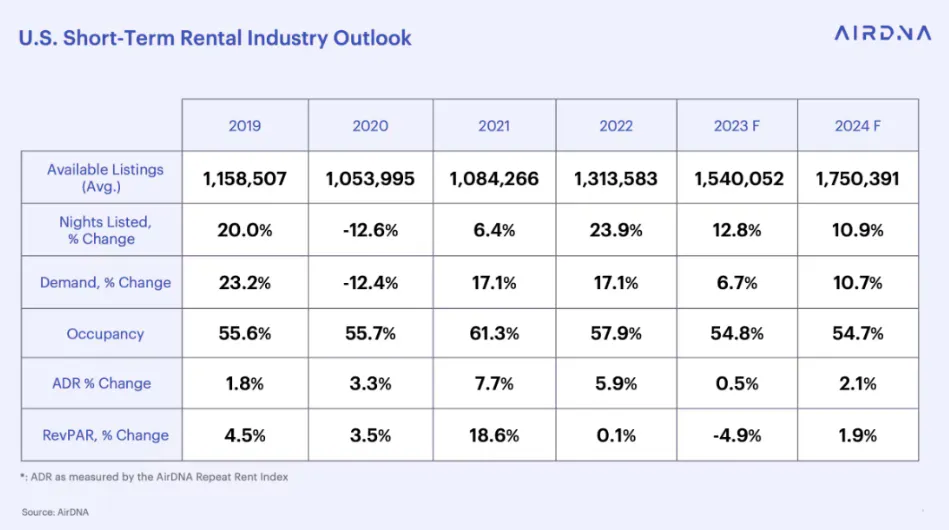
What does that mean for the short-term rental industry? Our data experts expect the industry to grow by 10.7% as the economy grows and domestic travel surges.
Here’s a roundup of other takeaways:
- Demand: Demand growth slowed in 2023, but we expect it will increase by 10.7% in 2024.
- Supply: Listings grew surprisingly near the end of 2023, but that growth will return to long-run averages before settling at 10.9% to strike a better balance with demand.
- Occupancy: Occupancy has fallen since the highs of 2021. However, we expect balanced supply and demand growth will keep occupancy at 54.7%, the same rate as 2023.
Get Insights for Your Market, Not National Trends
During a recession, the impact on the vacation rental market can vary significantly from one location to another. Rather than relying solely on national trends, hosts and investors need to understand the unique dynamics of their local market. By gaining market-specific insights, hosts can better assess the demand, supply, and pricing trends in their area and make informed decisions to adapt their strategies accordingly.
Instead of reacting to broad economic indicators, such as GDP or unemployment rates, hosts should focus on analyzing data relevant to their specific market. Factors such as local tourism trends, seasonal fluctuations, and regulatory changes can have a more significant impact on property performance than national economic conditions.
Learn how to analyze all that and more with our guide to short-term rental market analysis.
FAQs
Was Airbnb founded during the recession in 2008?
Yes, Airbnb was founded during the 2008 recession. It’s for that reason that many see it as a recession-proof business.
Will Airbnb suffer during recession?
Airbnb most likely won’t suffer during a recession. While hosts and investors may see lower performance than in non-recession years, Airbnb has historically demonstrated resilience.
Are short-term rentals recession-proof?
Any investment carries risk, but short-term rentals can be more resilient than other asset classes. Flexibility and affordability are among the reasons why short-term rentals tend to be able to navigate economic downturns well.
ARTICLE SUMMARY
History tells us that short-term rentals are better equipped than most businesses to ride out economic hardship. We explore why and how to further foster that resiliency.
Bram Gallagher
AirDNA Director of Economics and Forecasting
Bram Gallagher is an Economist at AirDNA, specializing in uncovering insights that drive smarter short-term rental decisions. He put his Ph.D. in Economics from the University of Georgia to work researching and forecasting hotel data with CBRE prior to joining AirDNA, as well as teaching economics at a number of universities. In his spare time, Bram enjoys making wooden furniture with hand tools.