

 Calculate Revenue
 Research Markets
 Find For Sale Properties
 Compare My Listing
 STR Revenue Calculator
 Custom Comp Sets
 Submarket Insights
 Custom Search Filters
 Rate Recommendations
 Performance Benchmarking
 Competitor Comparison
 Owner Contact Details
 Property-level performance data
 Tourism Insights
 Real Estate Investment Analytics
 About Us
 Sales
Sales Support
 Press
PressAirbnb New Listing Boost: The Best Time to Launch Backed by Data
Published: September 22, 2025
Last updated: October 20, 2025

Linda Rollins
Key Takeaways
- New listings benefit most when launched a few months before peak booking season.
- Launching in slower periods often delivers stronger first-year occupancy gains, while high season launches tend to underperform as high demand leaves little room for a boost.
- Local booking patterns vary, so timing should be based on market-specific data.
Every new host has one big advantage on their side: the Airbnb new listing boost.
For a short time after launch, Airbnb pushes fresh listings to the top of search results, giving them extra visibility and more chances to book their first guests. Timing matters here. Launching at the wrong point in the year can waste that boost, while the right timing can set your property up for stronger occupancy for months to come.
In this blog, we’ll break down how the Airbnb new listing boost works, why timing is so important to boost your Airbnb listing, and the best months to launch your property. By the end, you’ll know exactly when to go live to maximize your first year’s occupancy.
What Is the Airbnb New Listing Boost?
Airbnb gives new properties a temporary lift in search results when they first go live. This new listing boost is designed to help hosts secure their first reservations, gather guest reviews, and give Airbnb more data to decide where the property should rank long term.
For hosts, that extra visibility pays off quickly. On average, new listings receive around 40% more bookings in their first month compared to a typical month after six months of operation.
How the Airbnb New Listing Boost Impacts Your First Month Of Bookings
We dug into data going all the way back to 2016 to assess how your listing launch month affects first-year occupancy. We averaged the first-year occupancy increase or loss associated with each launch month across the 11-year period to give you an idea of the trend.
Looking at occupancy performance on an annual level revealed that the Airbnb new listing boost has far-reaching effects that extend beyond the first month of bookings.
On average, a property receives about 25 booked nights in its first month, dropping to around 20 nights in the second month. After six months of operation, performance tends to stabilize at roughly 17 nights per month.
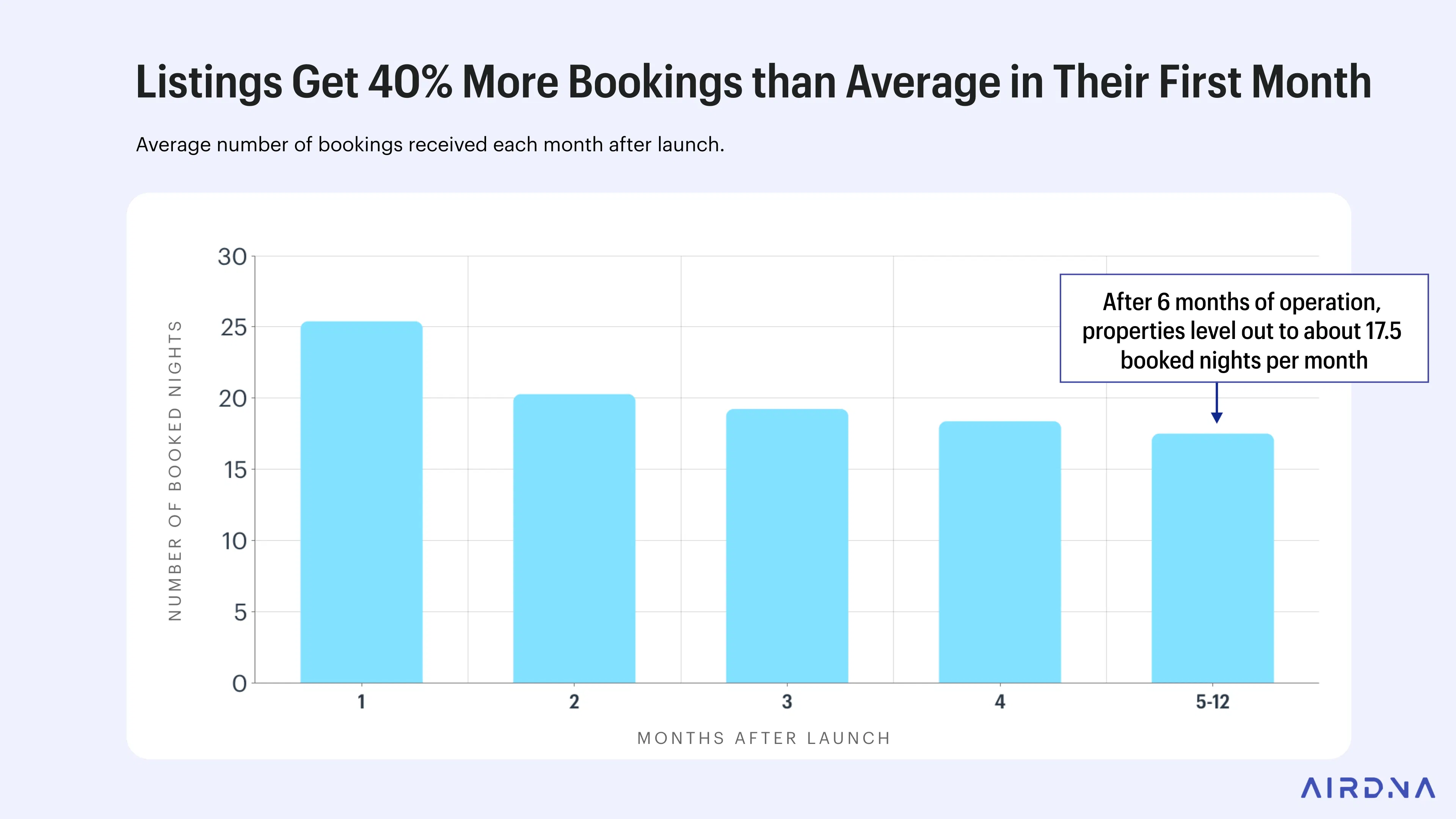
The data indicates that the new listing boost isn’t just a short-term perk. Instead, the boost is designed to set the tone for a property’s longer-term performance.
The initial surge in bookings helps new hosts build up reviews quickly, which in turn improves their position in search results even after the initial boost fades. Without that early push, it can take much longer for a listing to gain traction, rank higher on Airbnb, and reach the same level of visibility.
The Best (& Worst) Time of Year to Launch On Airbnb
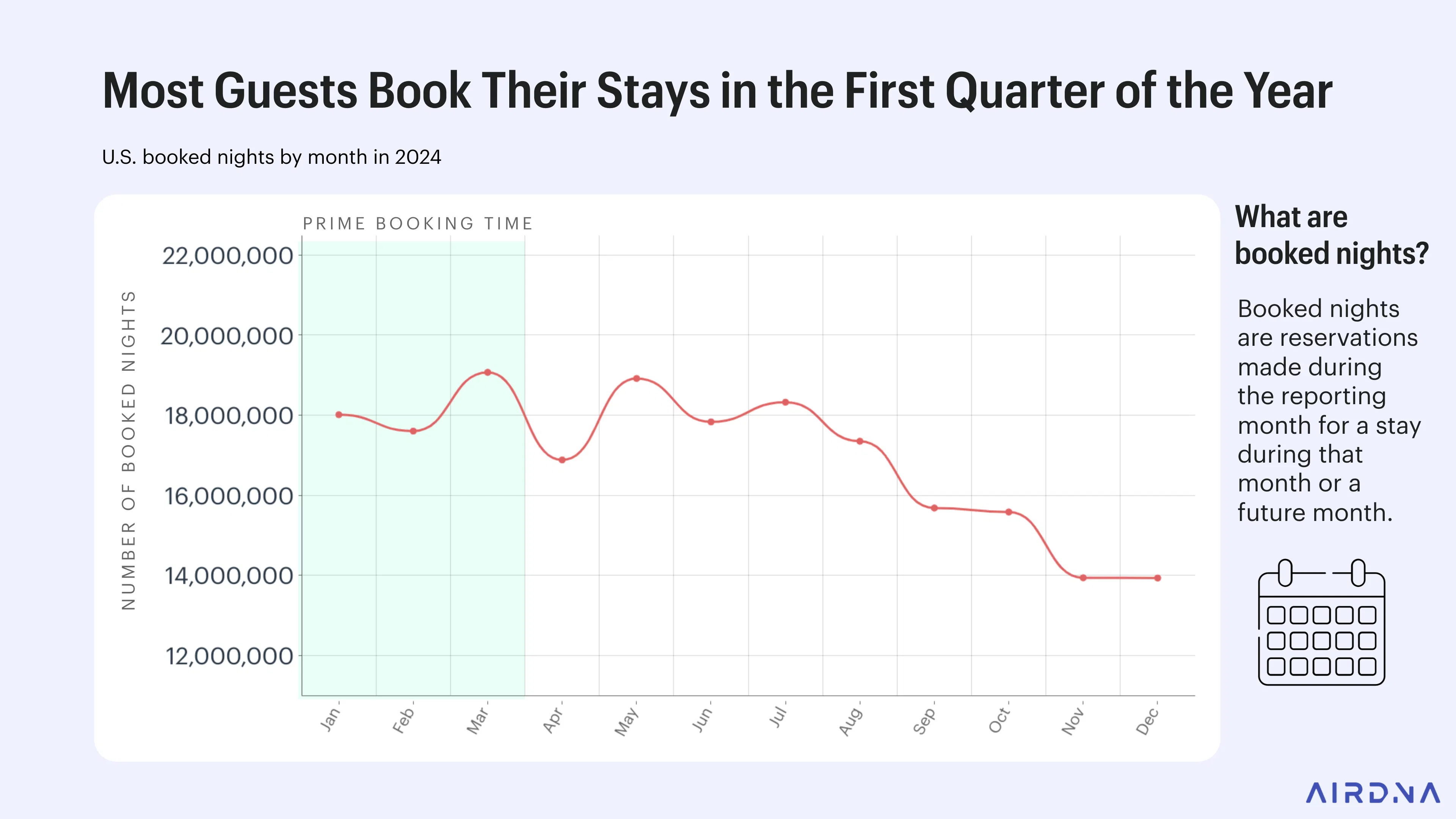
In the US, booking activity follows a clear seasonal pattern. The first quarter of the year is the busiest, with January through March accounting for about 27% of annual reservations. Spring and summer each capture roughly 25%, while the final quarter is the slowest, with October through December making up only 21% of annual bookings.
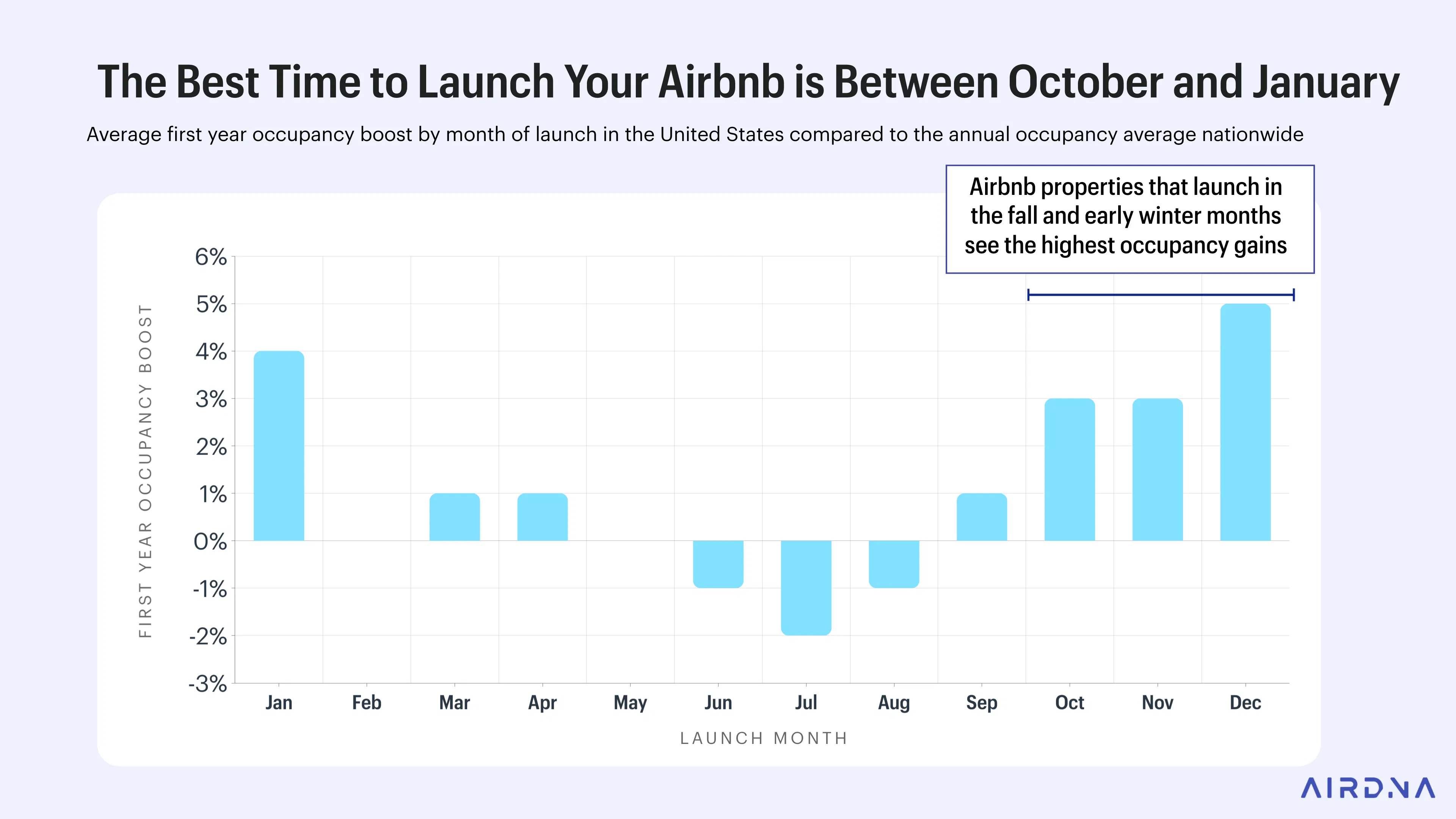
When we look across all US markets, the best time to launch a new listing is between October and January.
Although fall is generally a slower period for bookings, the extra visibility from the new listing boost helps properties stand out. Most fall reservations are made within a month of travel, so hosts can quickly collect reviews that strengthen their ranking ahead of the January surge. Listings launched during this window see higher occupancy than the market average for up to six months after launch and record an average 4% uplift in their first-year occupancy.
By contrast, summer is the least favourable time to go live.
Properties launched between June and August often underperform, averaging 1–2% lower occupancy in their first year compared to the market. This is because summer demand is already high, leaving little room for the boost to have an effect. As soon as the season tapers off, those listings lose momentum and struggle to maintain the same level of visibility.
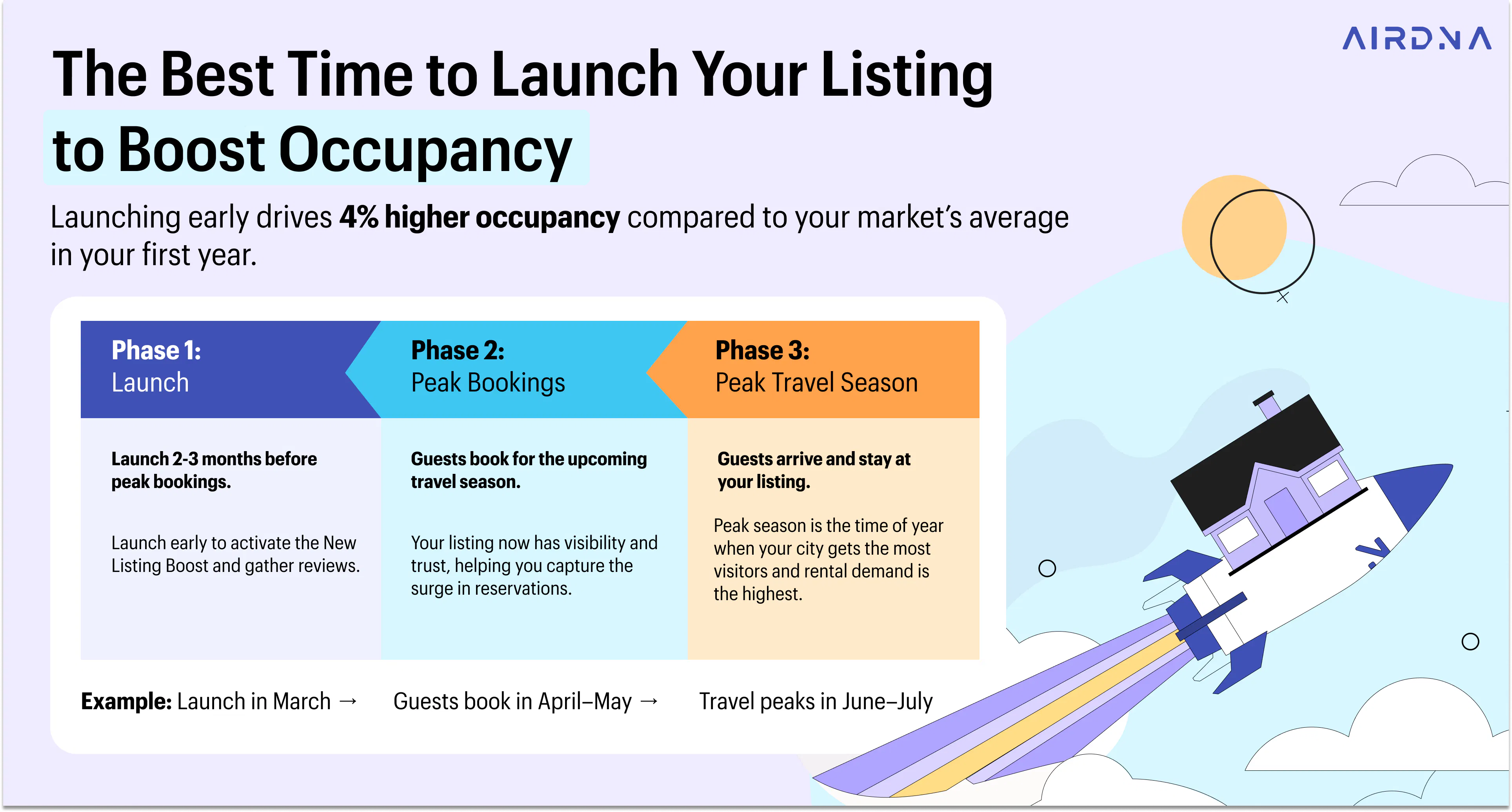
The takeaway is that launching two to three months before peak booking season offers the strongest advantage, while launching during peak travel months brings little gain (and in some cases, a disadvantage). Since booking windows vary by location, understanding the dynamics of your specific market is essential to timing your launch effectively.
Case Studies for Timing the Airbnb New Listing Boost for Your Market
While national trends highlight the best and worst times to launch, the reality is that each market has its own booking patterns. Seasonality, local events, booking windows, and other demand drivers can all influence how much benefit you get from the new listing boost.
To show how this plays out in practice, we’ve analyzed a few U.S. markets with very different demand cycles. Let’s take a look.
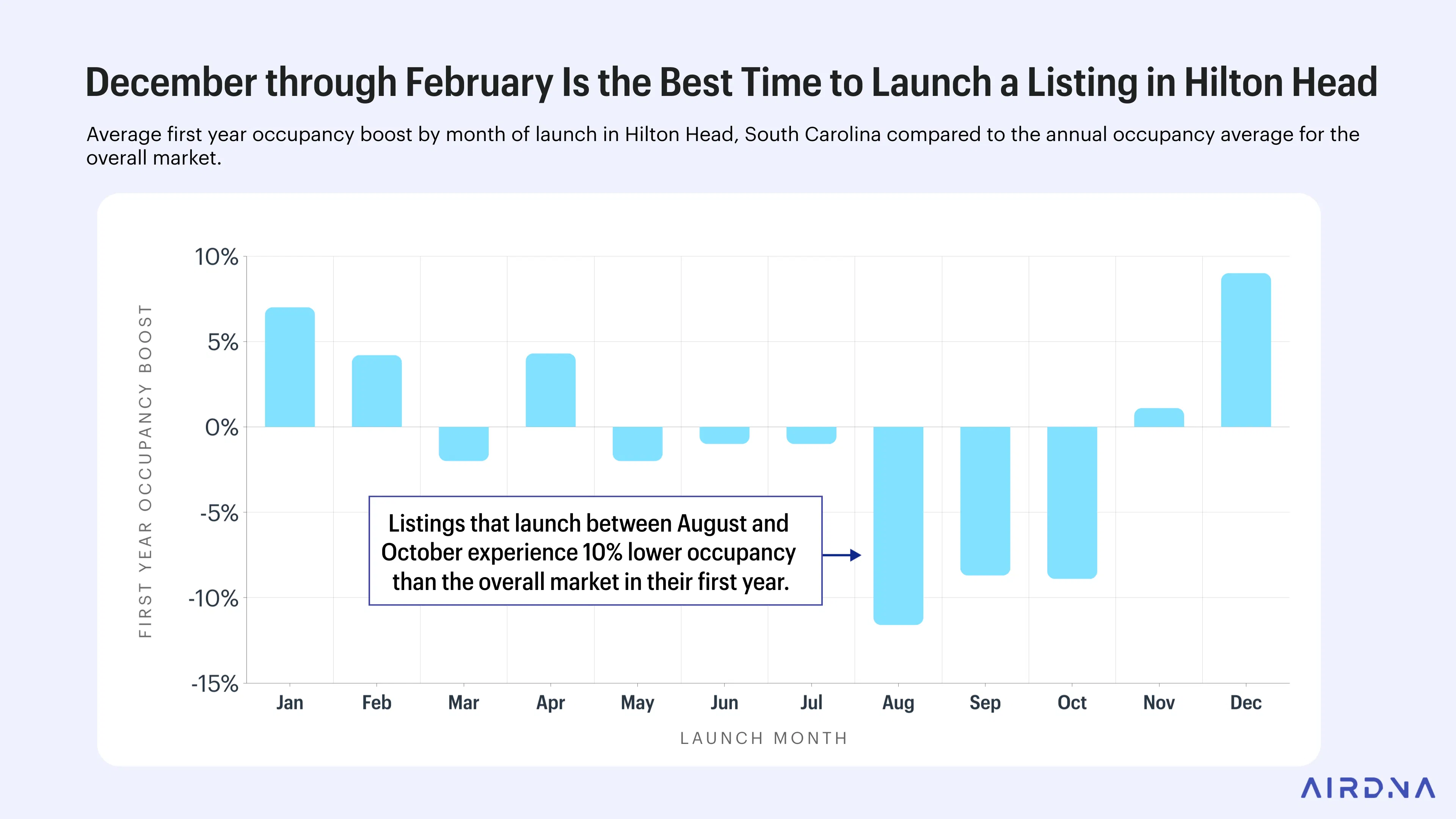
Hilton Head, South Carolina

Hilton Head sees the bulk of its bookings in spring, with March through May being the most popular period for booking stays.
For new hosts, the best time to launch is December through February. This window comes right before peak booking season, when occupancy is lower and the Airbnb new listing boost has the most impact. Properties that go live during this period average 7% higher occupancy in their first year compared to the market overall.
The least favourable time to launch a vacation rental in Hilton Head is August through October. Properties entering the market in this period typically see no occupancy advantage and, in fact, perform worse than average. Short-term rentals that launch in early fall experience up to 10% lower first-year occupancy compared to the rest of the market.
Phoenix/Scottsdale, Arizona

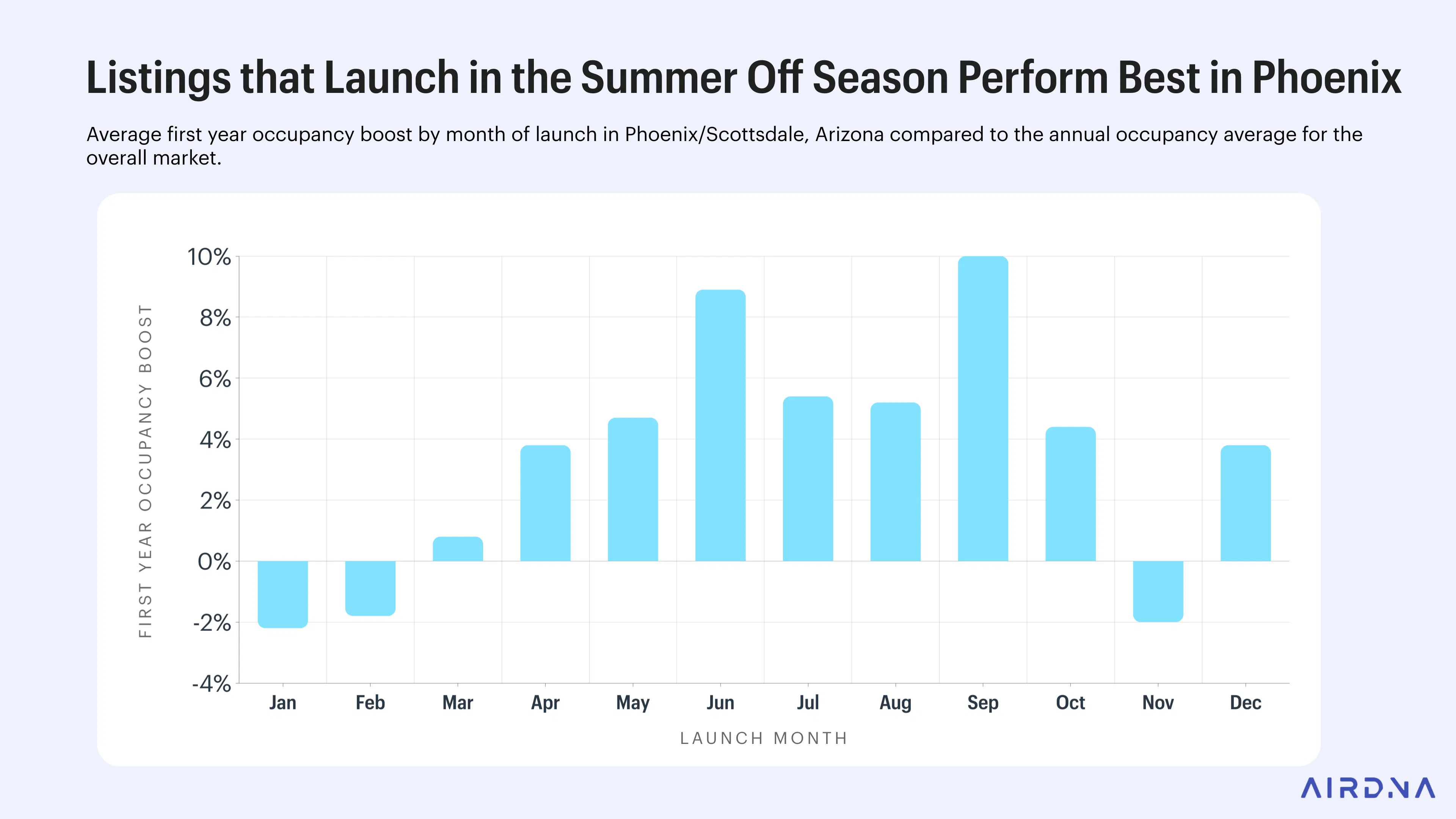
In Phoenix/Scottsdale, the busiest travel period is winter, while summer sees the lowest demand. Fall tends to bring a modest uptick before the high season.
In contrast to the national trend, the best time to launch is June through August. Properties that go live in summer average a 6% boost in first-year occupancy compared to the market. By entering during a slower period, they benefit more from the new listing boost and carry that momentum into the stronger fall and winter seasons.
Launching in winter is less effective in the Phoenix/Scottsdale area. Demand is already high, so the boost has little additional impact. Properties launched during this period see around 2% lower occupancy in their first year than the market average.
Chicago

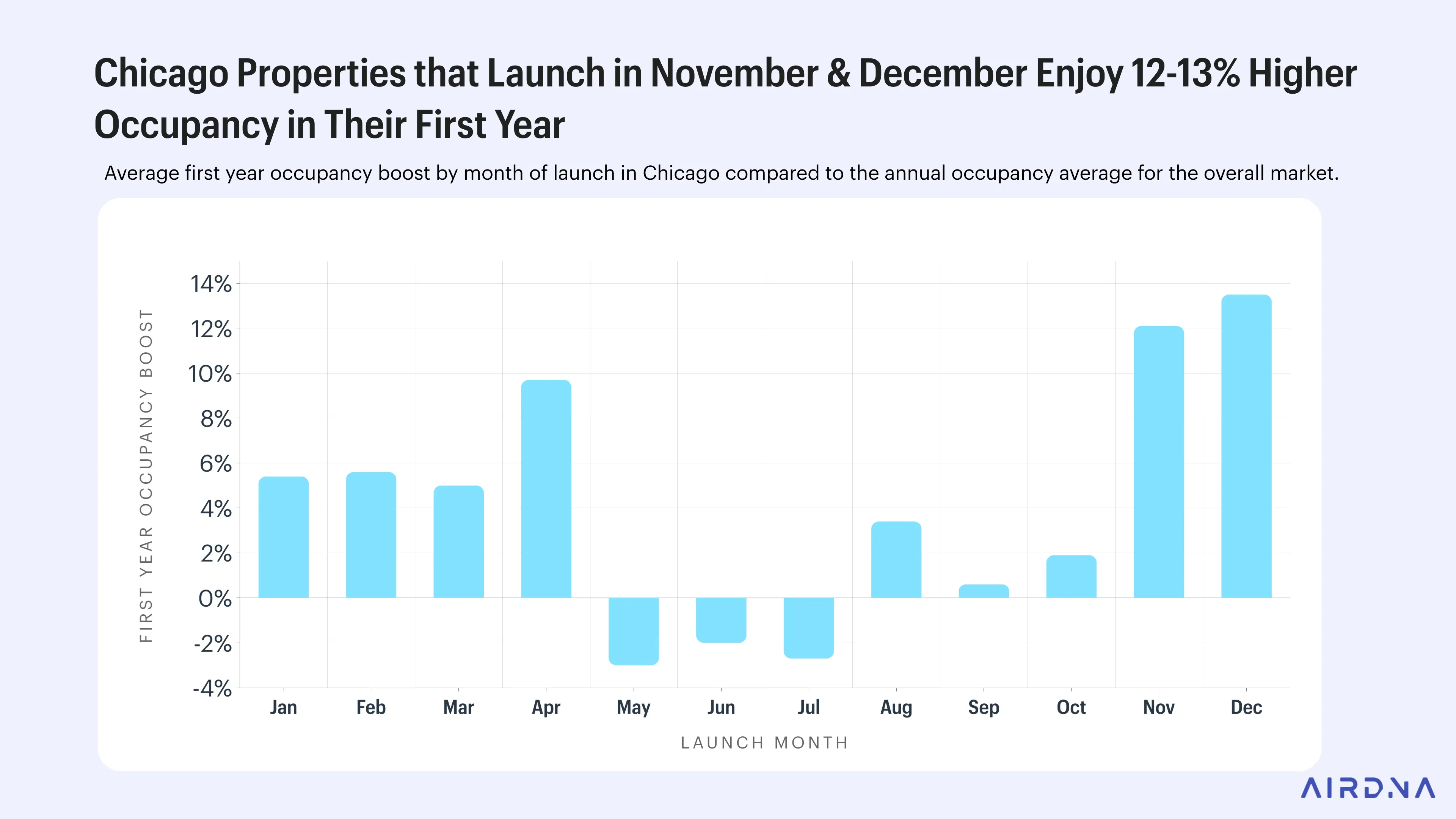
Chicago’s peak booking season falls in spring, with March through May drawing the highest demand. After May, bookings gradually decline through the end of the year.
The most favourable time to launch is November and December. Properties that go live during these months see the biggest lift from the new listing boost, averaging an impressive 12–13% higher occupancy in their first year compared to the market. Launching between January and April can also be effective, with properties typically seeing around a 6% increase in occupancy in their first year.
The least advantageous window is May through July. Properties launched in the summer peak often underperform, averaging up to 3% lower first-year occupancy than the rest of the market.
Gatlinburg/Pigeon Forge, Tennessee

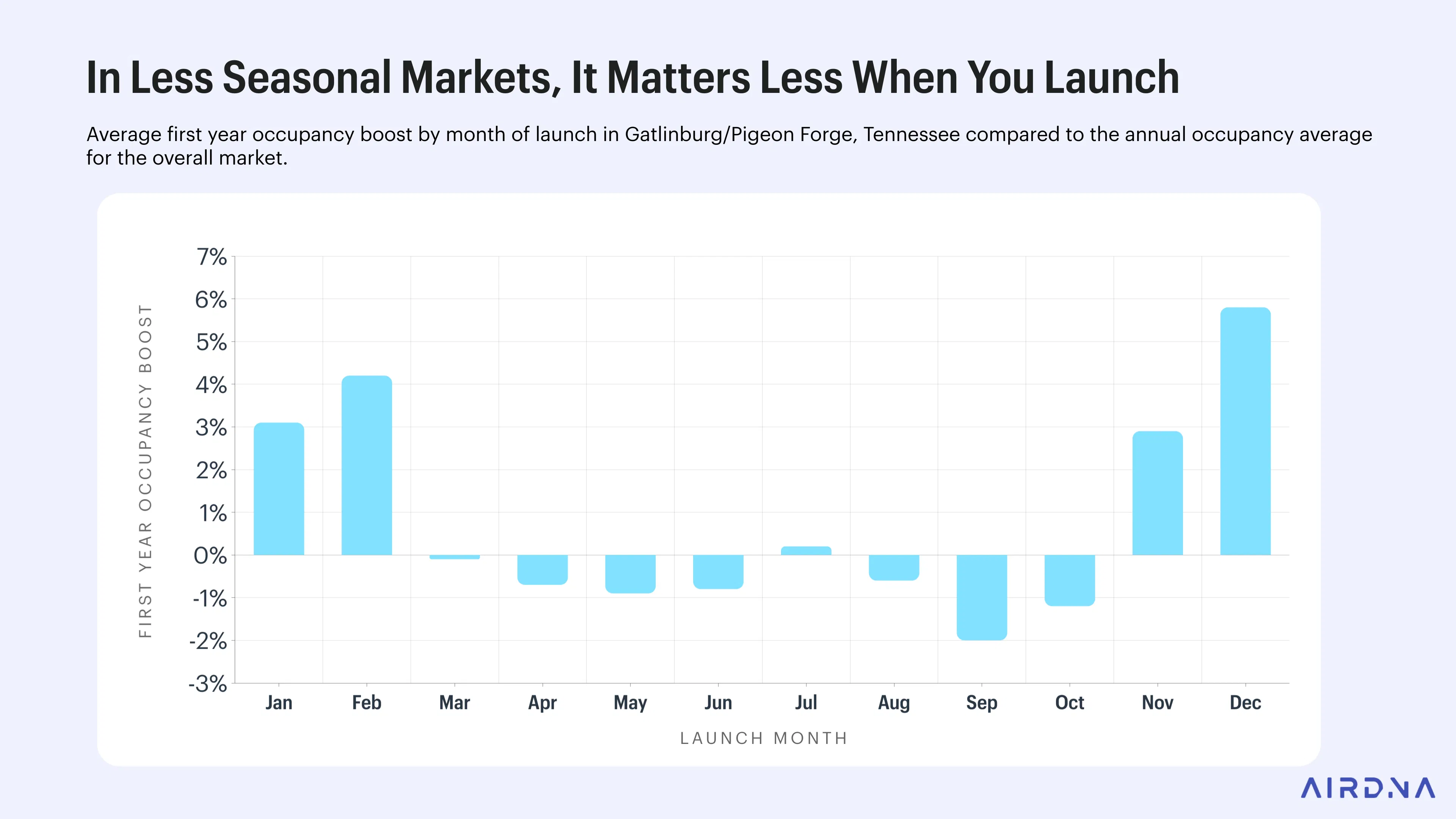
Unlike many other destinations, Gatlinburg and Pigeon Forge experience relatively steady demand through most of the year, with only a noticeable dip in the final quarter.
The best time to increase Airbnb bookings in this location via a strategic launch is December through February, when occupancy is lower and the new listing boost can make a bigger difference. Properties that go live in this period typically record a 4% uplift in first-year occupancy compared to the market average.
Launching between March and August has little effect, as bookings remain stable throughout these months. However, entering the market in September or October can slightly hurt performance, with properties seeing 1–2% lower occupancy in their first year as they head into the slower booking period.
Maximize the Airbnb New Listing Boost with AirDNA
While every market has its own quirks, the data shows a clear pattern: Properties that launch during the off-season, a few months before peak season, build stronger momentum. They benefit from both the boost when it’s needed most and build further momentum with the natural rise in demand that follows
For new hosts, timing is everything. By pairing the Airbnb new listing boost with smart market timing, you give your property the best chance to achieve higher occupancy, collect strong reviews early on, and set the stage for a profitable first year.
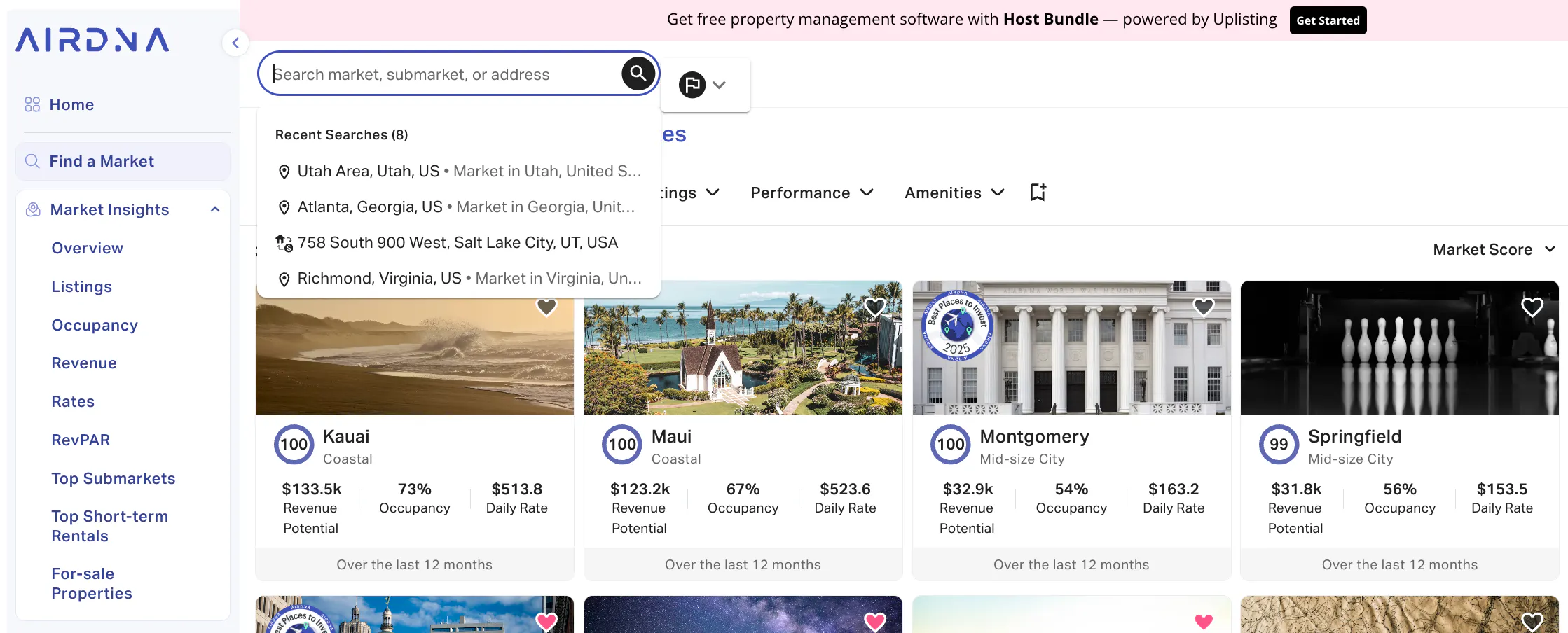
Ready to make the most of your new listing? AirDNA can help. Start by finding your market in the search bar at the top of the app.
Then, scroll down to the Occupancy section of Market Insights. In the line graph that depicts average monthly occupancy, you’ll be able to identify which months experience higher demand. In the case of Michigan’s Upper Peninsula, we can see that occupancy is lowest between November and March and peaks in the summertime at around 75%.
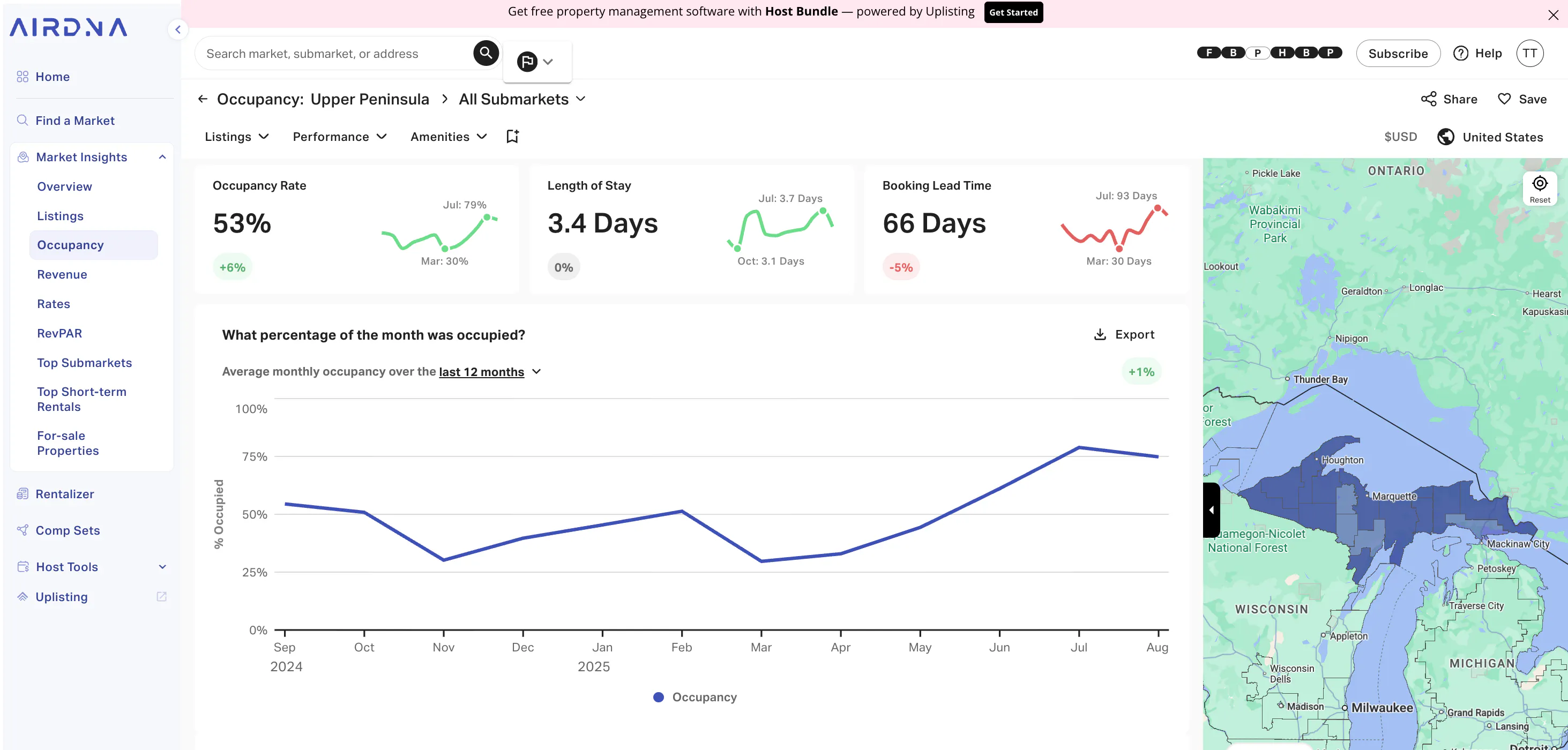
Launching your short-term rental during the low occupancy period for your market is likely to give you the highest returns on the Airbnb new listing boost. In the case of the Upper Peninsula, booking lead time averages at 66 days over the course of the year, but it drops to 30 days in March. That means that launching in February, for instance, would likely result in significant March bookings a month later.
AirDNA empowers you to analyze your market’s booking patterns and identify the best time to launch so your property gets the strongest start possible.
FAQs
How to increase Airbnb listing views?
To increase Airbnb listing views, start by taking advantage of the Airbnb new listing boost, which places your property higher in search results. Strong photography, detailed descriptions, and instant book settings help attract potential guests. Outside the platform, promote your Airbnb through social media platforms, referral programs, and other marketing efforts to expand your reach and drive more views.
How to boost my Airbnb listing?
Boosting your Airbnb listing performance is all about pairing your listing launch with the right season and continuing to build visibility with consistent marketing tactics.
Positive reviews, Superhost status, and user generated content (UGC) can help your listing rank higher on Airbnb. Combining Airbnb SEO optimization with a targeted Airbnb marketing strategy will keep your property competitive long after the initial boost.
How long does Airbnb boost new listings?
The new listing boost usually lasts for several weeks to a couple of months after launch.
During this period, Airbnb promotes new properties in its search engine to give them a stronger start. The boost helps hosts secure early bookings, gather reviews, and build a foundation for long-term occupancy growth.
What are some tips on how to make your Airbnb stand out?
To make your Airbnb stand out, highlight unique experiences and features that set your space apart, whether it’s location, amenities, or design. Pair this with professional photos, a welcoming tone in your description, and quick responses to guest inquiries. Promoting your Airbnb on social media and encouraging repeat stays from past guests can also help strengthen your reputation.
What is the best Airbnb marketing strategy?
The best Airbnb marketing strategy combines strong in-platform practices with external promotion. Inside Airbnb, focus on Airbnb SEO, instant book, and earning positive reviews to rank higher.
Beyond the platform, use social media, UGC, and referral programs to attract a wider target audience and increase bookings throughout the year.
How can I advertise my Airbnb?
To advertise your Airbnb effectively, share your listing across multiple social media platforms, create engaging content for your target audience, and encourage guests to leave reviews that you can feature in your marketing efforts. Paid ads can help promote your Airbnb to potential guests, but organic methods like partnerships and storytelling often build trust more effectively.
ARTICLE SUMMARY
The Airbnb new listing boost gives hosts a temporary lift in search rankings, driving significantly more bookings in the first month. Timing the launch around local booking patterns leads to stronger occupancy rates throughout the first year.
Linda Rollins
Senior Research Analyst
Linda Rollins is a Senior Research Analyst at AirDNA and a self-managing short-term rental host, which means she understands the market as both an analyst and an operator. She writes research and blogs for AirDNA and for Adapt, its revenue management tool, making her work a go-to resource for investors trying to find and size up the right opportunities, and for operators looking to understand changing market dynamics and find concrete ways to improve occupancy, rates, and guest experience. Her data is regularly cited in major news outlets, and she has a knack for bringing both the numbers and the story behind them. In her free time, Linda enjoys spending time with her family, traveling, and looking for good eats.
