


European Review: A Deep Dive into 2025 Performance
Published: January 21, 2026
Last updated: August 31, 2026

Camilo Schmid Rivas
Key Takeaways
- Available listings in 2025 averaged 3.65 million listings per month, up 3.5% year-over-year (YoY).
- Demand nights reached 470 million for 2025 (4.4% YoY), which drove occupancy up by 0.7% to 59%.
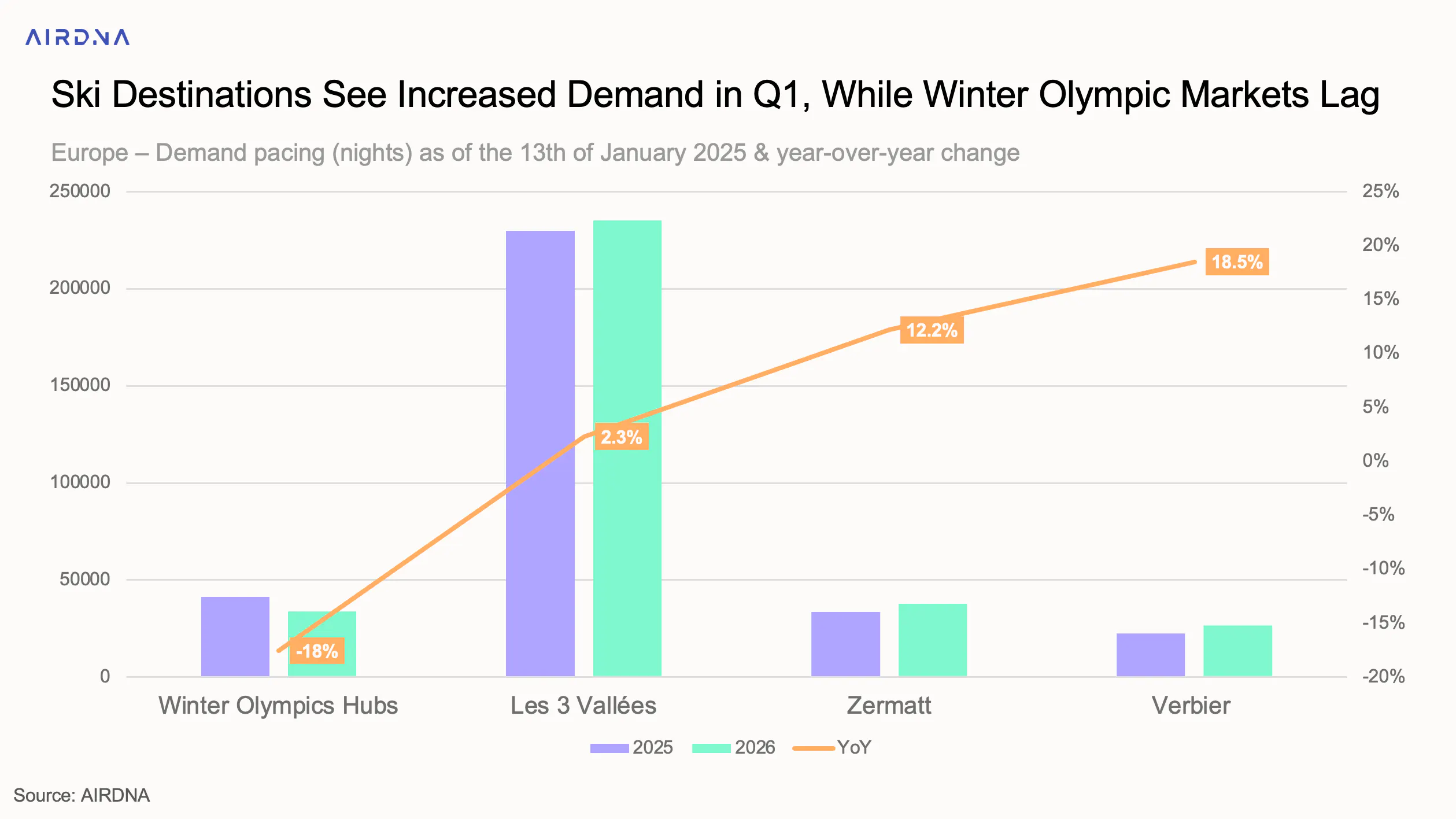
- Demand pacing for skiing destinations appears mixed in early 2026, with France and Switzerland hubs experiencing growth while Italian locations decline despite the Winter Olympics.
The European short-term rental market in 2025 experienced slower supply growth due to stricter regulations across Europe. Supply increased by only 3.5%, down from 18.1% in 2024. While supply growth slowed to a more sustainable level, demand kept rising steadily at 4.4%, leading to a 0.7% increase in occupancy.
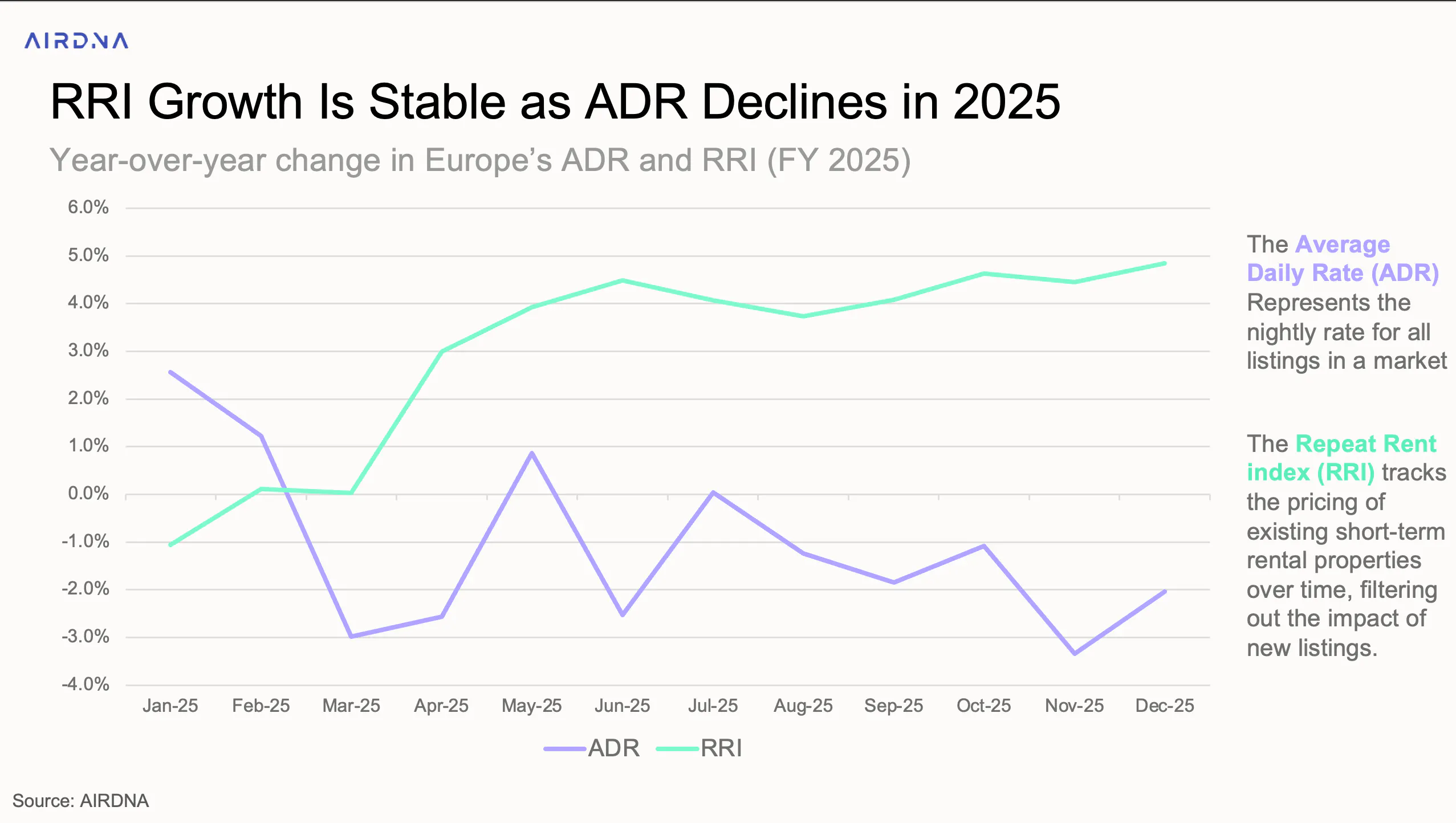
Average Daily Rates (ADR) across the continent fell by 1.1%, driving down Revenue per Available Rental (RevPAR) by 0.4% despite gains in occupancy. Although ADR decreased, the Repeat Rent Index (RRI) posted gains in 10 of 12 months, growing on average by 3%. The RRI tracks pricing for existing operators and removes the impact of new listings, with growth suggesting pricing power among established operators.
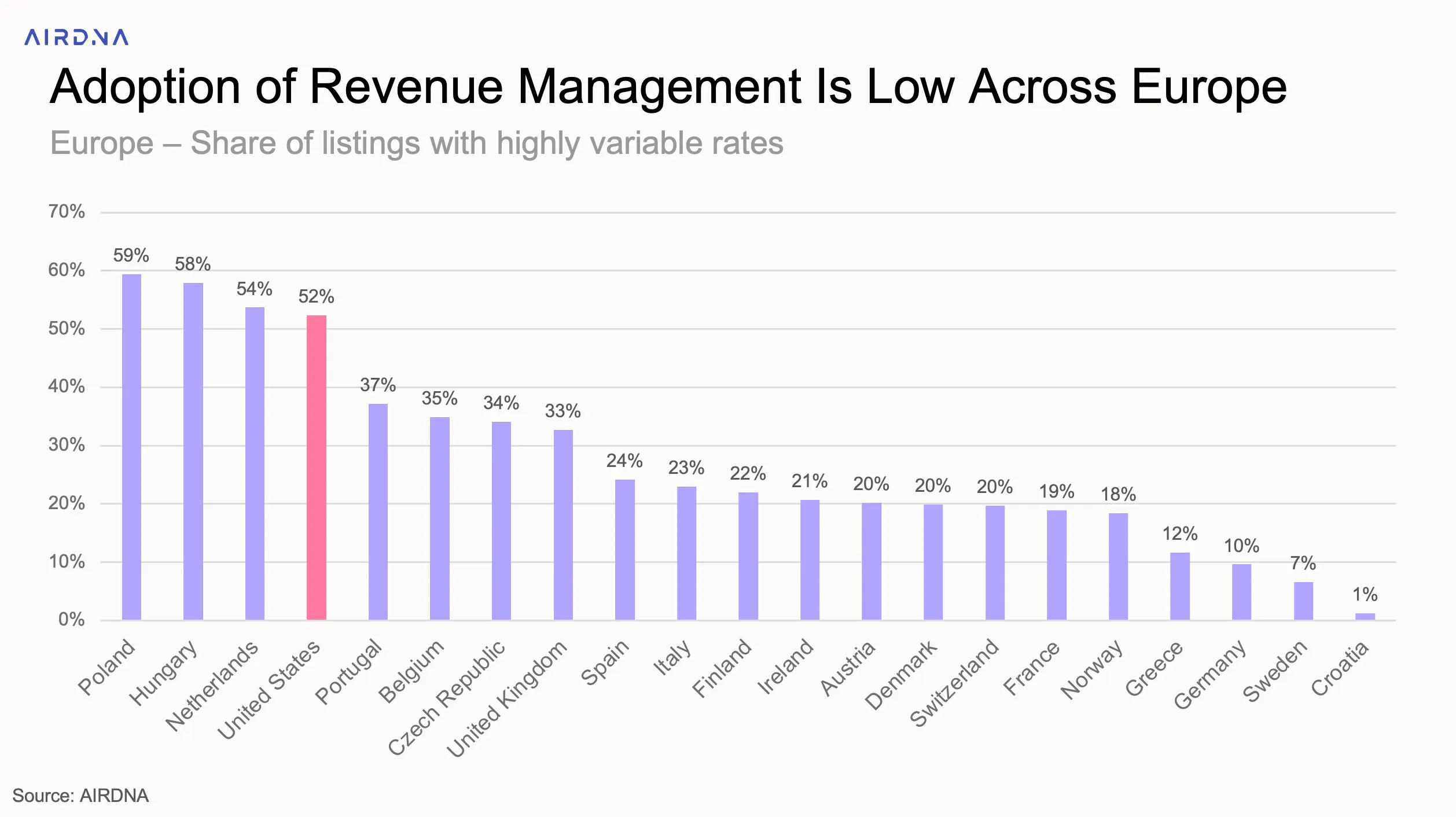
With supply growth remaining in the single digits and demand surpassing supply, 2026 is likely to be a challenging year for operational efficiency. This is especially true given the low adoption of revenue management across Europe. In France, Europe’s largest market, only 19% of listings have highly variable rates. That’s low compared to 52% of listings deploying dynamic pricing in the United States.
At a Glance: 2025 STR Performance in Europe
- Available listings reached an average of 3.65 million, an increase of 3.5% YoY
- Demand Nights grew by 4.4% YoY to a Total of 470 million
- Average daily rates (ADR) decreased by 1.1% YoY to €130
- Average occupancy rate reached 59%, up 0.7% YoY
- Revenue per Available Rental Night (RevPAR) decreased by 0.4% YoY to €76
2025 marked a year of sustained growth in Europe, as supply growth slowed from double digits to more manageable single digits. Meanwhile, demand increased steadily. Existing hosts maintained their pricing power despite a decline in ADR.

Supply Growth in 2025 Trailed Previous Years
In 2025, the growth in the average number of available listings in Europe slowed to 3.5% year-over-year (YoY), reaching an annual total of 3.65 million listings across the continent. This indicates a departure from the rapid growth phase experienced in previous years.
For comparison, the YoY increase in available listings from 2023 to 2024 was 18.1%. If you look at monthly supply growth, Europe's performance in 2025 was split in two halves. The first six months saw the highest YoY growth rates, averaging 4.7%. July and August experienced the lowest growth rates at 0.7% and 1.3%, respectively. Supply growth then steadily recovered, ending the year at 3.1% in December.
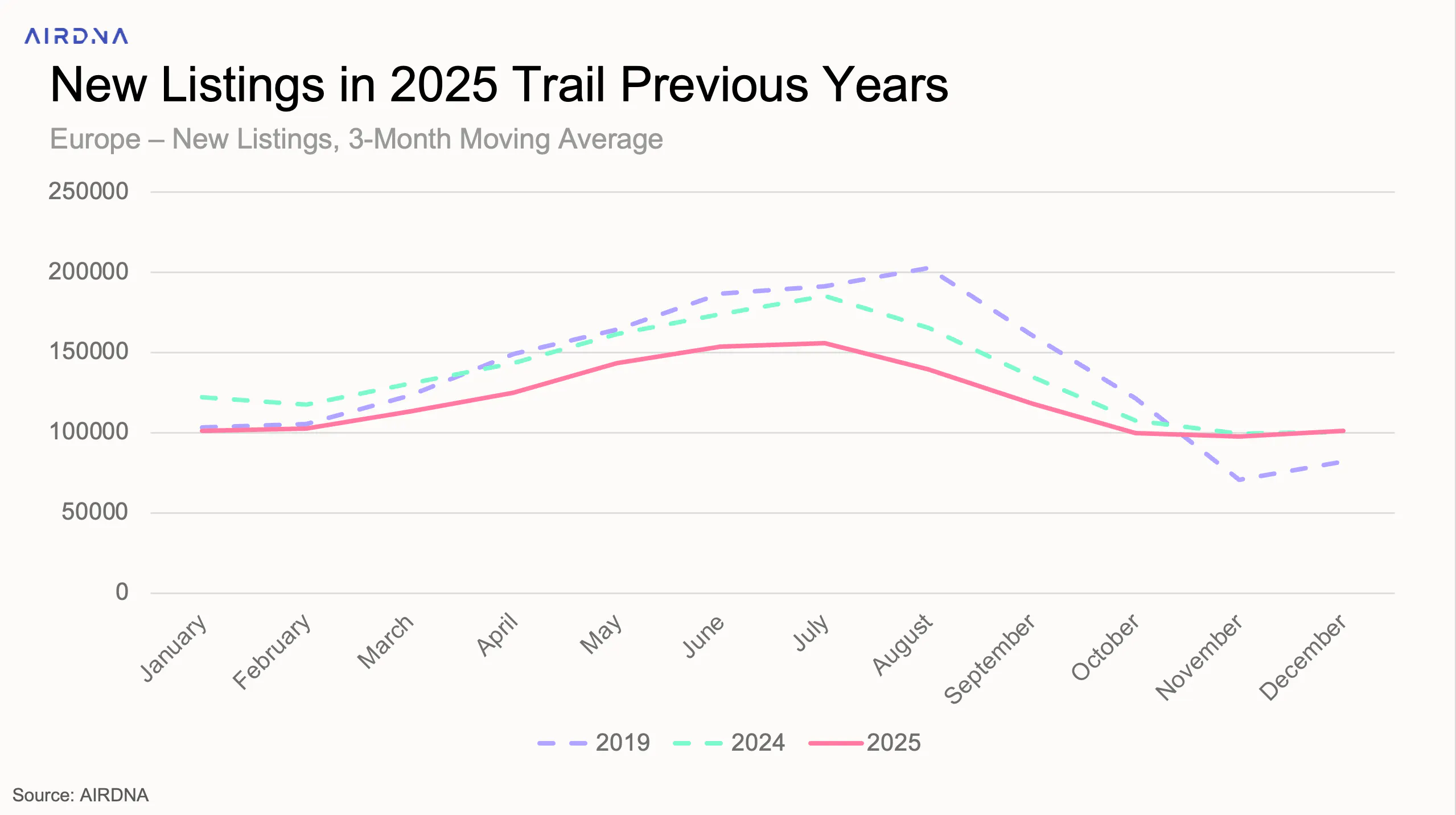
An analysis of new listings, which includes properties entering the market for the first time, shows a continued slowdown throughout 2025 thanks to intensifying regulatory pressure on the short-term rental industry across Europe. If we compare new listing totals in 2025 and 2024, we observe a 9.9% decrease. When comparing 2025 with 2019, new listings are 12% lower.
Demand Growth Was Strongest in the First Half of the Year
Total nights stayed in short-term rentals in 2025 hit a record high of 470 million across Europe, reflecting a 4.4% year-over-year increase that outpaced the growth in available listings.
Looking at demand trends throughout the year, April stands out with the highest YOY growth. April demand was driven by the calendar shift moving Easter from March into April, resulting in a 19% increase. The second half of the year experienced a notable slowdown, with YoY growth since August remaining below 1%, and declines of -3% in November and -1.1% in December.
Nights booked
Nights booked in 2025, which include reservations made during the reporting month for stays in the current or upcoming months, totaled 484 million nights. This marks a 3.7% increase from 2024.
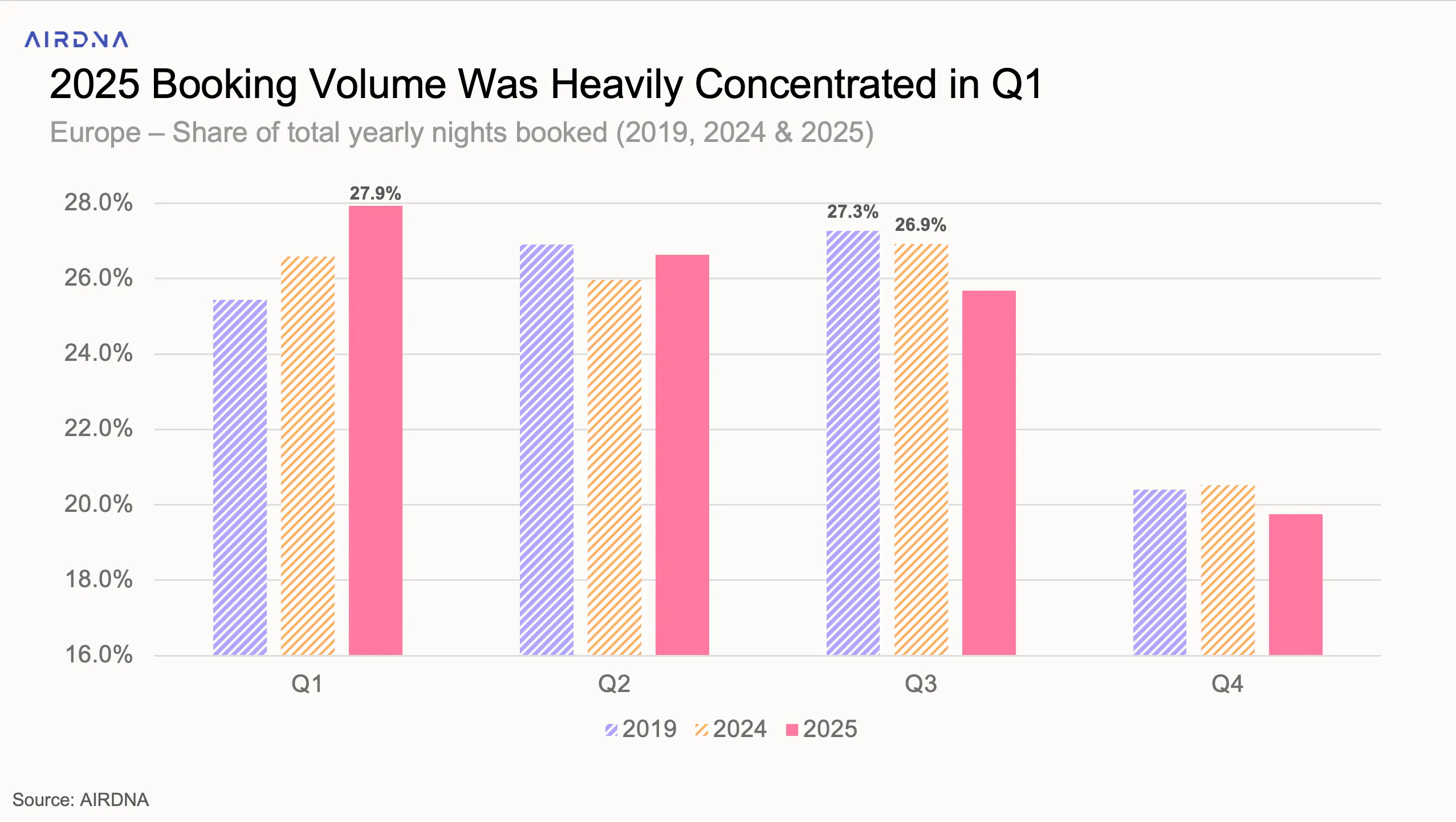
The monthly distribution of bookings has changed significantly. Due to economic and political uncertainties influencing travelers, most bookings now occur in Q1 of the year. Ten percent of the annual nights booked are made in January alone. In previous years, Q3 saw the most bookings. This trend suggests that travelers might be reserving earlier to avoid uncertainty or to benefit from early booking discounts.
Occupancy Was Boosted by Demand Outpacing Supply
Listing growth in Europe slowed from double digits to low single digits, while demand outpaced supply. This dynamic led to a 0.7% year-over-year rise in occupancy to 58.7%. This is in contrast to 2024, when sharp supply increases caused occupancy to decline by 5.2% YoY. Occupancy in Europe also grew more quickly than occupancy in the United States over the same period. In the U.S., occupancy increased by 0.3% to 57%.
Pricing and Revenue
ADR & RRI
Average Daily Rates (ADR) in Europe declined for the second consecutive year, with a 2.9% decrease in 2024 and a 1.1% year-over-year decline projected for 2025. Despite this overall decline,the Repeat Rent Index (RRI), which tracks price changes among existing operators and excludes the impact of new listings, presents a more positive outlook for current operators.
RRI experienced eleven months of growth, particularly during the summer months where the average year-over-year increase was 4.1%. This steady growth indicates two key points:
- Existing operators are able to maintain or raise their rates more effectively, while new entrants tend to underprice.
- As regulations tighten across Europe, higher-priced properties tend to exit the market, potentially elevating the RRI by removing these listings and shifting the market mix.
RevPAR
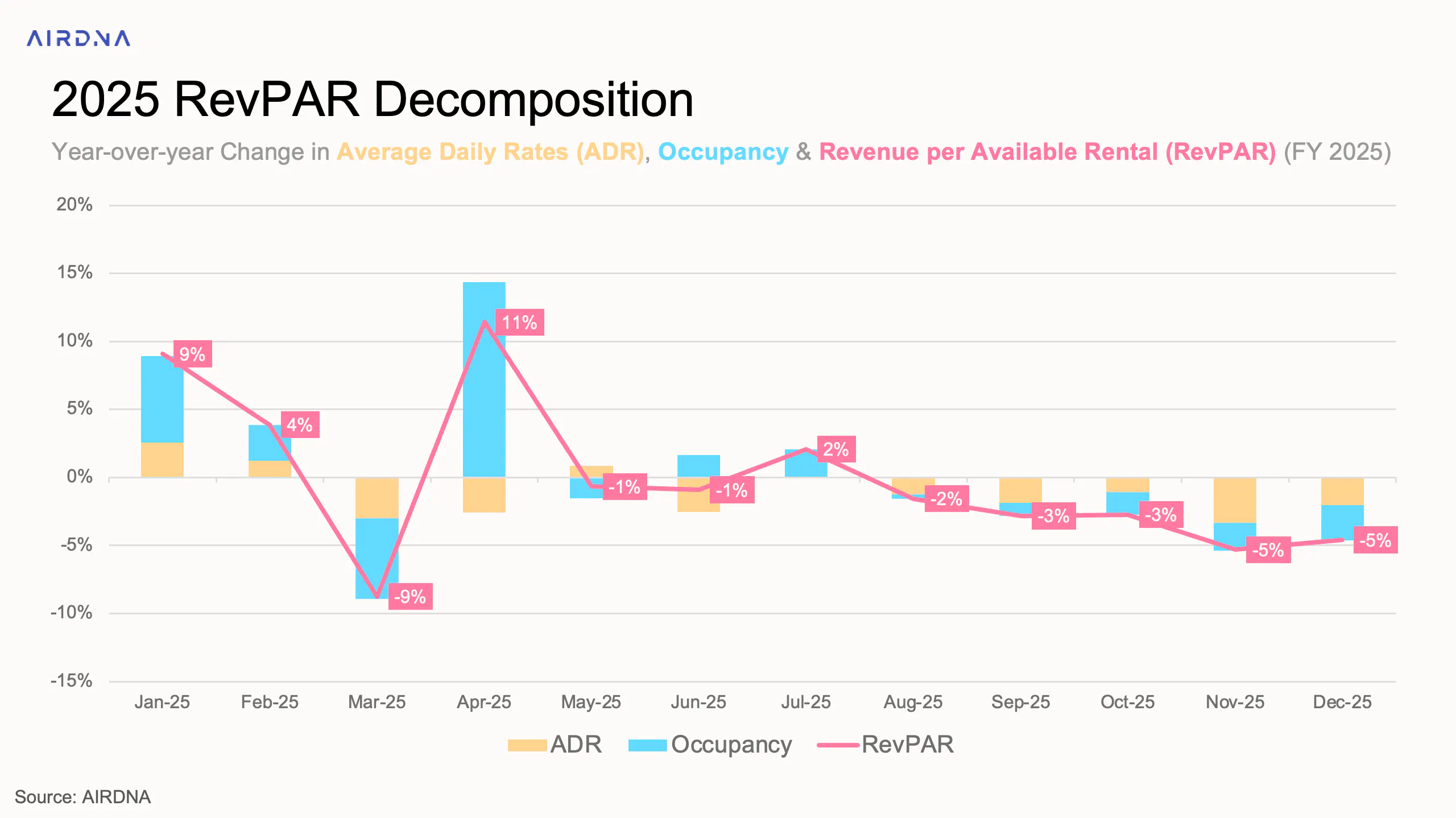
Despite a 0.7% rise in occupancy in 2025, a 1.1% drop in ADR led to a 0.4% decrease in RevPAR, averaging at €76. Although RevPAR declined slightly, this represents a recovery after an 8% decline in 2024. Total revenue for STRs in Europe increased by 3.2%, reaching €61 billion.
Performance Was Mixed Among the Top 20 European Nations
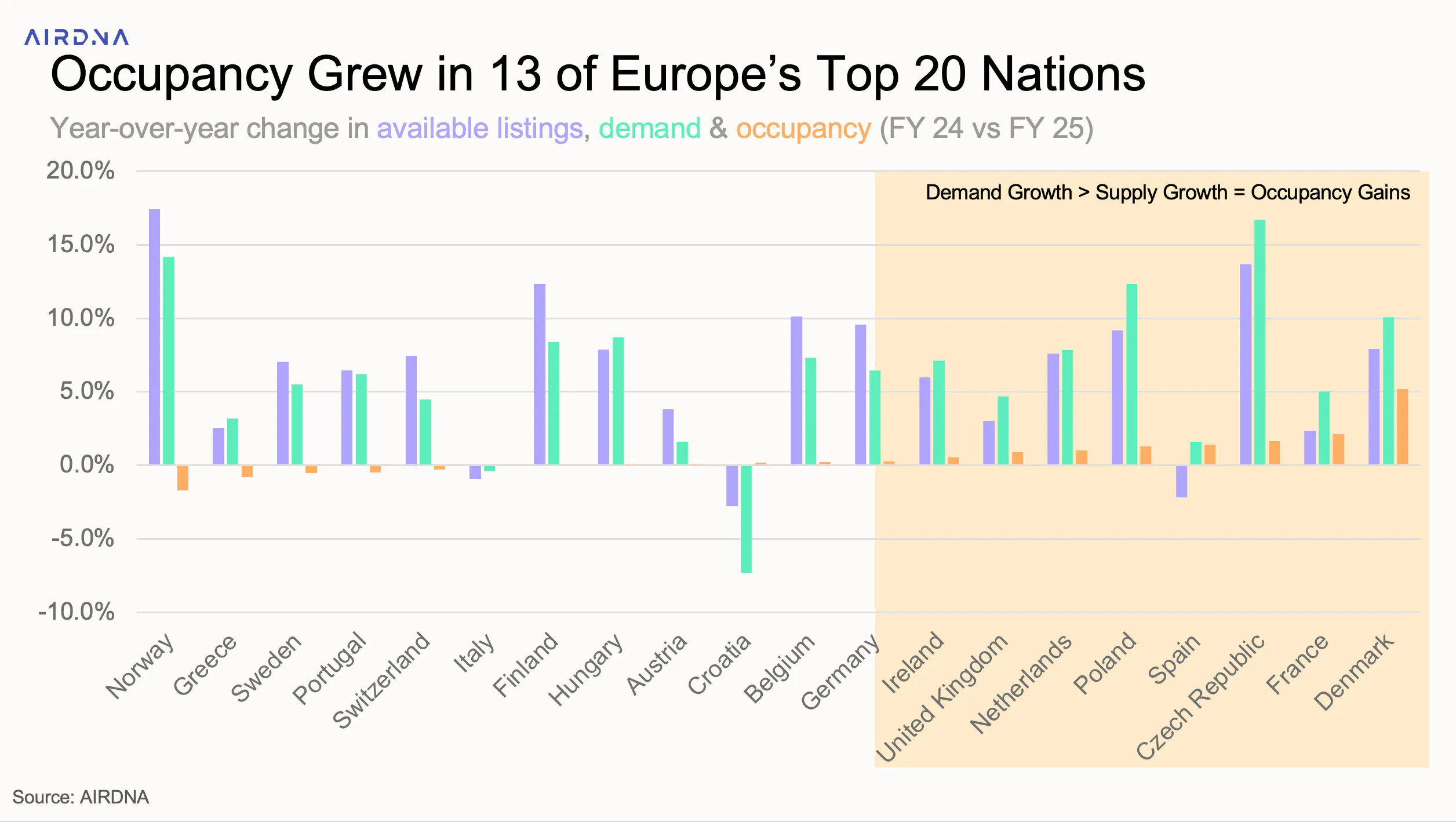
One of the key challenges in the EU's short-term rental market has been rising regulatory pressure that restricts new entrants. Nevertheless, the average number of available listings, which includes the total number of properties listed and open for bookings, increased in 17 of Europe’s top 20 countries. Some countries experienced growth declines:
- Croatia (-2.8%)
- Spain (-2.2%)
- Italy (-0.9%)
Since 2019, Croatia has seen a consistent decline and now has 21.6% fewer listings than that year. In Spain, regulatory pressures imposed by the government caused tens of thousands of listings to be delisted, significantly reducing supply. Italy’s supply decline may also stem from stricter regulations, including higher taxes for multi-listing hosts and more structured registration procedures.
On the other hand, multiple nations experienced strong growth rates, including:
- Norway (17.4%)
- Czech Republic (13.7%)
- Finland (12.3%)
- Germany (9.6%)
Germany is now firmly established as the fourth-largest short-term rental market in Europe. The other top 5 nations—France, Italy, Spain, and the United Kingdom—failed to achieve growth above 3% in the past year. Germany significantly outperformed them with almost 10% supply growth. France experienced steady growth at 2.4%, while the United Kingdom grew by 3%. The latter market boasts the second-highest growth rate among Europe's 5 largest markets. If these trends continue into 2026, the United Kingdom could surpass Spain to become the third-largest market in Europe.
The Czech Republic takes the cake for demand growth
Combined demand nights among Europe's top 20 nations grew steadily at 4%, slightly lower than the continental growth at 4.4%. Demand growth rates among the individual nations varied considerably, with the top performers being:
- Czech Republic (16.7%)
- Norway (14.2%)
- Poland (12.3%)
Performance among Europe’s largest five markets was mixed:
- Germany (6.5%)
- France (5%)
- United Kingdom (4.7%)
- Spain (1.6%)
- Italy (-0.4%)
- Croatia (-7.3%)
Croatia now falls 21.1% short of its 2019 demand.
Regulations Constrain Performance in the Top 50 European Cities
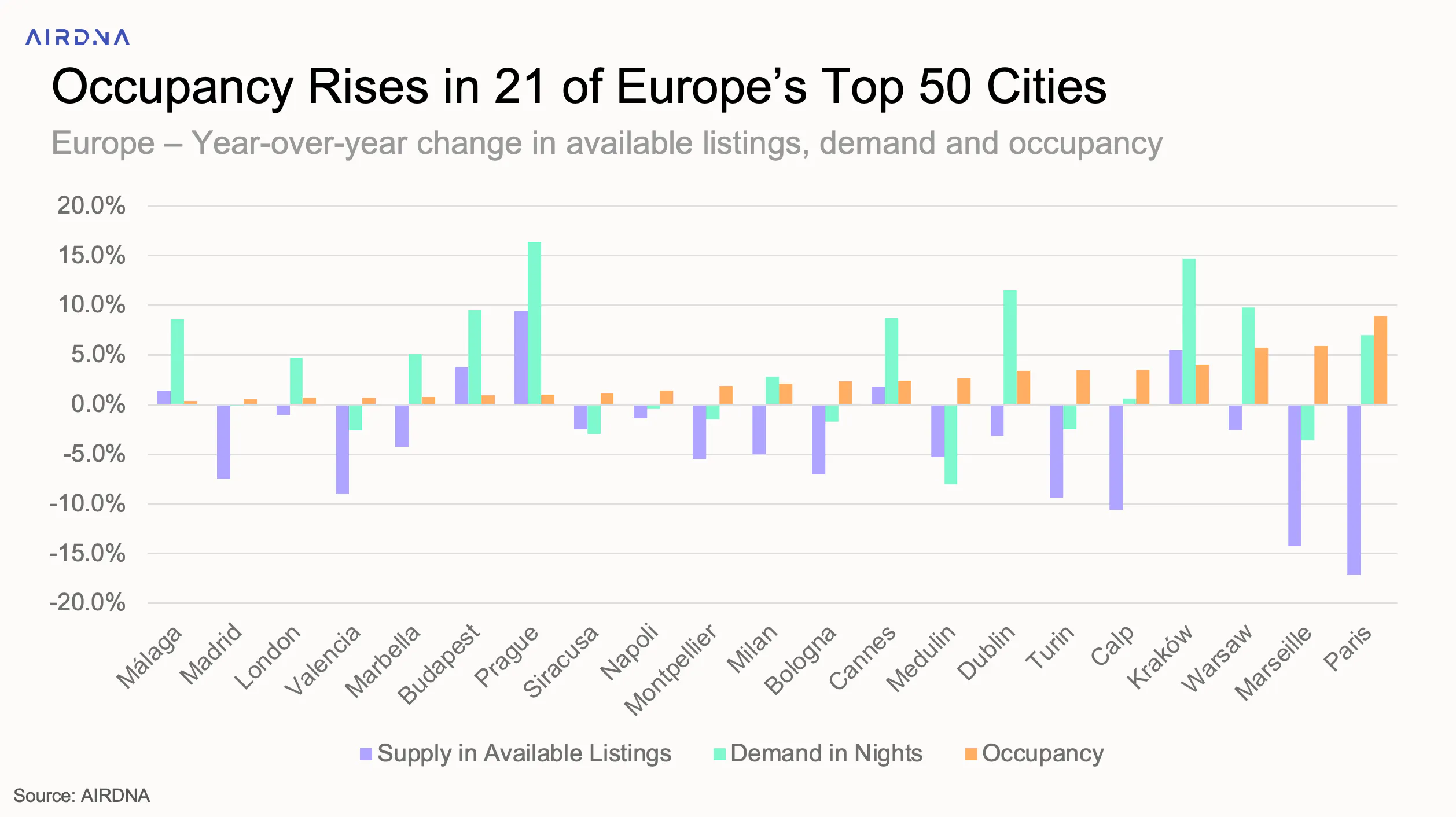
As regulations tighten across Europe, cities are experiencing some of the strictest enforcement. By 2025, only 22 of the top 50 European cities saw an increase in available listings, with Prague leading with a 9.4% year-over-year growth rate. Meanwhile, Paris experienced the largest decline, with a 17.1% drop in supply. This decrease follows a surge in listings by opportunistic hosts during the 2024 Paris Olympics, which are now receding from the market.
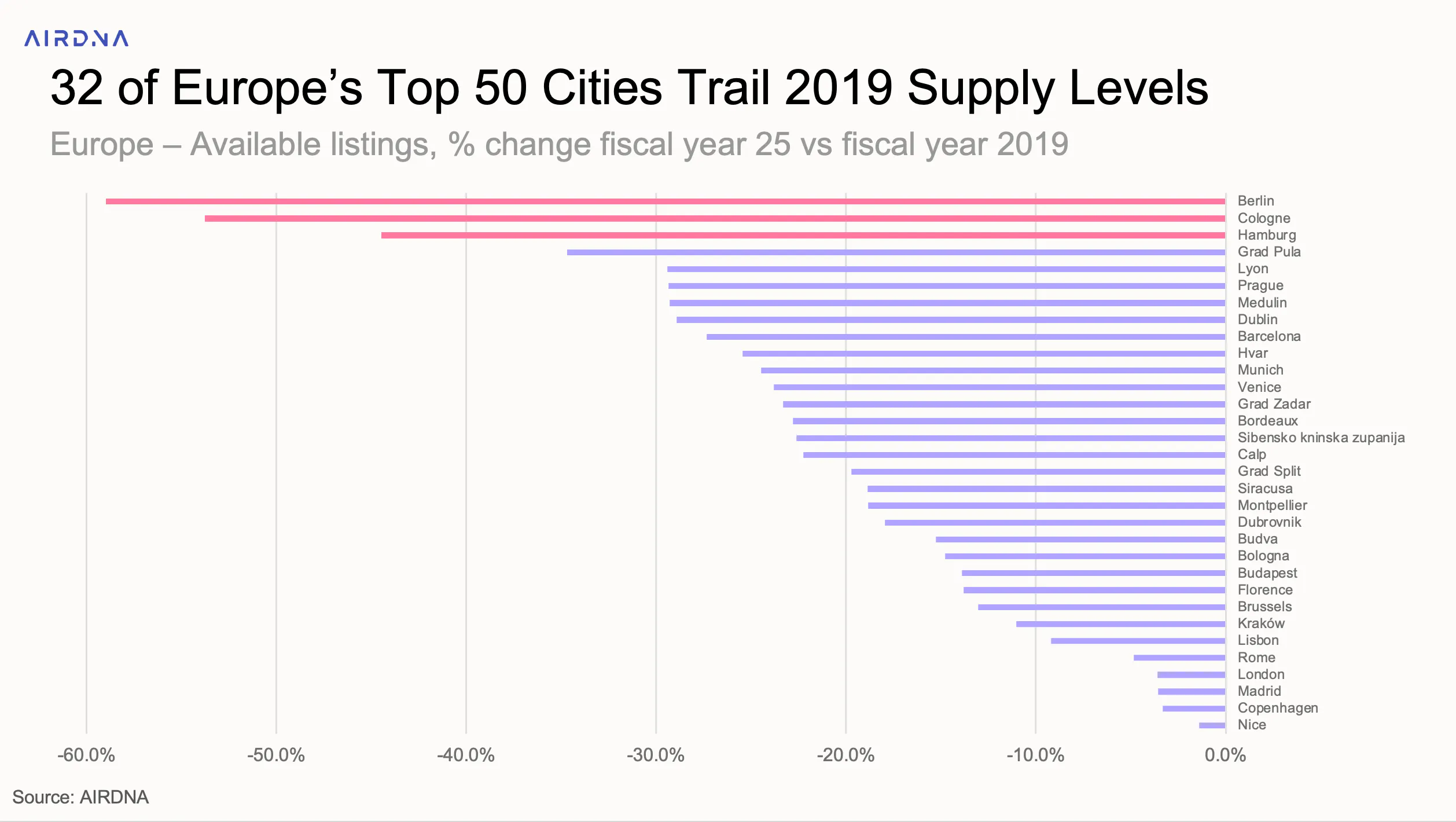
Compared to the pre-pandemic baseline of 2019, the tightening regulations are more evident. Only 17 cities had more listings in 2025. The three cities experiencing the largest declines are all German hubs:
- Berlin (-59%)
- Cologne (-54%)
- Hamburg (-46%)
These supply declines are due to increasing pressure on residential housing in major cities.
Prague and Rome saw double digit demand growth
Demand nights in Europe’s Top 50 Cities grew by 4.6%, slightly higher than the continental average of 4.4%, with 31 of the 50 cities seeing positive growth. The following markets stood out in terms of growth:
- Prague (16.4%)
- Krakow (14.7%)
- Rome (14.2%)
With an increase in direct flight routes from Canada, East Asia, and Arab nations, demand in Prague rose significantly. Asian visitors increased by 12%, according to Prague's Tourism Association. The rest of the country also benefited, making the Czech Republic the region with the highest demand growth among Europe’s top 20 destinations.
As inflation saps spending power and travelers seek more budget-friendly options, Krakow offers a more affordable choice. Its ADR is 34% below the average of the top 50 European cities. Demand growth is especially noticeable during the shoulder months of September and October, which saw a 40% increase. That’s compared to just a 9% rise over the summer.
The Jubilee Year in Rome significantly increased demand, boosting it by 14.2%. Meanwhile, Milan experienced 2.8% demand growth, and Florence saw a 1.9% increase. In contrast, cities like Naples (-0.4%) and Turin (-2.5%) faced declining demand. Rome’s demand in 2025 marks a notable deviation from the national trend of -0.4%.
Demand and supply in Europe experienced different growth rates, with only 21 of the top 50 cities seeing higher occupancy. Paris had the largest increase, as shown in the graph below. The boost in new listings during the 2024 Olympics faded, reducing supply. This was combined with a strong demand growth of 8.6%, resulting in higher occupancy. Marseille saw occupancy rise mainly because supply contracted quickly, despite a demand slowdown of -3.6%.
An interesting case appears at the lower end of cities with occupancy gains. Malaga experienced a modest 0.4% rise in occupancy despite an 8.6% surge in demand and only a 1.4% increase in available listings. This is likely due to the announcement of a three-year suspension of new permits for short-term rentals.
Europe’s Short-Term Rental Trends in Review
Looking at short-term rental performance with an annual lens reveals some trends in the short-term rental market.
Domestic travel boosted Germany and UK STR performance
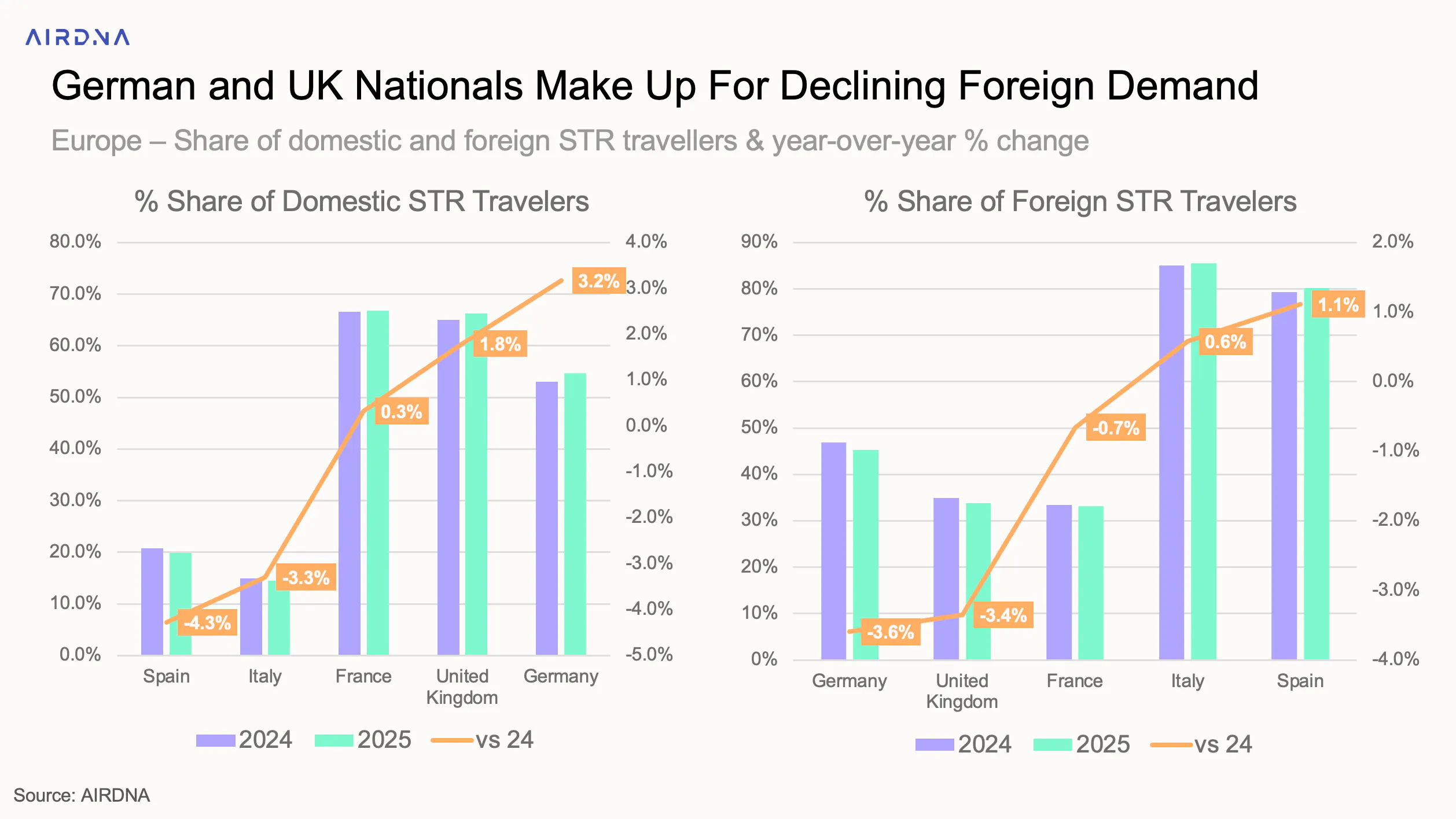
In 2025, there was a clear shift in traveler origins between northern and southern Europe. Spain and Italy experienced notable declines in domestic demand, dropping by -4.3% and -3.3% respectively. However, their markets were supported by a rebound in international visitors.
Conversely, Germany and the UK depended largely on the "staycation" trend to counteract the decrease in foreign arrivals. Germany’s domestic travel share grew a solid 3.2%, compensating for a -3.6% decrease in foreign demand. Similarly, the UK saw a 1.8% increase in domestic travelers.
European operators lag behind in revenue management adoption
Another interesting trend in 2025 is the rise of revenue management systems that are aimed at optimizing rates and boosting revenue. We use pricing variability as a proxy for measuring the adoption of revenue management.
When we compare Europe to the United States, we see that Europe has a substantial operational gap compared to the US. Only Poland, Hungary, and the Netherlands show revenue management adoption rates similar to the US, despite being smaller markets.
The graph below indicates that the top five European nations lag considerably behind in pricing variability, even though they are the largest and most mature markets on the continent. The percentage of hosts using revenue management strategies within these markets is less than half:
- United Kingdom (33%)
- Spain (24%
- Italy (23%)
- France (19%)
- Germany (10%)
As regulations continue to tighten supply across the continent, operational efficiency and maximizing rates amid ever-shifting booking patterns will remain a key focus for the European short-term rental market.
Demand Pacing in Ski Destinations
European ski destinations are expected to continue attracting visitors in the first quarter of the year. Les 3 Vallées maintains its leading position as one of Europe’s largest ski resorts with a 2.3% year-over-year increase in demand, adding over 5,000 nights to its already large number of visitors.
Growth was especially notable in luxury Swiss markets, where popular resorts like Zermatt (+12.2%) and Verbier (+18.5%) saw a surge in bookings, reflecting strong confidence among affluent travelers.
Conversely, early trends for Winter Olympics host cities are much slower, with an 18% decrease in bookings compared to last year. This slowdown may indicate some displacement or hesitation among travelers, despite the region’s preparations to host the world’s top winter sports event.
ARTICLE SUMMARY
Europe’s short-term rental market entered a more balanced phase in 2025, with slower supply growth, steady demand gains, and resilient pricing among established hosts despite softer ADRs. As regulations tighten and booking patterns shift earlier in the year, operational efficiency and smarter revenue management are becoming key differentiators heading into 2026
Camilo Schmid Rivas
Senior Research Analyst
Camilo Schmid Rivas is a Senior Research Analyst at AirDNA who brings a uniquely well-rounded perspective to short-term rental analytics. With a background that spans investment, real estate, and business analysis—including roles at Stayery and Sollers Consulting—Camilo has worn many analyst hats, each sharpening his ability to turn complex data into clear, actionable insights. A graduate of École hôtelière de Lausanne, he now channels his multidisciplinary expertise into uncovering trends that drive smarter STR decisions. In his free time, he enjoys playing tennis or scuba diving in or around Barcelona.
