

 Calculate Revenue
 Research Markets
 Find For Sale Properties
 Compare My Listing
 STR Revenue Calculator
 Custom Comp Sets
 Submarket Insights
 Custom Search Filters
 Rate Recommendations
 Performance Benchmarking
 Competitor Comparison
 Owner Contact Details
 Property-level performance data
 Tourism Insights
 Real Estate Investment Analytics
 About Us
 Sales
Sales Support
 Press
PressHow to Find Underpriced Properties to List on Airbnb
Published: March 29, 2025
Last updated: March 31, 2025

Jamie Lane
Key Takeaways
- Consistently leverage diverse tactics (like direct mail, call centers, niche list stacking) to find motivated sellers who will sell below market value.
- Buying investment properties at a deep discount creates pathways for cash flow and early equity positions, fueling faster portfolio growth.
- Stay educated on local regulations and short-term rental demand to ensure ongoing profitability.
Everybody wants a deal, but most short-term rental (STR) investors are looking in all the wrong places. While the average buyer refreshes Zillow for the 47th time today, hoping for divine intervention, smart investors are quietly securing cheap Airbnb investment property opportunities through methods the masses haven't bothered to master.
We’ve seen countless aspiring investors overpay for mediocre properties, then scratch their heads when it barely breaks even after expenses. Meanwhile, the investors who understand how to find the diamonds in the rough are building wealth with rental properties at a pace that makes traditional real estate investing look like watching paint dry.
Finding genuinely underpriced Airbnb properties comes down to having a tactical advantage and the discipline to execute when others hesitate. Whether you're looking to buy an Airbnb property for the first time or expand your portfolio, this guide reveals exactly how to find cheap Airbnb opportunities that deliver exceptional returns.
A Framework for Finding Underpriced Rentals
Too many STR investors fail because they use homebuyer tactics for investor-grade acquisitions. They scroll through the same MLS listings as everyone else, apply conventional valuation methods, and then wonder why they can't find profitable deals.
Finding underpriced properties for Airbnb requires a completely different framework that recognizes the unique factors that drive STR profitability versus traditional real estate metrics.
The most successful real estate investing strategies for short-term rentals don't rely on luck or market timing. Instead, they're built on three pillars: Understanding seller motivations, identifying properties with hidden STR potential, and applying valuation methods that capture future income rather than just current condition.
Let's break down each component of this framework that consistently uncovers properties the masses overlook, starting with how to identify the sellers most likely to accept below-market prices.
Identify motivated sellers
Forget market timing and crash theories—the real opportunity lies in human psychology, not economic cycles. The sellers practically giving away properties aren't victims of market conditions; they're people whose circumstances have turned their property into a liability. Motivated sellers have completely realigned their priorities away from profit maximization toward problem elimination.
Think about it: When someone's inherited a property 2,000 miles away that's bleeding them dry with maintenance costs, or they're staring down a looming foreclosure, or they've been transferred across the country for work—suddenly, that extra $30K on the sale price means far less than ending their property ownership nightmare by Friday. Their desperation is your opportunity, and knowing how to identify and approach these situations ethically creates a pipeline of deals that plenty of investors never see.
The key signs of seller motivation aren't always obvious in listing descriptions. Look for properties with:
- Extended days on market with multiple price reductions
- Vacant homes with unmaintained yards or visible deferred maintenance
- Absentee owners who live out-of-state
- Language in listings that subtly signals flexibility ("bring all offers," "seller motivated," "as-is condition")

Find distressed properties
Distressed property owners face a double bind: They lack the capital or desire to fix their deteriorating asset, yet can't easily sell it in poor condition through traditional channels. This creates a unique leverage point for investors who recognize that outdated bathrooms and worn flooring are purely cosmetic issues that dramatically reduce purchase price without proportionally affecting future STR income.
Targeting problematic properties facilitates what’s called buying deeper. Buying deeper means acquiring assets significantly below their potential value. Think of it as getting profit from day one. Instead of hoping a property might appreciate someday, you're securing instant equity at closing.
Here's an example: Say you buy a property for $150,000 that needs $30,000 in repairs but will be worth $250,000 after renovations. You’ve just created $70,000 in equity, a cushion that gives you options most investors don't have. Your mortgage payments stay low (because the purchase price was low) while your rental income reflects the property's true market value after improvements. This means stronger cash flow, protection during market downturns, and the ability to refinance later to extract equity for your next investment.
Leverage direct mail marketing and call center lead generation
Sometimes, finding underpriced properties for Airbnb means creating opportunities rather than reacting to listings. Creating direct connections with motivated sellers can lead you to off-market real estate deals and below-market opportunities. There are two powerful channels to leverage: direct mail and cold calling.
Direct mail marketing for real estate produces results when you target specific owner types with problem-solving messages rather than a generic "we buy houses" offer. Expect to spend $0.75-1.50 per piece with a 0.5-2% response rate.
Real estate call center lead generation accelerates your timeline through direct phone or SMS contact with owners. This approach requires thicker skin but gives you a leg up over competitors unwilling to embrace the discomfort. Start affordably with basic call tracking software ($45/month) and a virtual assistant ($5-10/hour) before scaling up. The critical factor is speed-to-lead follow-up—responding within 5 minutes versus 30 minutes increases conversion rates by over 400%.
To track leads, start with a simple spreadsheet before graduating to an investor-specific CRM like REISift once you exceed 50 active leads.
Use stacking data to create niche property lists
A lot of investors seeking underpriced properties for Airbnb target obvious, broad categories like pre-foreclosures or tax-delinquent properties, which creates fierce competition for a limited pool of deals. Smart investors instead use niche property lists (stacking data) to identify highly specific opportunity segments that others overlook.
Stacking data means layering multiple criteria to create hyper-targeted marketing lists with dramatically higher conversion rates. Instead of contacting every property owner in a zip code, you might target only those who own properties free and clear, live out of state, have owned for 20+ years, and have recently received code violations. This approach reduces your marketing costs while dramatically increasing response quality.
Data stacking sources include:
- County tax assessor records (ownership length, tax values, mailing addresses)
- Code enforcement violations (maintenance issues, potential motivation)
- Divorce filings (life changes creating urgency)
- Probate records (inherited properties often unwanted by heirs)
- Utility shutoffs (potential vacancy indicators)
The magic happens when combining datasets—a property with high equity (75%+) owned by someone living out-of-state with recent code violations represents motivation stacked on motivation. While your competition fights over obvious pre-foreclosure lists, you'll discover sellers desperate to offload properties they don't want, can't maintain, or can’t afford.
Before launching any campaigns, verify the accuracy of your data by cross-referencing addresses between datasets and running samples through property information websites. Bad data leads to wasted marketing dollars and missed opportunities, so investing time in validation pays substantial dividends.
Skip tracing for seller leads
Say you've identified the perfect distressed property, but the owner's contact information doesn't appear in public records. Don’t let this roadblock stop you. Instead, use skip tracing.
Skip tracing uses specialized databases that aggregate information from credit bureaus, utility records, and subscription services to locate contact information. For $0.15-0.75 per search, services like BatchSkipTracing or PropertyRadar can provide phone numbers, email addresses, and even relative contacts for property owners who seemingly disappeared.
When reaching out with skip-traced data, start with less intrusive contact methods before escalating to direct calls.

Try wholesaling
Most beginner STR investors struggle with two critical barriers: Insufficient cash reserves and limited renovation experience. Wholesaling real estate solves both problems by allowing you to control undervalued properties without actually buying them.
The wholesaling process is beautifully simple: Find deeply discounted properties, get them under contract, then assign that contract to another investor for a fee—typically $5,000-15,000 per deal. You're essentially monetizing your deal-finding skills without needing substantial capital or renovation expertise. Three or four successful wholesale deals can quickly build the cash reserves you need to purchase your first Airbnb property.
Use the fix and flip strategy
As your capital position strengthens, graduating to fix and flip strategies like the BRRRR method provides the next logical stepping stone toward building a short-term rental portfolio. While wholesaling teaches you to find deals, flipping teaches you to execute renovations efficiently—a skill set you’ll need to transform underpriced properties into highly profitable STRs.
Flipping teaches you:
- Contractor management and quality control systems
- Budget optimization for maximum visual impact
- Timeline management for efficient property turnovers
- Material sourcing at wholesale prices
- Design trends that drive emotional purchasing decisions
Many investors find that combining wholesaling and fix and flip strategies creates the optimal pathway: Wholesale deals generate initial capital, flips build renovation expertise and additional cash, and the knowledge from both feeds directly into creating a portfolio of cheap Airbnb investment property acquisitions positioned for maximum ROI.
How to Build a Rental Portfolio for Long-Term Success
Finding one great deal feels amazing, but it won't necessarily earn you complete financial freedom. You’ll really start building wealth when you shift from "property hunter" to "portfolio architect." Building a rental portfolio doesn’t mean buying up random properties, it means engineering a money-making system that transforms dormant capital into automated income streams while you sleep.
Think of your portfolio like a championship sports team. You need different players with different strengths: Your cash flow properties are your reliable everyday performers, your appreciation plays are your long-term investments, and your tax-advantaged properties help shield your growing income.
Smart portfolio-building moves for STR investors:
- Spread across different markets to smooth out seasonal dips
- Space out your purchases to avoid back-to-back renovation nightmares
- Create systems that work whether you have 3 properties or 30
- Cultivate relationships with vendors who'll prioritize your business
- Develop a recognizable brand that helps your listings stand out
That conventional financing that worked for your first couple of properties? It's going to hit a wall faster than you think. Most lenders cap you at 4-10 mortgages before cutting you off. That's when you'll need to graduate to portfolio loans, DSCR products, and private money to keep your momentum going.
As for property management—sure, you can handle those first couple of properties yourself. But at some point, you'll need to decide: Build a team or hire one. Either way, without standardized procedures for everything from guest communication to maintenance, your dream portfolio will become a nightmare that owns you instead of the other way around.
Here's where AirDNA becomes your secret weapon. While other investors are guessing which properties might perform well, you'll have actual data showing exactly which locations command premium nightly rates, maintain high occupancy, and deliver the strongest returns. You’ll even have a tool to find listings for underpriced properties for sale.
Achieving equity upside and instant profit with rental properties
Why wait 30 years for wealth when you can create it immediately? With the right tactics, equity upside and instant profit can happen the moment you close on a property.
Here's how to build equity from day one:
- Off-market acquisition discounts: When buying directly from motivated sellers, you're often paying 10-30% below retail—instant equity created through hustle and negotiation.
- Strategic value-add renovations: Spend $15K on the right renovations and watch your property value jump $30-45K.
- STR conversion premium: A property valued on long-term rental income of $1,500/month transforms into an STR earning $3,000-5,000/month, immediately doubling or tripling its market value.
Keep in mind that accurate cash flow projections separate success from failure. Account for expenses like seasonal fluctuations, maintenance costs, utility spikes, platform commission increases, and evolving regulations that amateur investors consistently overlook.
For renovations, forget HGTV-inspired overhauls. Focus exclusively on improvements that directly increase nightly rates or booking frequency—statement features that photograph beautifully and unique amenities that drive reservations, while skipping costly updates that guests barely notice.

Take Action: Next Steps to Secure an Underpriced Property for Airbnb
Now that you understand the strategies for finding an underpriced property for Airbnb, it's time to create your action plan. Let's break down the specific steps to acquire your first (or next) underpriced Airbnb property.
Step 1: Research market trends
Stop guessing which markets have potential and start knowing with certainty. Data-driven decisions consistently outperform gut feelings, particularly for cheap Airbnb investments where small pricing differences dramatically impact ROI.
Begin with comprehensive market research focused on:
- Average Daily Rates (ADR) throughout the year (not just peak season)
- Occupancy patterns by month, day of week, and property type
- Supply growth trends and saturation indicators
- Regulatory environment and licensing requirements
- Operational costs specific to each market
AirDNA provides this critical data across more than 100,000 global markets, allowing you to compare potential investment locations based on actual performance metrics rather than anecdotal "hot market" claims. Pay particular attention to RevPAR (Revenue Per Available Room) trends, which show whether rates are strengthening or weakening—a leading indicator of market health.
We recommend doing this research before choosing a market to invest in, rather than starting with a location and forcing an investment to work there. This data-first approach frequently reveals overlooked markets with stronger fundamentals than trendy locations, creating opportunities to acquire properties at lower entry points with superior returns.
Step 2: Choose a lead generation method
The biggest mistake novice investors make isn't choosing the wrong lead generation method—it's trying multiple methods simultaneously and mastering none of them. Commit to a single approach for at least 90 days before adding additional channels.
For most beginners, the optimal starting point depends on your personal strengths:
- If you're comfortable with cold calls, focus on call-based lead generation.
- If you prefer systems and processes, start with direct mail campaigns.
- If you enjoy research and analysis, begin with niche property lists and data stacking.
Remember that consistency trumps perfection. A modest but consistent lead generation effort will produce more deals than sporadic bursts of activity followed by inaction.

Step 3: Analyze potential deals
Deal analysis separates professional investors from perpetual tire-kickers. When you've got a potential property in your sights, don't just go with your gut—that's amateur hour. Instead, analyze every deal to evaluate what it costs to buy and fix and what it can actually earn as an STR.
Your analysis should include:
- Purchase price and acquisition costs (closing, transfer taxes, etc.)
- Renovation budget with 15-20% contingency buffer
- Expected After Repair Value (ARV) based on comparable sales
- Projected STR income across all seasons
- Operational expenses including management, cleaning, utilities, and maintenance
- Financing costs and cash flow calculations
- Return metrics: cash-on-cash return, cap rate, and IRR
Remember to establish minimum performance thresholds and stick to them ruthlessly. If a property doesn't meet your criteria, walk away—regardless of how much time you've invested in the deal.
Step 4: Build your network
Real estate is a relationship-driven industry. Your network directly impacts your access to deals, financing options, and operational capabilities.
Establish connections with:
- Local wholesalers who are already finding distressed properties
- Real estate agents who specialize in investment properties
- Property managers with STR experience
- Contractors and renovation specialists
- Lenders offering investor-friendly financing
- Experienced STR operators in your target markets
Join local real estate investment groups, attend meetups, and participate in online communities focused on short-term rentals. The most valuable information rarely appears in books or courses—it comes through relationships with people already succeeding in your target markets.
Step 5: Use AirDNA to find for-sale properties
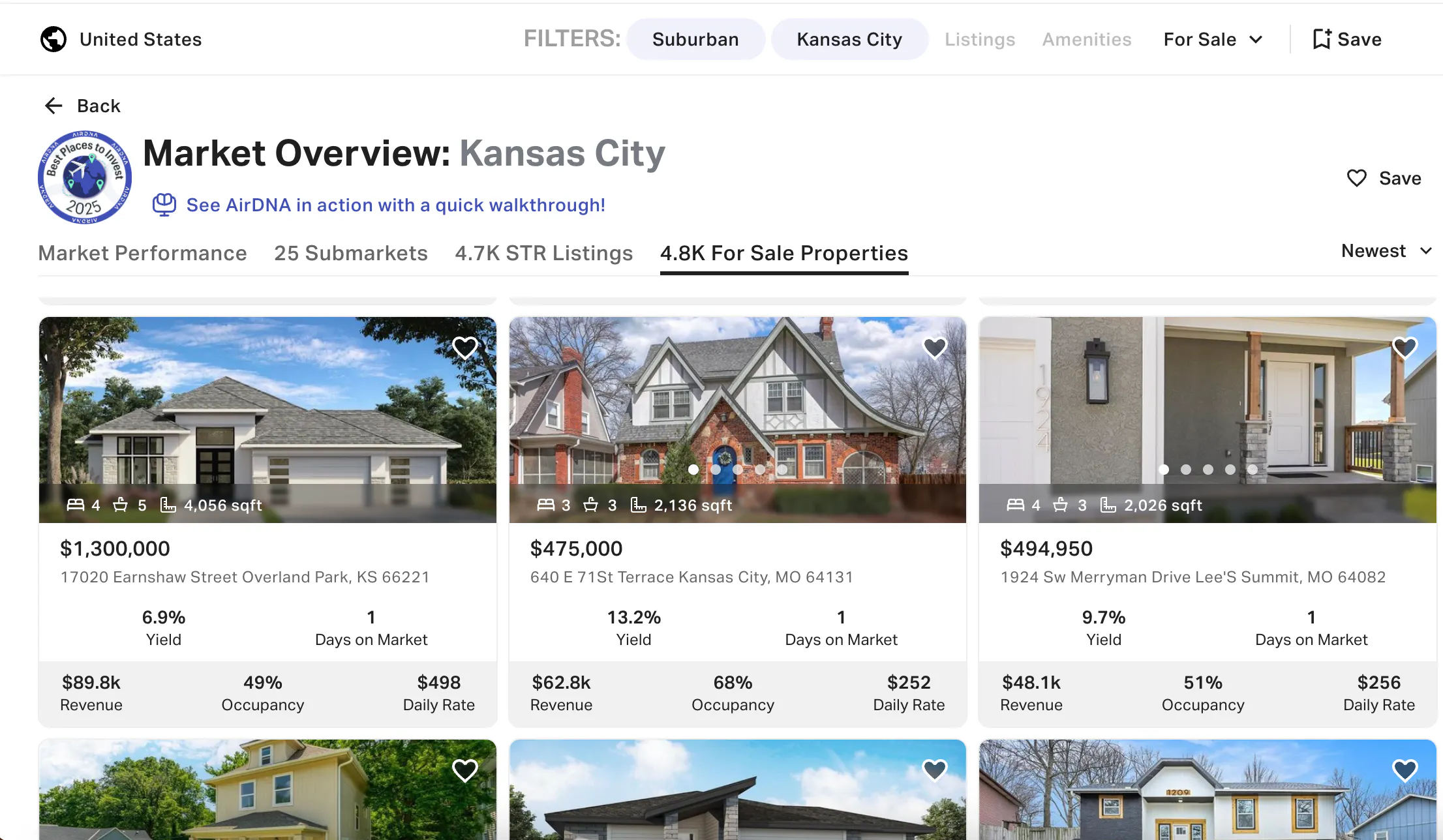
Built into the AirDNA platform is a handy tool to browse for-sale properties. Use it to find cheap Airbnb investment property opportunities.
This tool lets you:
- Filter available properties by price to target properties within your budget
- Sort listings from lowest to highest price
- Immediately see projected STR performance for each listed property
- Compare potential ROI across multiple properties simultaneously
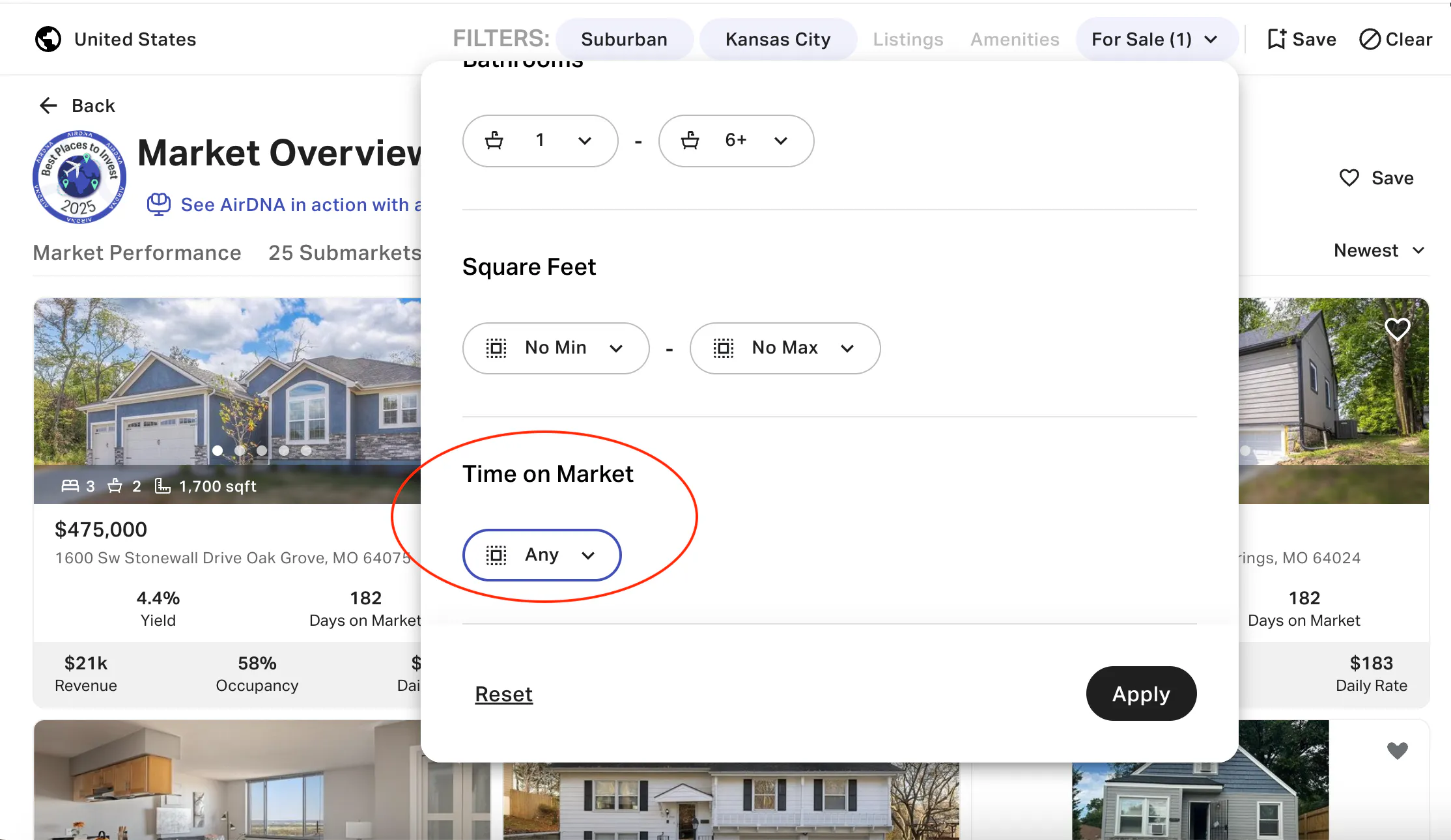
Pro tip: Filter your search results for properties that have been sitting on the market for ages. When a house has been languishing for 90+ days with no takers, there’s a growing chance that the seller is ready to negotiate a below-market deal.
FAQs
What’s the difference between wholesaling real estate and buying a property directly for rentals?
Wholesaling real estate means finding underpriced properties, getting them under contract, then selling that contract to another investor without ever taking ownership. You make a quick profit ($5K-15K typically) without needing renovation capital or dealing with the property long-term. It's essentially monetizing your deal-finding skills.
Buying directly for rentals means you actually purchase, renovate, and hold the property for ongoing income. This requires more capital upfront and involves managing the property (or hiring someone to), but builds long-term wealth through cash flow, appreciation, and equity growth rather than one-time profits.
How do I thoroughly estimate the rehab costs and ARV of distressed properties?
Accurate rehab estimation requires breaking renovations into specific line items rather than relying on square-footage guesses. Create a detailed scope of work covering:
- Foundation/structural issues (get professional assessments)
- Roof and exterior components
- Plumbing and electrical systems
- HVAC replacement or repair
- Kitchen and bathroom updates
- Flooring, paint, and cosmetic items
- Landscaping and curb appeal
- Permits and inspection costs
For ARV (After Repair Value), don't just look at nearby sales. Analyze properties with similar:
- Square footage (within 20%)
- Bedroom/bathroom count
- Lot size and amenities
- Quality of finishes
- School districts

When should I hire a property manager vs. self-manage my short-term rentals?
Self-management makes sense when:
- You have fewer than 3 properties
- They're located within easy driving distance
- You have systems for guest communication and maintenance
- Your time is valued below $50/hour
- You're still learning the operational fundamentals
Professional management becomes compelling when:
- Your portfolio exceeds 3-5 properties
- You've expanded into distant markets
- Your time is better spent finding new deals
- You need specialized knowledge of complex regulations
The tipping point isn't just about property count—it's about opportunity cost. If self-managing takes 10 hours/week that could be spent finding deals with $10K+ profit potential, the math clearly favors outsourcing management, even with the 15-30% fee.
How can I structure financing to maximize equity upside and instant profit?
The financing approaches that create maximum equity upside include:
- Hard money for acquisition + immediate refinance after forced appreciation renovations. This allows you to extract most of your capital while maintaining ownership.
- Subject-to financing where you take over the seller's existing mortgage. This often enables below-market purchase prices since you're solving the seller's problem.
- BRRRR method (Buy, Renovate, Rent, Refinance, Repeat) adapted for STRs. This systematic approach creates a capital recycling machine where each property funds the next.
- Seller financing with balloon payments gives you time to increase property value before needing traditional financing.
The key is separating purchase financing from long-term financing. Short-term, higher-interest acquisition loans make sense when they help you buy at steep discounts, quickly add value, then refinance into conventional long-term loans once you've forced appreciation.
ARTICLE SUMMARY
Most investors struggle to find underpriced properties for Airbnb, but the pros use a few strategic methods to secure profitable investments. This guide reveals their secrets.
Jamie Lane
AirDNA Chief Economist
He is responsible for data analysis, thought leadership, and leveraging advanced analytical techniques to provide new insights into short-term rental market trends. Native to Atlanta and an Airbnb host himself, Jamie enjoys cycling, mountain biking, backpacking, running, and playing in a dart league in his free time.
