8 Data Points That Help You Finance a Rental Property
Published: April 9, 2025
Last updated: May 5, 2026

Jamie Lane
Key Takeaways
- Clear, well-supported numbers help reduce risk in lender eyes, which can lead to faster approvals, better rates, and stronger negotiating power.
- Short-term rentals require more data for financing. Financing a short-term rental means accounting for seasonality, occupancy, and variable expenses.
- The same numbers that help you get approved also help you manage your rental more strategically.
When you're preparing to finance a rental property, it’s easy to focus on the big numbers: Your loan amount, down payment, maybe your credit score. But what really makes a difference for lenders is how well the property itself performs on paper.
Can it generate steady income? Cover operating costs? Support the loan without relying on your personal finances? Answering those questions takes solid data.
If you're financing a long-term rental, you're likely thinking about monthly rent, fixed costs, and a lease agreement. But even those deals benefit from stronger projections. With short-term rentals, the bar is even higher. Yes, there’s more earning potential—but also more unpredictability. Seasonality, guest turnover, and fluctuating nightly rates all affect performance. And lenders will expect you to account for that.
Here are 8 data points for rental property financing that you should be ready to provide—and how to use them to build a stronger case for your rental investment.
1. Net Operating Income (NOI)
Net Operating Income (NOI) is one of the most important numbers lenders use to assess a rental property’s performance. It shows how much income the property generates after covering day-to-day operating costs—but before accounting for mortgage payments or financing. Here’s how NOI is calculated:
NOI = Gross income – Operating expenses
In a short-term rental, gross income might include nightly rates, cleaning fees, and extra guest charges. Operating expenses cover essentials like management fees, utilities, maintenance, taxes, and HOA dues. What’s not included? Mortgage payments and financing costs. That’s intentional—NOI is used to evaluate how well the property performs on its own, without factoring in your personal loan structure.
For long-term rentals, a strong NOI typically comes from stable lease income and minimal turnover. For short-term rentals, it’s driven by consistently high occupancy, strategic pricing, and careful control of host costs like cleaning and guest services.
The higher and more reliable your NOI, the more attractive your property looks to lenders. And the cleaner your data, the easier that conversation becomes. Tools like rental property accounting software—or AirDNA’s automated estimates—help you calculate NOI with confidence and back it with market data.

2. Capitalization Rate (Cap Rate)
Cap Rate is one of the fastest ways to assess whether a property is worth a closer look. It measures how much return you can expect from a property based on its income, not appreciation—making it a go-to metric for comparing investments across markets.
Cap Rate = Net Operating Income (NOI) ÷ Property value
Say your property earns $30,000 in NOI and is priced at $500,000. That’s a 6% Cap Rate. The higher the rate, the more income you’re generating relative to the purchase price. But higher Cap Rates often come with more volatility or market risk—so it’s not just about chasing the biggest number.
Lenders use Cap Rate to sanity-check your projections. If your income looks too good to be true for the market or price point, it raises questions. A solid Cap Rate—grounded in local data—helps show your deal is realistic and your assumptions are sound.
If you're evaluating short-term rentals, Cap Rates can shift depending on seasonality, occupancy, and nightly rates. That’s why AirDNA includes Cap Rate estimates when you're browsing STR properties for sale—giving you a snapshot of how much of your initial investment you could expect to earn back in the first 12 months.
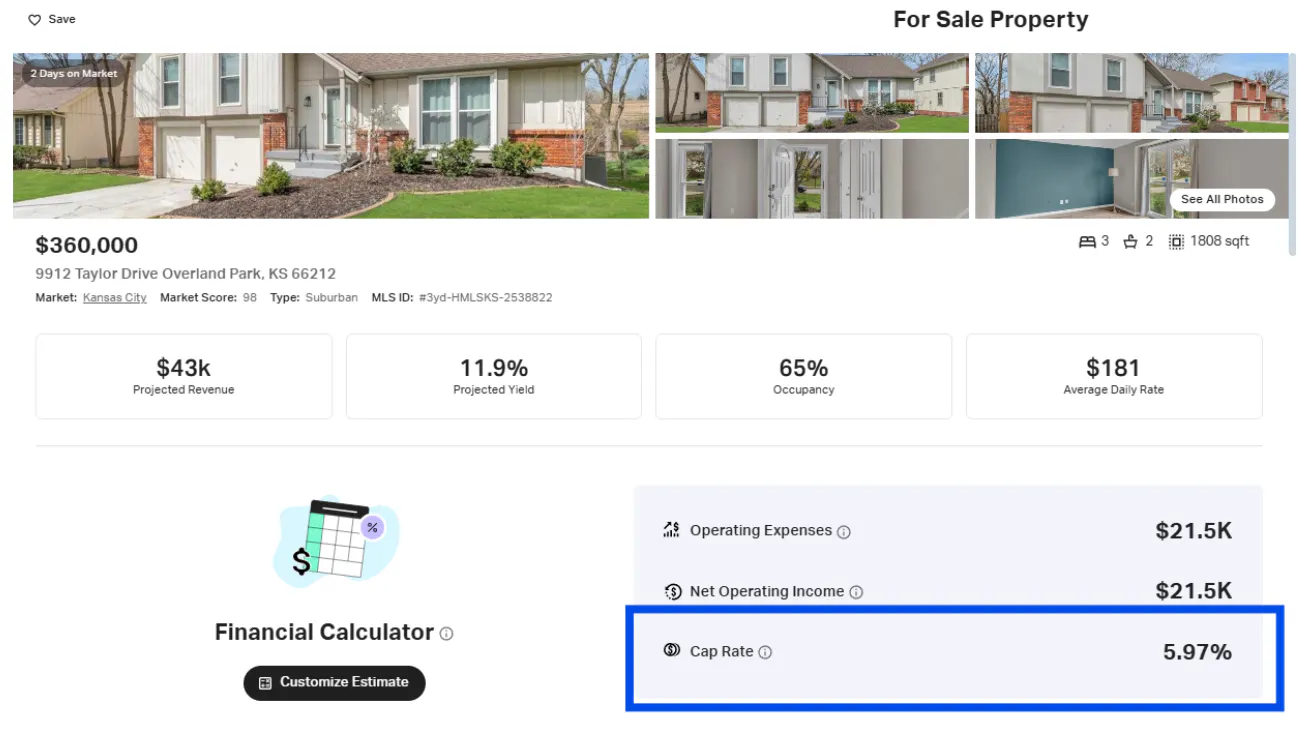
Take this property listed at $360,000 in Kansas City. Based on projected revenue and expenses, its Cap Rate is estimated at 5.97%. That means you'd earn back nearly 6% of your investment in the first year through rental income alone—before factoring in financing or appreciation.
Traditionally, a Cap Rate between 4% and 10% is considered strong for rental properties, but that range can vary depending on location, property type, and your risk tolerance. With data like this at your fingertips, you can quickly compare opportunities and focus on the ones that align with your financial goals.
3. Cash-On-Cash Return
Cash-on-Cash Return tells you how efficiently your investment is turning real cash into real returns. It measures how much profit you’re making each year as a percentage of your actual out-of-pocket investment.
Cash-on-Cash Return = (Net Income ÷ Total Cash Invested) × 100
That net income includes everything left after expenses: Operating costs like cleaning and maintenance, as well as mortgage payments. And total cash invested means just that—your down payment, closing costs, and any initial setup or renovation costs to get the property guest-ready.
For example, if you put $120,000 into a property (between your down payment and setup costs) and end the year with $28,600 in net income, your cash-on-cash return is 23.8%. That’s a strong signal—not just that your rental is profitable, but that it’s putting your capital to work efficiently.
This metric is especially useful for short-term rental investors because it reflects how well a property performs with real-world variables like occupancy, seasonality, and expenses. It’s also a powerful comparison tool—helping you evaluate whether one STR outperforms another, or whether a short-term rental makes more sense than a long-term lease or even a different asset class entirely.

4. Gross Rent Multiplier (GRM)
The Gross Rent Multiplier (GRM) is a high-level screening tool that helps you quickly size up whether a property might be worth deeper analysis. It doesn’t factor in expenses or financing—but it does give you a starting point.
GRM = Property price ÷ Gross annual rental income
Let’s say a property is listed for $400,000 and is expected to generate $50,000 a year in gross rental income. That gives you a GRM of 8. A lower GRM often signals a better deal—but only if the expenses aren’t unusually high.
For long-term rentals, GRM can be a quick way to compare properties in similar markets. For short-term rentals, it’s less reliable on its own. That’s because STR income is more variable, and gross income doesn’t always reflect the impact of seasonality, management costs, or nightly pricing.
Still, GRM is a helpful filter in the early stages of a property search—especially when combined with deeper metrics like NOI and Cap Rate. If you're browsing multiple listings, GRM can help you rule out overpriced or underperforming options before diving into full financial models.
Just remember: It’s a blunt tool. Use GRM to shortlist properties, not to seal a deal.
5. Loan-to-Value (LTV) Ratio
The Loan-to-Value (LTV) ratio is one of the first things a lender looks at when reviewing your financing application. It shows how much you’re borrowing compared to what the property is worth.
LTV = Loan amount ÷ Property value
For example, if you’re buying a $500,000 property and taking out a $400,000 loan, your LTV is 80%. That means you’re putting 20% down—and carrying 80% of the value in debt.
Lenders use LTV to measure risk. A lower LTV means you have more skin in the game and the lender has a stronger equity cushion if the market shifts. It also opens the door to better financing terms: Lower interest rates, fewer underwriting hurdles,

6. Internal Rate of Return (IRR)
Internal Rate of Return (IRR) is a long-term measure of how profitable your investment will be—taking into account everything you earn over time, not just what you make each month.
Here’s the simplest way to think about it:
IRR is the annualized return you expect to earn on your investment, including both cash flow and the profit you’ll make when you eventually sell.
It’s like asking, “If I hold this property for five or ten years, how much money will I have made back each year, on average?” IRR combines your income, your upfront costs, and your future sale price into one number—expressed as a percentage.
Unlike Cash on Cash Return, which just looks at the next 12 months, IRR gives you the big-picture view. And while lenders don’t always require this number, it helps show that you understand how time, resale value, and long-term performance all affect your returns.
For short-term rentals, IRR is especially useful if you're investing in a fast-growing market or planning to hold and sell down the line. It helps you see whether the property will continue to build value—not just generate income right now.
7. Debt Service Coverage Ratio (DSCR)
Debt Service Coverage Ratio (DSCR) is one of the most important numbers a lender will look at—and one of the easiest ways to show your property can carry its own weight.
DSCR = Net Operating Income (NOI) ÷ Annual debt payments
This ratio tells a lender whether your rental brings in enough income to comfortably cover its loan payments. A DSCR of 1.0 means you're breaking even. Anything below that suggests the income might not fully cover the debt—which is a red flag for financing. Most lenders want to see a DSCR of 1.25 or higher, meaning your property earns 25% more than what’s needed to cover the loan.
For short-term rentals, DSCR is especially important. With income that can rise and fall seasonally, lenders want assurance that even in slower months, your rental can still meet its obligations. Strong historical or projected NOI backed by market data helps support a solid DSCR.
A healthy DSCR not only improves your chances of getting approved—it can also unlock better terms, like lower interest rates or reduced personal income verification. It’s one of the cleanest ways to say: “This property can pay for itself.”
8. Operating Expense Ratio (OER)
Operating Expense Ratio (OER) helps you see how much of your rental income is going right back out the door. It’s a key metric for spotting inefficiencies—and for proving to lenders that your property is being run lean and smart.
OER = Operating expenses ÷ Gross operating income
A lower OER means you’re keeping more of what you earn, which points to better profitability. A higher OER? That might signal your utility bills are bloated, your maintenance costs are too high, or your management fees are eating into your margins.
For short-term rentals, this ratio can be especially telling. STRs tend to have higher variable costs—like cleaning, restocking, and guest communication—which can all push OER upward if not managed carefully. Property management fees play a big role here, too.
Lenders pay attention to OER because it affects both your Net Operating Income (NOI) and your ability to service debt. A well-managed property with a healthy OER can often make the difference between a borderline loan and a green light.
Tracking your OER over time—and knowing what’s driving it—can help you course-correct faster and make smarter decisions as you grow your portfolio.

The Data Points You’ll Need to Finance a Short-Term Rental
If you’re planning to finance a short-term rental or vacation property, you’ll need to come prepared with more than enthusiasm—and more than just the standard real estate metrics. Lenders expect a full financial picture, built on reliable, data-backed projections.
Here’s what should be in your STR financing toolkit:
- Occupancy rates (historical and projected)
- Average Daily Rate (ADR)
- Revenue per Available Rental (RevPAR)
- Seasonality trends and off-peak performance
- Comparable properties and local market benchmarks
- Booking lead time and cancellation trends (optional, but helpful)
Yes—lenders still want to see your standard real estate investment metrics we went through earlier. But when you’re seeking Airbnb financing, those numbers carry more weight. Why? Because STR income isn’t fixed. It depends on pricing, demand, guest turnover, and seasonality—not a year-long lease. Your short-term rental financing metrics will be scrutinized more closely, and lenders will want to see where your projections come from.
That’s where AirDNA makes all the difference.
AirDNA gives you access to market-level data that shows how properties like yours actually perform. Not assumptions—actual bookings, real ADRs, and short-term rental market trends specific to your area. You can benchmark occupancy, estimate income potential, and even calculate Cap Rate on for-sale listings before you ever speak to a lender. Whether you’re figuring out how to finance an Airbnb or comparing Airbnb loan options, AirDNA helps you show your work.
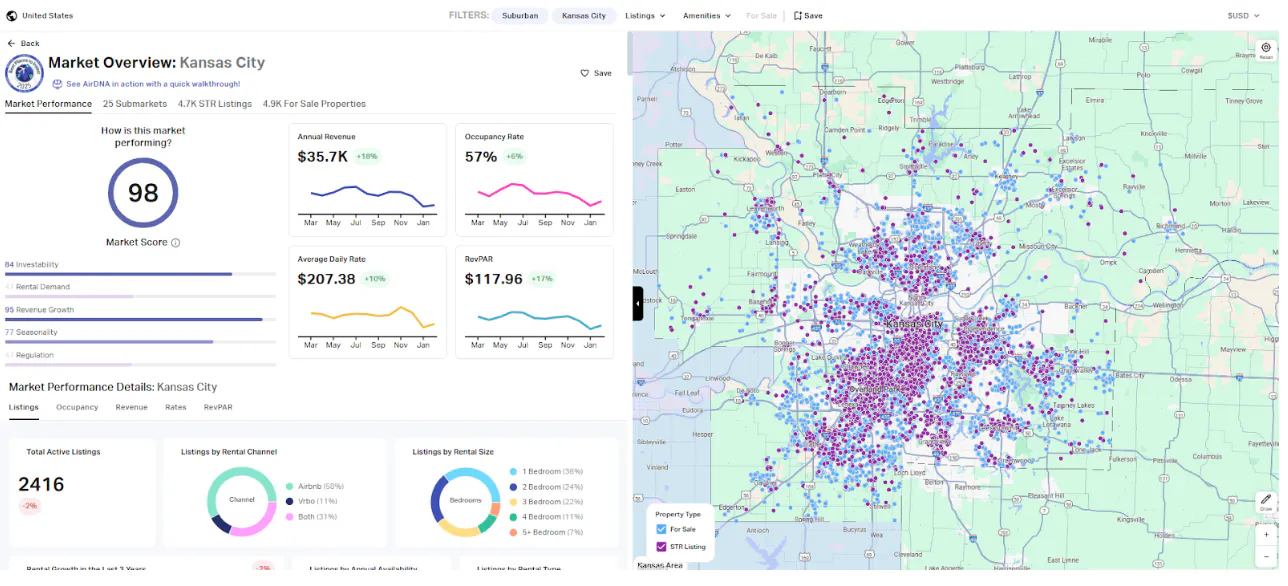
And when your numbers are grounded in reliable data, lenders notice. It builds trust. It reduces perceived risk. And it can help you qualify faster, unlock better rates, and get one step closer to owning the STR you’ve got your eye on.
How Lenders Use Metrics in the Financing Process
So, you’ve gathered all the numbers—NOI, DSCR, LTV, Cap Rate, and maybe even projections for ADR and occupancy. But what do lenders actually do with all that data?
In short: They use it to assess risk, decide what type of loan you qualify for, and determine the terms you’ll be offered. The more reliable your metrics—and the clearer your financial picture—the better your chances of getting the financing you want.
Here’s how the process typically works:
1. Underwriting risk
Lenders use Net Operating Income (NOI) and Debt Service Coverage Ratio (DSCR) to evaluate whether your property can support itself financially. They pair that with your Loan-to-Value (LTV) ratio to understand how much of the purchase is being financed. A strong combination—high NOI, high DSCR, low LTV—tells them you’re low risk.
2. Loan product matching
Different metrics support different types of loans. Want to qualify for a DSCR loan that’s based on rental income instead of personal income? You’ll need strong cash flow and a DSCR of at least 1.25. Looking at a conventional mortgage or an asset-based loan? Lenders will weigh your overall real estate investment metrics—and how they stack up over time.
3. Documentation needs
This is where your prep pays off. Lenders expect clean documentation: itemized operating expenses, consistent income records, and ideally, historical performance trends. STR investors can support these with detailed reports or AirDNA’s data to show income isn’t just projected—it’s supported.
4. Negotiation leverage
Stronger numbers lead to stronger terms. The best data points for rental property financing don’t just help you get approved—they help you unlock better rates, lower fees, and more favorable loan structures. In a competitive lending environment, good data becomes a bargaining chip.

Why You Still Need Data After Financing
Securing financing is a big milestone—but the real work begins once you own the property. The metrics you used to get the loan? They’re not one-and-done. They become the foundation for how you manage, monitor, and ultimately grow your investment—whether it's a long-term lease or a short-term rental.
Metrics like Net Operating Income (NOI), Cap Rate, Debt Service Coverage Ratio (DSCR), and Operating Expense Ratio (OER) are just as important post-close as they are in your loan application. They help you evaluate monthly performance, flag issues early, and make smarter decisions about pricing, expenses, and growth.
For long-term rentals, this might mean tracking lease renewals, reducing vacancies, and managing maintenance costs to keep your NOI healthy. For short-term rentals, you’re dealing with more moving parts—changing nightly rates, seasonal demand, and fluctuating occupancy. That makes staying close to your metrics not optional, but essential.
Actively tracking your performance helps you:
- Catch rising costs or underperformance before they impact returns
- Improve your DSCR in case you want to refinance
- Compare properties and markets as you grow your real estate portfolio
- Prove results to lenders, partners, or potential buyers down the road
With tools like AirDNA, you can benchmark your property's performance against local market data—so you’re not just managing by instinct. You’re managing with insight.
Because the most successful rental investors—long-term or short-term—don’t just know their numbers when financing. They know them all the time.

FAQs
What do I need to qualify for a rental property loan?
Lenders typically look at your credit score, income, and the financial strength of the property itself. You’ll need to provide real estate investment metrics like Net Operating Income (NOI), Cap Rate, and DSCR. These help lenders assess the property’s ability to generate income and repay the loan reliably.
Do lenders finance short-term rentals like Airbnbs?
Yes, but short-term rentals are usually evaluated more closely than long-term leases. Lenders may require market data to support your income projections. That’s where short-term rental financing metrics—like ADR, occupancy, and RevPAN—become essential. If you're seeking financing for Airbnb, bring historical data or third-party insights to back your numbers.
How do I estimate what my STR property will earn?
A strong rental property income analysis includes projected income from nightly rates, cleaning fees, and upsells—minus expenses like management, maintenance, and taxes. Tools like AirDNA help investors analyze STR property investments using real booking data from similar listings in your market.
What makes my loan application more competitive?
Bringing clean, reliable data to the table. Lenders want to see detailed projections, consistent income assumptions, and a thoughtful strategy for managing expenses. Backing your application with finance benchmarking metrics—like Cap Rate, DSCR, and local market performance—can help reduce risk and improve your negotiating power.
ARTICLE SUMMARY
Getting financing for a rental property? Here’s what data lenders really want to see—and how the right real estate investment metrics can help you qualify faster and unlock better loan terms.
Jamie Lane
AirDNA Chief Economist
He is responsible for data analysis, thought leadership, and leveraging advanced analytical techniques to provide new insights into short-term rental market trends. Native to Atlanta and an Airbnb host himself, Jamie enjoys cycling, mountain biking, backpacking, running, and playing in a dart league in his free time.