


Best Places to Invest in Airbnbs Near Airports
Published: January 27, 2026
Last updated: November 13, 2026

Jamie Lane

Key Takeaways
- The best airport-adjacent Airbnb markets balance steady demand with attainable home prices.
- Short booking windows and year-round travel help support consistent performance for Airbnbs near airports.
- AirDNA helps investors compare airport markets and nearby submarkets using yield, pricing, and demand data.
Airports aren’t vacation destinations in and of themselves, but they are consistent short-term rental (STR) demand engines. Travelers flying in or out with late-night or early-morning flight times don’t need charm or views, they need convenience.
That kind of functional demand can create surprisingly strong short-term rental performance, especially in rental markets near airports where demand is less tied to leisure cycles. Not every airport-adjacent market makes sense for investors, but the right ones benefit from steady occupancy, shorter booking windows, and home prices that haven’t been inflated by lifestyle buyers.
To identify the best places to invest in Airbnbs near airports, we analyzed AirDNA data using yield as the primary lens, comparing average revenue potential against the prices of homes for sale near airports. This approach revealed where airport-driven demand actually supports returns.
Why Proximity to Airports Is a Powerful STR Investment Driver
Airport-driven demand functions differently than leisure destinations—and that’s exactly why it can be so reliable for short-term rental investors. These stays are usually practical, time-bound, and tied to travel logistics rather than experiences, which creates booking patterns that are often steadier and easier to predict.
Short, consistent booking windows
Most stays near airports are booked close to arrival. Guests are flying in for a quick business trip, a family event, a medical appointment, or an early-morning departure. Plans change, trips get added last minute, and flexibility matters more than long-term planning.
For hosts, that typically means shorter lead times but consistent demand throughout the year. You’re less exposed to big seasonal swings, and calendars tend to refill quickly—even when broader travel demand softens.
Demand isn’t tied to tourism cycles
Unlike beach or ski markets, airport-adjacent rentals don’t rely on peak vacation seasons to perform. Business travel, relocations, visiting family, and layovers happen year-round. That keeps occupancy more stable and reduces the pressure to make all your revenue in a narrow window.
Price sensitivity works in your favor
Guests staying near airports are usually trading experience for convenience. They’re less focused on views or amenities and more focused on location, cleanliness, and ease of access. That shifts competition away from luxury offerings and toward functional, well-priced properties.
In many markets, that also shows up on the acquisition side. Homes near airports are often priced lower (because let’s face it, not everyone likes living near an airport), which can improve yield even when nightly rates are relatively modest.
Function over flair
Travelers staying near an airport don’t need ski-in access or waterfront sunsets. They need fast check-in, easy parking, reliable Wi-Fi, and a quiet place to sleep. That makes it easier for small, modest properties to compete without heavy upfront investments in furniture or design.

Our Methodology for Ranking Rental Markets Near Airports
To identify the best places to invest in an Airbnb near an airport, we looked at the average revenue potential of properties currently for sale in airport-adjacent markets. We compared that against the average home price to calculate yield—and sought out the markets with the highest average yield.
In other words: We assessed how much income a property is likely to produce relative to what it costs to buy.
Why did we take this approach? Because big revenue numbers don’t always tell the full story. Markets near major airports can book well, but expensive homes and crowded competition can quickly narrow margins. In more accessible markets, lower purchase prices often do more for returns than higher nightly rates ever could.
Keep in mind that the average home prices, revenue potential, and yield for each market is based on data from December 2025, so figures are subject to change as the real estate market shifts.
Best Places to Invest in an Airbnb Near an Airport
The markets that made it onto our list rose to the top based on average yield. These are the rental markets near airports that will deliver the strongest returns in relation to purchase price.
That said, pricing will vary widely depending on the type of property available. Layout, parking, and noise exposure all play a role in performance, which means yield can shift meaningfully from one listing to the next.
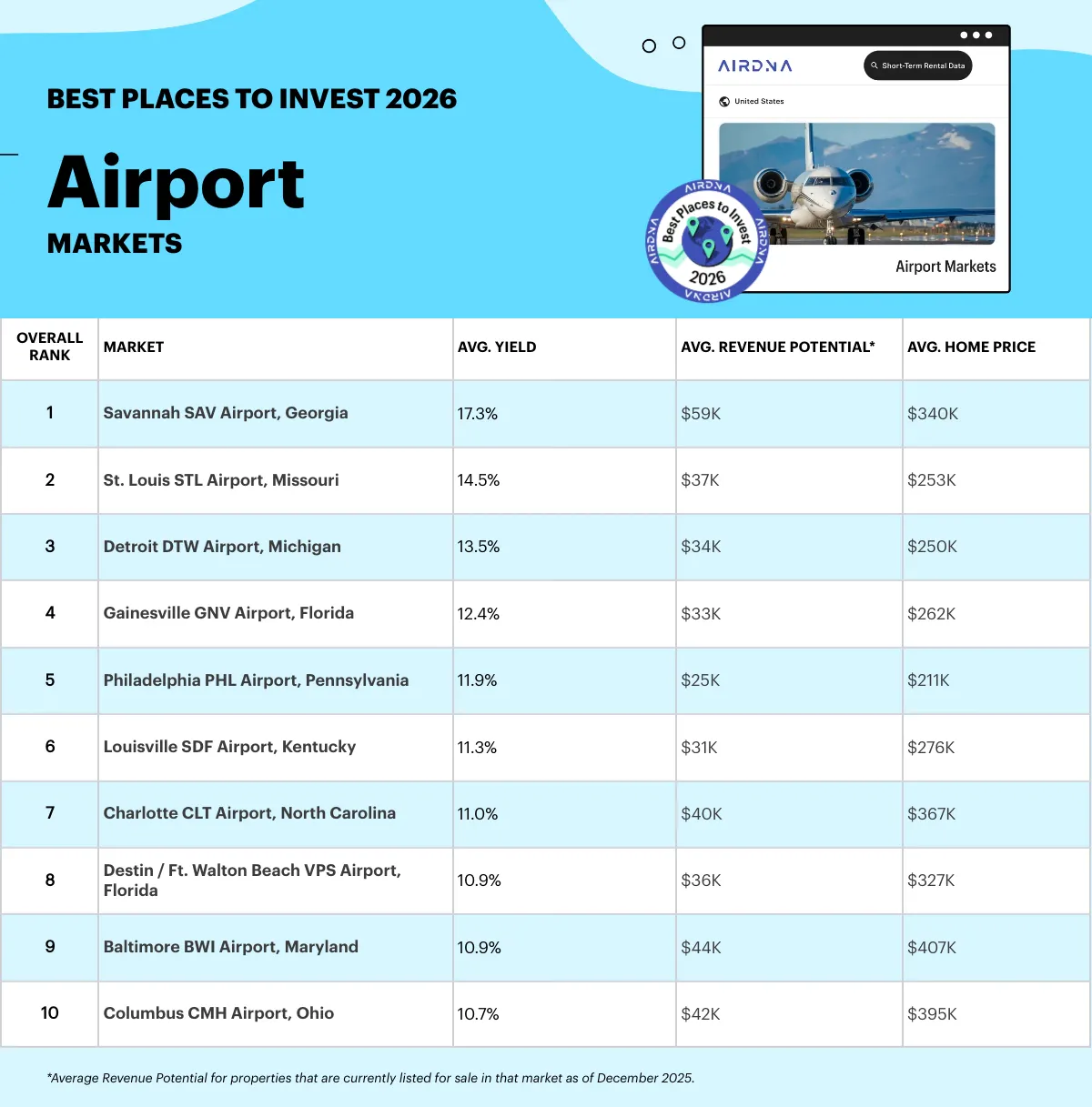
The ranking data reflects properties that are currently for sale, which naturally change over time. As always, investors should evaluate individual listings closely to understand how pricing and expected performance line up before making a purchase.
1. Savannah, Georgia - Savannah/Hilton Head International Airport
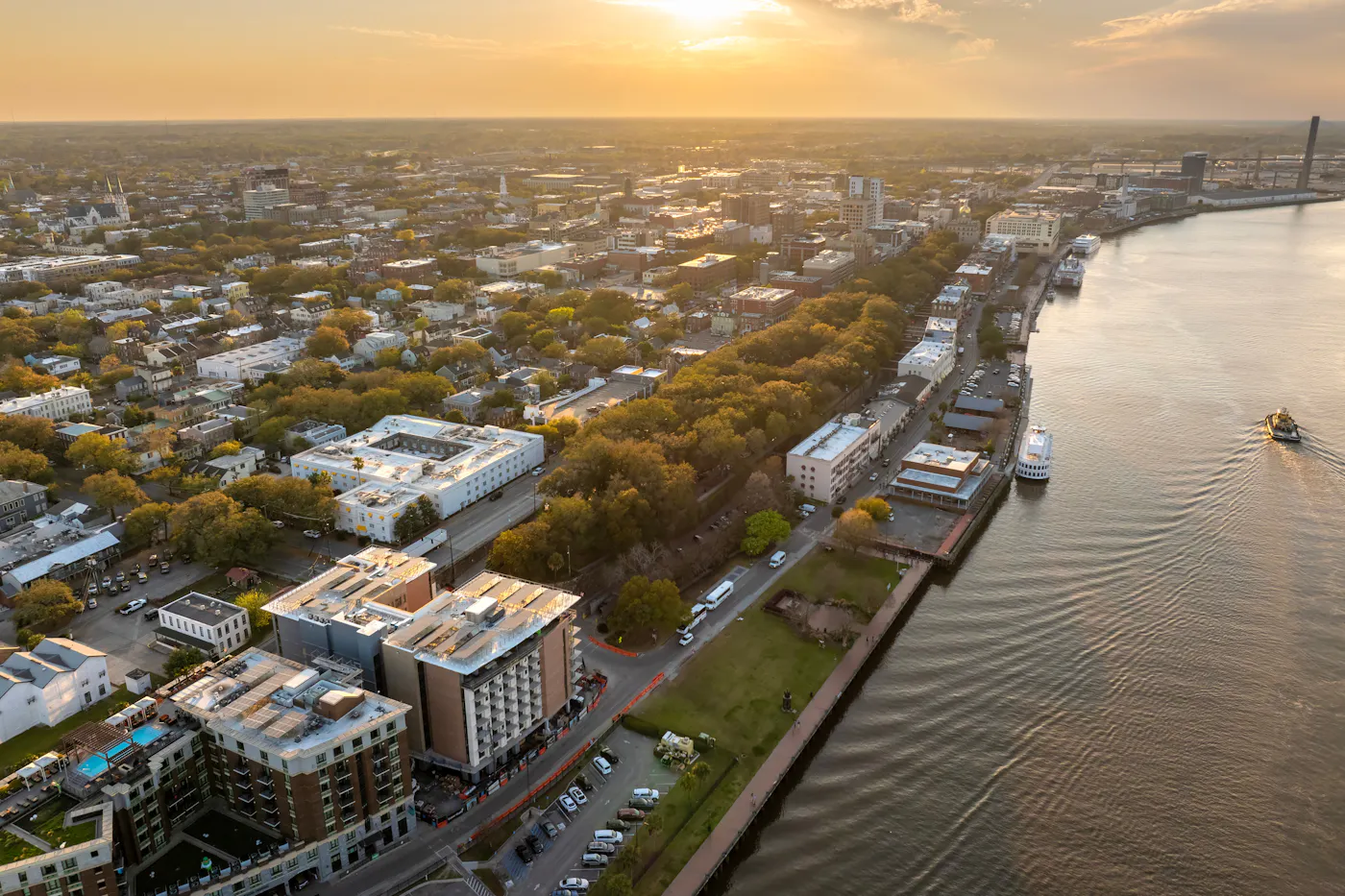

Savannah, Georgia stands out as one of the strongest airport-adjacent STR markets where demand, pricing, and returns line up cleanly. Airbnbs near Savannah/Hilton Head International Airport (SAV) benefit from steady year-round bookings tied to tourism, business travel, weddings, and regional events.
The AirDNA submarket of SAV Airport includes neighborhoods like Pooler, Bloomingdale, and Port Wentworth Junction. Located merely 15 minutes from Savannah’s Historic District and adjacent to the airport, areas like Pooler offer easier access, newer housing stock, and more drive-and-park-friendly properties than many parts of downtown Savannah. That setup appeals to families, groups, and short-stay travelers who prioritize space and convenience while still wanting quick access to the city’s main attractions.
Average home prices in the SAV airport submarket sit just under $340K, with revenue potential of $58,630 for an average yield of 17.3%. That spread leaves room to manage operating costs and pricing pressure while still supporting solid returns relative to buy-in cost.
Regulations:
Savannah allows short-term vacation rentals but regulates them with a defined framework, including rules on where and how they can operate. Vacation rentals are permitted within the short-term vacation rental overlay district, which includes the Downtown, Victorian, and Streetcar local historic districts. Prospective hosts must submit an application and secure an STVR (short-term vacation rental) certificate. Fees include a one-time $400 application fee and an annual $250 renewal fee.
2. St. Louis, Missouri - St. Louis Lambert International Airport
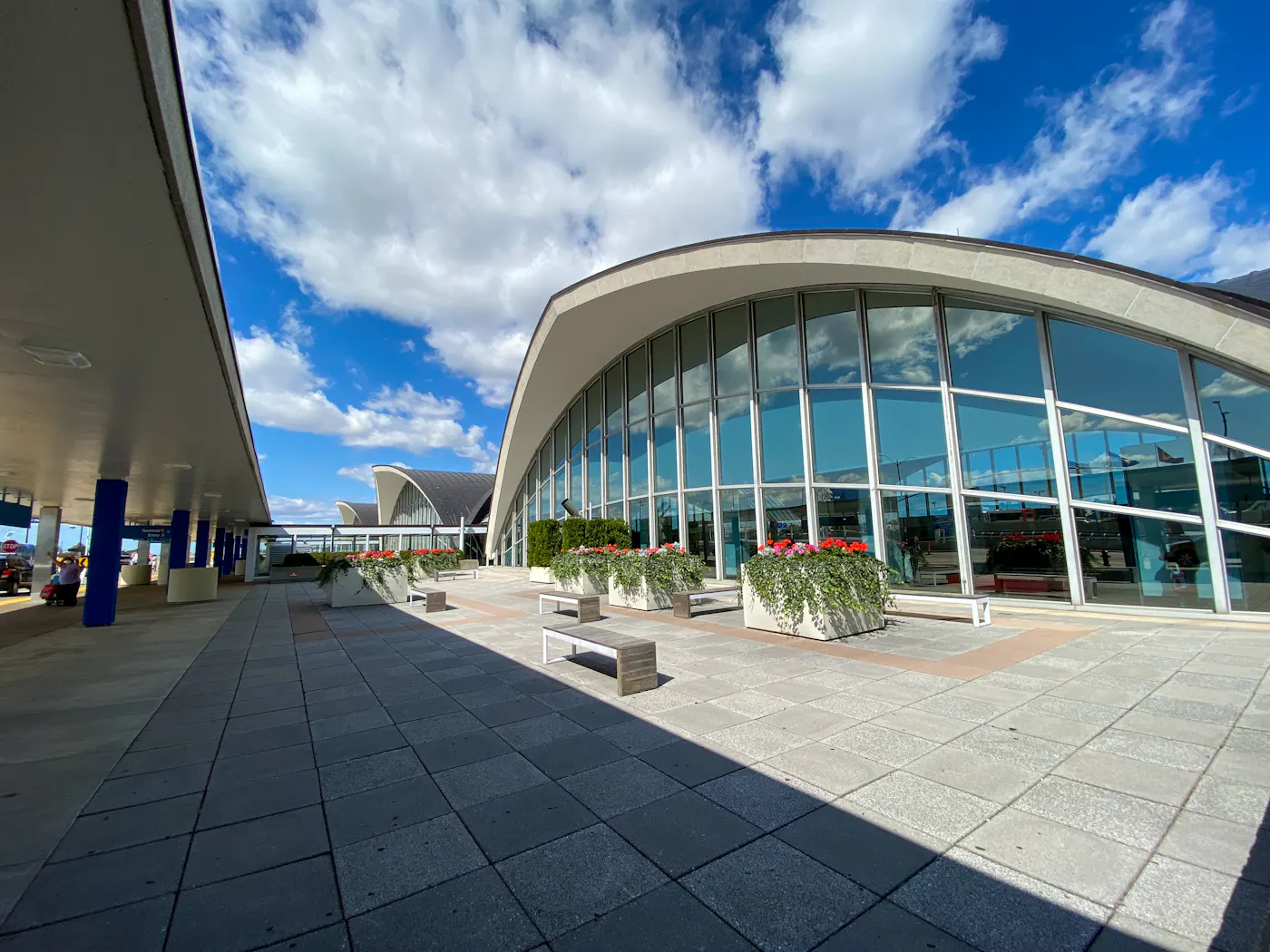

St. Louis stands out as a metro where airport-driven demand and affordability work in investors’ favor. Airbnbs near St. Louis Lambert International Airport (STL) benefit from a steady flow of stays tied to business travel, events, weekend trips, and visiting friends and family. That consistent movement supports year-round bookings without relying on a single tourism season. The average length of stay is 6 days, proving that bookings are diversified and aren’t limited to quick airport stopovers.
The STL Airport submarket within AirDNA includes areas like Maryland Heights, Woodson Terrace, St John and more. Breckenridge Hills has emerged as a neighborhood of interest for STR investors seeking Airbnbs near the airport. Located just minutes from the airport and a short drive from the city’s major attractions, Breckenridge Hills offers suburban acquisition pricing with strong demand. Guests can stay in a quieter, residential setting while remaining close to sports venues, cultural institutions, parks, and downtown. It’s an appealing setup for families, groups, and longer-stay travelers.
Average home prices in Breckenridge Hills sit just over $253K, with revenue potential at $36,597 and an average yield of 14.5%. That makes it easier to get in at a reasonable price and still see solid returns after operating costs.
Regulations:
St. Louis’ regulatory environment is currently somewhat uncertain. The City’s Ordinance 71729 mandates that all short-term rentals obtain a permit. However, a court order filed in April 2025 prohibited the City of St. Louis from enforcing the ordinance. While the court’s order is in effect, the City is not enforcing its permit requirements. While regulations hang in the balance, investors should underwrite conservatively and monitor guidance from the city on the latest enforcement and implementation updates.
3. Detroit, Michigan - Detroit Metropolitan Wayne County Airport


Airbnbs near Detroit Metropolitan Wayne County (DWV) Airport benefit from a steady mix of business travel, overnight layovers, early departures, and spillover demand from central Detroit throughout the year.
The DWV Airport submarkets includes neighborhoods like Belleville, Taylor, and Romulus. Located right next to DTW and a short drive from Downtown Detroit, these neighborhoods appeal to travelers who prioritize convenience and value. Guests often use areas like Romulus as a home base for sporting events, concerts, and dining downtown, while avoiding the higher prices associated with Detroit proper.
The numbers reflect that positioning. Average home prices in the DWV airport submarket are about $250K, an affordable entry cost. Almost $34K in annual revenue potential means Airbnbs near Detroit Metropolitan Wayne County Airport see an average yield of 13.5%.
Regulations:
Detroit allows short-term rentals, but they’re regulated through a citywide licensing system. Hosts must obtain a short-term rental license from the city, pass a property inspection, carry liability insurance, and designate a local contact who can respond to issues within 45 minutes.
License types and allowable rental duration vary based on whether the host lives on-site and where the property is located, with stricter limits in certain parts of the city. STR investors in Detroit should confirm the specific policies that apply to the property they’re interested in before buying.
4. Gainesville, Florida - Gainesville Regional Airport
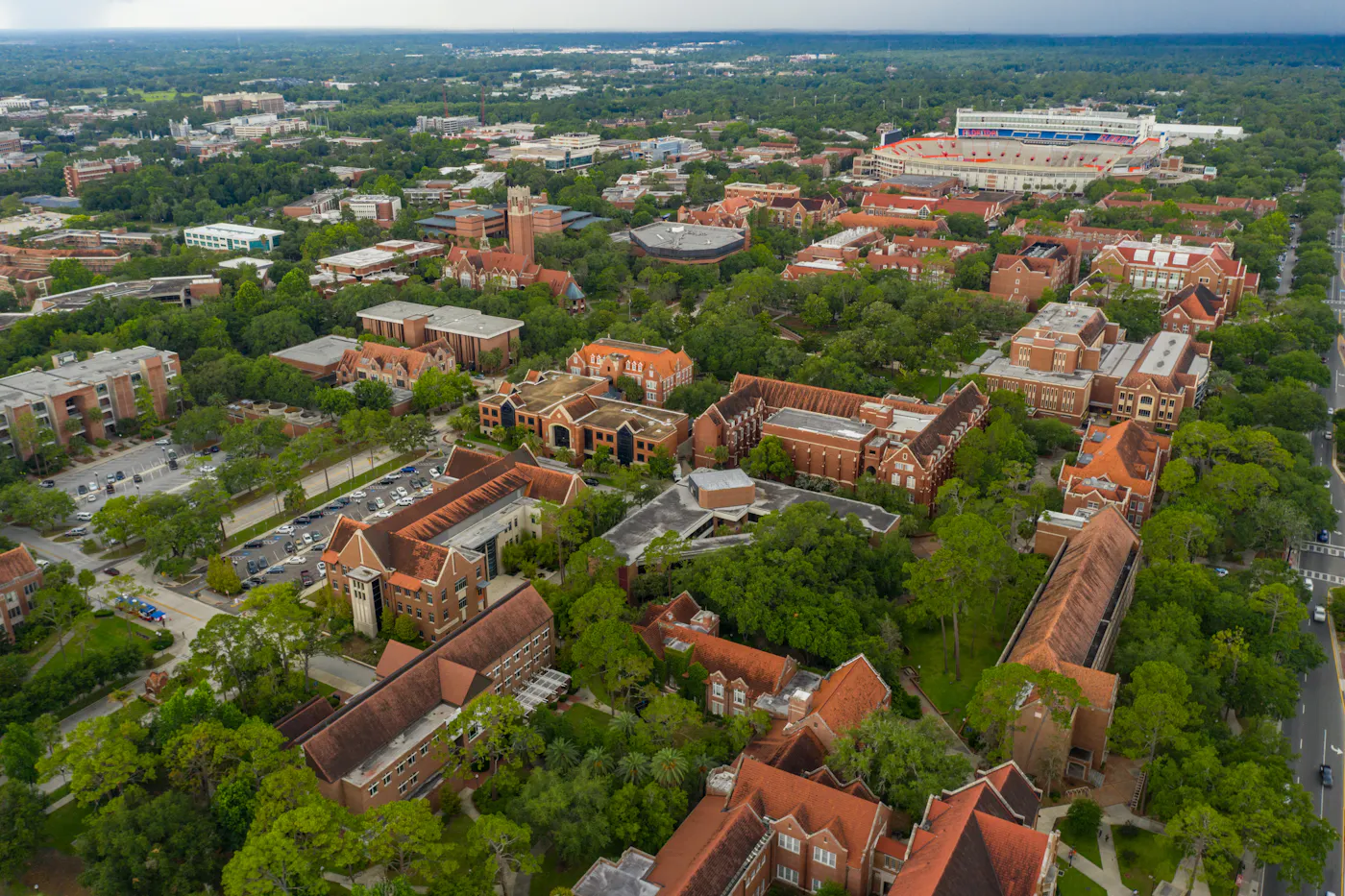

Gainesville, Florida benefits from steady, year-round travel that isn’t tied solely to traditional tourism cycles. Airbnbs near Gainesville Regional (GNV) Airport capture a consistent mix of university-related visits, medical travel, and quick weekend stays. That creates dependable baseline demand that holds up outside of peak vacation seasons.
The GNV airport submarket includes areas like Duval Heights and Highland Court Manor. Both are practical neighborhoods for STR investors. Located close to the airport and within easy reach of the University of Florida, this area appeals to guests who prioritize convenience, straightforward access, and quieter residential settings. Visitors staying here tend to value proximity to campus, hospitals, and regional attractions without the congestion or pricing of downtown Gainesville.
From a pricing perspective, the GNV airport submarket offers a manageable entry point for investors. Home prices average about $262K, which leaves flexibility to invest in quality furniture, safety upgrades, and setup without stretching the deal. Revenue potential averages $32,581, supporting an average yield of 12.4%.
Regulations:
As of Oct. 1, 2021, the City of Gainesville doesn’t regulate short-term rental units for stays of less than 30 days. This is a great sign for investors, who won’t have to jump through the hoops of permitting or licensing to start hosting here.
5. Philadelphia, Pennsylvania - Philadelphia International Airport


Philadelphia’s travel demand extends well beyond Center City, supported by year-round tourism, major events, and one of the busiest airports in the Northeast. Airbnbs close to Philadelphia International Airport benefit from a steady flow of business travelers, medical visits, and visitors looking for easy access to the city without the cost or congestion of Center City.
Within AirDNA’s PHL airport submarket are neighborhoods like Ridley Park, Eddystone, and Chester. Located south of Philadelphia and within easy reach of the airport, this area appeals to guests attending sporting events, concerts, and casino stays, as well as travelers who want convenient access to the city at a lower nightly cost. Its proximity to Citizens Bank Park (home of the Phillies) and Lincoln Financial Field (home of the Eagles) give the area its own demand drivers, while remaining close enough to benefit from Philadelphia’s constant visitor traffic.
From an investment perspective, the PHL airport submarket’s affordability is the differentiator. Average home prices are just over $210K, creating a lower barrier to entry than most airport-adjacent markets. Revenue potential averages $25K, supporting an average yield of 11.9%—strong for a metro this close to a major city.
Regulations:
Philadelphia requires STR hosts to get a zoning permit to rent a property short-term. You may also need a
Limited Lodging Operator License or a Rental License with a hotel designation.
Overall, the city’s regulations are structured rather than hands-off. They’re workable for professional operators who follow permitting rules, but not “set it and forget it.”
How to Find the Best Markets to Invest In
Looking at demand drivers expands your options beyond a single “hot” destination. Instead of starting with a city name, you can start with why guests travel, and then find markets where that demand lines up with your budget and return goals.
AirDNA lets you explore markets shaped by different types of demand, from outdoor recreation and seasonal travel to transportation hubs like airports. That makes it easier to compare markets with similar booking dynamics, even when pricing or competition looks very different on the surface.
Use demand driver market filters
Not all demand behaves the same way. Some attractions drive long lead times and seasonal spikes, while others create shorter stays and steadier occupancy. Using AirDNA’s demand driver filters helps you focus on markets where bookings are tied to specific travel reasons, rather than broad geography alone.
This approach helps you:
- Find markets aligned with the types of stays you want to host
- Spot other markets that share demand patterns but offer more favorable pricing or less competition
From the Find a Market tab in AirDNA, click the Market filter to choose which demand drivers you want to search for.

Filter by budget and yield
Once you’ve identified markets with the right kind of demand, the next step is to look at what’s actually for sale.
To narrow down your options, use these filters:
Price range filter
Use the listing price filter to only view for-sale properties within your budget. You can set upper and/or lower limits. Find this filter in the For-sale properties tab.

Yield filter
Use the yield filter to highlight properties that meet your desired yield. Setting a minimum yield will filter out any properties that likely won’t provide the returns you’re seeking. Find this filter in the For-sale properties tab.

FAQs
What’s it like living near an airport?
Living near an airport often means easier access to highways, transportation, and services, but it can also come with tradeoffs like noise and higher traffic at certain times of day. For short-term rentals, those factors tend to matter less to guests staying one or two nights for convenience-driven trips. From an investment perspective, airport proximity can translate into lower purchase prices and steadier demand, as long as noise exposure, property condition, and guest expectations are managed appropriately.
Is investing in an Airbnb near an airport a good idea?
It can be, depending on the market and purchase price. Airport-adjacent Airbnbs often benefit from steady, year-round demand tied to short stays, business travel, and regional trips. The key is whether that demand translates into strong yield after accounting for acquisition cost, operating expenses, and local regulations.
What type of Airbnb performs best near airports?
Smaller single-family homes and townhomes tend to perform well, especially those with easy parking and simple layouts. Guests staying near airports usually prioritize convenience and value over luxury amenities, which can keep setup and operating costs more manageable. You can use filters in AirDNA to see how short-term rental performance varies by bedroom count, amenities, real estate type, price tier and more.
Do Airbnb markets near airports rely on last-minute bookings?
Booking windows can be shorter in airport-adjacent markets compared to strictly leisure-driven markets, but the share of demand coming from last minute layover stays is usually balanced against demand for attractions in the larger area. For investors, that can mean consistent occupancy supported by a range of last-minute bookings and ones made farther in advance.
How important are local regulations in airport-adjacent Airbnb markets?
Very. Many airport-area properties fall within larger metro jurisdictions, which may have licensing requirements, zoning rules, or limits on short-term rentals. Always review local regulations before purchasing and factor compliance costs into your underwriting.
How can I find homes for sale near an airport?
Start by identifying markets where airport-driven demand is strong, then focus on nearby neighborhoods rather than the airport itself. Using AirDNA’s for-sale properties data, you can filter listings by location, price range, and yield to narrow in on homes that fit your budget and return targets.
Start with yield, go deeper later
Use AirDNA to assess market performance and compare Airbnb yield across for-sale listings before diving into full ROI.
Filter by Yield NowARTICLE SUMMARY
Airport proximity alone doesn’t guarantee strong short-term rental performance. This guide breaks down which airport-adjacent markets actually work for investors, using yield, pricing, and real for-sale property data to show where airport-driven demand translates into sustainable returns.
Jamie Lane
AirDNA Chief Economist
He is responsible for data analysis, thought leadership, and leveraging advanced analytical techniques to provide new insights into short-term rental market trends. Native to Atlanta and an Airbnb host himself, Jamie enjoys cycling, mountain biking, backpacking, running, and playing in a dart league in his free time.


Get started with AirDNA today.
Powerful, easy-to-use tools that help hosts and investors succeed in the short-term rental market.
Try for free