Is Airbnb a Good Investment? Why Now Is the Best Time to Start
Published: November 3, 2025
Last updated: September 25, 2026

Bram Gallagher
Key Takeaways:
- Cash flow is just one piece of a short-term rental investment: tax savings and equity growth often drive the biggest returns.
- In 2025, the One Big Beautiful Bill reactivated powerful tax incentives that can significantly offset your upfront costs.
- Using tools like AirDNA helps you evaluate total ROI (not just monthly income) before you buy.
You’ve thought about buying an Airbnb. Maybe even run the numbers.
Then the headlines hit: tighter rules, crowded markets, hosts complaining about fewer bookings.
Suddenly, that promising side hustle doesn’t seem so simple.
Sure, you might clear $15,000 or $20,000 a year in profit. However, with the upfront costs, the time, and the learning curve, you start to wonder: Is Airbnb still worth it? Are short-term rentals a good investment?
The thing is, that kind of surface-level math misses most of the return on investment (ROI).
In 2025 especially, monthly income is just a piece of the pay-out from Airbnb investing, not the whole picture. Short-term rentals (STRs) are one of the most efficient ways to build wealth in real estate, especially for first-time investors who understand how the full ROI works.
Why Invest in Airbnb? ROI Is Not the Same as Cash Flow
When people picture Airbnb returns, they tend to focus on passive income: covering the mortgage, paying the bills, and making a few thousand a year . . . and yes, that part matters.
However, monthly cash flow is only one layer of the return. In fact, it’s often the smallest.
Short-term rentals actually generate value in three ways:
- Monthly cash flow: The income left over after you cover your mortgage, cleaning, maintenance, utilities, and management fees.
- Equity growth: As your guests help you pay down the mortgage and your property value appreciates over time, your equity grows automatically (even while you sleep).
- Tax savings: With the right setup, you can deduct a large portion of your upfront investment and operating costs, significantly reducing your tax bill. That’s more money left in your pocket.
That third piece, tax benefits, is where most new investors miss out. Tax savings can be one of the most impactful ways your short-term rental generates returns, especially in your first year.
In fact, when structured right, the money you save on taxes can match or even exceed your rental income. That’s without any extra bookings or nightly rate increases.
Let’s look at how it works in practice.

How Tax Savings Actually Boost Your ROI on an Airbnb
Let’s say you buy a short-term rental property for $500,000 and spend another $30,000 to furnish and set it up.
In your first year, you might earn around $18,000 in net cash flow after covering your mortgage, utilities, management, and cleaning. That’s solid income, but here’s where your return really starts to grow:
Because of bonus depreciation in 2025, you can write off a large portion of your purchase and setup costs in year one instead of spreading those deductions over many years.
Here’s how that might break down:
- $30,000 in furnishings and appliances
- $10,000–$20,000 in eligible property improvements (like lighting, flooring, landscaping)
- $30,000–$50,000 in accelerated building depreciation (from a cost segregation study that breaks out individual assets like cabinets, carpet, and fixtures into shorter depreciation periods)
Total potential first-year deductions: $70,000 to $100,000
If you’re in a 24% tax bracket, that could translate to:
- $16,800 to $24,000 in actual tax savings
That’s money you don’t pay to the IRS and money that stays in your pocket.
So while your cash flow says you made $18,000, your effective return could look more like $35,000 to $42,000 in year one, when you include tax savings.
More importantly, these savings aren’t reliant on how your Airbnb performs. You simply made the most of how the tax code works for short-term rental investments.
The Big Beautiful Bill and Its Effect on Airbnb Tax Benefits
In 2025, the One Big Beautiful Bill (OBBB) reinstated and expanded a series of powerful tax incentives, especially for first-time short-term rental investors.
That means if you're buying, furnishing, or upgrading an Airbnb this year, you’re walking into one of the most favorable tax environments in years.
Here’s what OBBB changed and why it matters:
- 100% bonus depreciation is back: You can now deduct the entire cost of eligible items like furniture, appliances, and interior improvements in the same year they’re placed in service. No more spreading write-offs over 5, 7, or 15 years.
- Expanded SALT deduction cap: The state and local tax (SALT) deduction cap has been raised to $40,000 for eligible income brackets, which is a major win in high-tax states like California, New York, and Illinois.
- Permanent QBI deduction: If your Airbnb qualifies as a business (and many do through material participation), you can deduct 20–23% of your net profits under the Qualified Business Income (QBI) rule, which is essentially a built-in discount on your taxes.
Bottom line: OBBB makes it easier to reduce your taxable income and faster to recoup your upfront investment when you launch a short-term rental in 2025.

Why 2025 Is a Great Time to Start Investing in Airbnb
Between favorable market conditions and new tax advantages, 2025 offers a uniquely strong window for entering the STR market, especially for first-time investors looking to break into real estate.
Here’s why now is the right time to start your short-term rental investment:
You can write off more in 2025 than in most years
The 100% bonus depreciation brought back by the One Big Beautiful Bill (OBBB) lets you fully deduct qualifying purchases in the same year they’re placed in service. That creates immediate tax savings that can offset startup costs and reduce your first-year risk.
Keep in mind that these deductions only apply to assets that are placed in service after January 19, 2025. Placed in service means that eligible assets need to be installed, functional, and ready for guests after that date.
If you place your short-term rental in service by December 31st, 2025, you can claim those deductions in the fast-approaching tax season. Wait until next year, and you’ll see those savings in 2027 during the 2026 tax season. It’s always possible that bonus depreciation rules will change as legislation evolves, so it’s best to take advantage sooner rather than later .
The current market still gives you room to find a deal
In many areas, real estate inventory remains higher than usual, offering more selection and sometimes softer pricing, especially compared to the peak frenzy of past years. However, that’s starting to shift in many markets as more investors move to capture the new tax advantages.
Getting in now gives you more choice, stronger cash flow potential, and a smoother path to launching before competition increases again.
Starting this year sets you up for faster growth
Getting your Airbnb up and running in 2025 isn’t just about saving on taxes. It’s about building momentum.
When you start now, you’re giving yourself a head start on every part of the wealth-building curve: learning, reinvesting, and qualifying for ongoing tax benefits.
Here’s how that plays out:
Learn the ropes while competition is stabilizing
Launching in the 6 months to a year means you can refine pricing, operations, and guest experience before inventory tightens again. You’ll gain real performance data with less competitive pressure. By the time buyer demand and property prices start climbing again, you’re already optimized.

Turn first-year deductions into reinvestment capital
The tax savings from your first STR (via bonus depreciation and deductible startup costs) can directly fund your next down payment or property improvements. Instead of waiting to build capital from cash flow alone, you can reinvest sooner and accelerate portfolio growth.
Lock in ongoing tax advantages for future properties
Once you’re operating and materially participating, you qualify for continuing deductions like the QBI deduction, expanded SALT limits, and permanent 100% bonus depreciation on future acquisitions. Each new purchase compounds your ability to lower taxable income while building equity.
The sooner you start, the sooner the cycle begins: Learn → deduct → reinvest → expand.
Each loop builds on the last, helping you grow from one STR to a scalable, tax-efficient portfolio.
You'll be ready when the next upswing hits
Real estate rewards those who act early and plan ahead, not those who wait for the perfect timing.
Launch during a favorable tax year and you build:
- Equity before prices climb: If investor demand rises again, your entry cost is already behind you.
- A proven income stream: Lenders and partners look for performance data, which is something first-time buyers don’t have.
- Tax positioning for expansion: Future properties can build on the same structure, maximizing QBI, SALT, and ongoing bonus depreciation benefits.
When the next market upswing hits, you’re not starting from zero—you’re scaling from a position of strength.
How to Evaluate a Short-Term Rental Investment
Most new investors look at nightly rates, guess at occupancy, and do some back-of-the-napkin math on profit. However, to make the best decisions, you need a big-picture approach.
AirDNA makes that possible. With tools that estimate revenue, compare comp sets, and model seasonality, you can go beyond surface-level profit and see your real return: cash flow, equity growth, and tax benefits combined.
Here’s how to do it step by step:
1. Estimate your revenue with real data
Start by plugging your property’s address into AirDNA’s Airbnb Calculator. In seconds, it generates a personalized Rentalizer report that estimates how much your property could earn as a short-term rental based on how similar Airbnb properties are performing in your area. You’ll get a data-backed projection for:
- Average Daily Rate (ADR)
- Occupancy rates
- Seasonality
- Local comp sets (comparable listings)
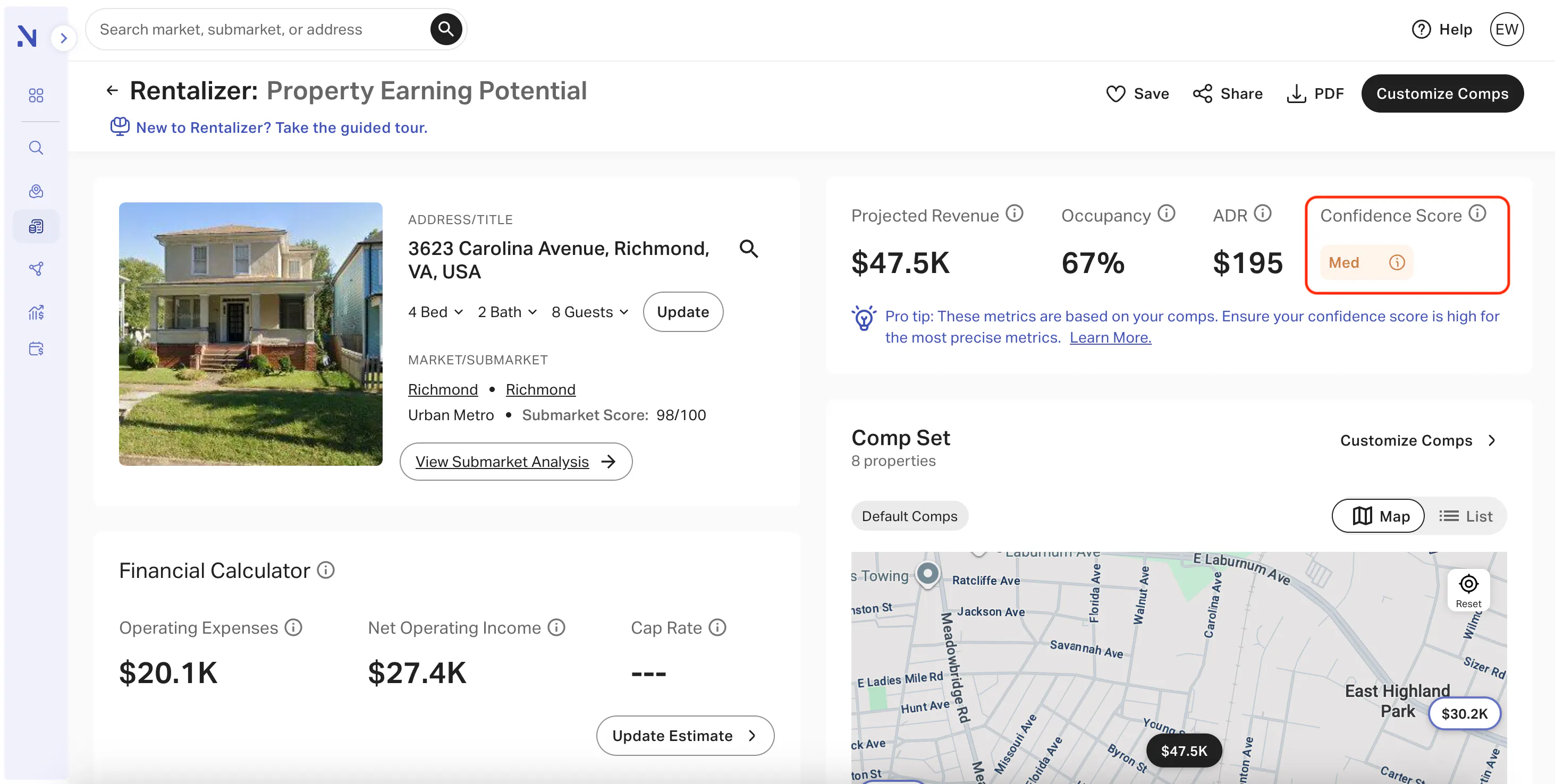
You’ll also see a Confidence Score: a rating system that shows how reliable the projections are. The higher the score, the more robust the local data is behind your estimate.
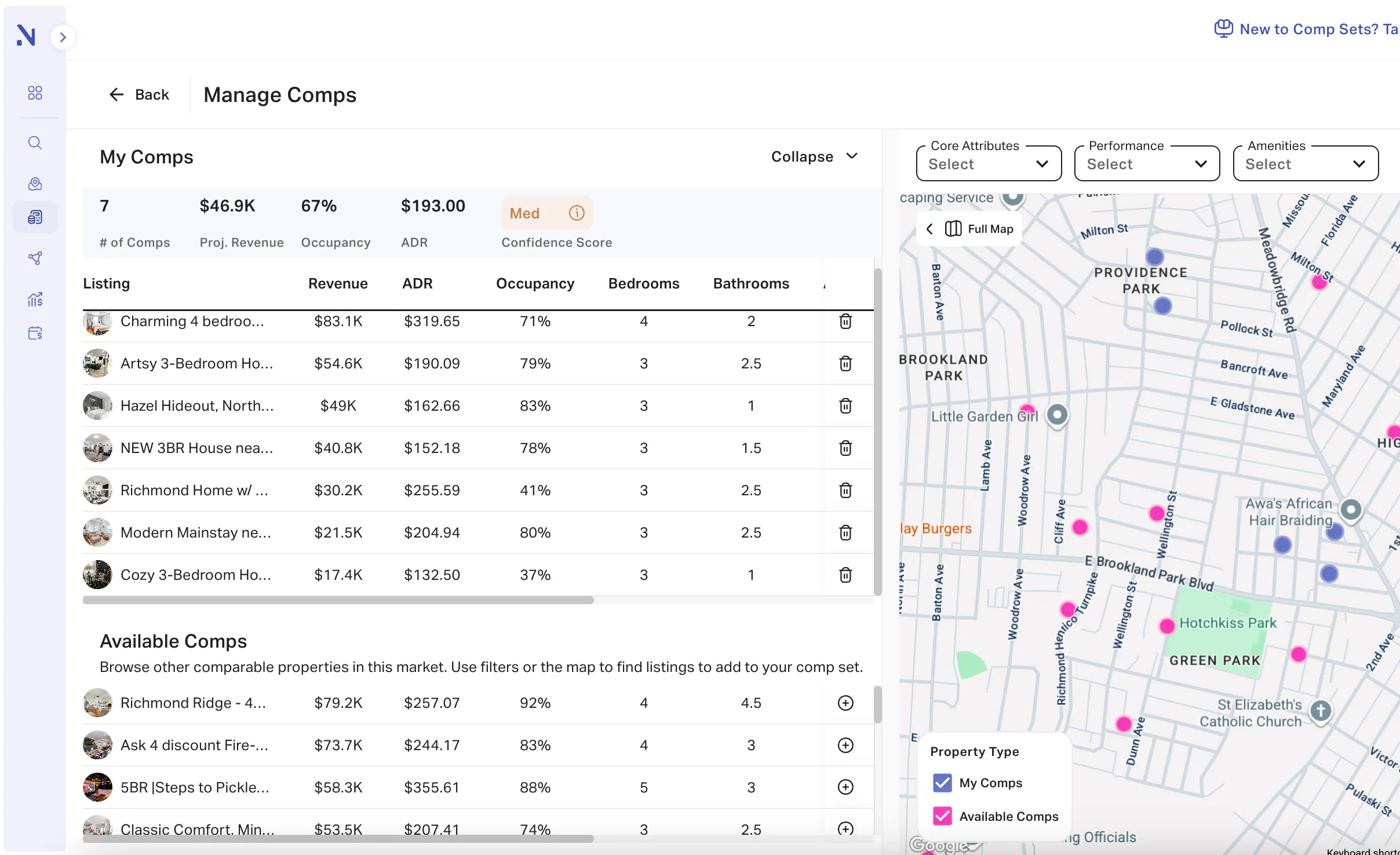
Important: A lower Confidence Score doesn’t mean your property isn’t viable. It just means you should take the next step: customize your comp set. You can fine-tune filters like bedroom count, amenities, and property type to see nearby short-term rentals that more accurately reflect your specific property.
By doing this, your estimate becomes more tailored, accurate, and useful for informing an investment decision.
2. Calculate your monthly cash flow
Compare your projected income to expected monthly expenses, including:
- Mortgage
- Utilities
- Maintenance
- Cleaning
- Management fees (if applicable)
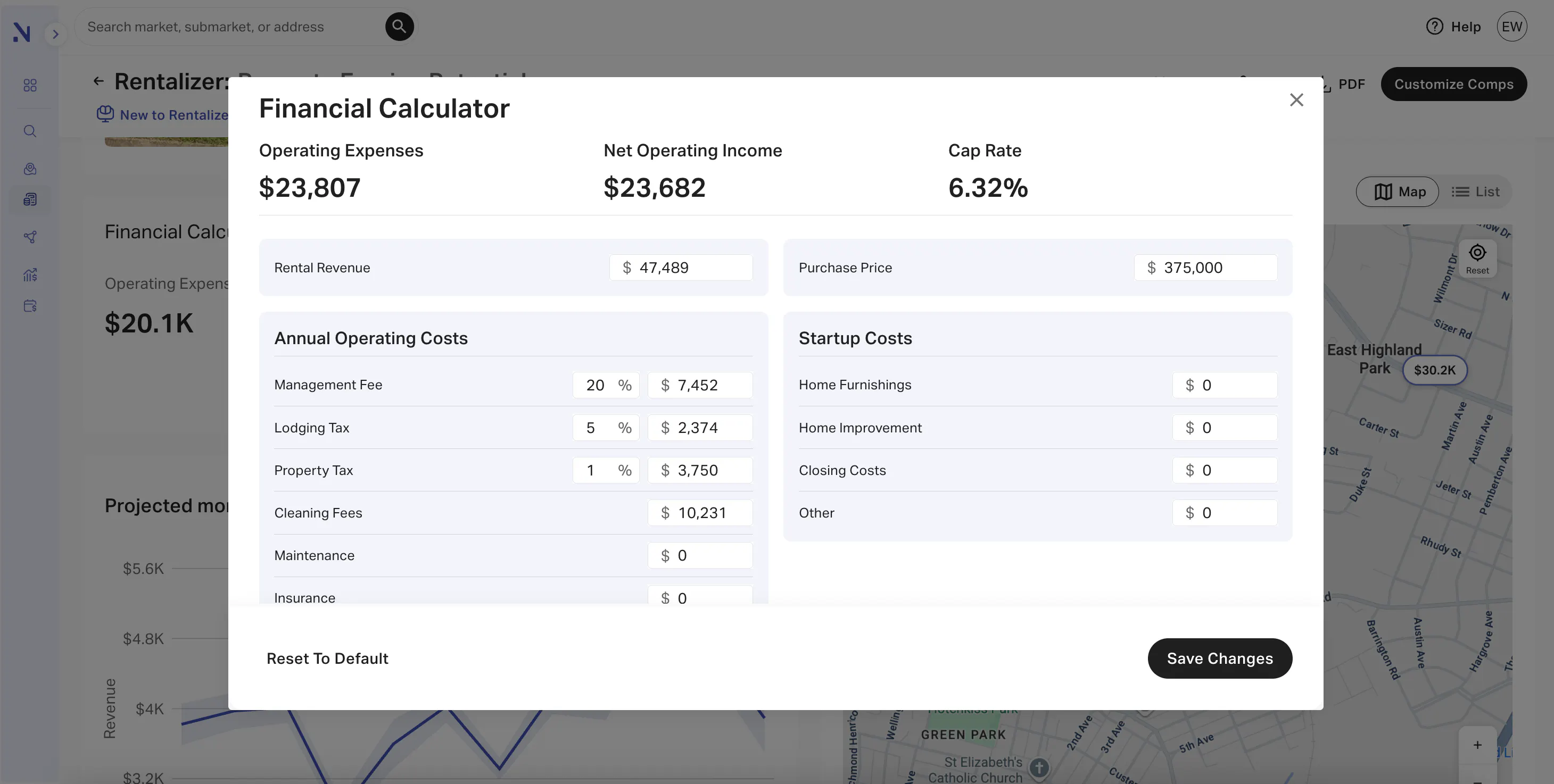
The Rentalizer report comes with a customizable financial calculator where you can input expense information to better estimate your net operating income (NOI). The calculator defaults to a 20% management fee, a 5% lodging tax, and a 1% property tax. If you don’t plan on hiring a property manager, you can set that percentage to zero. Update the tax fields to reflect your local tax code.
If your income exceeds your costs, that’s your starting cash flow. Keep in mind that startup costs will likely put a hefty dent in your first year’s earnings. Since these are one-time expenses for the most part, your annual NOI will increase starting in your second year.
3. Add expected equity gains
You build equity in two ways:
- Principal paydown: each mortgage payment chips away at your loan balance, increasing your ownership stake.
- Appreciation: As property values rise, so does your equity.
Imagine you purchase a short-term rental for $500,000 with a 20% down payment ($100,000) and a 30-year mortgage. Each month, part of your payment goes toward principal. In your first year, that might total around $7,000–$8,000 in principal paydown.
Historically, U.S. home prices have appreciated around 3–5% per year (some STR markets are even higher). If your property appreciates 4%, that’s $20,000 in value growth during the first year.
Combined, that’s roughly $27,000–$28,000 in equity added, on top of any cash flow you earn.
Pro tip: Use AirDNA’s market data to find areas with strong historical appreciation and occupancy rates. Pairing high-performing markets with favorable tax rules and long-term appreciation potential gives you a powerful recipe for compounding wealth.
4. Factor in tax benefits
Work with a CPA or use a bonus depreciation calculator to estimate:
- First-year deductions from furnishings, appliances, and upgrades
- Potential savings based on your income bracket
- Ongoing tax benefits like QBI or SALT
This can add tens of thousands of dollars to your return, especially under 2025’s rules.
5. Compare your total return, not just the monthly number
When you add up cash flow, equity, and tax savings, you get your real after-tax ROI and it’s often a much more compelling number than monthly profit alone.
Let’s put it all together using the example from step 5:
- Your short-term rental earns $10,000 in annual cash flow.
- You build $27,000 in equity through mortgage paydown and appreciation.
- You capture $25,000 in first-year tax savings via bonus depreciation and other deductions.
That’s a $62,000 total first-year return on a $100,000 down payment.
Between the current tax incentives, favorable market conditions, and smarter tools for finding and evaluating properties, 2025 gives first-time investors a meaningful edge. The best part? You don’t need to figure it all out on your own. AirDNA gives you the data to model your full return and spot opportunities early while the numbers still work in your favor.
Frequently Asked Questions
Is Airbnb a good investment?
Yes, it can be, especially when you evaluate the full return and not just monthly profit. In 2025 especially, short-term rentals are one of the most tax-advantaged real estate investments available. Between cash flow, equity growth, and powerful tax deductions under the Big Beautiful Bill (like 100% bonus depreciation and the permanent QBI deduction), first-time investors can often achieve returns that far exceed traditional rentals or passive investments.
That said, success depends on location, management, and market understanding. AirDNA’s revenue projections and market insights help ensure you’re buying into the right opportunity at the right time.
Where is the most profitable place to own an Airbnb?
There isn’t a single “most profitable” city. Profitability depends on your budget, goals, and management style.Some markets shine for cash flow (high occupancy, lower purchase prices), while others excel in long-term appreciation. The best investors look for the overlap: strong nightly rates, steady occupancy, and sustainable regulations. Check out AirDNA’s annual Best Places to Invest report to find those sweet spots.
What is the downside of Airbnb?
Like any investment, short-term rentals come with tradeoffs. The main risks include:
- Regulation changes: Local laws can limit or restrict STR operations in certain neighborhoods. Always check city and HOA rules before buying.
- Higher management demands: Compared to long-term rentals, Airbnbs require more hands-on work that ranges from guest communication to cleaning and maintenance.
- Market sensitivity: Occupancy and nightly rates can fluctuate with travel trends, competition, and seasonality.
- Startup costs: Furnishing, design, and compliance can add up, especially in your first year.
Most of these challenges can be managed and offset, however, through data-driven planning. AirDNA helps you forecast realistic performance, understand your market’s regulatory landscape, and stress-test your numbers before you buy.
ARTICLE SUMMARY
Most headlines say the Airbnb boom is over. This article explains why 2025 could be the best time in years for first-time investors to get in.
Bram Gallagher
AirDNA Director of Economics and Forecasting
Bram Gallagher is an Economist at AirDNA, specializing in uncovering insights that drive smarter short-term rental decisions. He put his Ph.D. in Economics from the University of Georgia to work researching and forecasting hotel data with CBRE prior to joining AirDNA, as well as teaching economics at a number of universities. In his spare time, Bram enjoys making wooden furniture with hand tools.