How Much Can You Make on Airbnb? A Realistic Look at Host Earnings
Published: January 29, 2025
Last updated: March 10, 2026

Jamie Lane
Key Takeaways
- The median revenue for Airbnb hosts in the U.S. in 2025 was $2,408 per month, but top performers brought in $7,912 or more.
- Location, property type, amenities, seasonality, and regulations all play a significant role in how much you can earn.
- Use AirDNA's free Airbnb calculator to get a personalized estimate based on real performance data from your market
So you're thinking about listing on Airbnb or you're already hosting and want to know if you're leaving money on the table. Either way, the first question is usually the same: how much can you actually make?
The honest answer is that it depends. Your property, your market, and how you manage your listing all play a role. But there's plenty of real data to work with. This guide breaks down what hosts are actually earning these days, what drives those numbers up or down, and how to get a clearer picture of what your specific property could bring in.
How Much Can You Make on Airbnb?
Airbnb income figures can vary a lot depending on the source, which makes it tough to know what to actually expect. Based on AirDNA data, the typical U.S. short-term rental host earned about $2,408 per month in 2025. That number is the median Airbnb revenue, which simply means half of hosts earned more and half earned less. That gives us a great starting point to understand what hosts typically make.
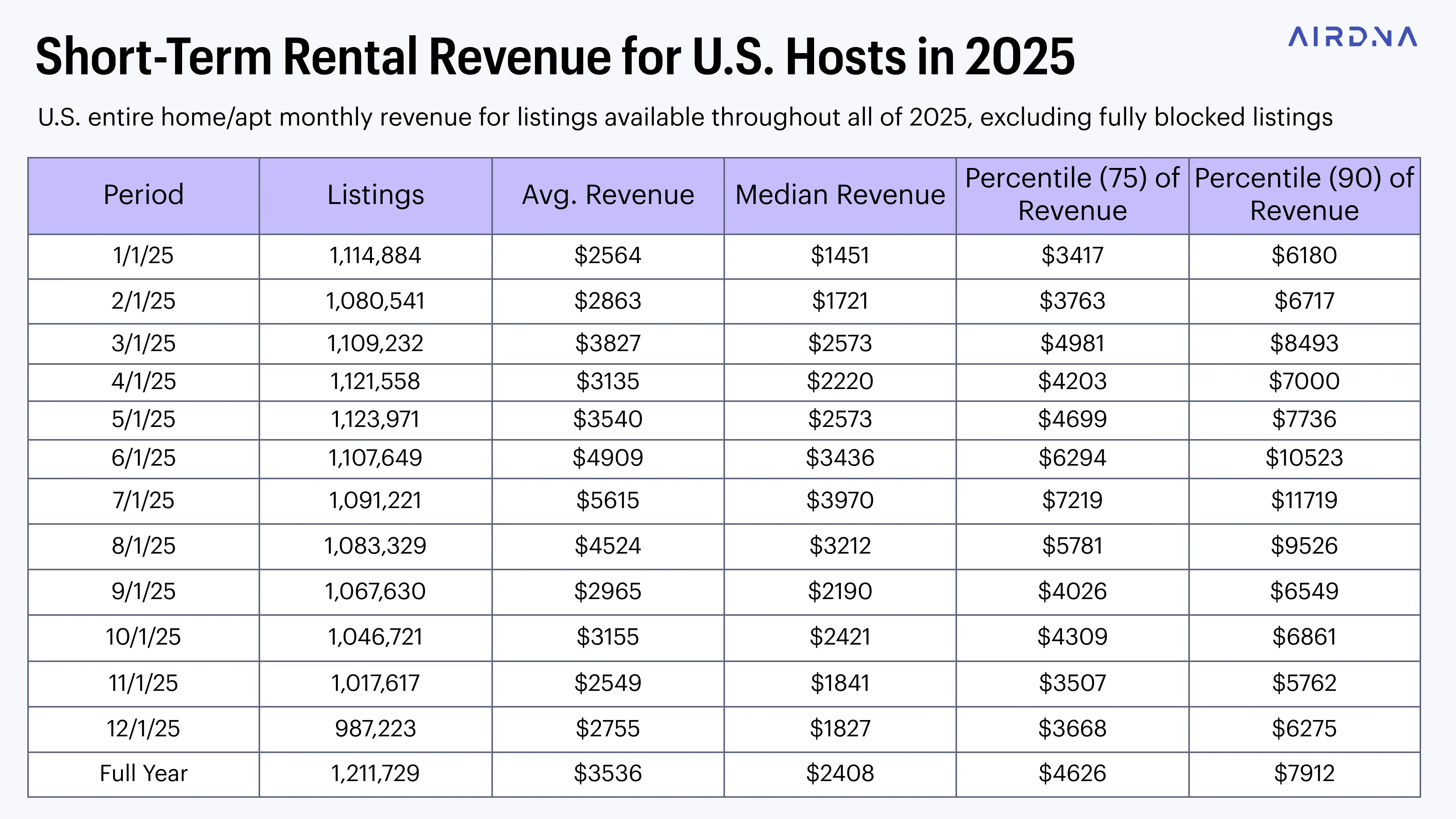
Of course, not every host is typical. The average Airbnb income per month varies quite a bit depending on the property, location, and how well the listing performs. Hosts in the top 25 percent earned at least $4,626 per month in 2025, while the top 10 percent brought in $7,912 or more. Consider that a reminder that, for the right property in the right market, there is meaningful earning potential.
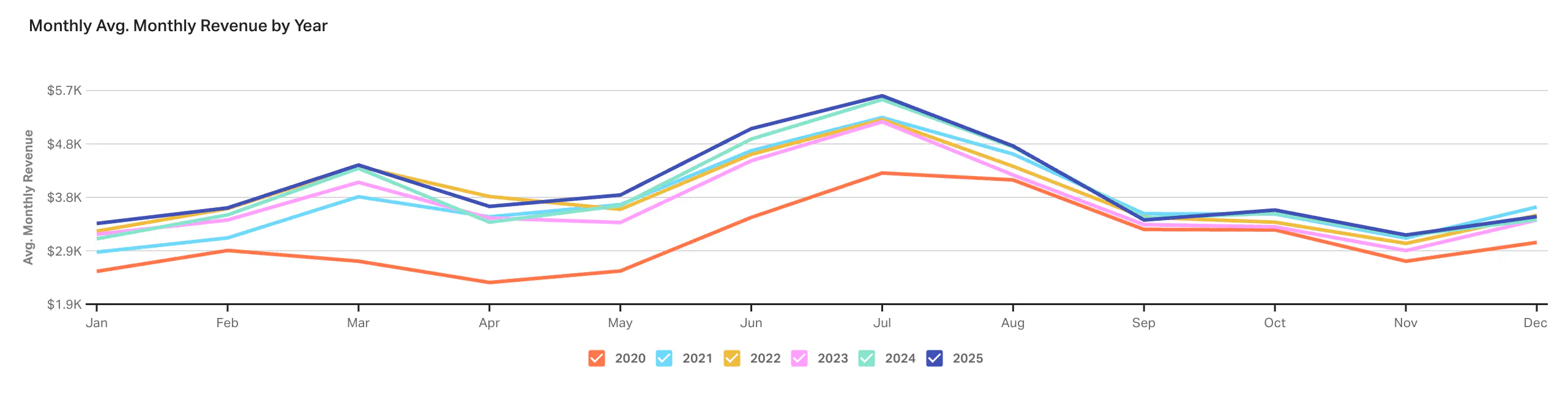
No matter what type of host you are or what property you have, the longer-term picture for making money on Airbnb continues to be encouraging. As the chart below shows, average Airbnb income has grown each year since 2020, with 2025 sitting above every previous year on record. Airbnb reports that the typical U.S. host earned about $15,000 in supplemental income in 2024. With demand for short-term rentals continuing to grow, that figure has only trended upward since.
Here’s the bottom line: Airbnb can generate real, meaningful income, but how much you make depends on your property, your market, and the time of year.
Find Out How Much You Can Make on Airbnb With an Airbnb Calculator
If you want a clearer idea of how much you can make on Airbnb, broad averages only go so far. Earnings can vary widely depending on the property, the location, and demand in your market.
An Airbnb monthly income calculator can give you a more personalized estimate.
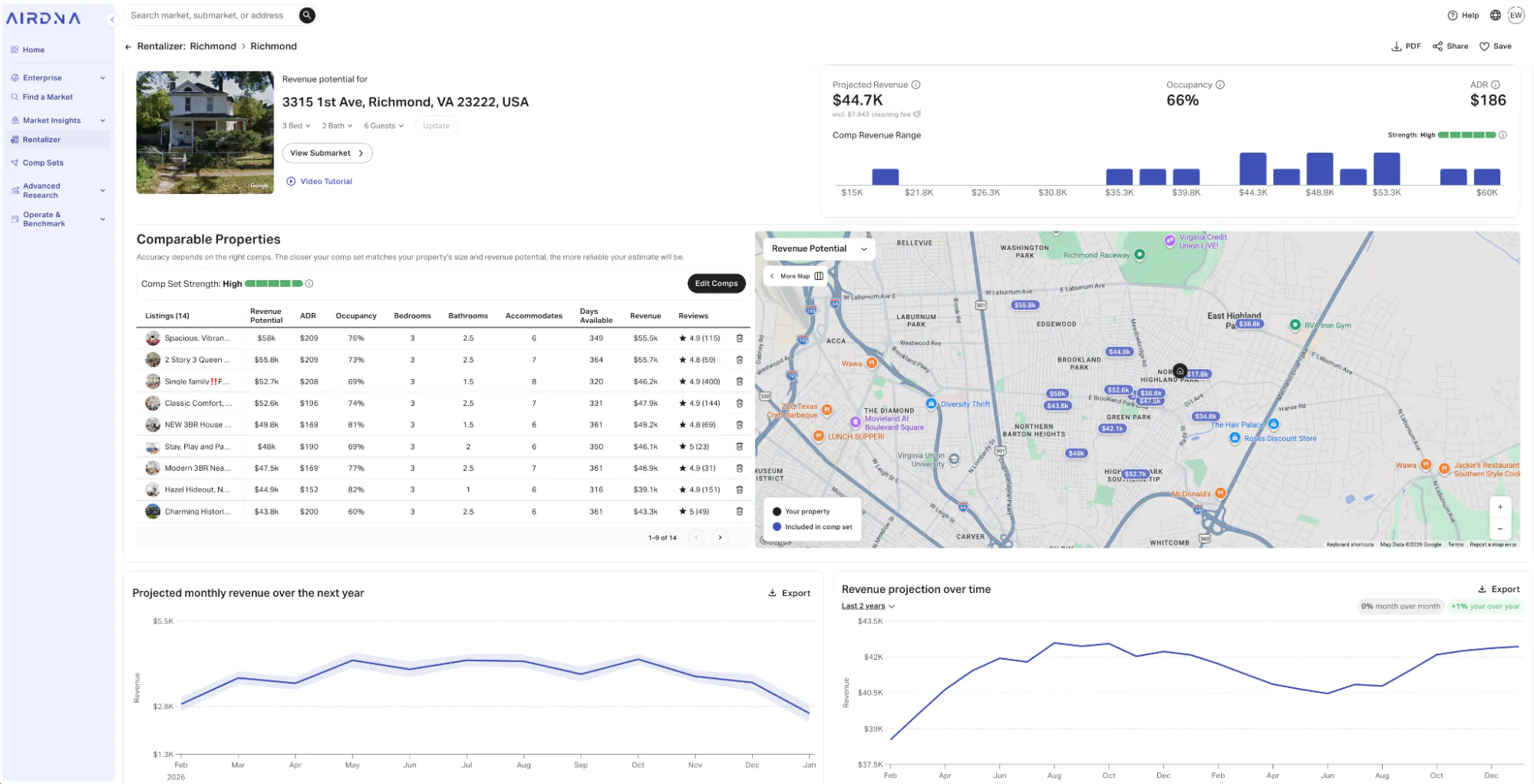
AirDNA’s free Airbnb calculator estimates potential short-term rental income using real performance data from millions of Airbnb and Vrbo listings. Instead of relying on general averages, it analyzes how similar properties in your area are performing to provide a projected annual revenue figure.
Using the calculator is simple:
- Enter a property address to analyze the local short-term rental market
- Add basic details like bedrooms, bathrooms, and guest capacity
- View estimated revenue based on local demand and market trends
Behind the scenes, the calculator evaluates factors like average nightly rates, occupancy levels, and seasonal demand to estimate how much a property could earn.
For example, a 3-bedroom house in Richmond, Virginia might show an average nightly rate around $186 with about 66% occupancy, along with projected monthly earnings based on current market conditions and seasonality.
For anyone thinking about making money with Airbnb, tools like this can help you move beyond rough estimates and see what a specific property might realistically earn.
How Much You Can Make on Airbnb Depends on a Lot
Maximizing your Airbnb revenue isn’t as simple as listing your property and watching the bookings flood in. A variety of factors work together to determine your earning potential, including location, amenities, seasonal demand, past reviews, and availability.
Let’s take a look at a few of the factors that will impact how much you can make on Airbnb:
1. Location
Nothing influences Airbnb rental income more than where your property is located. A beach house in a popular vacation destination, a cabin near a national park, and a city apartment can all generate very different income—even if they're similar in size and quality—simply because of where they sit on the map.
The type of market matters too. Vacation destinations tend to see strong seasonal spikes where nightly rates climb significantly during peak periods. Urban markets often offer steadier year-round bookings but come with more competition and, in many cities, stricter short-term rental regulations. Suburban and rural properties may have less competition, but typically require more effort on pricing and marketing to attract consistent bookings.
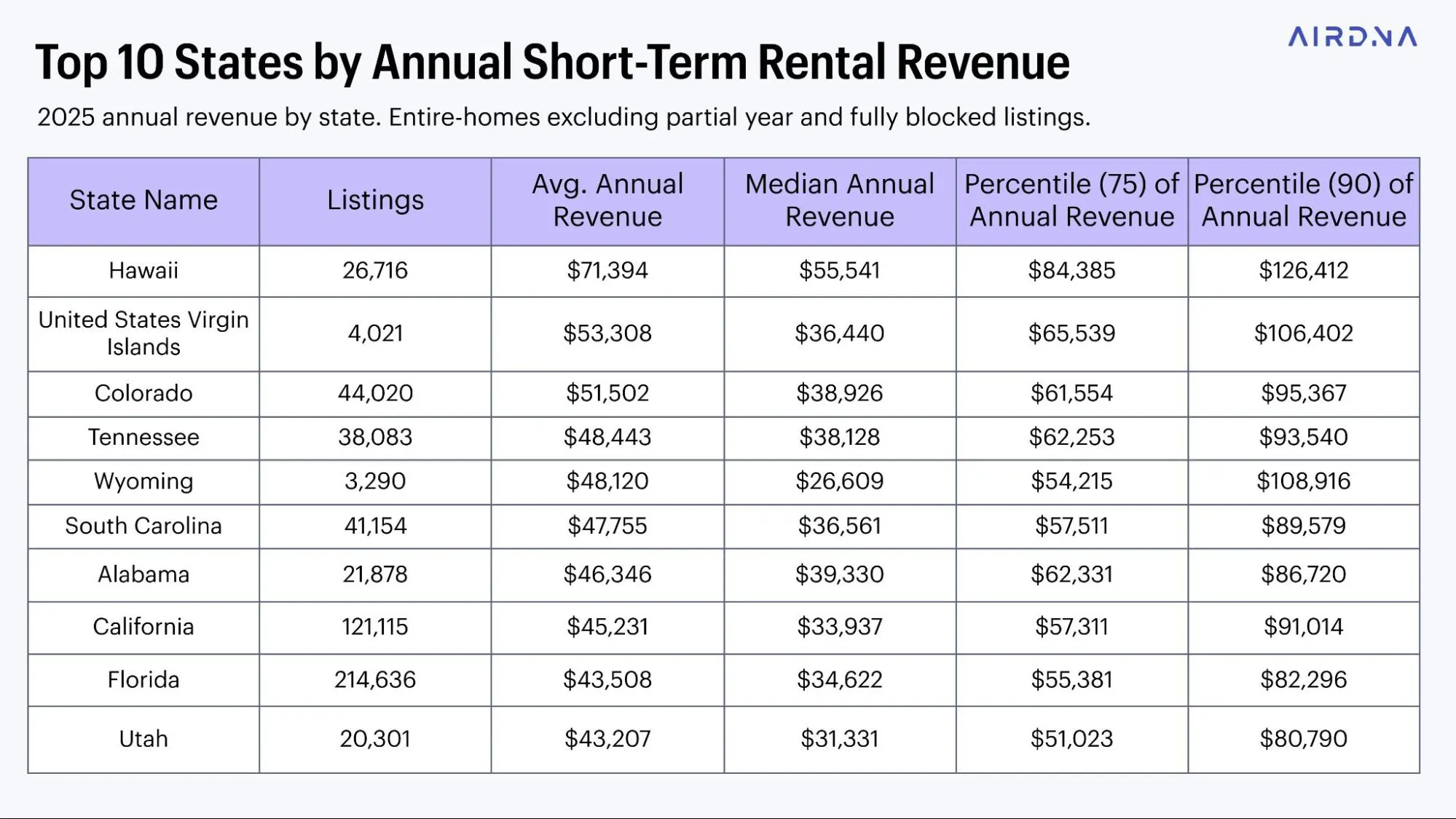
Looking at the state level, the highest-earning states for short-term rental hosts in 2025 based on median annual revenue were:
- Hawaii: $55,541
- Alabama: $39,330
- Colorado: $38,926
- Tennessee: $38,128
- South Carolina: $36,561
Within each state, earnings can vary dramatically from one market to the next. The top five markets by median annual revenue in 2025 were:
- Aspen/Snowmass, Colorado: $85,952
- Kauai, Hawaii: $80,709
- Telluride, Colorado: $73,044
- Charleston, South Carolina: $60,083
- Maui, Hawaii: $59,109
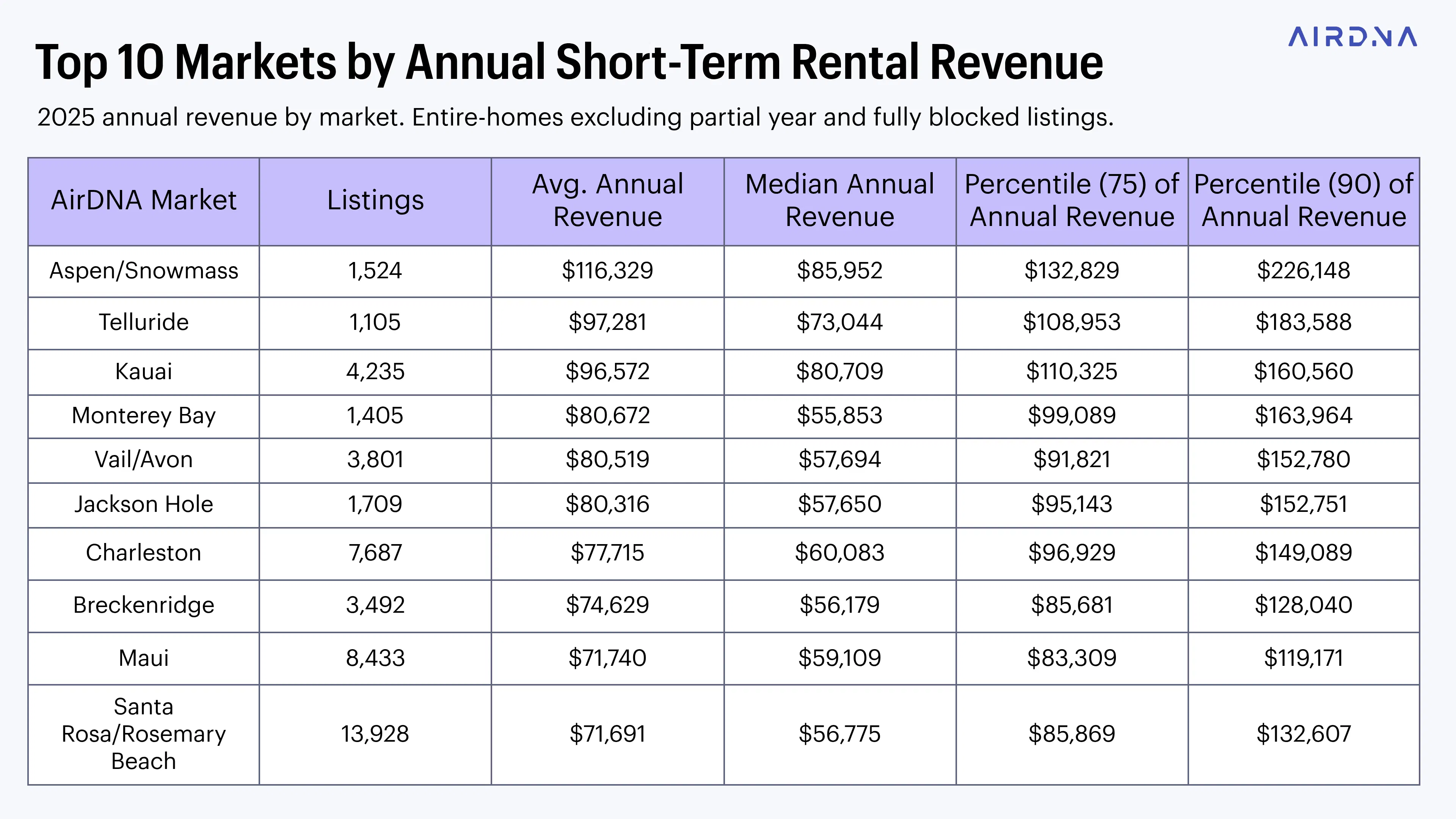
The key is not to go with your gut. Researching a market thoroughly before committing to a property is one of the most important steps you can take. AirDNA's Best Places to Invest report is a good starting point for identifying markets with strong earning potential, and tools like AirDNA let you dig into specific neighborhoods and submarkets before you buy.
2. Property type
The type of property you list on Airbnb can have a big impact on how much you earn. Larger properties that can host more guests often generate higher monthly revenue, but different property types can perform well depending on the market.
AirDNA data shows that average monthly earnings in 2025 vary by property type:
- Entire homes: about $4,700 per month
- Entire apartments: about $3,800 per month
- Entire unique properties: about $4,500 per month
Entire homes tend to earn the most overall because they can accommodate larger groups and families. Apartments can still perform well in urban markets where travelers prioritize location and convenience.
Meanwhile, unique Airbnb properties, such as cabins, tiny homes, or treehouses, can command strong rates because they offer a distinctive experience that stands out in search results.
It’s also worth noting that many hosts start by renting out their own home on Airbnb rather than purchasing a property specifically for Airbnb. Depending on the market, this can still generate meaningful monthly income while helping hosts test the short-term rental market.

3. Amenities
Adding desirable amenities like hot tubs, parking, or premium furnishings can boost your income substantially. Just remember to do your research when determining which amenities guests in your areas will pay a premium for.
AirDNA data shows a noticeable difference in 2025 monthly earnings depending on certain amenities:
- With hot tub: Average $6,200 per month
- Without hot tub: Average $3,600 per month
- With parking: Average $4,100 per month
- Without parking: Average $3,500 per month
However, the value of an amenity depends heavily on the location. For example, hot tubs often perform especially well in ski towns, mountain destinations, and lakefront markets, where guests are looking to relax after outdoor activities. In tropical destinations, on the other hand, a hot tub may not have the same impact on pricing or bookings.
Similarly, parking can significantly increase earnings in dense urban areas, where guests may struggle to find a place to leave their car. In rural destinations, parking is often expected and may not add much additional value.
4. Price tier
Price tier also plays a major role in how much you can make on Airbnb. Properties positioned at higher price points typically command higher nightly rates and, as a result, generate more monthly revenue. However, higher-end listings often come with higher upfront investment and operating costs.
AirDNA data shows that average monthly earnings increase steadily across price tiers. Tiers are determined by average daily rate (ADR) performance over the last 12 months. The budget tier captures the bottom 20% of listings by ADR in a given market and luxury the top 20%. Here is average monthly earnings in 2025:
- Budget properties: about $2,400 per month
- Economy: about $3,100 per month
- Midscale: about $3,700 per month
- Upscale: about $4,500 per month
- Luxury: about $6,700 per month
Luxury properties tend to earn the most because they offer premium features, larger spaces, and higher-end finishes that allow hosts to charge significantly higher nightly rates. Budget and economy listings, on the other hand, often rely on competitive pricing and consistent occupancy to generate steady income.
The key is choosing a price tier that matches both your property and the expectations of travelers in your market.

5. Calendar availability
How often your property is available to book also affects how much you can make on Airbnb. Simply put, more available nights usually mean more opportunities to earn revenue.
However, the difference isn’t always as large as many new hosts expect. Some listings perform well even when they’re only available part of the year, especially if they’re priced strategically or located in high-demand destinations.
AirDNA data shows a relatively small gap between part-time and full-time listings, but keep in mind that these figures are 2025 averages for the U.S. as a whole and could look different in your specific market:
- Available 1-90 days per year: about $3,400 per month
- Available 90 days or more per year: about $4,100 per month
This means that even hosts who rent their property occasionally, such as when they travel or during peak tourism seasons, can still generate meaningful monthly income.
6. Seasonality
How much you make on Airbnb can also change significantly throughout the year. Airbnb rental income is heavily influenced by seasonality, since travel demand rises and falls with the calendar.
For example, AirDNA data shows that median monthly revenue for U.S. Airbnb listings in 2025 was about $1,451 in January, one of the slowest travel months. By July, when summer travel peaks across many markets, median monthly earnings climbed to about $3,970.
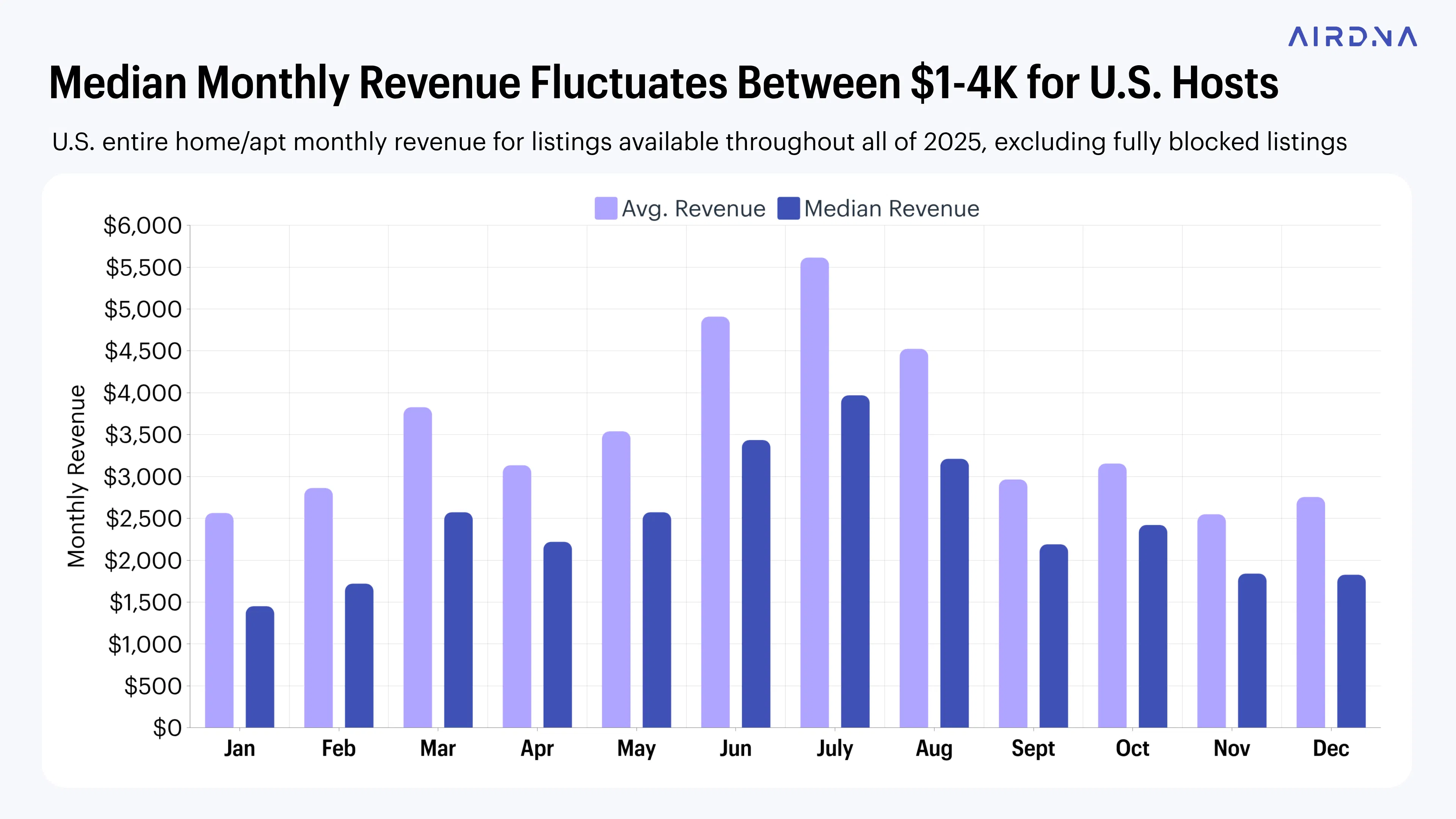
These swings happen because travel patterns change throughout the year. Beach destinations often peak in summer, ski towns see their busiest months during winter, and lakefront markets tend to perform strongest during warm-weather travel seasons.
The key takeaway is that Airbnb income rarely stays the same month to month. When estimating how much you can make on Airbnb, it’s important to think in terms of seasonal highs and lows rather than a fixed monthly average.
7. Your competition
In most markets, guests are comparing many different listings before they book.
If there are many similar properties nearby, you may need to price more competitively or offer standout amenities to attract bookings. On the other hand, if your property offers something unique or fills a gap in the market, you may be able to charge higher nightly rates and maintain stronger occupancy.
This is where comp sets are useful. A comp set is a group of listings that are similar to yours in terms of location, size, amenities, and guest capacity. By looking at how these comparable properties perform, you can get a better sense of realistic nightly rates, occupancy levels, and potential monthly revenue.
Monitoring your competition can help you:
- Set competitive nightly rates
- Identify amenities guests expect in your market
- Spot opportunities to differentiate your listing
Ultimately, understanding your competitive landscape helps you price and position your listing more effectively, which can directly influence how much you can make on Airbnb.
8. Short-term rental regulations
Short-term rental regulations can have a real impact on Airbnb income potential. Many cities now require permits, charge local occupancy taxes, or place limits on how often a property can be rented.
These policies can shape both supply and earnings in a market. In cities with stricter rules, fewer listings may be allowed to operate, which can reduce competition and support higher nightly rates. At the same time, restrictions like annual night caps or zoning limits can reduce how many nights you’re able to host and in what areas.
That’s why regulations don’t just affect whether you can list a property. They can also influence how much you can realistically make on Airbnb in a particular market.
9. Ratings
Guest ratings can have a large impact on Airbnb income. Listings with stronger reviews tend to appear higher in search results and build more trust with potential guests, which often leads to more bookings and the ability to charge higher nightly rates.
AirDNA data shows a clear relationship between ratings and average Airbnb income per month:
- 4.0–4.5 star properties: about $3,800 per month
- 4.5–5.0 star properties: about $4,100 per month
- Properties with only 5-star reviews: about $4,300 per month
Even small improvements can make a difference. In some markets, a 0.1-star increase in your average rating can add roughly $100–$200 in monthly revenue.
In other words, consistently delivering a great guest experience can directly influence how much you can make on Airbnb.

10. Events
Major events can significantly increase how much you can make on Airbnb, especially in cities that host large festivals, conferences, or sporting events. When thousands of visitors arrive at the same time, hotel rooms often sell out quickly, pushing many travelers to short-term rentals instead.
During these high-demand periods, hosts can often raise nightly rates and maintain high occupancy, leading to much higher earnings than a typical month.
A good example is the FIFA World Cup 2026™, which will take place across cities in Canada, Mexico, and the United States. According to estimates from Deloitte cited by Airbnb, residents hosting during the tournament could earn around $3,000 on average per booking due to the surge in travel demand.
While events like the World Cup are rare, similar opportunities can arise around music festivals, major sporting events, conventions, or holiday weekends. For hosts, these peak demand moments can play a meaningful role in boosting annual Airbnb income.
For a deeper look at how to adjust nightly rates during major events, check out our guide to event-based Airbnb pricing.
11. Host Status
Host experience can also influence your overall revenue. Listings run by Superhosts, which are operators with consistently high ratings and strong guest feedback, often attract more bookings.
AirDNA data shows that Superhosts tend to earn more on average because their listings rank higher in search results and build more trust with guests. Over time, consistently great reviews and quick communication can help boost both your visibility and your Airbnb income.
12. Where you list
The platforms you choose to list on can also influence how much you make from your short-term rental. While many hosts begin with Airbnb, many choose to expand their reach by cross-listing on multiple booking sites, such as Vrbo and Booking.com.
Listing on more than one platform can help expose your property to a wider audience. Vrbo tends to attract families and vacation travelers planning longer stays, while Booking.com is widely used by international guests and last-minute bookers (you can compare the platforms here!).
By appearing across multiple booking platforms, hosts can capture demand from different types of travelers and fill more nights on their calendar. In many cases, that increased visibility and occupancy can lead to higher overall Airbnb rental income.

Factors That Affect Your Overall Airbnb Profit Margin
Knowing how much you can make on Airbnb is only half the equation. Revenue tells you what the property brings in, but your profit depends on the costs required to run it.
These common short-term rental expenses can significantly affect how much Airbnb income you actually keep:
- Mortgage or property costs: If you purchased the property as an investment, mortgage payments, insurance, and utilities can take a large share of your Airbnb revenue and directly affect your yield.
- Airbnb host fees: Airbnb charges service fees on each booking, which reduces the total amount hosts take home.
- Cleaning fees: Frequent guest turnover means paying for cleaning, laundry, and preparation between stays.
- Supplies and restocking: Essentials like toiletries, paper goods, coffee, and kitchen supplies need to be replenished regularly.
- Maintenance costs: Furniture, appliances, and fixtures experience heavier use in short-term rentals and often need repairs or replacement.
- Short-term rental taxes: Local lodging taxes, licensing fees, and income taxes can all impact overall profitability.
- Property management fees: Hiring a manager to handle guest communication, pricing, and operations can reduce workload—but also cuts into revenue.
Taken together, these costs determine your overall return on investment, just not what you make. Two properties might generate similar revenue, but the one with lower operating costs will ultimately produce more profit.
Frequently Asked Questions About How Much You Can Make on Airbnb
How much can you realistically make on Airbnb?
Most Airbnb hosts earn between $1,000 and $4,000 per month, depending on their location, property type, and how often they rent it out, according to AirDNA. The median U.S. listing brought in around $2,000 per month in 2025.
Hosts in popular tourist areas or high-demand destinations tend to earn above that figure, while occasional hosts renting out their place a few times a month can expect something on the lower end.
How much do Airbnb hosts make on average per month?
Monthly Airbnb earnings vary throughout the year, but the median U.S. host brought in $2,564 in January 2025, rising to $5,615 by July, according to AirDNA.
That gap reflects how much the time of year matters for short-term rentals. Peak travel months bring stronger demand and higher nightly rates, which directly pushes revenue up. If you're planning to host an Airbnb, expect your busiest months to do a lot of the heavy lifting.
What is a good profit margin for an Airbnb?
Many vacation rental owners evaluate performance using return on investment (ROI) rather than profit margin alone. A common benchmark for short-term rental investors is around a 5–10% annual ROI, depending on the property price, location, and operating costs.
Your actual return will depend on factors like mortgage costs, occupancy rates, nightly pricing, and expenses such as cleaning, maintenance, and taxes.
Is Airbnb worth it to make money?
For many investors, Airbnb can be a profitable real estate strategy, but monthly income is only part of the return.
Beyond cash flow, short-term rentals can generate value through property appreciation, mortgage paydown from guest income, and potential tax advantages. When those factors are considered together, Airbnb investing can offer stronger long-term returns than monthly rental income alone might suggest.
That said, success depends on choosing the right market, understanding local demand, and managing the property effectively.
Is Airbnb income consistent year-round?
No. Airbnb income is typically seasonal. Travel demand rises during peak periods such as summer vacations, holidays, and major events, and slows during off-peak months.
As a result, hosts often see higher earnings during busy seasons and lower revenue during slower travel periods, rather than a steady monthly income.
ARTICLE SUMMARY
Wondering how much you can make on Airbnb? This guide breaks down real earnings data, what drives income up or down, and practical strategies to maximize your short-term rental revenue.
Jamie Lane
AirDNA Chief Economist
He is responsible for data analysis, thought leadership, and leveraging advanced analytical techniques to provide new insights into short-term rental market trends. Native to Atlanta and an Airbnb host himself, Jamie enjoys cycling, mountain biking, backpacking, running, and playing in a dart league in his free time.