


Why Short-Term Apartment Rentals Can Outcompete in the Right Market
Published: November 7, 2024
Last updated: November 8, 2024

Scott Sage

Key Takeaways
- Apartments can outperform other property types, but size and market matter. The bigger, the better!
- The best-performing apartment rentals are in cities with year-round demand from diverse guests.
- From platform selection to guest targeting, success means adapting your approach to what urban travelers want—whether that's workspaces or monthly rates for longer stays.
Conventional wisdom says success in short-term rentals means owning a vacation home or a detached house. What if the easier path to profit is hiding in plain sight? Our data reveals something surprising: in major urban markets, apartments aren't just competing—they're often outperforming traditional vacation rentals, especially when it comes to consistent income.
Short-term apartment rentals offer unique advantages worth considering, whether you're just starting your hosting journey or you're a seasoned pro looking to diversify your portfolio.
Let’s look at exactly where and how apartments succeed, which booking platforms work best with this property type, and what it takes to turn an apartment into a profitable short-term rental.

Why You Should Consider an Apartment For an Airbnb
When it comes to seasonality, short-term apartment rentals have a major edge over traditional vacation homes.
While non-apartment rentals often see dramatic swings between their highest and lowest months, apartment occupancy remains notably steadier throughout the year. In fact, AirDNA analysis shows that all property types combined experience lower occupancy in their slowest months and higher peaks in their busiest months compared to apartments alone. This makes short term apartment rentals one of the most reliable property types for consistent income.
Here's some other reasons that make short-term apartment rentals attractive for property owners:
- Less maintenance: No yard work, fewer external maintenance concerns, and typically smaller spaces mean you can turn over units more quickly between guests.
- Steady income: Our data shows that apartments demonstrate more stable occupancy patterns than non-apartment rentals throughout the year.
- Built-in amenities: Many apartment complexes offer a long list of amenities like pools, gyms, or parking—perks that can make your listing stand out without additional investment on your part.
- Proximity to attractions: Urban apartments are typically close to business districts, entertainment venues, and public transit—major selling points that contribute to higher occupancy rates.
- Appeals to multiple types of guests: While beachfront homes might only attract vacationers, urban apartments serve multiple markets. Business travelers want workspace and access to business districts, tourists need proximity to attractions, and extended-stay guests seek that home-away-from-home feel. This versatility means you're never dependent on just one type of traveler.
Google backs us up here. People search for "short-term apartment rentals near me" over 5,400 times each month. Just as AirDNA has found with townhomes, apartments offer an accessible entry point into the short-term rental (STR) market. In major urban markets, they're leading the pack (which we'll explore in detail later), proving they're a solid business model with high market demand.
Tip: If you’re feeling torn between all the options, be sure to read our guide on how to decide on the best type of property for Airbnb. We also have an entire article dedicated to condos and apartments as investment opportunities, including an overview of the top markets for these STR types.

How Short-Term Apartment Rentals Perform Compared to All Property Types
Thinking about turning an apartment into a short-term rental but worried it can't compete with houses? Let's look at what the data actually says—the answer might surprise you.
Yes, as you can guess, smaller apartments earn less than non-apartment rentals of the same size. Specifically, AirDNA analysis found one and two-bedroom apartments typically earn about 10% lower average daily rates (ADR) than all property types of the same size.
This performance discrepancy is likely because smaller apartments compete more directly with nearby hotels. They also have lower operating costs compared to detached houses. Think less maintenance, no yard work, and often fewer furnishings to maintain, which may ultimately allow hosts to charge less.
Here's where it gets interesting: the numbers shift dramatically for larger units. Four-bedroom apartments earn 9.2% higher daily rates than all four-bedroom properties combined. This advantage grows even stronger with size—apartments with 6+ bedrooms command rates 9.8% higher than comparable properties. Even five-bedroom units keep their edge, with daily rates 2.5% higher than all property types of the same size.
The occupancy data paints a similar picture. Once you hit three bedrooms, occupancy rates outperform all property types with the same bedroom count, and the gap gets bigger as you add more bedrooms. Five-bedroom apartments have 9.6% higher occupancy than all comparable properties.

RevPAR (revenue per available rental)—which combines both daily rates and occupancy—seems to also tell us bigger is better. Small apartment units, which include one or two bedrooms, generate about 10-12% less RevPAR than all 1-2 bedroom property types combined.
Meanwhile, three-bedroom units earn 1.29% more than similar listings. And larger apartments? They're the real revenue generators, bringing in 12-17% more than all property types of the same size.

The bottom line? If you're entering the apartment rental market, think bigger. While large apartments might be harder to find, their premium rates and higher occupancy make them worth seeking out.
If a smaller unit is what you have or can afford, don't be discouraged—lower maintenance costs and steady demand in urban markets can still make these properties profitable, even with slightly lower rates.

Case Studies on Short-Term Apartment Rentals: Boston, Chicago, Miami
If you think success in the short-term rental market means owning a vacation home, think again. Apartments in cities like Chicago, Boston, and Miami offer one of the easiest ways to break into the market—and, in a lot of cases, they’re performing better than all property types as a whole.
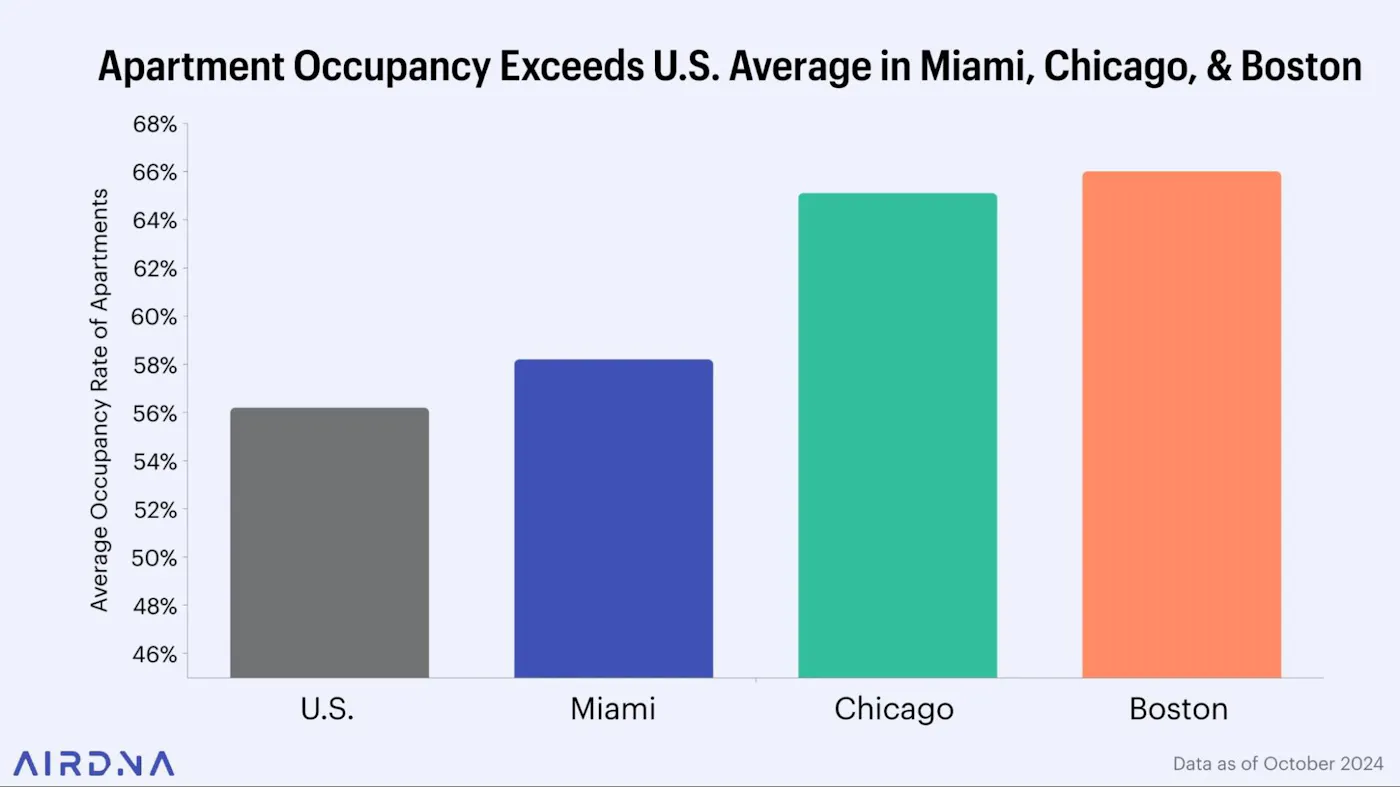
While apartments make up only 20% of vacation rental listings nationwide, that ratio is much higher in some urban markets, including Chicago, Boston, and Miami.
Apartment occupancy rates in these markets soar well above the national average. Let's look at what makes these cities such fertile ground for short-term apartment rentals and what their success tells us.
Chicago
Short-term apartment rentals in Chicago make up 54.3% of STR listings in that market, the highest share among our case study cities.
This market’s consistent demand for short-term apartment rentals allows one-bedroom units to capture 68% of the city’s total STR revenue for this property type—a notable lead in revenue share.
Chicago’s apartments also have a significant edge on occupancy, where apartments have a 10.8% higher occupancy rate than the average for all property types. This steady demand, paired with the city’s large share of STR apartment listings, positions Chicago as a stable market for hosts seeking strong, reliable occupancy rates and revenue.
Boston
Boston’s high density and year-round appeal for both tourists and business travelers contribute to its thriving short-term apartment rental market. In fact, short-term apartment rentals in Boston represent 51.2% of all STR listings in Boston, more than double the national average.
One-bedroom apartments in Boston capture 62% of the city’s total STR revenue for this unit size. Boston’s apartments enjoy an occupancy rate 9.3% higher than non-apartment STRs, providing hosts with more consistent bookings throughout the year.
While the average RevPAR for apartment listings in the U.S. is approximately $90, short-term apartment rentals in Boston earn close to $140 per night in RevPAR. That’s 40% higher than the national average.
For investors, Boston’s strong demand, healthy occupancy, and high RevPAR make it a promising city for STR apartment hosts.

Miami
Short-term apartment rentals in Miami cover 44.7% of the city’s listings. Though slightly lower in occupancy advantage than Boston and Chicago, Miami apartments still deliver high revenue potential. One-bedroom units in Miami account for 52% of total STR revenue for this unit size.
Miami’s apartments have comparable occupancy rates to all property types as a whole, but they benefit from higher RevPAR due to steady tourist demand, especially in peak seasons. Miami hosts earn $115.71 per night in RevPAR, significantly higher than the national average of $90.
For hosts, Miami’s high revenue potential for apartments can yield consistent returns, particularly during the city’s high-demand travel periods.
The lesson here? If you're looking to start a short-term rental in a major city, don't just assume you need a house. The data from these urban markets shows that short-term rental apartments aren't just a viable option—they can be the stronger choice.

Where to List Your Short-Term Apartment Rental
Where you list matters as much as what you list. While Airbnb and Vrbo remain the go-to platforms for short-term rentals, apartment hosts have unique opportunities to tap into specialized and mid-term markets as well.
Keep in mind that people looking for apartment rentals aren’t necessarily going to Airbnb right off the bat—they may be looking for 1-6 month stays and vacation rental booking platforms won’t be their first search strategy. This is where your listing platform choices come into play. If you’re willing to serve guests looking for 1-6 month stays, an additional suite of booking platforms opens up.
For hosts looking to tap into platforms that best serve apartment rentals, consider these:
- National Corporate Housing: A trusted platform for business travelers and relocating guests, NCH offers fully furnished apartments with flexible lease terms—ideal for work assignments and extended relocations.
- Blueground: Popular in urban areas, Blueground offers high-quality, furnished apartments with flexible lease options. Blueground caters to business and extended-stay guests looking for premium, ready-to-live spaces.
- Sonder: With stylish, hotel-like apartments in prime locations, Sonder attracts premium guests looking for well-designed, amenity-rich stays. It’s ideal for hosts in popular city markets.
- Trulia: Trulia connects hosts with guests seeking flexible, furnished options in major cities. Trulia serves both short- and medium-term stays.
These corporate-focused platforms help hosts reach guests needing reliable, comfortable accommodations for work or relocation, positioning apartments with a “move-in ready” appeal.
How to choose the right listing platform
How do you know which platform to list your apartment on? The key is to match your platform choice to your apartment's strengths. If you're near a business district, consider corporate housing platforms. Close to hospitals? Medical staff housing networks might be your sweet spot.
Success often means spreading your net wide. Cross-listing your property on multiple platforms can maximize your visibility and keep your calendar full.
Just remember to invest in a good channel manager to keep your availability synchronized across platforms—nothing ruins a reputation faster than double bookings.

Hosting Considerations for Short-Term Apartments
Let’s say that you've decided to turn your apartment into a short-term rental. Smart move—but success in the apartment market looks different than managing a traditional vacation home or beach rental. Whether you're new to hosting or expanding your portfolio from houses to apartments, you'll need to think a little differently.
Getting approval for rental arbitrage
If you’re renting a space (like your own, for example) with the intent to sublet it short-term, you must get landlord approval. It’s called rental arbitrage and it can be profitable, but it depends on a clear agreement with the property owner. Outline the benefits of short-term rental income for the landlord, such as consistent rent payments and diligent property upkeep, to gain their support.
Review local and state regulations
Ensuring your rental meets local regulations is essential. Many cities require short-term rental licenses, have occupancy limits, or require specific tax reporting. Research your city and state regulations to confirm that your listing complies with all legal requirements, including rules on minimum stays and occupancy limits.
Consider adjusting your listing for peak and off-peak seasons
Consider setting minimum stay requirements according to demand to optimize occupancy and income. During peak season, longer minimum stays can reduce turnover, while accepting shorter stays in slower months keeps your calendar filled. Tailoring your listing to the season helps you maintain steady bookings and income year-round.
Consider crunching the numbers to see if offering a monthly discount could be worthwhile. Your revenue potential could be highest with a flexible strategy that accommodates mid-term tenants in addition to short-term rental guests.
Elevate your amenities
Luxury amenities can make your listing standout. Consider providing high-quality linens, premium toiletries, a fully stocked kitchen, and extras like a smart TV or a coffee station. If possible, invest in stylish decor and thoughtful touches such as local artwork or cozy blankets. These small upgrades add a touch of luxury that elevates your apartment above standard listings and attracts guests looking for comfort and style.
Is Hosting a Short-Term Apartment Rental Right for You?
Looking at all these strategies and stats might feel overwhelming. Let's cut to the chase: apartment hosting isn't for everyone, but it could be perfect for you if you're in the right position. You might be an ideal short-term apartment rental host if:
- You're in a high-demand urban market where apartments already dominate the short-term rental scene.
- You have access to a larger apartment (our data shows 3+ bedroom units often outperform houses).
- You prefer steady, predictable income over seasonal peaks and valleys.
- You're comfortable balancing a mix of short stays and extended bookings to keep your calendar full.
The key is matching your goals with what apartment rentals do best: providing consistent returns in urban markets, especially with larger units that stand out from the typical one-bedroom offerings.

Frequently Asked Questions
Can I Airbnb my apartment?
Yes, but first check three key things. Start with your lease or HOA rules—many explicitly mention short-term rentals, and you'll need written approval from the property owner if you're renting. Secondly, review your local regulations. Cities have different rules about permits, taxes, and how many nights you can rent. Finally, research your market. Our data shows apartments perform particularly well in urban areas, but success depends on factors like location, size, and local demand patterns.
Are short-term apartment rentals profitable?
Yes, but your success depends heavily on your market. Our data shows apartments in urban areas like Boston, Chicago, and Miami often outperform all property types as a whole, especially larger units. The key to profitability is matching your apartment type to the right market and guest mix.
Are short-term apartment rentals in NYC legal?
New York City has some of the strictest short-term rental regulations in the country. As of September 2023, rentals under 30 days require registration with the city, hosts must be present during the stay, and there’s a limit of two guests. Always check current local regulations and obtain necessary permits before listing your apartment.
How do you run a short-term apartment rental business?
First, get your ducks in a row legally—get the landlord's approval if you don't own it yourself, and review any regulations that might apply in your city. Once that's sorted, you can focus on building your business. That's a big question (we actually have a whole beginner’s guide to Airbnb here), but success comes down to mastering a mix of marketing, operations, guest experience, and business management. Start by learning your market and ideal guests, then build out your systems for everything from pricing to cleaning to guest communication. The best hosts are always learning and adapting to what their market wants.
How do you find short-term apartment rentals?
Focus on urban markets with strong short-term rental performance. Look for areas with diverse demand drivers (business districts, universities, tourist attractions) and research local regulations. Consider working with an investor-friendly real estate agent or short-term apartment rental agency who understands the short-term rental market.
ARTICLE SUMMARY
If you think apartments can't compete with vacation homes in the short-term rental market, our data tells a different story. While beachfront properties grab headlines, urban apartments are quietly outperforming in major markets. We'll show you why apartments might be your smartest play in short-term rentals, exploring everything from platform selection to hosting strategies that work for apartments.
Scott Sage
Senior Vice President, Marketing & Customer Experience
Scott is an Airbnb Superhost and industry pro, having founded Home Base BnBs—a short term rental management company that scaled to 200+ units. Scott combines his experience and passion for hosting to empower AirDNA customers' success. When he's not thinking about STRs, he is hiking, playing basketball, or playing pickleball.


Get started with AirDNA today.
Powerful, easy-to-use tools that help hosts and investors succeed in the short-term rental market.
Try for free