

 Calculate Revenue
 Research Markets
 Find For Sale Properties
 Compare My Listing
 STR Revenue Calculator
 Custom Comp Sets
 Submarket Insights
 Custom Search Filters
 Rate Recommendations
 Performance Benchmarking
 Competitor Comparison
 Owner Contact Details
 Property-level performance data
 Tourism Insights
 Real Estate Investment Analytics
 About Us
 Sales
Sales Support
 Press
Press12 Short-Term Rental Trends to Watch in 2025
Published: February 10, 2025
Last updated: June 10, 2025

Jamie Lane
Key Takeaways
- U.S. short-term rental supply growth is slowing in 2025, creating stronger pricing power for existing hosts.
- Climate change and evolving regulations are pushing investment toward emerging markets in small cities and rural areas.
- Larger vacation rentals are driving market growth in 2025, with spacious, multi-bedroom properties commanding higher occupancy rates and Average Daily Rates (ADR).
In the short-term rental industry, when one door closes, another often opens—and 2025 is proving this true in remarkable ways. The latest short-term rental statistics show supply growth at its lowest rate in years, yet hosts who adapt are finding success in new markets where yields can reach up to 14%.
Sure, major markets are becoming more challenging to succeed in—but smart hosts are discovering new opportunities, whether that's investing in smaller cities or adjusting their strategy around local events. From shifting supply dynamics to evolving guest preferences, these short-term rental trends are reshaping how successful hosts operate and where they invest.
We've analyzed the data to bring you the trends that matter most in 2025, along with practical insights on how to prepare for and benefit from these changes.
Vacation Rental Industry Trends
1. For luxury rentals, the experience is everything
Compared to 2024’s broad focus on short-term luxury rentals, hosts in 2025 need to go beyond premium properties and spotlight uniquely tailored experiences and high-value amenities to attract affluent travelers. High-end finishes and prime locations are no longer enough—travelers booking short-term rentals want exclusivity, seamless convenience, and curated services that make their trips unforgettable.
Luxury stays are becoming smaller but more refined. According to AirDNA’s 2025 Outlook Report, demand for one- and two-bedroom high-end properties is rising as fewer large groups travel together. Solo travelers, couples, and remote professionals are now driving the market, leading to a shift from sprawling estates to intimate, high-end spaces with premium amenities.
International demand is another key driver of luxury STR growth. Travelers from the Middle East and Asia are becoming significant contributors to luxury bookings in both the U.S. and Europe. With longer stays and higher spending power, these travelers prioritize personalized services, high-tech features, and wellness-focused spaces over sheer property size.
Luxury guests now expect rentals that offer:
- Eco-conscious design – Properties featuring solar panels, energy-efficient appliances, and sustainable materials appeal to environmentally conscious travelers.
- Smart home automation – AI-powered concierge services, automated climate control, and voice-activated smart features provide a seamless guest experience.
- Wellness-focused spaces – Infrared saunas, yoga studios, private chefs, and spa-like bathrooms cater to travelers seeking relaxation and self-care.
- Exclusive local experiences – High-end guests are willing to pay for private adventure tours, sommelier-led wine tastings, or VIP access to local attractions.
- Luxury tech integration – High-speed internet, soundproofed workspaces, and immersive home entertainment systems attract remote professionals and business travelers.
Hosts should focus on curating high-end travel experiences to stay competitive in 2025’s luxury rental market, rather than just offering premium accommodations.
Investing in smart home technology, wellness amenities, and exclusive local partnerships will help attract high-paying guests. Additionally, targeting international travelers and optimizing for smaller, upscale properties can position hosts to capture demand from this growing segment.

2. Climate change is a growing risk to hosts
Extreme weather events are becoming a bigger threat to short-term rental (STR) markets, with hurricanes, wildfires, and floods testing operator resilience in 2024. Hosts in high-risk areas have already experienced sudden booking drops, property damage, and market-wide slowdowns following major disasters.
For STR owners, climate risk is no longer an abstract concern—it’s a critical business factor. Hurricane-prone markets like Florida and the Gulf Coast saw significant declines in supply following major storms, while wildfire-affected areas in California and Hawaii experienced long-term booking disruptions.
Our data shows that even after the immediate crisis passes, demand in impacted areas can take months—or longer—to fully recover.
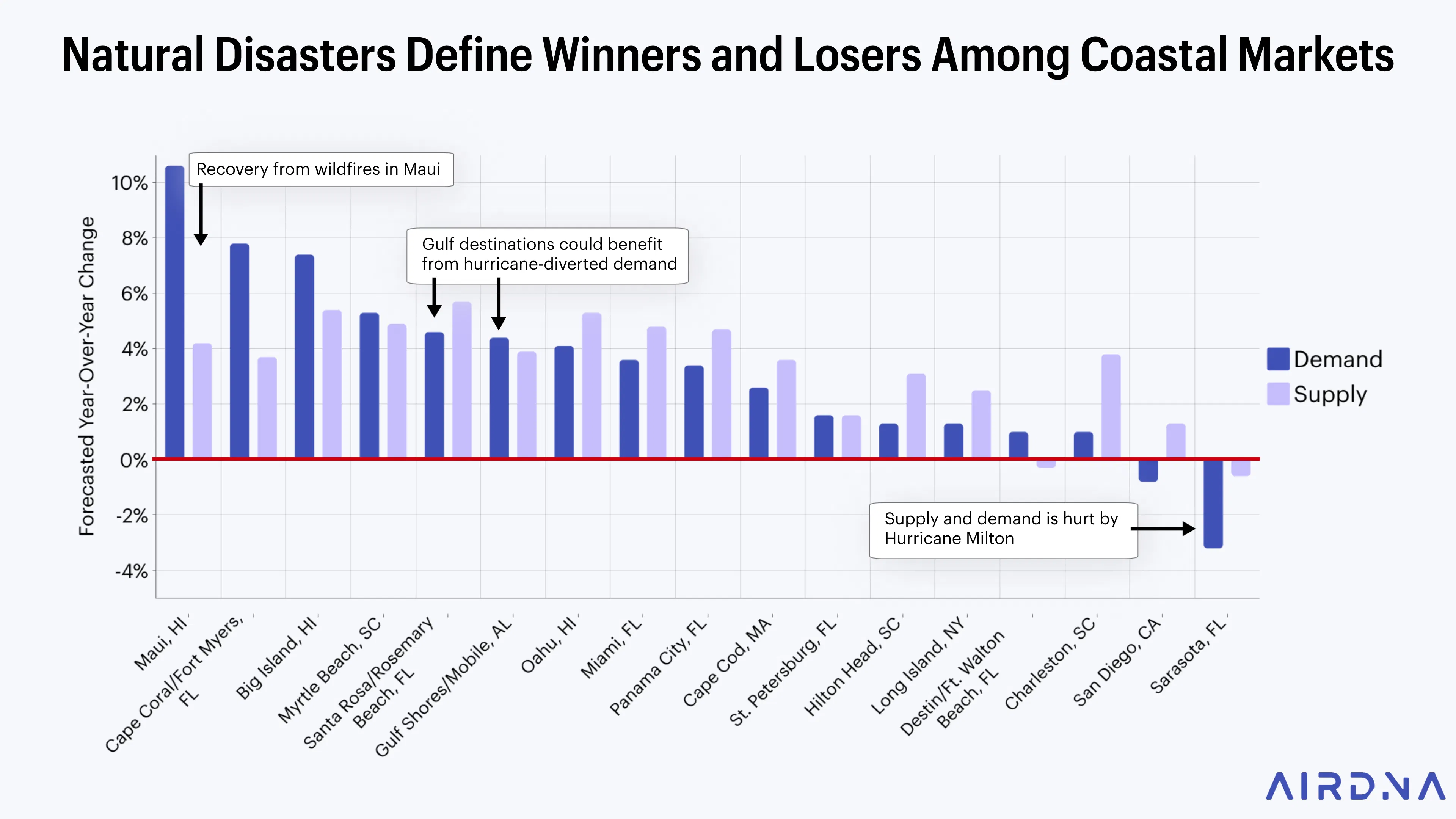
Here’s how to stay prepared as a short-term rental host:
- Fortify your property: Weatherproof your rental against common risks in your region, such as installing storm shutters, upgrading roofing, or maintaining defensible space against wildfires.
- Secure strong insurance: Standard policies often exclude natural disasters—review your coverage to ensure protection against flooding, hurricanes, and wildfires.
- Have a contingency plan: When your rental is forced off the market, consider diversifying revenue streams, maintaining emergency funds, and knowing your cancellation policies inside and out.
Natural disasters may be unavoidable, but hosts who plan ahead can minimize disruptions and recover faster. You can also read more on how hurricanes affect Airbnb revenue and what STR owners should know about Airbnb’s disaster policies.
3. Unique rentals continue to outperform in 2025
Standard vacation homes aren’t cutting it for today’s travelers. In 2025, uniquely designed rentals—think A-frame cabins, houseboats, domes, and architectural showpieces—are standing out in an increasingly competitive market.
AirDNA data shows that unique properties continue to command higher occupancy and nightly rates compared to traditional vacation homes. Listings that offer a visually striking, unconventional stay—whether it’s a geodesic dome in the desert or a luxury treehouse in the mountains—are outperforming standard homes as travelers actively seek out accommodations that add to the excitement of their trip.
What makes these properties successful isn’t just their quirkiness but their thoughtful execution. The most in-demand unique rentals pair bold architecture with modern comforts, ensuring guests get the best of both worlds. Well-designed interiors, strong branding, and high-end amenities all play a role in transforming an unusual space into a must-book property.
For hosts, standing out in 2025 means offering something guests can’t find anywhere else—whether that’s through striking design, an unforgettable location, or a stay that feels like a destination in itself.

4. Regulations create opportunity, not just challenges
Short-term rental regulations have been evolving for years, but in 2025, they’re becoming more structured and widespread. Instead of scattered local crackdowns, many regions are moving toward standardized regulations, aiming to bring clarity to an industry that’s long been a legal gray area. The EU is one example, where officials introduced new registration and reporting requirements across multiple countries. These take effect in May 2026, so hosts in those regions are starting to prepare now.
In high-demand cities like Paris, officials aren’t pulling any punches. Stricter licensing requirements, annual renewal mandates, and tighter occupancy limits mean hosts in these markets need to stay on top of evolving policies or risk being pushed out. At the same time, platforms like Airbnb are facing new data-sharing mandates in Europe, requiring them to report host and guest details to regulators, making it harder for under-the-radar listings to stay in business.

It’s not all bad news, though. Some markets are becoming more STR-friendly, offering relief for hosts looking to expand without constant legal uncertainty. Parts of the U.S. Midwest and Latin America are emerging as investor-friendly regions, where short-term rentals face fewer barriers.
In cities where tighter regulations are forcing out non-compliant listings, licensed hosts may actually benefit from reduced competition and stronger pricing power. In these areas, being compliant is a way to secure more bookings while others scramble to adjust.
Many hosts are proactively navigating regulations instead of reacting to them to stay ahead. Some are working with legal advisors and property management companies that specialize in local STR laws to ensure they remain in compliance.
Others are shifting their investments to suburban and rural markets, where demand is rising and restrictions are lighter. While regulations will always be a challenge, hosts who stay informed and adapt early will be in the best position to thrive. Read more about how to become a short-term rental advocate in your community here.
Calculate potential earnings
Understand the investment potential of any address in the world.
5. Supply growth in the U.S. is slowing
The U.S. short-term rental market is entering a new phase of slower growth. According to AirDNA’s 2025 Outlook Report, the expansion rate for new listings is projected to be the lowest in years. After years of rapid supply growth, the pace is now cooling, creating a shift in market dynamics.
Several factors are making it more difficult for new listings to enter the market:
- Interest rates – Higher borrowing costs are making real estate investments more expensive.
- High property prices – Increasing home prices mean fewer investors are jumping into short-term rentals.
- Tighter local regulations – More cities are introducing restrictions, limiting how many new listings can enter the market.
Here’s what that means for hosts: With fewer new rentals entering the market, existing hosts may benefit from reduced competition, leading to higher occupancy rates and stronger pricing power. This shift also presents an opportunity to stand out—those who invest in better amenities, unique themes, or standout design can capture more demand and position themselves as top choices for travelers.

6. Investing potential is high in small city and rural markets
The best Airbnb markets sometimes come in unexpected places. Recent data shows small cities and rural areas as some of the most promising investment opportunities. Take Rockford, Illinois, for example, where investors are seeing a gross yield of 14%, signaling strong returns in areas that aren’t traditionally top of mind for STRs.
Why are small cities and rural areas gaining traction? For one, lower property costs make these markets much more accessible to investors than high-priced metro areas. Buying in a smaller town often means lower upfront costs and better cash flow potential. Tourism is also booming in unexpected places—take Quincy, Washington, a town in the middle of nowhere that’s now a hotspot thanks to its proximity to the Gorge Amphitheatre. Finally, there’s the growing demand for unique experiences—travelers in 2025 are seeking something different, whether it’s a secluded cabin, a vintage Airstream, or a charming historic home in a town they’d never heard of before.
With affordability, strong returns, and rising demand, these emerging markets present a compelling opportunity for investors looking to expand their STR portfolios.
7. Events draw tourists—and money—into STR markets
Major events have a significant impact on STR markets, creating spikes in demand that savvy hosts can capitalize on. By implementing strategic pricing and adjusting availability, hosts can significantly boost their profits during these periods.
For instance, during the 2024 Kentucky Derby, Louisville experienced a 22% surge in occupancy, with many hosts increasing their nightly rates to match the heightened demand. Similarly, the 2024 solar eclipse drew thousands of visitors to prime viewing locations, leading to an 18.4% increase in ADR in locations along the viewing path. Graduation ceremonies are also a hot ticket, as families travel to college towns. Our data found graduation weekends command a 55% premium on ADR ($330 versus $213 nightly rate on average).
By staying informed about local events and adjusting their strategies accordingly, hosts can effectively leverage these occasions to enhance their revenue.

8. Larger listings will come out on top
The market is witnessing a trend where higher-priced, larger homes are driving Average Daily Rate (ADR) growth across various locations. This preference is particularly strong in urban areas and among budget-conscious travelers who seek value through shared accommodations.
According to AirDNA's 2025 Outlook Report, investing in properties with more bedrooms can lead to higher occupancy rates and increased revenue. Larger listings appeal to groups and families looking for spacious accommodations, making them a lucrative option for hosts aiming to maximize their earnings.
Hosts can position themselves to benefit from this upward trend in the STR market by catering to this growing demand for larger spaces.
Research Airbnb Markets
Gain insights into the revenue and occupancy trends in your market.
9. Smart hosts use SEO to their advantage
Your vacation rental is a product—so why not market it like one? The best hosts understand that visibility is key to short-term rental marketing, and search engine optimization (SEO) best practices can help boost where your listing shows up in search results. Small tweaks to your keywords, listing description, and images can make a big impact on how often potential guests see (and book) your space.
Here are a few ways to optimize your listing:
- Write a compelling title: Your listing’s title isn’t just a label—it’s prime real estate for SEO. Include relevant keywords and highlight what makes your place special.
- Price competitively: AirDNA’s research shows that pricing plays a major role in Airbnb’s search rankings. Dynamic pricing strategies can help keep your listing competitive.
- Choose the right images: Photos aren’t just for aesthetics—they’re a critical SEO factor. High-quality, well-lit images that showcase your space will help drive clicks and engagement.
The days of "set it and forget it" are over. Hosts need to continuously refine their SEO strategy to keep bookings flowing if they want to stay ahead in 2025.
Read more on creating an Airbnb SEO strategy.

10. Direct Bookings are key to success
Reducing reliance on third-party platforms is becoming increasingly important for hosts aiming to maximize their profits and maintain control over their bookings. Encouraging direct bookings allows hosts to avoid platform fees and build direct relationships with their guests.
Listing properties on platforms like Google Vacation Rentals can enhance visibility and attract guests seeking direct booking options. Additionally, many travelers are now looking to book directly with owners to secure better rates and memorable experiences.
Hosts can increase their profitability and foster stronger connections with their guests, leading to repeat bookings and positive reviews, by focusing on direct booking strategies. Uplisting is a our recommended property management software that allows you to set up a direct booking site in minutes.
Enjoy the confidence & focus you need to scale your vacation rental business
With a reliable VRM solution you can trust, Uplisting can help you grow your business without wasting time on double bookings, unhappy guests, upset clients and worrying what could go wrong next.
11. Smart hosts cross-list
If you're not listing your property on multiple booking platforms, you're leaving money on the table. Our latest data confirms that hosts who list on cross-list consistently earn higher monthly revenue and secure more bookings.
Relying on just one platform exposes you to risks like algorithm shifts, sudden policy changes, and outages that could disrupt your income. Cross-listing not only mitigates these risks but also broadens your reach to different traveler demographics—Airbnb tends to attract younger urban guests, while Vrbo is a favorite among families and groups.
The process may seem daunting, but smart hosts streamline it by using channel managers and dynamic pricing tools to automate calendar syncing and optimize rates. With 28% of U.S. STR listings already cross-listed—and the number rising—it's clear that this strategy is no longer just a bonus, but a necessity for maximizing rental income.
For a step-by-step guide on how to list on multiple platforms without the hassle, check out our full breakdown here.
12. Interior design makes the best first impression
Airbnb guests in 2025 have higher expectations than ever. With a growing number of properties run by professional property managers, a well-designed space is a necessity. A thoughtfully decorated Airbnb can boost bookings, increase nightly rates, and earn more 5-star reviews.
Here’s what’s trending in 2025:
- Aesthetic consistency matters: Guests are drawn to listings with a clear, well-executed theme, whether it’s modern minimalism, rustic charm, or boutique luxury.
- Comfort is key: Travelers expect cozy, functional spaces with high-quality bedding, stylish furniture, and inviting layouts.
- Bathrooms as a selling point: A spa-like bathroom—complete with warm lighting, plush towels, and sleek finishes—can set your listing apart.
In a market where guests have more options than ever, investing in smart design choices isn’t just about making your space look good—it’s about making it booked.
Calculate potential earnings
Understand the investment potential of any address in the world.
Stay Ahead of Airbnb Trends
As we look ahead to 2025, short-term rental market trends continue to demonstrate the industry's resilience and adaptability.
While luxury and unique properties steal the spotlight, opportunities are blooming in surprising places—from small cities to rural retreats. Smart hosts are learning to navigate new challenges, whether that's climate risks, changing regulations, or evolving guest expectations.
The key to success? Using reliable data to make informed decisions about where and how to invest, what amenities to offer, and how to price your property. While trends come and go, understanding your market never goes out of style. Start exploring your market's potential with a free AirDNA account and turn these insights into action.
ARTICLE SUMMARY
Stay ahead of the curve with the top 12 short-term rental trends for 2025. Learn how climate change, evolving regulations, and changing guest preferences are shaping markets.
Jamie Lane
AirDNA Chief Economist
He is responsible for data analysis, thought leadership, and leveraging advanced analytical techniques to provide new insights into short-term rental market trends. Native to Atlanta and an Airbnb host himself, Jamie enjoys cycling, mountain biking, backpacking, running, and playing in a dart league in his free time.
