Best Places to Invest in a Short-Term Rental with $700K–$1M
Published: January 27, 2026

Jamie Zhang
Key takeaways
- A $700K–$1M vacation rental investment budget opens the door to some of the most competitive and promising short-term rental markets in the country.
- While yields are lower than in cheaper markets thanks to higher startup costs, there’s still plenty of opportunity in places where occupancy, ADR, and guest demand line up.
- Using AirDNA, investors can filter markets and active listings by price and yield to quickly focus on locations for their specific budget.
Short-term rental investing with a $700,000 to $1 million budget is a different ballgame. It’s the big leagues: exceptional properties, high-end guests, and tightly run operations to to offset the massive price tags.
You’re weighing how much income a property can generate, how reliable demand is, and whether the higher upfront cost is worth the long-term return. These metrics don’t add up for every market, even the ones that have a reputation for being popular vacation destinations.
The fact of the matter is that exceptional home prices demand exceptional performance to make sense from an investment perspective. This list of the best places to invest with a $700K–$1M purchasing budget focuses on markets where that amount of capital goes furthest in terms of ROI.
What to Consider Deciding Where to Buy an Airbnb With $700K–$1M
Investing in short-term rentals at this level comes with advantages, but also high stakes. You’re spending more than the average buyer, which means you need a market (and a property) that can deliver meaningful returns, not just high-end aesthetics.
Here’s what to keep in mind:
Expect tighter yields
Gross yields are typically lower in this tier than in more affordable markets. That’s not a red flag. It’s a reflection of higher buy-in and startup costs. You’re spending more to purchase, furnish, and operate the property. Even if revenue is higher, the return as a percentage of your initial investment will often be smaller.
While markets with higher prices typically have lower yields, they can generate more income per listing even at a lower return rate. With short-term rentals generally being a non-passive asset class, it can sometimes be advantageous to have fewer properties generating more profit, even if it comes at lower overall yields.
Prioritize operational efficiency to control costs
At this level, returns depend not just on what you earn, but on what you keep. Operating expenses scale quickly with property size and guest expectations. Higher-end homes often mean bigger utility bills, more frequent maintenance, and elevated furnishing costs.
Plan for high guest expectations
A $900K listing comes with different expectations than a $300K one. Guests booking in this tier want high-touch touches: curated design, quality linens, local flair, and seamless service.
Consider investing in luxury Airbnb amenities: hot tubs, fire pits, high-end appliances, or standout outdoor spaces. These can help you justify higher pricing, drive occupancy, and boost reviews.
Factor in tax strategy and long-term portfolio
Properties with high price tags come with higher property tax liabilities. Short-term rentals can offer significant tax advantages to offset this cost and others, especially for investors who qualify for real estate professional status or meet material participation requirements, use cost segregation for depreciation, or strategically hold property in LLCs or partnerships.
Many investors also consider how a property fits into their broader portfolio, whether it offers personal use, reduces risk by diversifying assets across locations, or sets them up for appreciation down the line.
Our Methodology for Ranking the Best Places to Invest with a $700K–$1M Budget
These rankings are based on gross yield, which measures how much annual short-term rental income a property could earn compared to its purchase price. It’s a simple way to compare return potential across different markets and price points.
For this breakout by budget, we focused specifically on homes currently for sale in the $700K–$1M range and used AirDNA data to estimate their income potential based on how similar short-term rentals are performing in the area. That means these aren’t just top-performing markets in theory—they’re places where the numbers work on real listings that are available to buy.
Note: Average home prices, revenue potential, and yield for each market is based on currently for-sale properties, which change day to day. The figures in this report are based on data from December 2025 but will fluctuate as the real estate landscape evolves.
Best Places to Buy Vacation Rental Property in 2026 in the $700K–$1M Range
Below are the top 10 places to invest where the average home price among properties currently for sale is between $700,000 and $1,000,000.
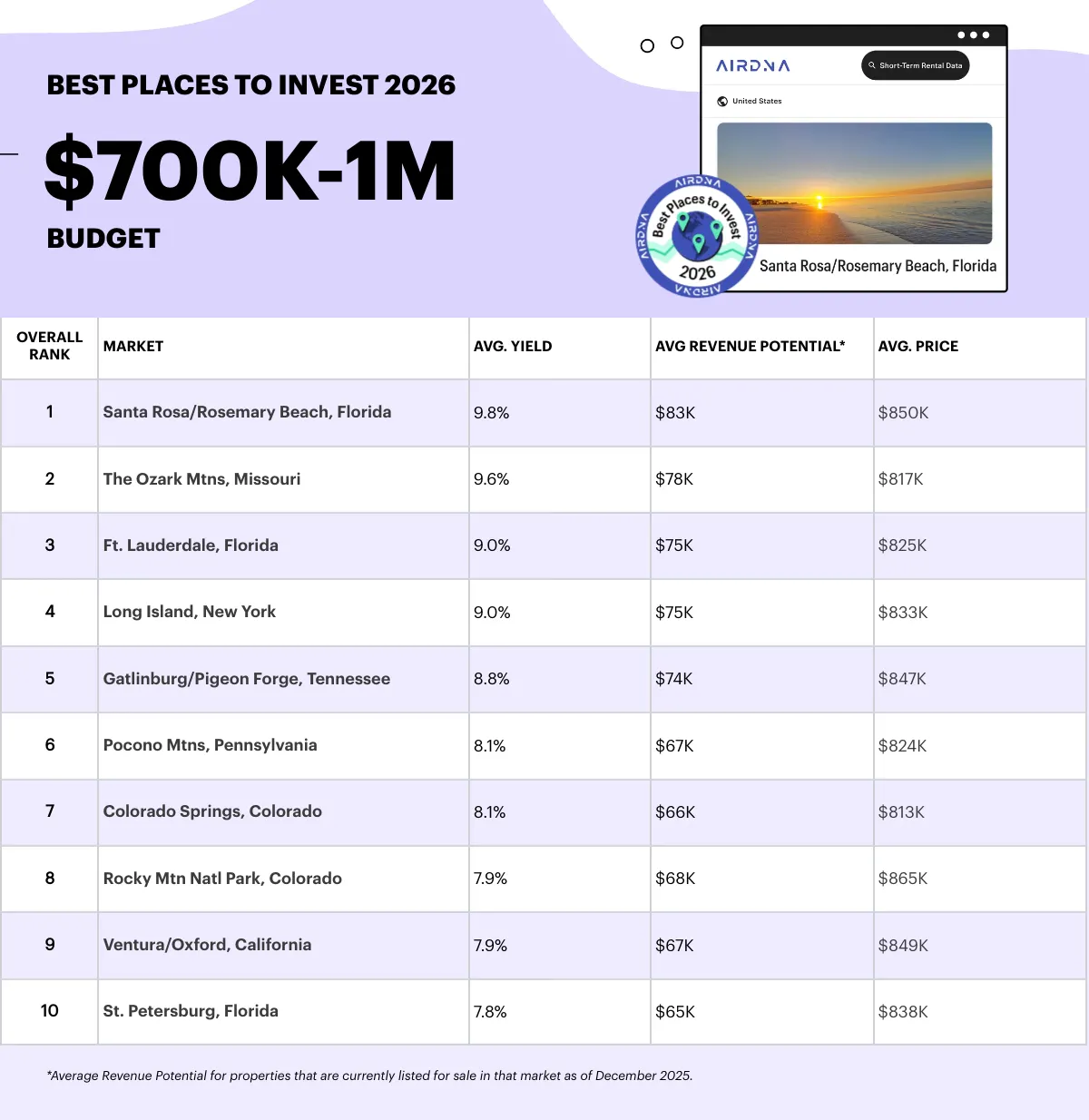
Remember that performance inevitably varies from asset to asset. Factors like location, layout, condition, amenities, and local regulations will impact a specific property’s yield.
1. Santa Rosa/Rosemary Beach, Florida
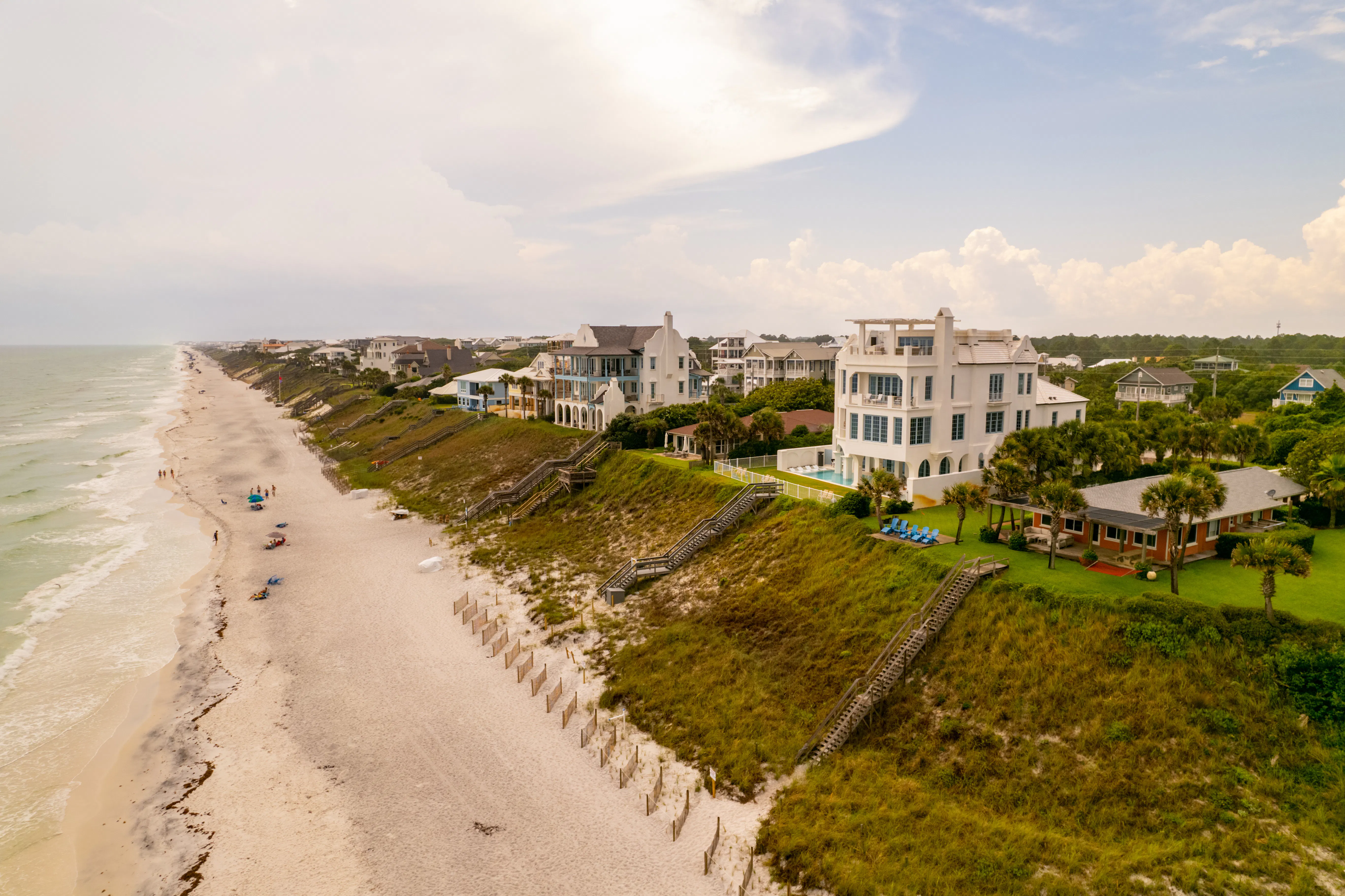

Santa Rosa Beach and Rosemary Beach, two standouts along Florida’s scenic 30A, have built a reputation as some of the most reliable and sought-after short-term rental markets in the Southeast. Guests come for the sugar-white beaches and stay for the walkable town centers, curated design, and nature-meets-luxury feel.
Average home prices sit around $850,000. Average revenue potential in this market is $83,401 a year, translating to a 9.8% gross yield. That’s a solid return in a coastal market where average occupancy in the summer months exceeds 80%.
Inventory is tighter than in some other destinations, with just 64 active listings in this market. That smaller pool of options can, however, actually benefit investors: there’s less noise in the market, and high-quality properties tend to move quickly, both with buyers and future guests.
Regulations: The regulatory framework is structured but manageable. Walton County requires a Short-Term Vacation Rental Certificate, renewed annually and tied to occupancy, safety, and compliance standards.
Florida also mandates a state-level vacation rental license through the Department of Business and Professional Regulation. In areas like Rosemary Beach, HOA rules may add another layer of review. Buyers should confirm short-term rental permissions at both the county and community level before purchasing.
2. Ozark Mountains, Missouri


The Ozark Mountains might not be the flashiest market on this list, but for short-term rental investors, this market checks a lot of boxes. This area is home to 7 submarkets, including Branson, Forsyth, Hollister, Kimberling City, Lampe, Ridgedale, and Shell Knob.
It’s one of the few places where you can still find high returns, healthy demand, and lifestyle appeal without crossing the million-dollar mark. Homes in this market average around $817,100, but pull in nearly $78,500 a year in projected revenue. That pencils out to a 9.6% gross yield. That’s one of the highest ROI among Airbnb locations on our list, and still a scenic, family-friendly destination.
For-sale inventory across the market is approximately 30 listings, as of December 2025. That means there is more competition when the right home comes up, but that kind of scarcity can actually work in your favor. In many cases, limited for-sale inventory signals a stable and high-demand area where owners tend to hold onto properties for the long term. For short-term rental investors, that can lead to less competition from new listings, stronger pricing power, and better visibility once your property is live.
Regulations: Short-term rental regulations in the Ozark Mountains region depend on location. In Branson, the most active tourism hub, properties must have a Short-Term Rental permit, a business license, and pass a fire inspection before operating legally. Outside city limits, rules vary by county or zoning district. All hosts in Missouri must register with the Department of Revenue to collect and remit state lodging taxes, and local tourism taxes may also apply. Always verify regulations at the parcel level before purchasing.
3. Fort Lauderdale, Florida
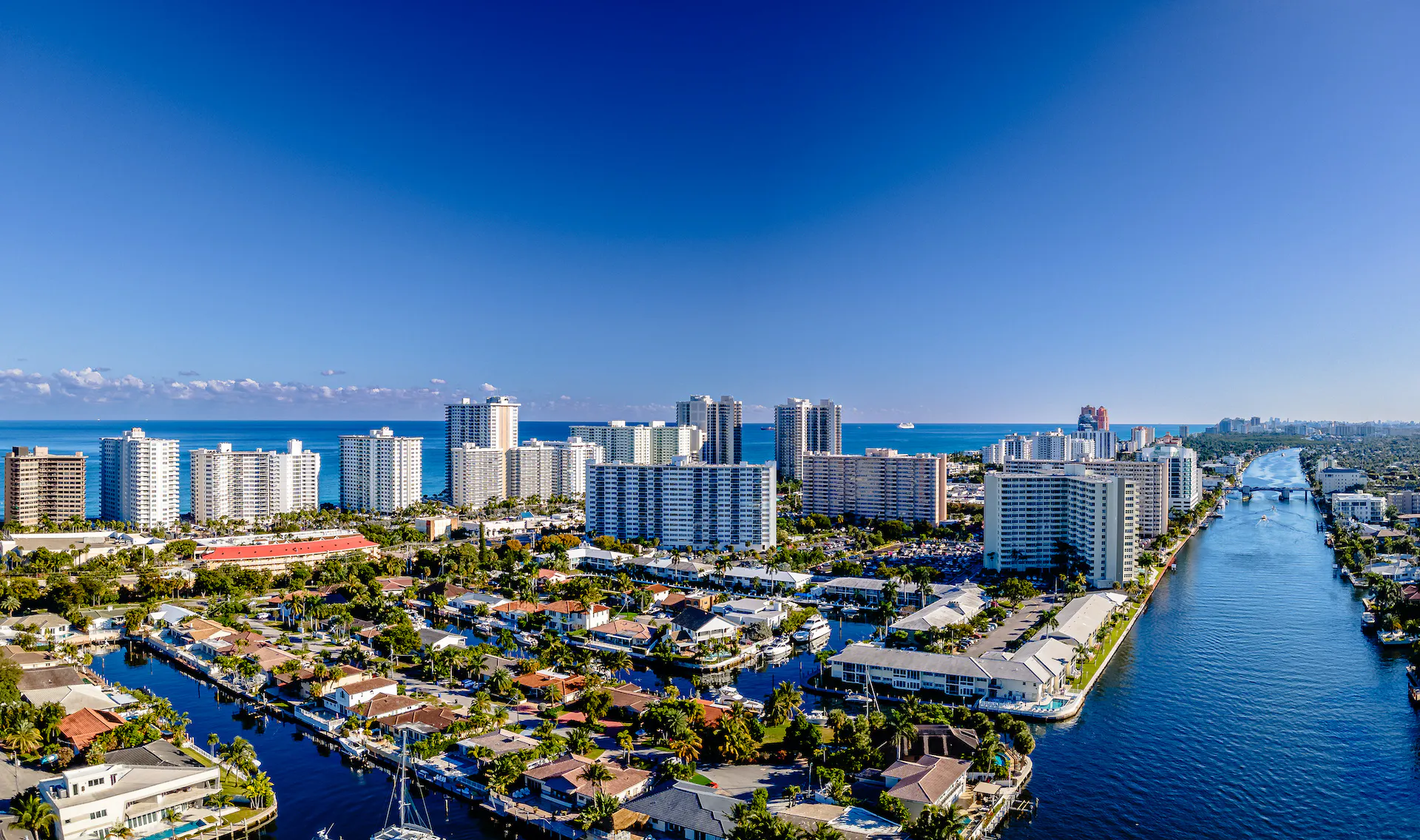

What makes Fort Lauderdale stand out is that it’s one of the most competitive markets on this list, and it still delivers great returns. This is a dense, year-round market with steady demand, high guest expectations, and a booking base that spans beachgoers, boaters, business travelers, and event guests.
The average home price is $825,219, and annual revenue potential sits at $74,515, resulting in a 9.0% gross yield. That’s a solid return in a well-known city with a mature short-term rental landscape. Fort Lauderdale also has more for-sale inventory than most markets in this range (sitting at 192), giving investors more options when it comes to layout, location, and amenities.
Regulations: Fort Lauderdale has a structured permitting process for short-term rentals, and it’s important to get everything in place before listing. The city requires a Vacation Rental Certificate of Compliance, which includes an application, a property inspection, proof of liability insurance, and compliance with rules around safety, occupancy, noise, and parking.
You'll also need to obtain a business tax license from the city and register with Broward County to collect and remit tourist development taxes. Lastly, a state license through Florida’s Department of Business and Professional Regulation is required. The process is manageable for investors who stay organized, but it’s not hands-off. Fort Lauderdale actively enforces compliance, so it’s important to keep documentation up to date.
4. Long Island, New York
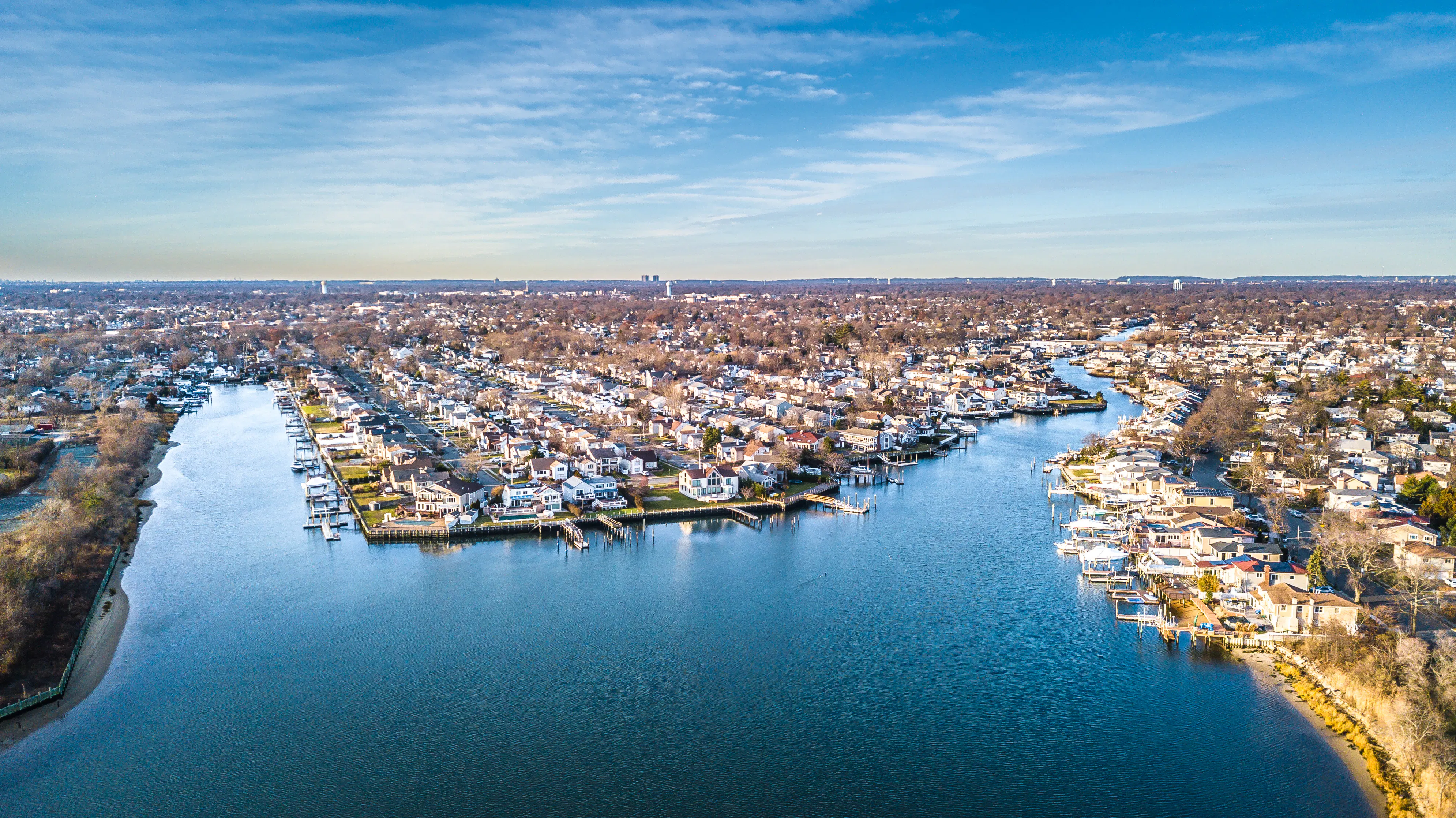

Long Island has the widest selection of investment inventory in this tier, with nearly 700 properties for sale as of December 2025. The best returns, however, still depend on picking the right property. With an average home price of $832,608 and annual revenue potential of $74,794, it sits on the higher end of the range for both cost and income. The 9.0% gross yield signals that performance holds up even with a higher buy-in, thanks in part to an average nightly rate exceeding $600.
Unlike many vacation markets that rely on one season or one traveler type, Long Island pulls from multiple guest profiles across multiple destinations. There’s summer demand in the Hamptons and Fire Island, but also shoulder-season stays driven by proximity to New York City, wineries, historic towns, and cultural events. That helps keep bookings consistent and gives investors more ways to win.
This market is a great fit for buyers with larger budgets who want to own a well-known destination and are ready to deliver a guest experience that matches the price point.
Regulations: Short-term rental regulations on Long Island vary by town. Most of the areas relevant to vacation rentals, especially in Suffolk County, have restrictions on stays under 30 days. Towns like Southold and Sag Harbor generally ban rentals shorter than 14 to 30 days unless you have a local permit, and some require the property to be your primary residence. The Hamptons, Montauk, and other East End communities often have additional zoning or seasonal limits, so it’s important to check local ordinances before buying. State and county taxes, including sales and occupancy taxes, may also apply.
5. Gatlinburg / Pigeon Forge, Tennessee


If you’re looking for consistent short-term rental income with room to scale, Gatlinburg and Pigeon Forge are hard to beat. These two neighboring cities may operate independently, but in combination they function as one of the most dependable vacation rental markets in the country.
Located just a few miles apart in the Smoky Mountains, they attract millions of visitors every year with a mix of national park access, family-friendly entertainment, and a travel culture built around multi-day, group-oriented stays.
The average home price here is $846,956, with annual revenue potential around $74,300, which translates to an 8.8% gross yield. That’s a solid return in a destination with a long track record of steady bookings and a guest base that knows exactly what they’re coming for.
Regulations: Both Gatlinburg and Pigeon Forge require city-level short-term rental permits, annual renewals, and compliance with local zoning and safety inspections. You’ll also need a business license and must collect applicable state and local lodging taxes. In unincorporated areas of Sevier County, STR permits and inspections are now required for rentals under 30 days. Because requirements differ by city and county, it’s important to confirm the rules based on your specific property location before buying.
How to Find the Best Airbnb Investment Cities at Any Budget
AirDNA helps you find where short-term rental performance actually supports the price tag. Instead of starting with a destination and hoping the math works, you can use real data to search by price, filter by yield, and dial in on the most promising investment opportunities.
Filter by budget
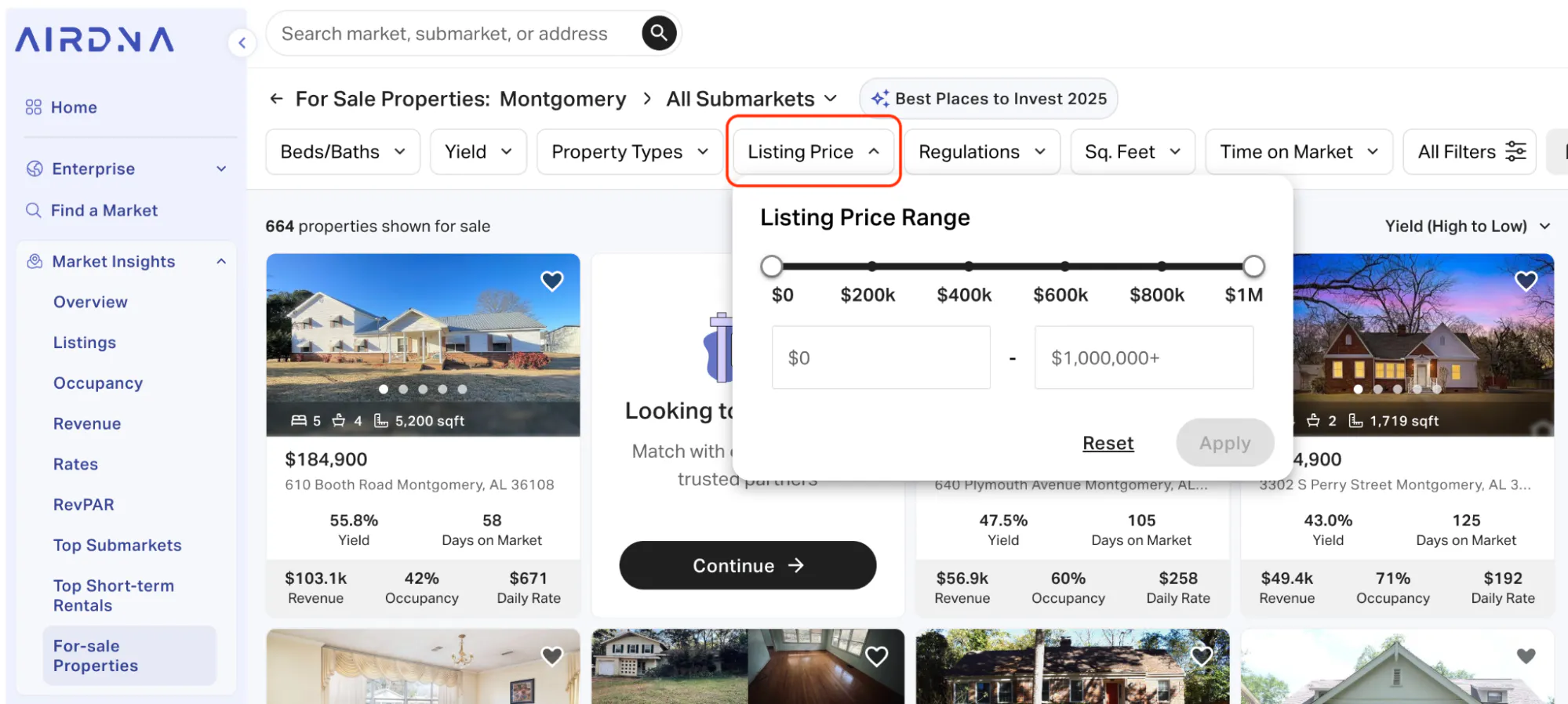
The best place to start is with what you can actually afford. Use AirDNA’s For-Sale Properties tool to explore markets where active listings fall within your price range. Or, start with a market and discover pockets of affordability within that area. The Listing Price filter lets you set your upper and lower limits, so you're only seeing properties that match your budget from the start.
Use yield to assess deals
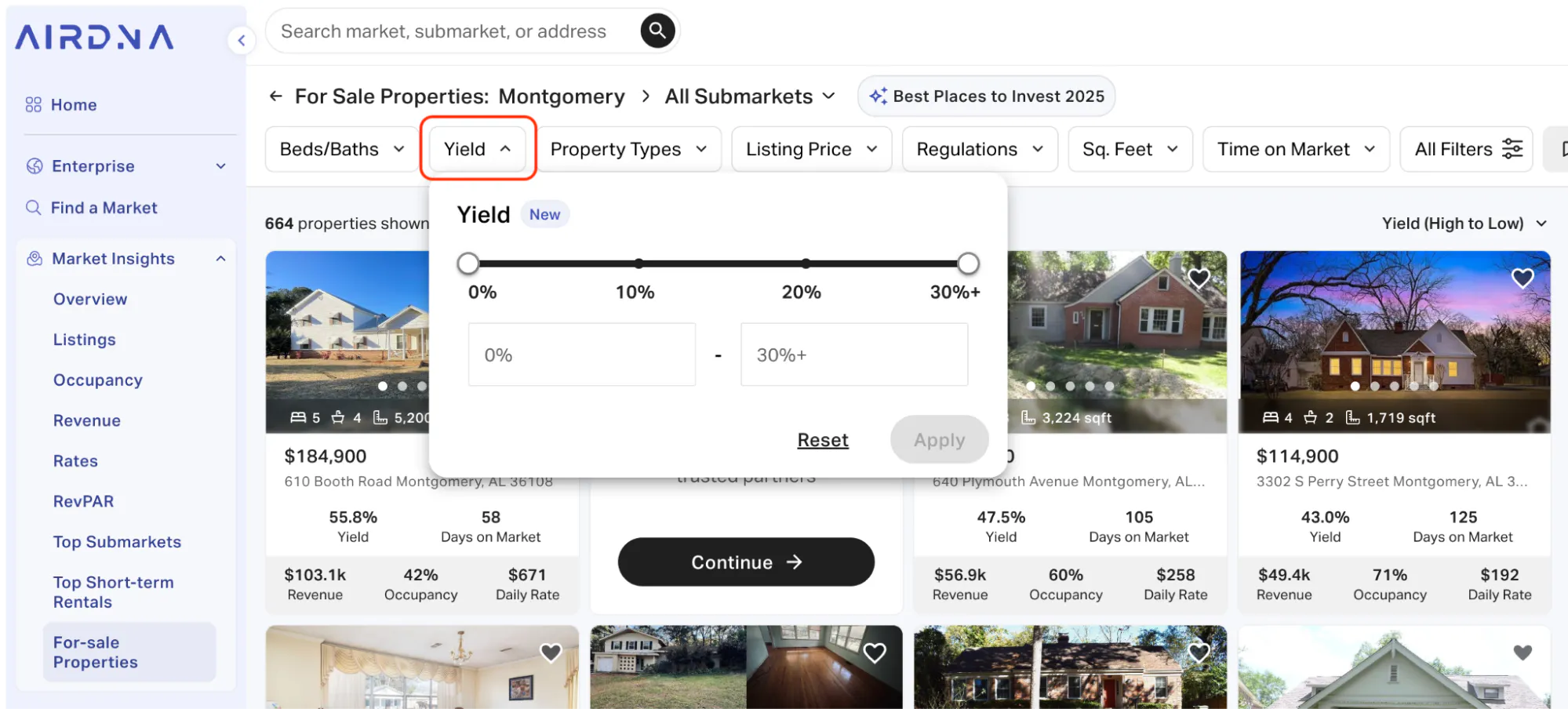
Just because a home fits your budget doesn’t mean it’s a solid investment. That’s where yield comes in. In AirDNA’s For-Sale Properties tool, you can sort listings by yield or set a minimum yield filter to narrow your list to properties that meet your targets. A 10% yield is considered middle-of-the-road in many markets. In this higher price range, though, it’s common to see yields a bit lower (around 8% to 9%), especially in premium or metro-adjacent destinations where nightly rates and occupancy are more stable.
FAQs
Are college towns good markets for short-term rentals?
College towns can be great places to invest in short-term rentals when pricing, proximity to campus, and demand are well-balanced. Universities generate recurring travel tied to events, graduations, sports, conferences, and visiting families, but performance varies by market. Looking at yield (not just demand) can help clarify where investment opportunities are realistic and actionable.
What are the top colleges for real estate?
Some of the top colleges for real estate for short-term rentals are University of Notre Dame, Michigan State University, Syracuse University, University of South Carolina,and University of Illinois Urbana-Champaign.
How close does an Airbnb need to be to a university to perform well?
Proximity often matters more than amenities in university markets. Properties near campus, stadiums, or major event venues tend to benefit from convenience-driven demand. That said, nearby neighborhoods with reliable public transportation can also perform well, especially when pricing is more accessible and competition is lower.
Are college town short-term rentals seasonal?
Seasonality varies by market, but generally speaking, short-term rentals in college towns see relatively stable year-round demand. Some college towns slow down during summer or academic breaks, while others maintain steady demand through conferences, camps, tourism, or regional travel. Markets with multiple demand drivers tend to feel less dependent on a single peak period.
ARTICLE SUMMARY
Looking for the best places to invest in a short-term rental in 2026 with a $700K–$1M budget? This guide highlights top markets where that budget gets you the highest return on investment for the some of the highest price tags.
Jamie Zhang
AirDNA Data Analyst
Jamie Zhang is a Data Analyst at AirDNA, leveraging her background in data science and analytics to uncover key trends in the short-term rental industry. Before joining AirDNA, she worked as a data analyst at Shanghai Disney, where she specialized in revenue forecasting and financial planning . She holds a Master’s degree in International Economics and International Relations from Johns Hopkins. Jamie enjoys cycling to explore different corners of the city.