Who Is Your Guest, Really? A Data-Driven Guide to Your Guest Avatar
Published: June 9, 2026
Last updated: October 22, 2026

Linda Rollins
Key Takeaways
- Guest avatars go beyond broad demographics by helping hosts understand the real motivations, priorities, and expectations behind each booking.
- Guest reviews, pre-booking questions, and market-level data can reveal valuable patterns about what travelers care about most.
- Understanding your guest avatar can help guide smarter decisions around amenities, property design, listing copy, and investment strategy.
Ask most short-term rental hosts who their ideal guest is and you’ll usually hear the same answers: families, couples, groups. But broad categories like these only tell part of the story.
The real opportunity comes from understanding what your guests actually care about, what motivates their booking decisions, and what makes a stay feel memorable to them.
That understanding has a direct impact on performance. Hosts who consistently win bookings aren’t always the ones with the biggest properties or the lowest prices. More often, they’re the ones who create listings that feel thoughtfully designed for a specific type of traveler. From the amenities they offer to the way they write their listings, every detail feels aligned with what that guest is looking for.
In this blog, we’ll break down how to identify your guest avatar using your own property data, guest reviews, and AirDNA’s new AI-powered insights. We’ll also look at how understanding your guests on a deeper level can help shape everything from the furniture you buy to your overall investment strategy.
What Is a Guest Avatar?
Before diving into the data, it helps to define what a guest avatar actually is and how it differs from a general guest demographic. There’s a big difference between knowing your guest category and understanding the person behind the booking.
“Families” is a demographic category. A parent traveling with two toddlers who filters listings based on fenced yards, blackout curtains, and whether there’s a pack-and-play available is a guest avatar.
That level of detail changes the way hosts make decisions. Suddenly, amenities become more intentional. Listing photos highlight the things guests actually care about. Descriptions speak directly to the concerns travelers have before they book.
It also creates a competitive advantage. Many hosts stop at broad audience categories like “families” or “couples,” which means their listings end up sounding similar to everyone else’s in the market. The hosts who stand out are usually the ones who understand their guests more deeply and create an experience that feels tailored to them from the very first click.
When a guest feels understood, they’re more likely to book, leave five-star reviews, and come back again in the future.
How to Find Your Guest Avatar
Most hosts already have the data they need to understand their guests more deeply. The challenge is knowing where to look and what patterns to pay attention to.
Step 1: Read your reviews closely
Your reviews reveal far more than whether guests enjoyed their stay. The language people use often points directly to what they value most.
For example:
- “Perfect for our girls’ trip” suggests guests care about shared spaces and group experiences.
- “The grandkids loved the yard” highlights the importance of outdoor family-friendly amenities.
- “We come here every year for our anniversary” points toward guests looking for comfort and relaxation.
Four-star reviews can be especially helpful because they often reveal the small gaps between a good stay and a great one.
Step 2: Look at pre-booking questions
Guest questions before booking can tell you exactly what travelers are worried about.
Repeated questions about pack-and-plays or high chairs may indicate you’re attracting young families. Questions about WiFi speed or workspaces can signal remote workers or business travelers.
These themes can also help improve your listing copy by showing what information guests need upfront.
Step 3: Use market-level data
Your own reviews tell one story. Market-level data reveals the bigger picture.
Looking at guest feedback across an entire market can uncover broader travel trends, common guest types, and the amenities travelers consistently care about most. With AirDNA’s AI-powered insights, hosts can quickly identify these trends without manually sorting through hundreds of competitor reviews.
How AirDNA’s AI Insights Help Identify Guest Avatars
Reading through hundreds of guest reviews manually can take hours, especially when you’re trying to compare multiple properties across a market. AirDNA’s AI-powered review insights help simplify the process by surfacing the patterns that matter most, from common guest complaints to the amenities travelers consistently mention in positive reviews.
Hosts can now quickly analyze guest sentiment at both the property and market level, making it easier to understand who their guests are, what they value, and where there may be opportunities to improve.
Start with your own property reviews
AirDNA’s property-level AI summaries provide an overview of what guests consistently praise, what they feel could be improved, and how recent guest sentiment is trending. Each property also includes an AI-generated sentiment score from 0 to 100 based on recent reviews, helping hosts understand how guests feel about the experience today.
Meet Jennifer, a host with a four-bedroom property near a popular national park. Recently, she noticed her reviews starting to slip and wanted to understand why.
Jennifer’s property has a sentiment score of 71 out of 100. Guests consistently praise the spacious layout, dog-friendly setup, and well-equipped kitchen. At the same time, multiple reviews mention limited dining seating, not enough kitchenware, and inconsistent cleaning.
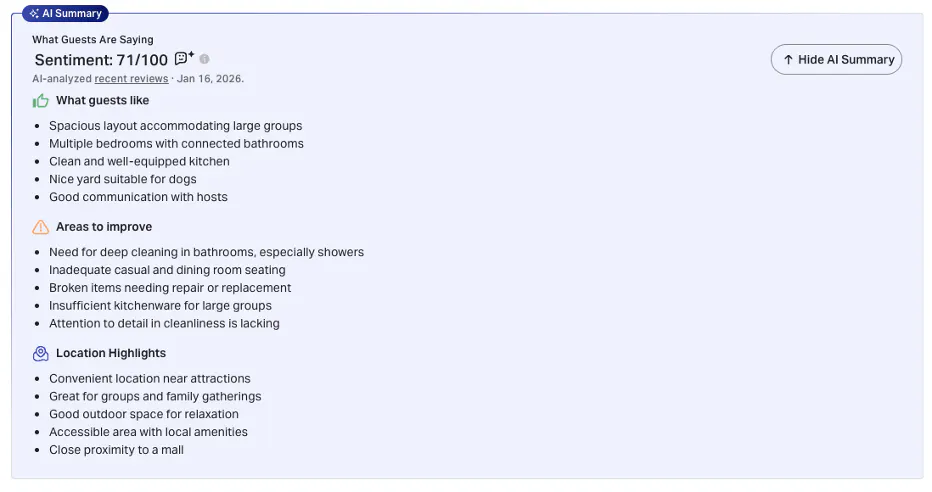
Rather than viewing these as isolated complaints, Jennifer starts identifying trends. Her guests are larger groups traveling together, cooking meals in the home, and spending significant time in shared spaces. That gives her a much clearer understanding of the type of experience her guests are actually looking for.
Compare nearby high-performing properties
With AirDNA, hosts can also compare nearby listings to see what highly rated properties are doing differently.
Jennifer pulls up a comparable four-bedroom property nearby with a sentiment score of 97 out of 100. Guests repeatedly mention the hot tub, cozy atmosphere, and game room with activities for all ages.
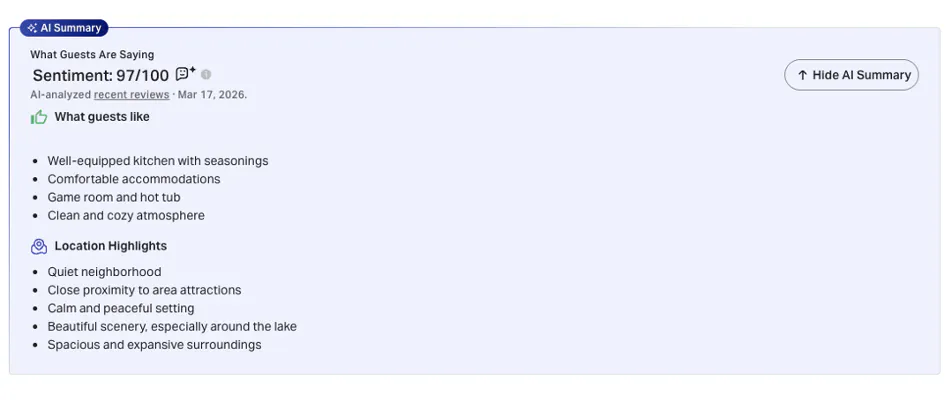
The comparison helps Jennifer spot a key difference in guest expectations. Travelers in her market are looking for more than extra beds and basic amenities. They’re looking for memorable group experiences.
That insight can help guide future upgrades, whether that means investing in larger amenities like a hot tub or making smaller improvements such as adding games, upgrading décor, or creating more inviting gathering spaces.
Look for shared market patterns
Lower-performing properties can also reveal useful insights.
Jennifer reviews another nearby listing with a sentiment score of 80. Across multiple reviews, guests mention not having enough seating and struggling with limited space to get ready before group outings or events.
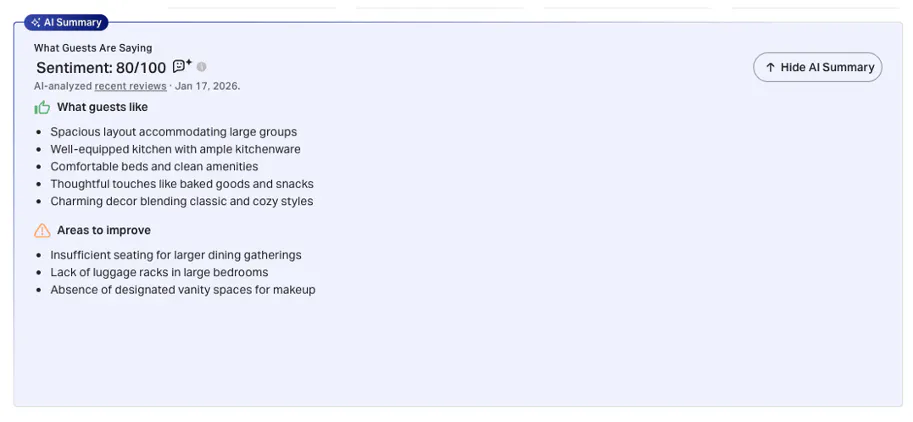
These recurring complaints help highlight common friction points for large-group travelers in the market. In many cases, relatively simple changes, like additional mirrors, better seating layouts, or more kitchen supplies, can have a meaningful impact on guest experience and future reviews.
Use Market-Level Insights to Spot Bigger Trends
While property level AI summaries give you a granular look at the performance of individual properties, AirDNA's AI market insights zoom out, giving you a bird's-eye view of the guest avatars across an entire market or submarket.
By analyzing recent Airbnb guest reviews, the tool surfaces what guests consistently value, common complaints, and the types of travelers most frequently booking in the area.
This can be especially useful when researching a new investment market. Take Port Arthur, Texas, AirDNA’s number one Best Place to Invest market for 2026.
At first glance, it appears to be a coastal leisure destination, but the AI insights reveal two distinct guest groups driving demand: family vacationers visiting for outdoor recreation and work travelers connected to the area’s oil, shipping, and infrastructure industries.
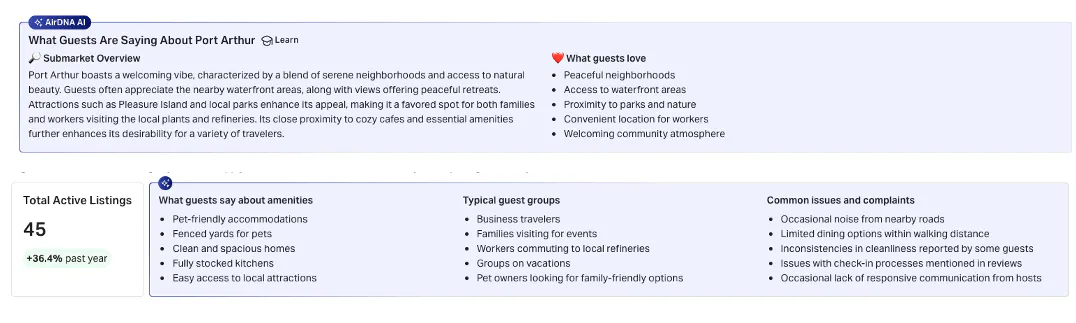
The data also highlights the amenities both groups consistently value, including pet-friendly accommodations, fenced yards, and well-stocked kitchens. For investors and hosts, these insights can help shape everything from property selection and amenities to listing positioning and marketing strategy.
Putting It All Together
At the end of the day, guest avatar data is only useful if it helps you make better decisions as a host or investor.
If you are an existing host, start with your AirDNA sentiment score and AI review summaries. Look for the patterns guests mention again and again, both the things they love and the things they wish were better. Then compare your property to nearby listings with higher and lower sentiment scores. Often, the differences are smaller and more actionable than hosts expect.
If you’re researching a new market, AirDNA’s market insights can help you understand who’s traveling there before you ever browse a listing. You can quickly identify the types of guests driving demand, the amenities they care about most, and the experiences they’re looking for during their stay.
The biggest change happens when you stop thinking about guests as broad categories and start thinking about the real people behind the booking. A family traveling with young kids has different priorities than a remote worker, a bachelorette group, or a couple booking a weekend getaway for Valentine’s. The more clearly you understand those motivations, the easier it becomes to create a listing that feels like the right fit from the very first click.
Short-term rentals made easy
AirDNA’s powerful yet easy-to-use tools make hosting and investing a breeze. This means having every insight you need, all in one place, always up-to-date.
FAQs
What is a guest avatar in short-term rentals?
A guest avatar is a detailed profile of your ideal guest based on their travel habits, preferences, booking motivations, and priorities. Unlike broad demographics such as “families” or “couples,” a guest avatar helps hosts understand what travelers actually value during their stay.
How can hosts identify their guest avatar?
Hosts can identify their guest avatar by analyzing guest reviews, pre-booking questions, booking patterns, and market-level data. AirDNA’s AI-powered review summaries and market insights can also help uncover common guest preferences, pain points, and travel trends.
Why is understanding guest behavior important for short-term rentals?
Understanding guest behavior can help hosts make better decisions about amenities, listing descriptions, pricing, and property upgrades. Listings that align closely with guest expectations are often more likely to attract bookings and receive stronger reviews.
How do AirDNA’s AI insights help hosts and investors?
AirDNA’s AI insights help hosts quickly analyze guest feedback at both the property and market level. Instead of manually reviewing hundreds of listings, users can identify common guest groups, top-rated amenities, recurring complaints, and overall sentiment trends within a market.
ARTICLE SUMMARY
Understanding your guest avatar can help short-term rental hosts make smarter decisions around amenities, listing copy, property investments, and market positioning. In this blog, we explore how hosts can use AirDNA’s AI-powered insights to better understand traveler behavior and create listings more aligned with guest expectations.
Linda Rollins
Senior Research Analyst
Linda Rollins is a Senior Research Analyst at AirDNA and a self-managing short-term rental host, which means she understands the market as both an analyst and an operator. She writes research and blogs for AirDNA and for Adapt, its revenue management tool, making her work a go-to resource for investors trying to find and size up the right opportunities, and for operators looking to understand changing market dynamics and find concrete ways to improve occupancy, rates, and guest experience. Her data is regularly cited in major news outlets, and she has a knack for bringing both the numbers and the story behind them. In her free time, Linda enjoys spending time with her family, traveling, and looking for good eats.