

 Calculate Revenue
 Research Markets
 Find For Sale Properties
 Compare My Listing
 STR Revenue Calculator
 Custom Comp Sets
 Submarket Insights
 Custom Search Filters
 Rate Recommendations
 Performance Benchmarking
 Competitor Comparison
 Owner Contact Details
 Property-level performance data
 Tourism Insights
 Real Estate Investment Analytics
 About Us
 Sales
Sales Support
 Press
PressUltimate STR Investor Checklist: 6 Steps to Profitability
Published: March 28, 2025
Last updated: March 31, 2025

Jamie Lane
Key Takeaways:
- Successful short-term rental investing starts with thorough market research.
- When you’re ready to buy, use AirDNA to find a for-sale property that’s in your budget and capable of delivering your desired cash-on-cash return.
- Once you’ve purchased an investment property, focus on preparing your finances, developing a tax strategy, and setting up contracts with essential vendors.
Most first-time short-term rental (STR) investors leave money on the table. They buy properties on gut feeling, set prices based solely on competitors' listings, and wonder why their occupancy rates flatline while others thrive in the same zip code.
The hard truth? Success in short-term rentals isn't accidental. The investors consistently banking six-figure annual revenues leverage data before spending a single dollar. They build systems that scale. And they know exactly which metrics actually matter.
This STR investor checklist is a blueprint for skipping the expensive learning curve that derails most new investors. For those serious about mastering STR investing, these beginner STR investment tips are backed by AirDNA's market intelligence. You'll learn precisely what to analyze before purchasing, how to structure operations to maximize efficiency, and which performance indicators accurately predict long-term success.
Ready to leave the guesswork behind?
Research Airbnb Markets
Gain insights into the revenue and occupancy trends in your market.
Quick Look: Short-Term Rental Checklist for Investors
Here are some quick guidelines to starting out in STR investing:
Perform market research
- Assess growth indicators to find a promising submarket
- Analyze seasonal patterns
- Assess the competition
Establish a team for support
- Find a real estate agent with STR experience
- Hire an accountant
- Hire a property manager or co-host
Purchase the right property
- Find a property in your budget
- Assess local demand
- Ensure the property appeals to your target guest
- Get necessary licenses
Prepare your finances and tax strategy
- Choose the right business structure
- Set up separate financial accounts for your STR business
- Get a tax ID
- Establish financial reserves
Furnish the property
- Select furniture and decor that balances aesthetics with durability
- Incorporate local and unique elements to add character
Set up essential vendor contracts
- Hire cleaning staff
- Hire a handyman
- Find a plumber
- Find an HVAC technician
- Find an electrician
- Find a landscaper

Step 1: Leverage AirDNA for Market Research
Amateur investors pick properties based on vacation experiences or real estate "hot tips." Seasoned STR investors know better—they make decisions driven by real market data. Following an STR investor checklist that prioritizes data analysis will set you apart from underprepared competitors.
AirDNA data transforms guesswork into strategic positioning. While others blindly enter markets hoping for returns, you'll identify exactly where demand consistently outpaces supply and which property types command premium rates in your market.
Investors who leverage AirDNA data before purchasing consistently outperform those who rely on general market assumptions. The platform becomes your personal GPS for starting out in STR investing. Trust us on this one—spend two solid weeks getting cozy with AirDNA's data before you even think about making an offer. Those hours spent perusing market reports could easily save you from a catastrophic six-figure blunder.
What to look for in AirDNA data
The STR investors who consistently outperform the market aren't just working harder—they're focusing on different metrics entirely:
Market growth indicators
Don't just look at today’s numbers—track the trajectory. AirDNA data reveals historical changes in average:
- Revenue
- Occupancy
- Average Daily Rates (ADR)
- Daily rates
- RevPAR
- Booking demand
- Daily lead times
- Length of stay
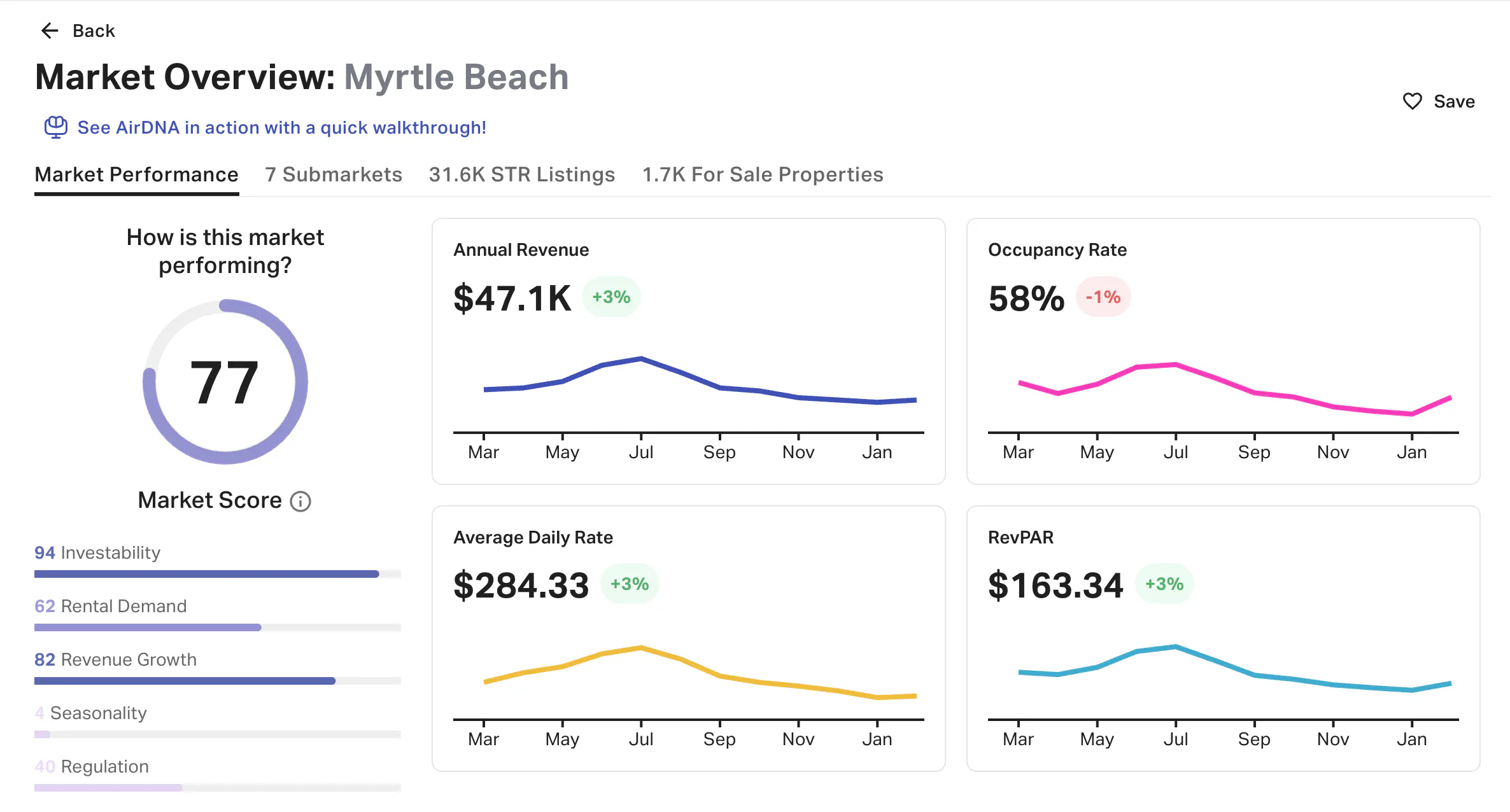
Our Market Overview dashboard aggregates these metrics into one easy-to-understand view. You can see the average values for these important metrics as well as how they've changed over the last 12 months. In the example of Myrtle Beach, South Carolina, you can see that annual revenue, ADR, and RevPAR have grown by 3% in that time frame.
Remember: AirDNA breaks down each market into submarkets, so you can drill down further to pinpoint which neighborhoods are most promising.
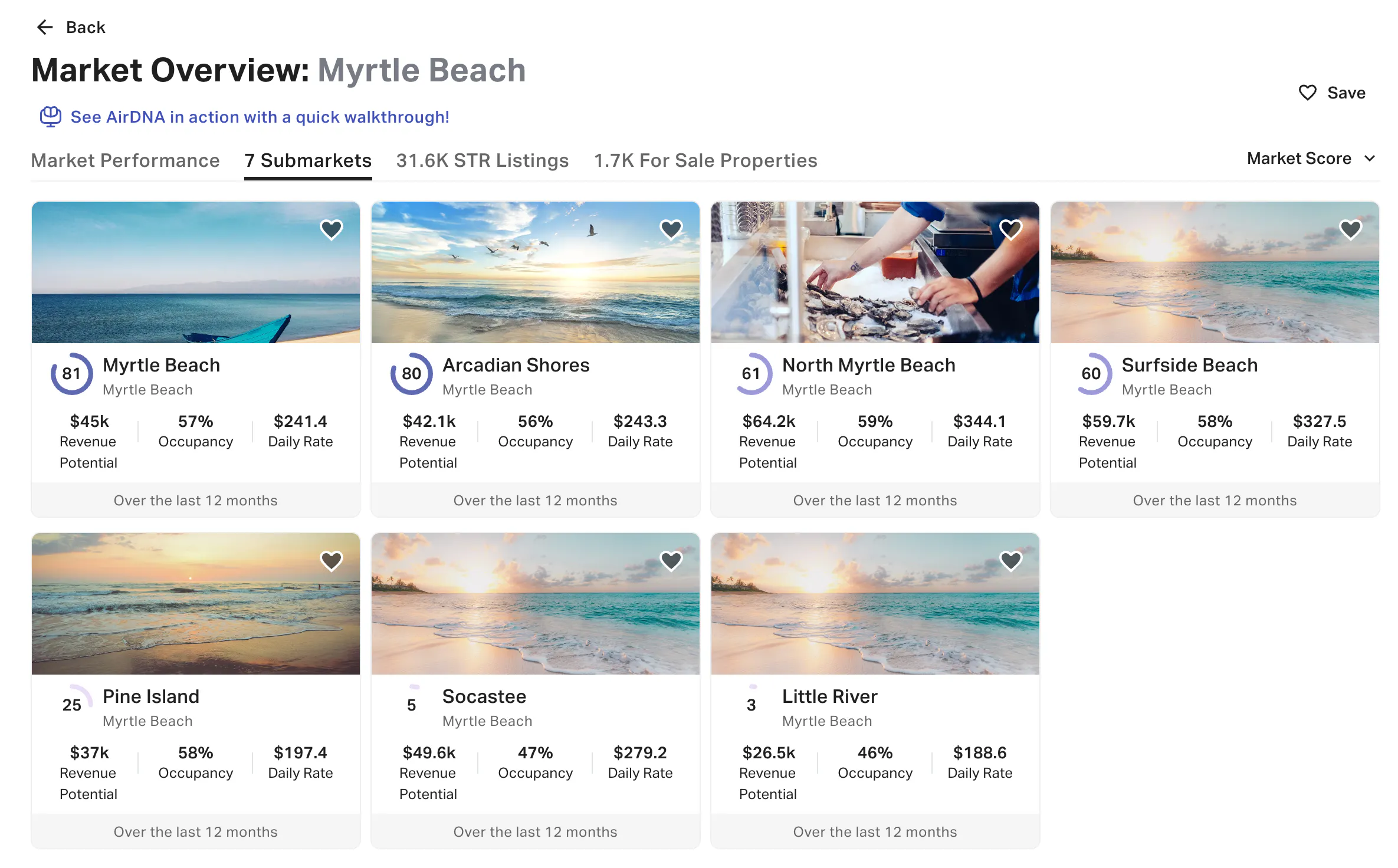
For example, Myrtle Beach comprises seven submarkets. Not every submarket is created equal in terms of performance. Each submarket has a unique Market Score on a scale of 0-100 that differentiates its performance from the larger market.
If you were to compare two of Myrtle Beach's submarkets, you'd see that annual revenue in the submarket of North Myrtle Beach has been stagnant over the last year, while revenue has increased 10% in the submarket of Arcadian Shores. That performance difference is reflected in their respective Market Scores of 61 and 80.
Learn how to perform a submarket analysis in AirDNA.
Competitor analysis
Every property within a one-mile radius is either your competition or your benchmark. Analyzing nearby properties will reveal:
- Which amenities drive higher rates in your specific location
- The optimal number of bedrooms for maximum occupancy
- Price points that attract your ideal guest demographic
- What five-star properties offer that three-star properties don't
If you have a property in mind, create a custom comp set in AirDNA to easily compare your prospective investment property to similar properties nearby. For example, if you’re thinking about buying a three-bedroom property with a pool, you can make sure your comp set only includes houses with three bedrooms and a pool.
Learn how to create a custom comp set in AirDNA.
Seasonal patterns
Most markets experience significant fluctuation throughout the year. Understanding seasonal patterns is like having a crystal ball to set your pricing—they show you exactly when to raise rates during peak demand and how to keep bookings flowing during quieter periods. Misunderstanding these patterns leads to cash flow problems that sink otherwise promising investments.
AirDNA's seasonality data reveals:
- The duration and intensity of peak season
- Off-season occupancy potential
- Opportunities to optimize during shoulder season
- Which special events drive temporary demand spikes
To get a feel for a market’s seasonality in AirDNA, first check its Seasonality Score. A low score indicates a very seasonal market, while a high score indicates low seasonality. (For reference: Myrtle Beach, South Carolina has a Seasonality Score of 4, meaning it’s a highly seasonal market).
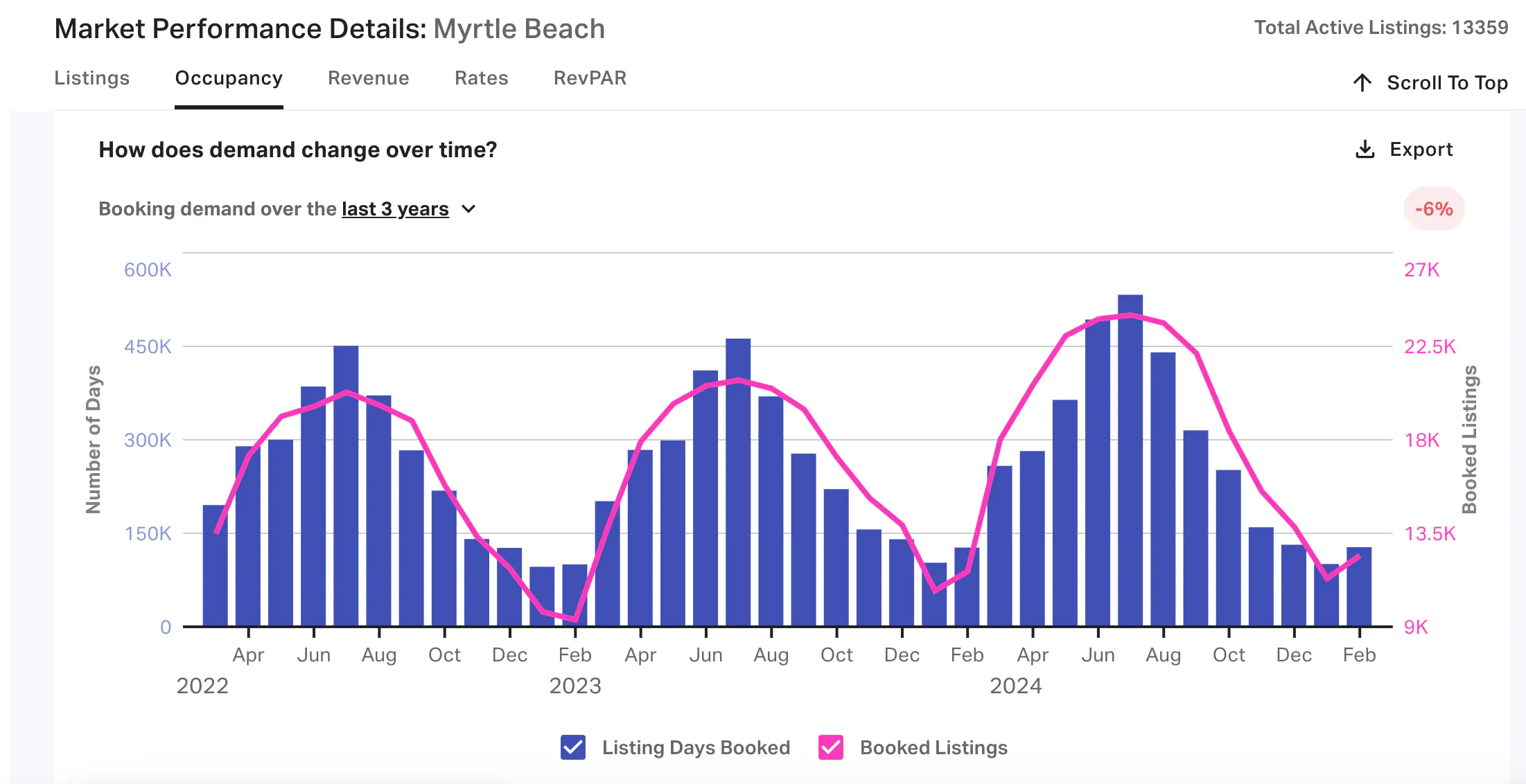
You can also check how demand has changed over time. Looking at 12 months of data gives you a sense of current seasonality, while reviewing data from the last three years can help you understand whether a market’s seasonal patterns have changed. When reviewing data for Myrtle Beach, we see a consistent pattern of high summer demand and low winter demand, indicating that seasonality hasn’t changed much in this market.
Step 2: Build Your Investing Team
One of the most valuable beginner STR investment tips is to surround yourself with experienced professionals
Behind every successful short-term rental portfolio stands a carefully assembled team of specialists who multiply your effectiveness and help you avoid costly rookie mistakes. Creating this support network can be the difference between scaling efficiently and drowning in operational chaos when you expand beyond one property. Your STR investor checklist must include assembling these key players:
Real estate agent
Not just any agent will do. You need someone who understands the unique demands of short-term rental properties and has experience with investment purchases. The right real estate agent support brings:
- Inside knowledge of neighborhoods where STRs actually perform (not just where they're allowed)
- Negotiation tactics specific to investment properties
- Early access to off-market properties well-suited for short-term rentals
- Local connections with inspectors who know what to look for in potential STR properties
A skilled agent isn't just helping you buy a house, they're helping you acquire a business asset. They should understand rental projections and be able to speak intelligently about cap rates, not just school districts.

Accountant
Tax strategy might sound boring until you realize it can easily represent a 15-20% difference in your bottom line. Consult an accountant who specializes in real estate investments before you make your first purchase. The right financial advisor will:
- Help you structure your business for optimal tax advantages
- Identify deductible expenses you might otherwise miss
- Create systems for tracking income and expenses from day one
- Advise on depreciation strategies that maximize cash flow
- Guide you on handling state and local occupancy taxes correctly
Think your property is too small to justify professional accounting help? Think again. The most expensive accounting mistakes happen early when you're setting up your business structure and record-keeping systems.
Property manager or co-host
Unless you're planning to handle every guest message, cleaning emergency, and maintenance issue yourself, you'll need operational support. Options include:
- Full-service property management (they’ll typically take a 15-25% cut of revenue)
- Co-hosting arrangements (expect a 10-15% cut for handling guest communications and some logistics)
- À la carte services where you outsource specific tasks while maintaining control
The right management solution depends on how hands-on you want to be and your proximity to the property. Remote investors typically benefit from comprehensive management, while local owners might prefer hybrid arrangements.
Step 3: Secure the Right Property
Successful STR investors approach buying a property as a business decision rather than a real estate purchase. The most gorgeous vacation home can perform terribly as an investment if it lacks the specific features that drive guest bookings and premium rates.
Your AirDNA market research should guide every aspect of your property search, from location parameters to ideal bedroom count. Remember: You're acquiring a revenue-generating asset designed to appeal to your target guest demographic, not shopping for your personal vacation dream home. Complete the following steps on your STR investor checklist to make sure you're purchasing an asset with strong revenue potential.
Align your purchase with your budget
Your first STR investment shouldn’t stretch your finances to their breaking point—you need to establish clear financial boundaries and stick to them. Beyond the purchase price, your investment budget should include renovation costs, furnishing expenses, and a healthy cash reserve for unexpected issues.
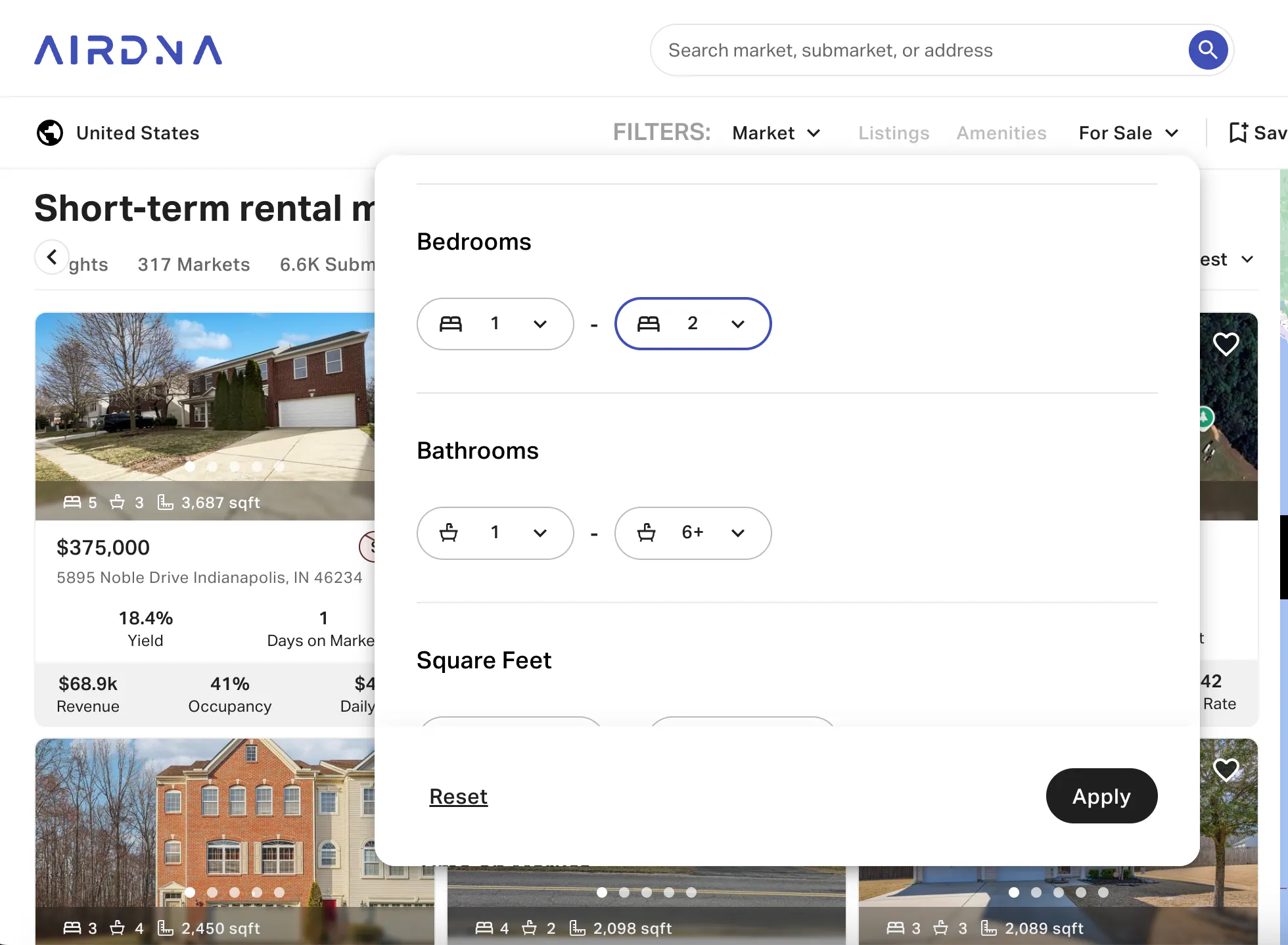
AirDNA’s For-Sale Listings tool is a great way to find available properties that tick all your requirements and fall within your budget. Navigate to the market you’re interested in, then select the For Sale Properties tab. From the Filters bar, select For Sale and set the appropriate listing price range.
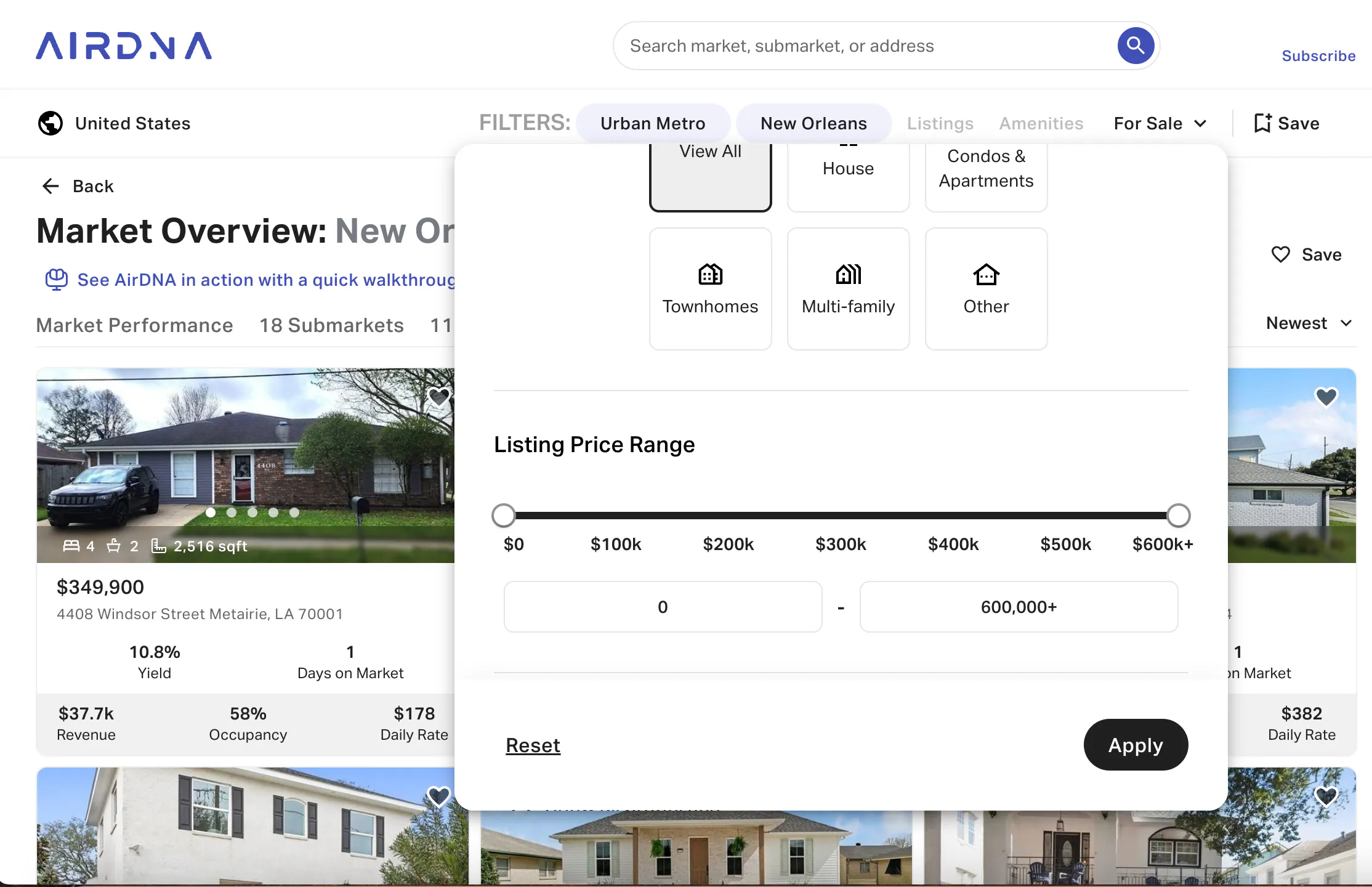
Beyond finding options within your budget, you’ll see each property’s projected revenue potential to instantly reveal which options are financially viable and spare you from wasting time on properties with inadequate returns. Before buying, set a minimum cash-on-cash return threshold (often 8-12%) and refuse to compromise regardless of emotional attachment to specific properties.
Consider your target guest
Choosing a property in the right area extends beyond conventional wisdom about "good locations" to a deeper understanding of what your specific guest demographic truly values.
For example:
- Family travelers often value proximity to attractions but prefer quieter streets slightly removed from nightlife
- Business travelers prioritize convenient access to commercial centers and transportation hubs
- Adventure travelers will pay premium rates for unique settings with outdoor access, even if somewhat remote
Once you’ve done the research to pinpoint the submarkets, property types, and bedroom counts that provide the best yield, you can peruse for-sale properties in AirDNA and filter the results accordingly. For example, say that 1- and 2-bedroom properties have the highest occupancy and ADR in your ideal submarket. In that case, filter for-sale properties by bedroom count to find properties in that sweet spot.
Assess local demand
AirDNA provides the concrete data you need to evaluate true market demand beyond surface-level impressions.
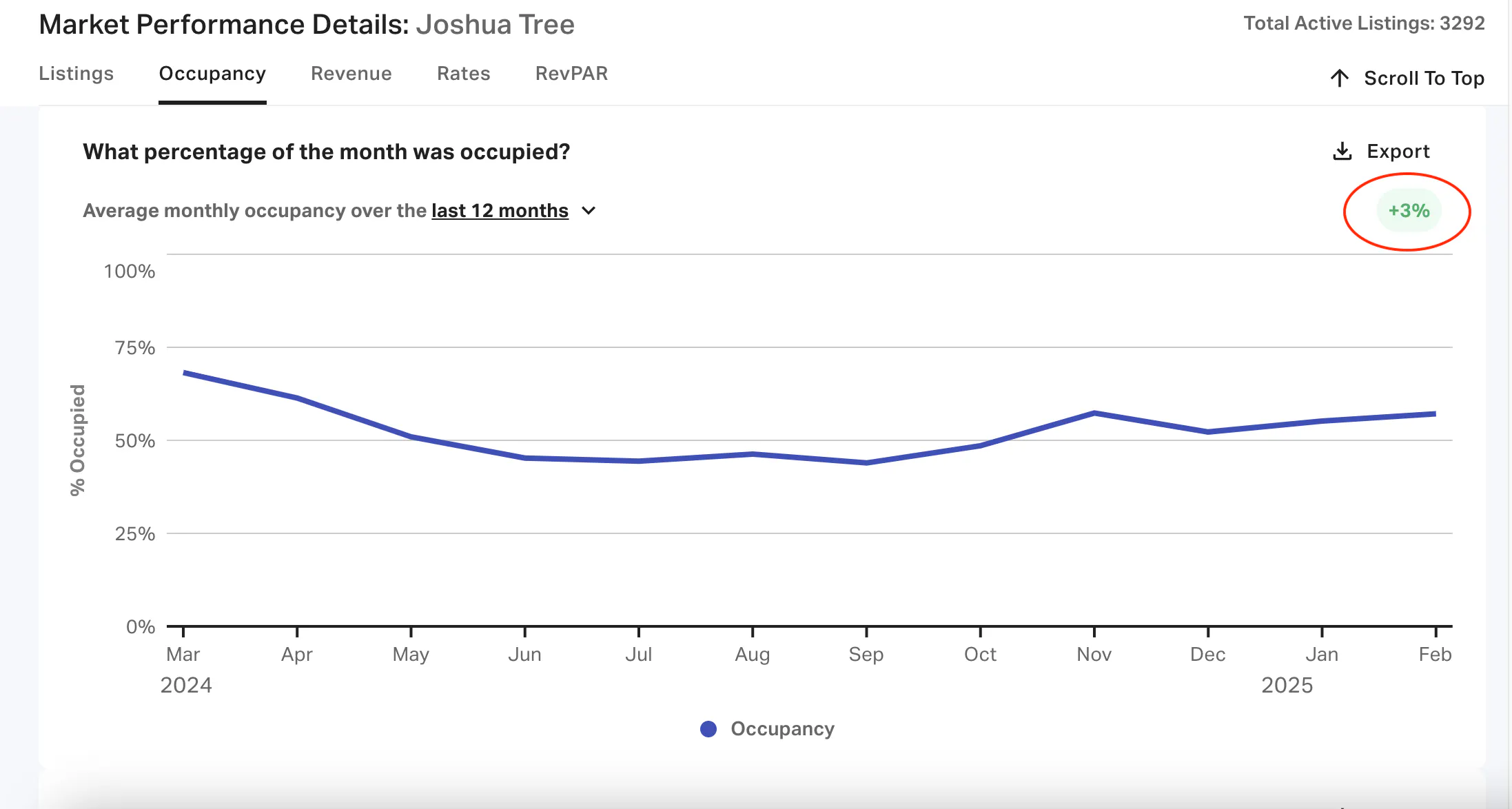
Navigate to the Market Overview for a market you’re interested in, and focus on the occupancy metrics—these are your most reliable indicator of genuine guest demand. While average annual occupancy offers a baseline, the monthly breakdown reveals crucial seasonal patterns that will impact your cash flow planning.
Look for these key demand indicators:
- Year-round demand stability: Markets with occupancy consistently above 50% throughout the year typically offer more reliable returns than those with dramatic seasonal swings.
- Length of peak season: Longer high seasons generally support stronger annual revenue.
- Shoulder season performance: Markets where shoulder seasons maintain strong occupancy provide more financial stability.
Pay special attention to the annual percentage change in occupancy rate. Markets showing steady occupancy increases of 3-5% annually typically offer better long-term investment potential than those plateauing or declining, regardless of their current rates.
Assess renovation potential
Sometimes the perfect STR isn't move-in ready. Evaluate properties not just for what they are, but what they could become with strategic upgrades like:
- Creating additional sleeping capacity through thoughtful conversions
- Enhancing outdoor spaces to include Instagram-worthy features
- Updating kitchens and bathrooms to meet modern guest expectations
- Adding amenities that differentiate the property from nearby competition
The key is calculating renovation ROI specifically for short-term rental use, not for traditional residential value. A $15,000 hot tub installation might seem expensive until you realize it could command a $50 nightly premium and pay for itself within a year.
Get the necessary licenses
Before making an offer, thoroughly research regulatory requirements in your target location.
Licenses needed for STR operation may include:
- Business licenses at multiple government levels
- Special zoning permits or variances
- Fire safety certifications
- HOA or condo association approval
Some jurisdictions maintain caps on STR density or require owner occupancy for certain periods. Others impose minimum night stays or restrict the total number of nights you can rent annually. Familiarize yourself with these constraints before purchasing to prevent nasty surprises after closing.
Pro tip: Avoid markets with pending legislation that might restrict future operations.
Smart investments happen here.
AirDNA’s powerful yet easy-to-use tools make hosting and investing a breeze. This means having every insight you need, all in one place, always up-to-date.
Step 4: Prepare Your Finances and Tax Structure
The difference between amateur and pro STR investors becomes glaringly obvious during tax season. While novices scramble to separate personal receipts from business expenses, experienced investors enjoy maximized deductions, bulletproof liability protection, and streamlined accounting—all because they set up proper financial structures from day one.
Financial preparation is often overlooked in beginner STR investment tips, but it's critical for long-term success. Add the following to your to-do list immediately after purchasing an investment property:
Choose the right business structure
How you legally structure your STR business significantly impacts liability protection and tax treatment. Common options include:
- Sole proprietorship: Simple but offers no liability protection
- Limited Liability Company (LLC): Provides personal asset protection while maintaining tax flexibility
- S-Corporation: May offer tax advantages for larger portfolios with substantial income
While many beginners default to sole proprietorships for simplicity, most experienced investors recommend forming an LLC at minimum. The modest setup costs ($50-$800 depending on your state) provide valuable liability protection if an injured guest or property damage leads to litigation.
Separate your finances
From day one, establish clear boundaries between your personal finances and your STR business. Create a dedicated business checking account where all income flows in and expenses flow out. Get a separate credit card exclusively for business-related purchases, from cleaning supplies to furniture upgrades. Even with just one property, implement an independent tracking system that treats your rental as the business it actually is.

Apply for a tax ID
Many jurisdictions require short-term rental operators to get an Employer Identification Number (EIN) from the IRS, even for single-property operations. When you apply for a tax ID, you'll need to:
- Complete IRS Form SS-4 or use the online application
- Specify your business structure
- Provide personal identifying information
- Indicate the business purpose (short-term rental activity)
You may need your EIN to open a business bank account, file tax returns, or remit lodging or occupancy taxes.
Create a financial reserve
Establish financial reserves before your first booking to cover:
- Unexpected maintenance emergencies
- Seasonal occupancy fluctuations
- Property tax obligations
- Periodic refurbishment requirements
Most experienced operators recommend maintaining at least three months of operating expenses as a dedicated reserve.
How is your STR performing?
Your vacation rental may be amazing, but is it better than your competition? Connect your Airbnb listing to AirDNA to see its Booking Performance Score.
Step 5: Furnish Your Property
Every STR investor checklist should include furniture selection as a top priority, not an afterthought. Furniture is the make-or-break element that separates five-star properties from the mediocre masses.
Effective property staging requires balancing aesthetic appeal with practical durability. Focus on creating spaces that photograph beautifully, function intuitively, and stand up to heavy use.
Select furniture strategically
Curious where your furniture dollars actually matter? Focus on these four zones that make or break your rental yields and guest satisfaction:
- Living areas: Invest in seating with performance fabric that holds up. Commercial-grade furniture costs more upfront but outlasts residential pieces by years under heavy guest use.
- Kitchen: Stock your kitchen with quality cookware, complete matching dishware, essential utensils, and reliable appliances. Thoughtful touches like sharp knives and basic pantry staples earn enthusiastic reviews.
- Bedrooms: Sleep quality appears in reviews more than almost any other factor. Prioritize hotel-quality mattresses (medium-firm satisfies most guests), multiple pillow options, high thread-count sheets, and blackout curtains.
- Bathrooms: Provide plenty of plush towels, adequate storage for toiletries, a quality shower head, and well-lit mirrors. Hotel-quality toiletries in refillable dispensers elevate the experience while reducing turnover costs.
Incorporate local and unique elements
In today's saturated STR market, travelers don’t want generic interiors filled with millennial gray. When listing properties on rental platforms, incorporate local art, books about regional attractions, and design elements that reference the area's character. These distinctive touches deliver the authenticity modern travelers crave.

Step 6: Set Up Essential Vendor Contracts
The difference between properties that scale profitably and those that drain owners? It's not location or design—it's having the right people on speed dial when things go sideways.
Your vendor network is the invisible infrastructure that keeps your five-star reviews flowing. While guests rave about your perfect location and stylish decor, they'll never know about the cleaner who rushed over last-minute to fix a housekeeping mishap before check-in, or the plumber who responded on a holiday weekend to save a booking.
Cleaning partners: Your most critical relationship
No vendor relationship impacts your success more directly than your cleaning team. Expect an instant one-star review when guests encounter someone else's hair in the shower or mysterious stains on the bedding.
When you contract with cleaners, look beyond the hourly rate to evaluate:
- Reliability and time management (late cleaners = late check-ins = angry guests)
- Attention to detail and quality control processes
- Ability to handle tight turnovers during peak seasons
- Strong and consistent communication
- Experience specifically with vacation rentals (not just residential cleaning)
- Capacity to provide emergency cleaning when needed
Pro tip: Establish backup cleaning arrangements for when your primary cleaners are unavailable. The modest additional expense of maintaining relationships with multiple cleaning providers pays for itself the first time you avoid a cancellation due to cleaning issues.
Establish a maintenance team
The real test of your short-term rental potential isn't whether issues arise—it's how quickly they're resolved when they inevitably do.
Build relationships with:
- General handyman for common issues (clogged drains, minor repairs)
- Licensed plumber
- Electrician
- HVAC technician
- Pest control service
- Lawn care/snow removal as needed for your location
Don't wait for a burst pipe at midnight to start Googling "emergency plumber." Build your maintenance vendor dream team before you even list your property. When your handyman already has a key code, knows the property, and understands your expectations, problems get solved while you're still asleep—and guests never sense the behind-the-scenes scramble that saved their stay.

FAQs
What if my local area has strict short-term rental regulations?
Strict regulations don't necessarily make STR investing impossible—they just require more diligence and creativity. Start by thoroughly researching the specific licenses needed for STR operation in your area.
Beyond basic licensing, pay close attention to:
- Zoning restrictions that may limit STR operations to specific neighborhoods
- Owner-occupancy requirements that might mandate you live on-site
- Annual night caps that restrict total rental days (common limits range from 60-180 nights)
- Special tax registration requirements for collecting and remitting occupancy taxes
Do I need a separate bank account for my short-term rental?
Yes, without question. Commingling personal and business finances creates tax nightmares, undermines your liability protection, and makes analyzing your property's true performance nearly impossible.
Setting up dedicated accounts:
- Creates clean financial records for tax preparation and audit protection
- Strengthens liability barriers between personal and business assets
- Provides accurate performance metrics for business decisions
- Simplifies expense tracking for maximum tax deductions
- Establishes professional banking history for future financing
Is it worth consulting an accountant for just one property?
Absolutely. The cost of professional accounting advice is trivially small compared to the potential tax savings and compliance protection it provides—even for a single property.
A CPA specializing in real estate investing typically:
- Identifies deductions and depreciation strategies you might otherwise miss
- Structures your business for optimal tax treatment
- Ensures compliance with complex STR tax requirements
- Advises on record-keeping systems that withstand IRS scrutiny
- Provides guidance on estimated tax payments to avoid penalties
Even if you plan to prepare your own taxes, an initial consultation with a rental property specialist is among the highest-ROI investments you can make when launching your STR business.
Should I self-manage or hire a property manager?
This decision hinges on three key factors: your proximity to the property, your available time, and your operational skills.
Self-management makes sense when:
- You live within 30 minutes of your property
- You have flexible work arrangements that allow for emergency responses
- You enjoy hospitality and guest communication
- You have existing relationships with reliable service providers
- You're detail-oriented and tech-savvy
Property management becomes worth the 15-25% fee when:
- You live far away from your investment property
- You have limited availability for guest communication
- You lack connections to local service providers
- You own multiple properties
- You value peace of mind over maximizing margins
Many successful investors begin with self-management to learn the business fundamentals, then transition to professional management as they scale beyond 2-3 properties. The right approach depends on your personal circumstances and investment objectives rather than a one-size-fits-all rule. Keep in mind that a property management system like Uplisting can be a cost-effective alternative to a professional property manager.
All-in-one Vacation Rental Software and Channel Management System
Manage short-term rentals & bookings, message guests, take payment, and so much more. All in one easy-to-use platform (that never double-books).
ARTICLE SUMMARY
This comprehensive guide walks first-time short-term rental (STR) investors through the six essential steps to build a profitable vacation rental business using data-driven strategies.
Jamie Lane
AirDNA Chief Economist
He is responsible for data analysis, thought leadership, and leveraging advanced analytical techniques to provide new insights into short-term rental market trends. Native to Atlanta and an Airbnb host himself, Jamie enjoys cycling, mountain biking, backpacking, running, and playing in a dart league in his free time.
