U.S. Review January 2025: High Demand Out-Paces Last Year’s Performance
Published: February 17, 2025
Last updated: October 30, 2026

Bram Gallagher
Key Takeaways:
- January 2025 saw strong demand, up 7.2% year-over-year (YOY), with record-breaking bookings and the first January occupancy increase since 2021.
- Mountain/Lake Resorts led ADR growth at 11.6% YOY, with overall pricing power improving as demand accelerated across all location types.
- High interest rates and regulations continue to limit supply growth, keeping competition low but making new investment challenging.
January 2025 saw the U.S. short-term rental (STR) market off to a strong start.
Last year, the market saw a severe cold spell across much of the Northern U.S., freezing out many trips that might have otherwise taken place. But this deep freeze didn’t translate into winter vacation numbers. Many popular ski resorts from Colorado to California retained a markedly low snow pack, discouraging skiers during the height of the season.
This year, on the other hand, snow was plentiful in the central U.S., reaching as far South as New Orleans. Mountain resorts took advantage, increasing demand in this location type on a year-over-year (YOY) basis by 6.4%. More dramatically, rates at these resorts soared, increasing 11.6% YOY, helping to raise January’s ADR for the U.S. as a whole by 5.3% — a January slightly above December for the first time since AirDNA has been keeping records.
Other performance metrics are positive. All location types accelerated their demand growth compared to December. Rate was somewhat mixed, but all locations saw increased ADR compared to last year. 2025 also saw the first January increase to occupancy YOY since 2021, setting the stage for another year of increasing occupancy, enhanced pricing power, and improving unit-level performance.

Employment and Inflation’s Impact
Newly inaugurated President Trump didn’t hesitate implementing several sweeping policy initiatives, including announcing new tariffs on Canada, Mexico and China.
Although North American tariffs have been delayed, the aggressive tack with which these policies were rolled out surprised some economists. Commenters had expected to see elevated tariffs in 2026, but not quite so soon. The upshot is that inflation is going to be carefully scrutinized by the market and by the Fed, likely delaying rate cuts.
Inflation increased for the third month in a row in December, to 2.9% as measured by YOY growth in the consumer price index. At the same time, employment increased by 143,000 in January, capping off three months of solid job gains and driving the unemployment rate down to 4.0%, the lowest since May of 2024. Rate cuts from the Fed are intended to stimulate an economy that isn’t fully employing its workforce. As a result, cuts when the economy is operating at near its full potential would add to inflationary pressure. Holding off on rate cuts is, therefore, supported by economic conditions.
AirDNA believes that high interest rates, including for mortgages on home purchases, have been a key factor in slowing supply growth in the U.S. STR market. It appears that this high rate environment will persist for the near to medium-term future, keeping new investment expensive, but benefitting current operators with slower growth in competition.
At a Glance: Key U.S. STR Performance Metrics for January 2025
- Revenue per Available Rental (RevPAR) increased 8.1% year-over-year (YOY) to $136.39
- Available listings were 1.61 million, up 4.3% YOY
- Total demand (nights) rose 7.2% YOY
- Occupancy was 2.7% higher YOY at 43.5%
- Average Daily Rates (ADR) increased 5.3% YOY to $313.61.
- Repeat Rent Index (RRI) increased by 6.2% YOY
- Nights booked increased by 8.9% YOY
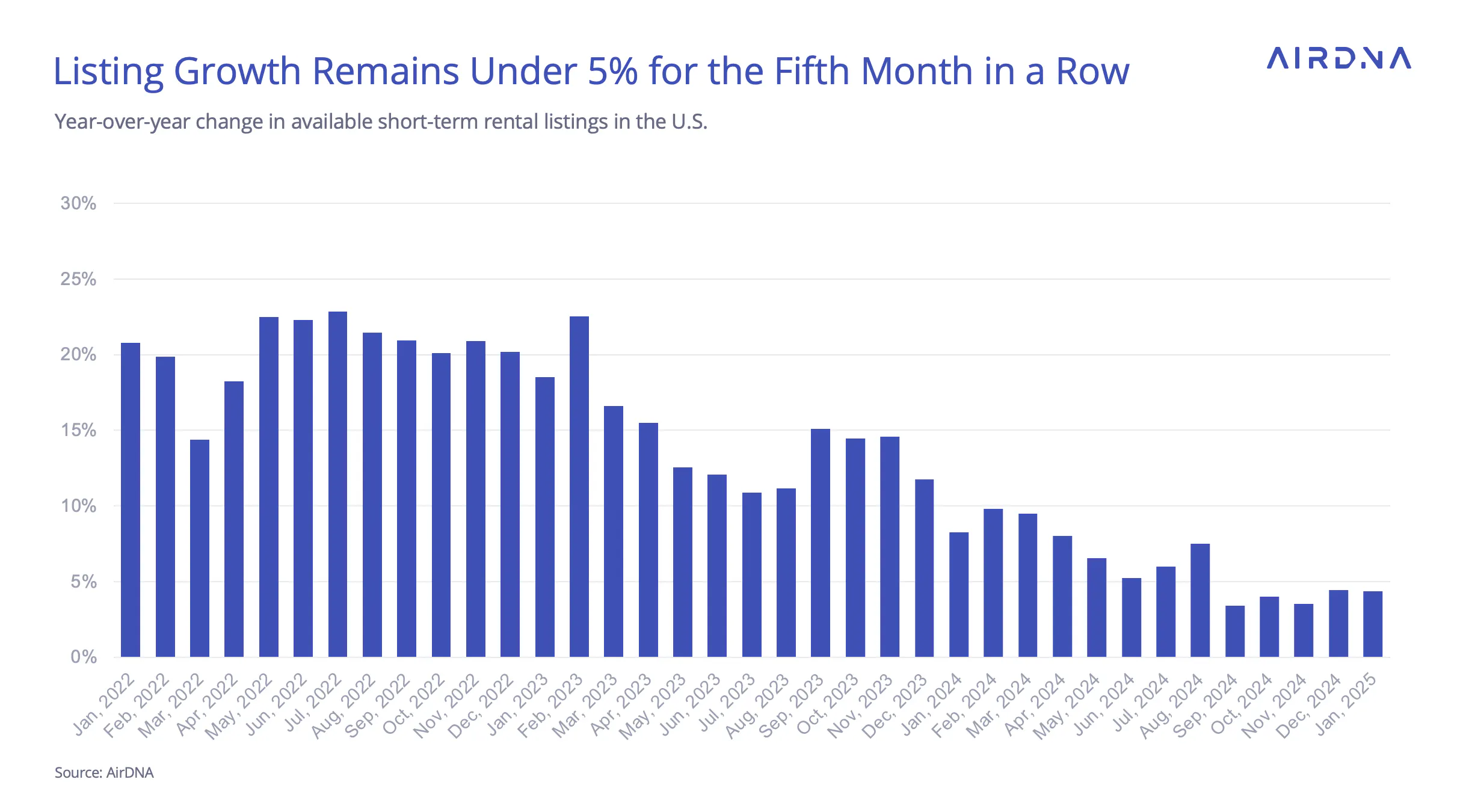
Supply Growth Fails to Reach 5% Fifth Month in a Row
High interest rates, below-average long-term occupancy, and restrictive regulations have constrained supply growth over the past two years, creating a clear downward trend.
While the supply cycle appeared to bottom out in September 2024, growth has since stagnated between 3.5% and 4.5%. January’s 4.3% growth rate marks a slight dip from December’s 4.5%, though not a significant one.

At the unit level, performance is improving. However, the same high interest rates that stifled supply growth are expected to persist, and regulatory pressures remain a looming threat to listings. As a result, the STR investment environment will likely remain challenging in the near term. That said, the slowdown is also helping restore performance to sustainable long-term levels.
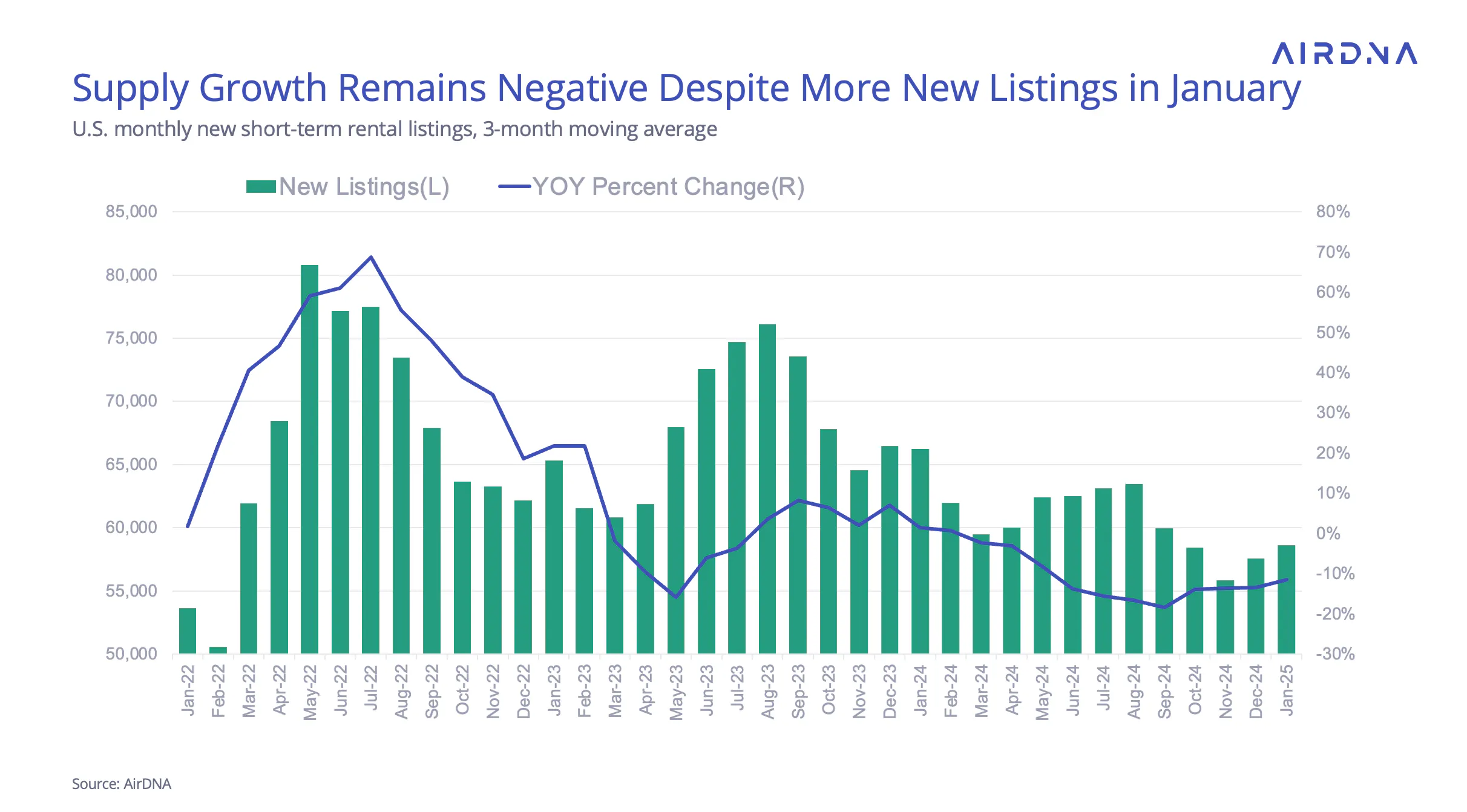
Perhaps the clearest indicator of the challenging investment landscape is the decline in new listings, which saw a growth rate of -11.5%. Monthly new listings have been shrinking since March 2024, and while the pace of contraction eased slightly in January (improving from -13.4% in December), new listing levels still posted a significant year-over-year decline.
Demand and Bookings
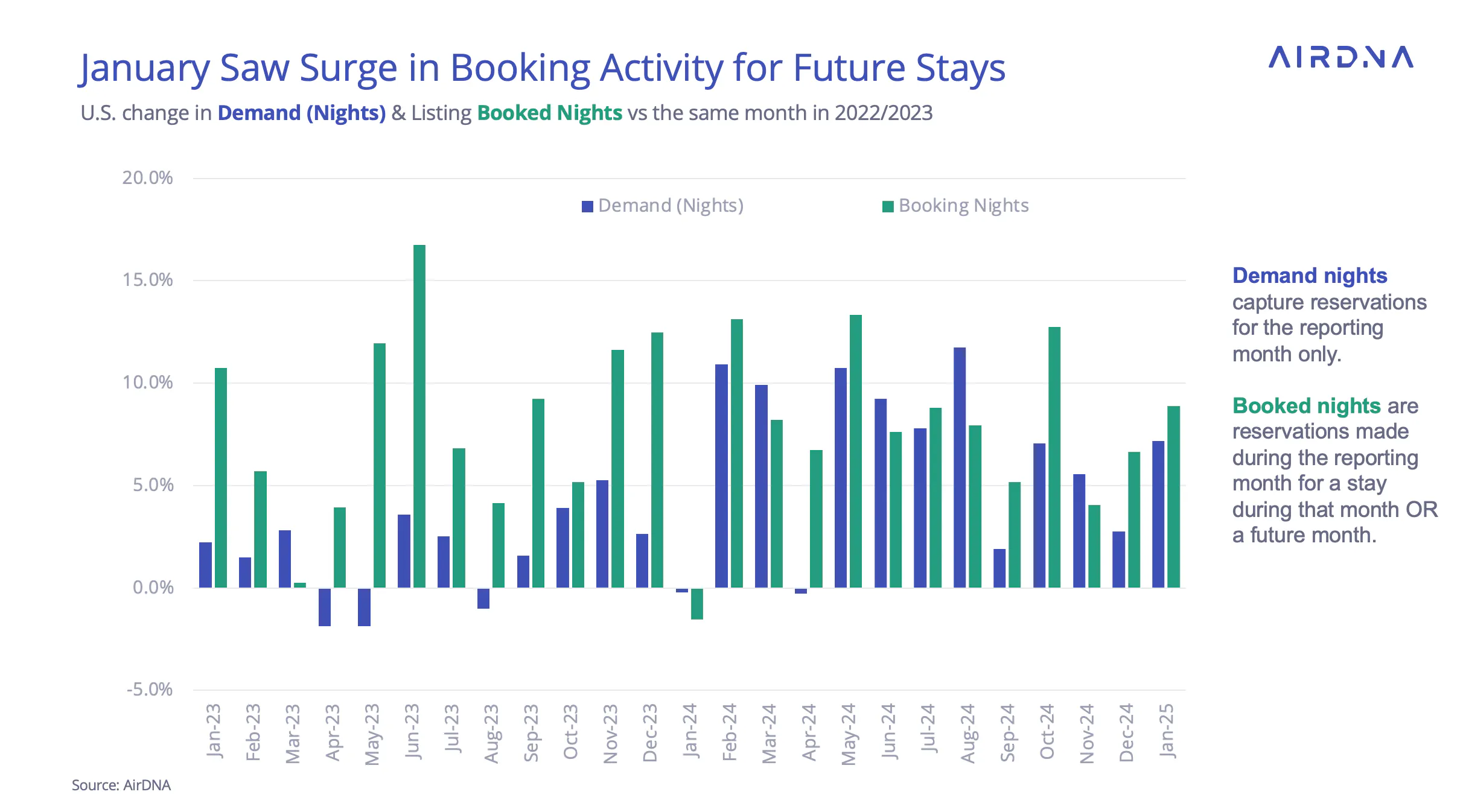
Meanwhile, U.S. travelers are showing strong interest in STRs, with demand surging to 7.2% in January, up from 2.8% in December. While part of this increase can be attributed to a weak performance last January—when demand and bookings saw a slight year-over-year decline—the growth signals a clear rebound. Last year’s cold snap and low snowfall temporarily dampened ski market performance, but this month’s gains suggest those setbacks were short-lived.
High booking levels also point to a promising travel year ahead. While actual travel peaks in spring and summer, the January–March period typically sees the highest booking activity, as vacationers start planning and securing accommodations for the months ahead.
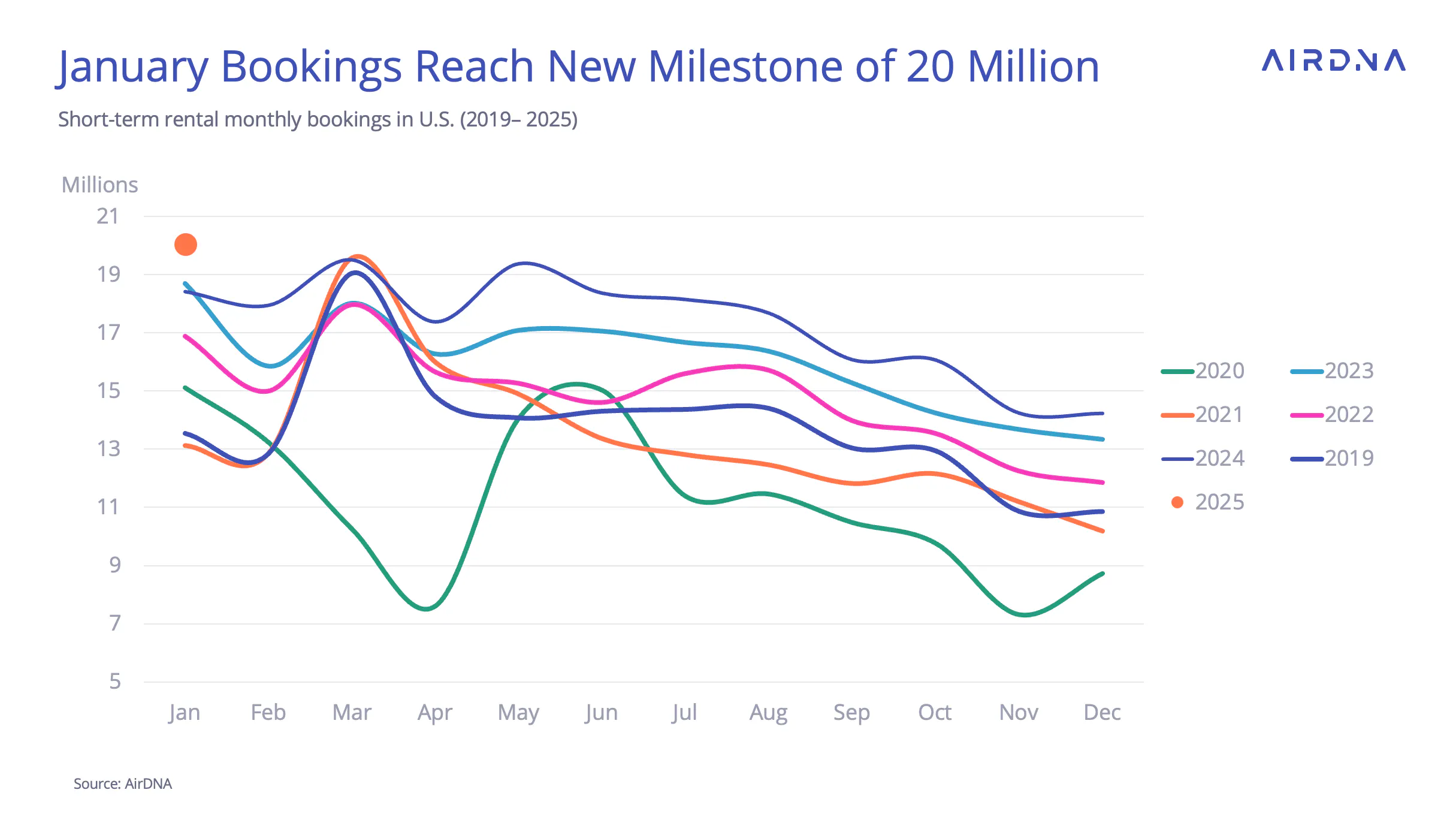
This January, bookings reached approximately 151% of nights stayed, meaning that out of more than 20 million nights booked, 6.8 million are for future stays and have yet to be reflected in demand figures.
This surge in booking activity has set a new record. January 2025 now holds the highest monthly booking total ever recorded by AirDNA.
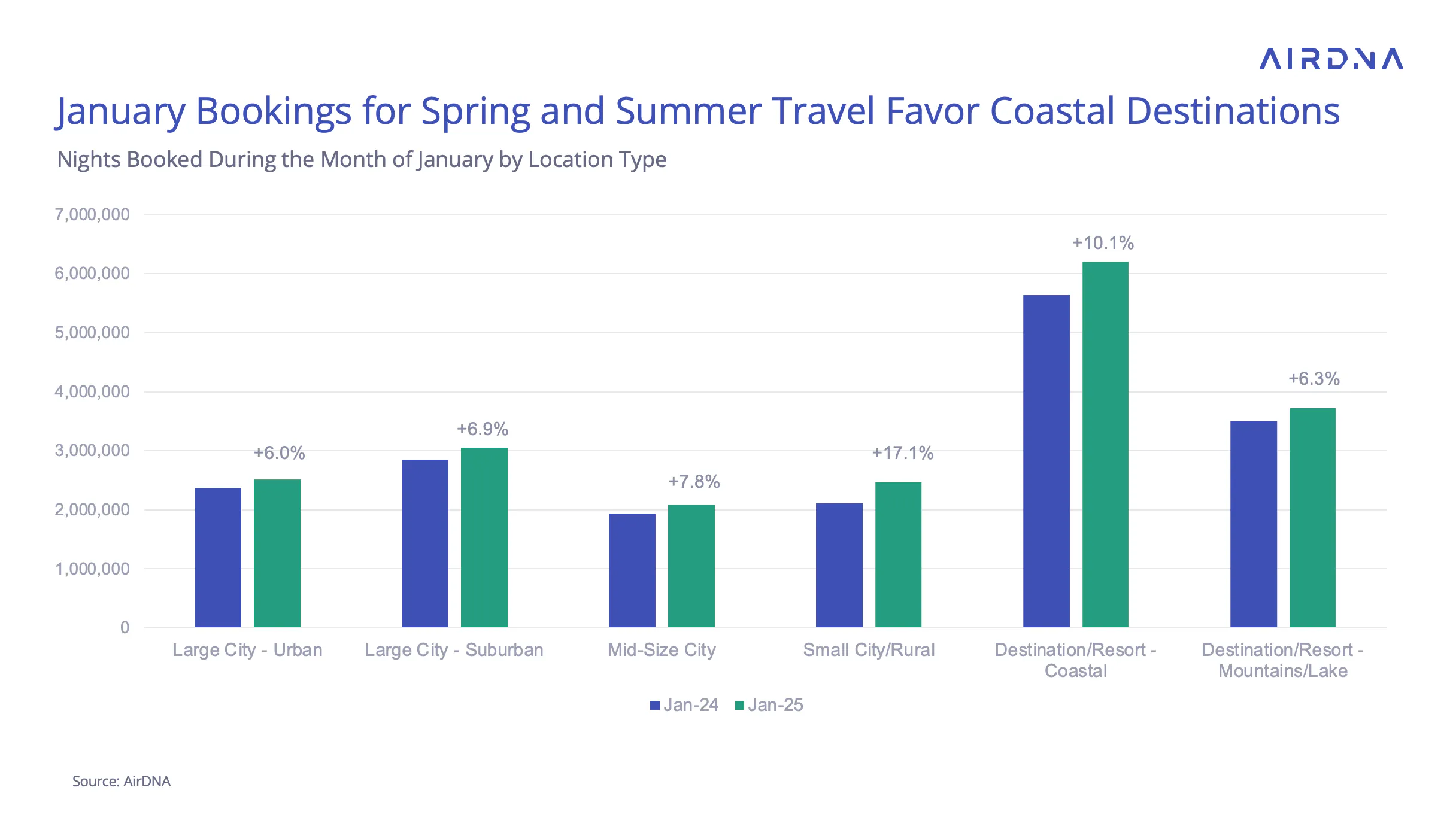
A significant portion of January’s bookings appear to be for spring and summer travel, as a breakdown by location type shows that coastal resorts (despite being largely inhospitable in January outside of Hawaii) claimed the largest share of bookings.
Despite already operating from a high base, coastal bookings saw the second-highest growth among all location types, trailing only small city and rural destinations.
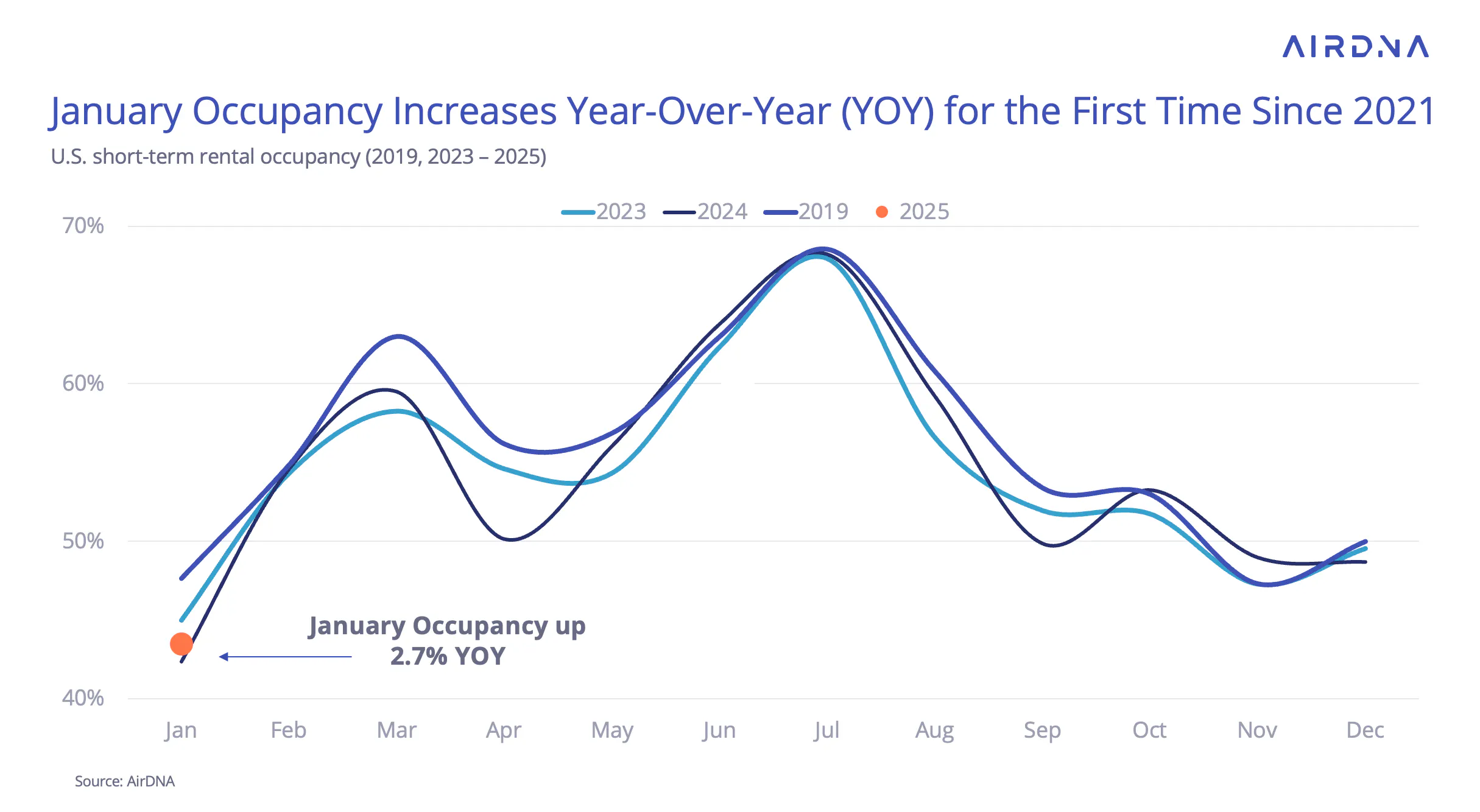
The combination of rising demand and slowing supply growth led to the first annual increase in occupancy since 2021. January also marked the first year-over-year occupancy gain for the month since 2021, reaching 43.5%, up from 42.4% in January 2024.
While still well below the 47.6% occupancy rate seen in 2019, this increase signals a shift, reversing the trend of steep off-season occupancy declines in recent years.
ADR Growth Accelerating, But Not Steadily
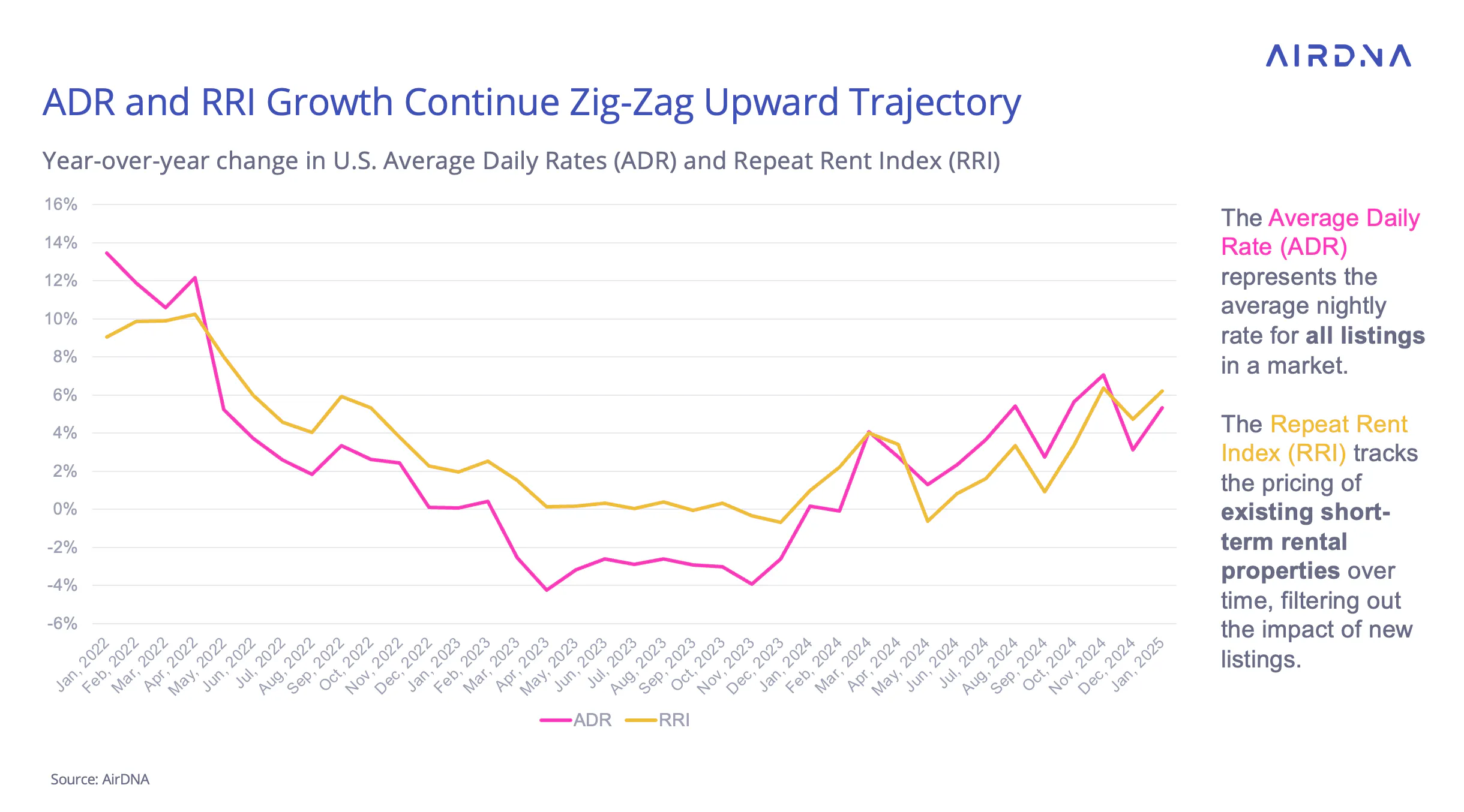
While rising shelter and long-term rental costs fueled inflation in 2022 and 2023, short-term rental prices followed a different trajectory, slowing and even declining for much of 2023.
However, the AirDNA Repeat Rent Index (RRI)—which adjusts for market shifts—suggests that conditions weren’t as tough for existing operators, as their average daily rate (ADR) remained largely stable rather than dropping.
Since early 2024, both ADR and RRI have shown uneven but upward momentum. Initially, ADR growth outpaced RRI, indicating that new listings were entering the market at higher price points, possibly to attract budget-conscious travelers. However, this trend reversed later in 2024, with both metrics climbing in a staggered pattern. In January, RRI growth once again outpaced ADR, though this shift likely reflects existing listings—particularly in high-end ski markets—raising prices rather than new listing dynamics.
Location-Specific Trends
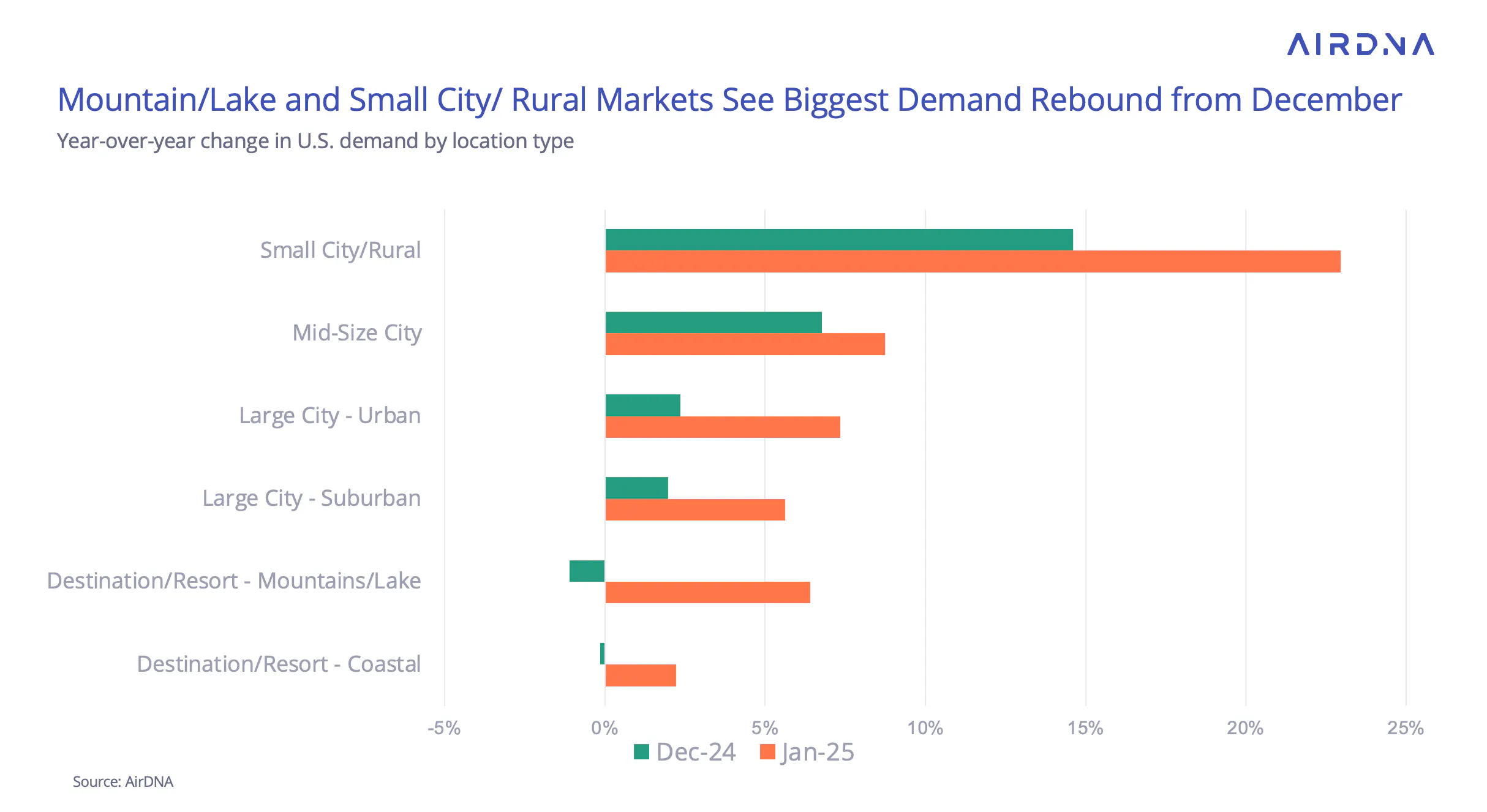
Across all location types, demand growth accelerated in January. While part of this increase reflects an easier comparison to January 2024—when low snowfall hurt ski markets and a deep cold snap made much of the Northern U.S. less inviting—the rebound is still notable.
Mountain/Lake Resorts, in particular, saw a sharp turnaround, with year-over-year demand growth jumping from -1.1% in December to +6.4% in January, moving it from the sixth to the fourth fastest-growing location type. However, the biggest surge came from Small City/Rural locations, where demand growth soared to 22.9% year-over-year in January, up from 14.6% in December.
When it comes to ADR, Mountain/Lake Resorts stand out as a clear outlier. These locations saw an impressive 11.6% increase in ADR—nearly double the growth rate of the next highest category, Coastal Resorts, which saw a 6.0% increase.
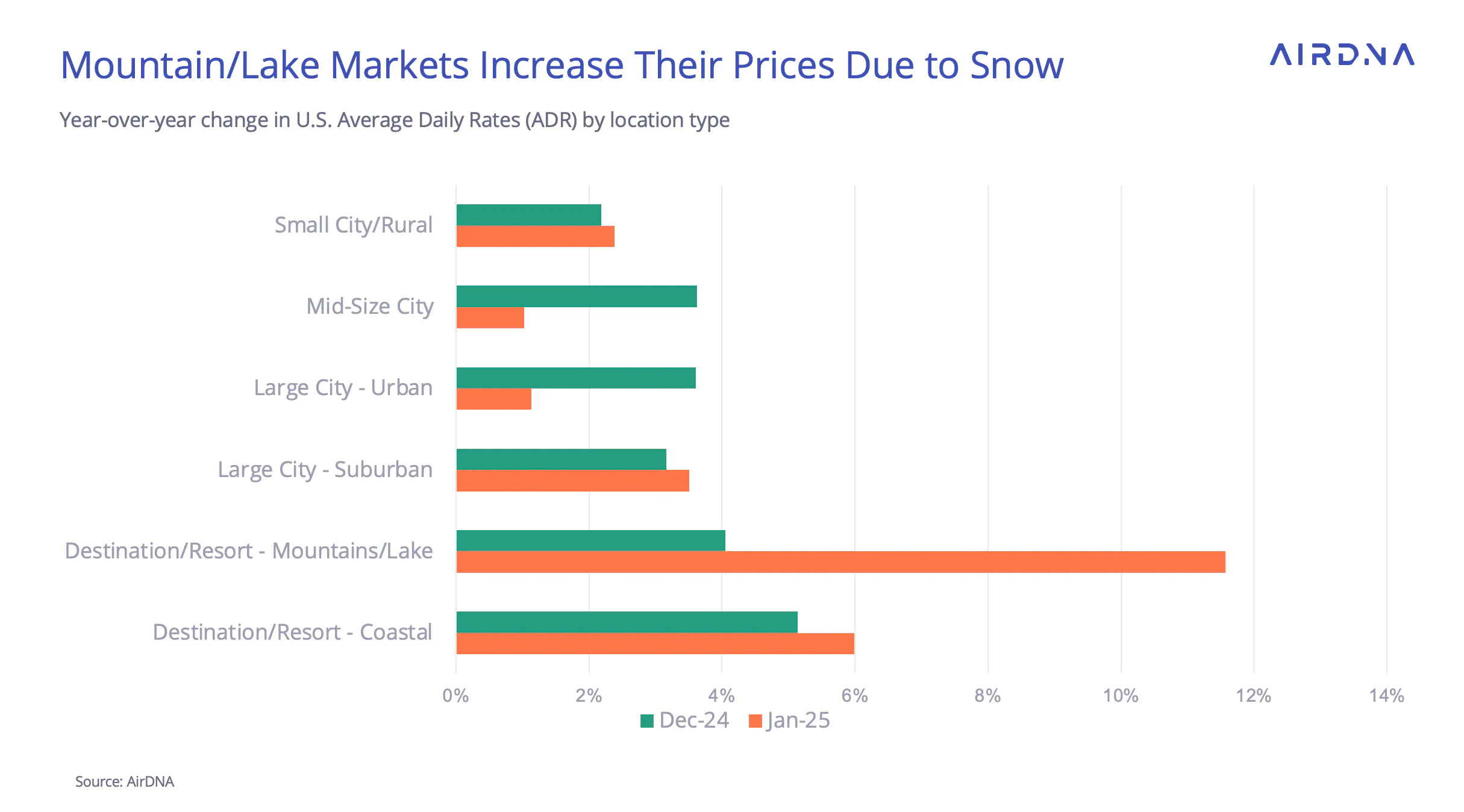
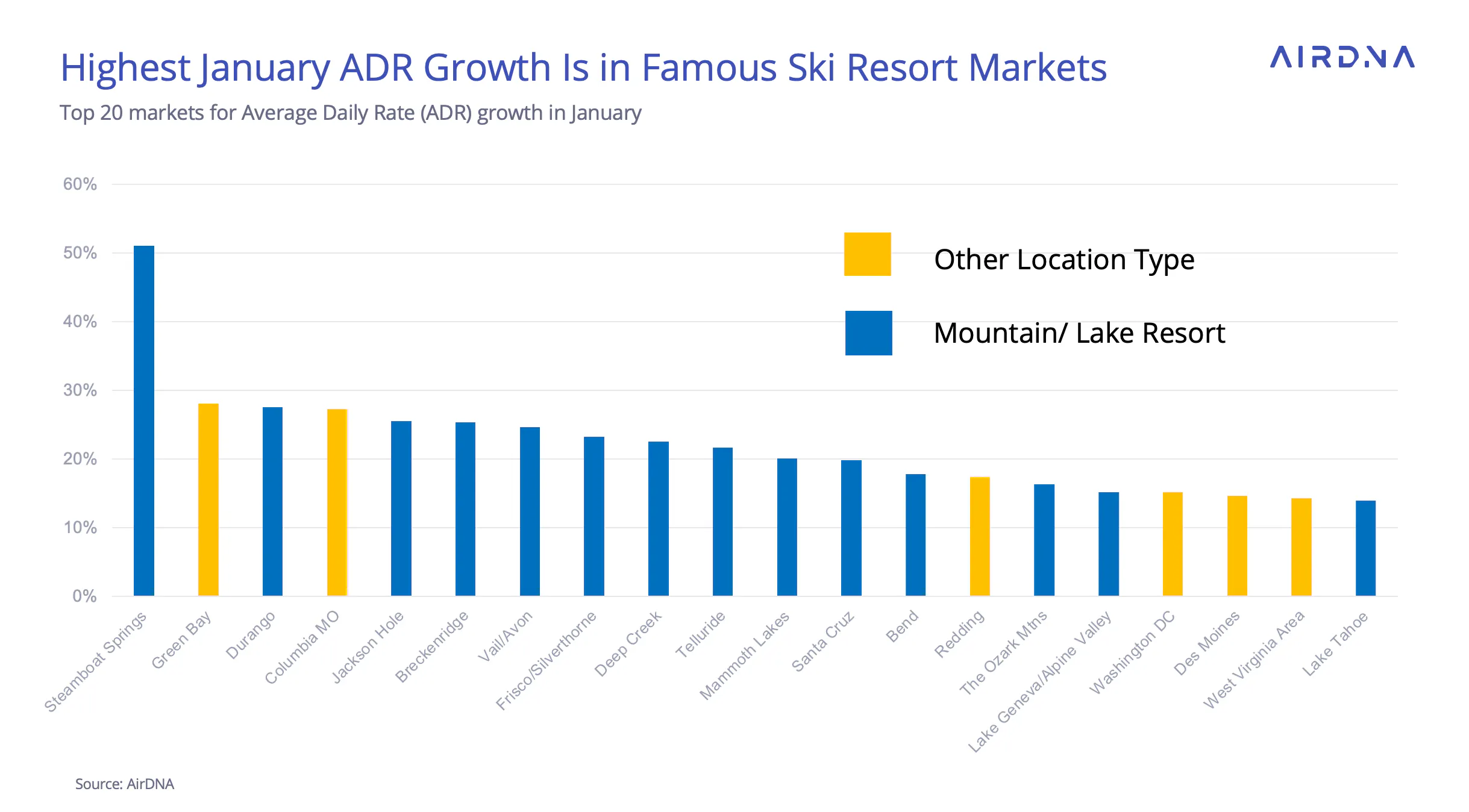
Examining individual markets, ski resorts stand out for their ability to push prices higher. Of the top 20 markets with the highest ADR growth, 14 are located in Mountain/Lake Resort destinations, highlighting the strong pricing power in these areas.
ARTICLE SUMMARY
January 2025 saw strong STR demand, record bookings, and the first January occupancy increase since 2021. Mountain/Lake Resorts led ADR growth, while high interest rates kept supply growth subdued.
Bram Gallagher
AirDNA Director of Economics and Forecasting
Bram Gallagher is an Economist at AirDNA, specializing in uncovering insights that drive smarter short-term rental decisions. He put his Ph.D. in Economics from the University of Georgia to work researching and forecasting hotel data with CBRE prior to joining AirDNA, as well as teaching economics at a number of universities. In his spare time, Bram enjoys making wooden furniture with hand tools.